
We Support Dockworkers Blocking Weapons on October 30, 2026
Unions representing workers at 40 ports in Europe and the Mediterranean are calling for an international day of action on October 30. Read more here. |
| World Federation of Trade Unions |
We Support Dockworkers Blocking Weapons on October 30, 2026
Unions representing workers at 40 ports in Europe and the Mediterranean are calling for an international day of action on October 30. Read more here.
Statement from the World Federation of Trade Unions:
Ports For Peace – Jobs With Dignity
Following the Third International Meeting of Mediterranean and European Dockworkers’ and Port Workers’ Unions, held in Istanbul in May 2026, the participating unions have launched a common international day of action on 30 October 2026.
The meeting focused on the struggle against wars, genocide and military aggression, while also addressing the challenges facing dockworkers and port workers, including wages, working conditions, automation projects, and occupational health and safety.
The participating organizations, CGT Ports and Docks (France), ENEDEP (Greece), LAB (Basque Country), Liman-İş (Turkey), ODT (Morocco), and USB (Italy), representing workers in more than 40 Mediterranean and European ports, are calling on dockworkers and port workers to mobilize together on 30 October 2026.
This mobilization is based on the Istanbul Declaration, adopted unanimously by the participating organizations and now fully endorsed by ORSA Porti of Gioia Tauro (Italy), which has joined our international network.
The declaration sets out the following demands:
· An immediate end to the genocide of the Palestinian people and recognition of an independent Palestinian state, recognized by the international community, within the 1967 borders and with East Jerusalem as its capital.
· An end to the US-Israeli wars of aggression in the West Asia and against Iran, and full solidarity with the peoples of Cuba, Venezuela and Sudan, alongside support for the right of all peoples to resist occupation and to self-determination.
· Ports must not be used for the transport of arms, ammunition, military equipment or troops destined for war zones.
· They must not become military bases for NATO, the United States or the European Union, nor serve as tools for shipowners and monopoly groups.
· No to the war economy, government rearmament plans, and the project of militarization of ports and strategic infrastructure from EU. Public resources must be used to meet people’s social needs, not to finance war.
· Collective agreements must guarantee real wage increases, secure employment, reduced working hours, and fair pension provisions.
· Technological progress, mechanization, automation and artificial intelligence must not be used to eliminate jobs or undermine workers’ rights. Dockworkers and port workers say NO to automation.
On October 30, all actions will be united as part of a common international struggle to stop wars, genocide and the militarization of ports at a very critical moment in history, while defending workers’ rights and better working conditions. Each union will decide the most appropriate form of mobilization according to its national circumstances, starting from strike action and from a shared commitment to prevent the loading of death and destruction.
The signatory trade unions of the Istanbul Declaration call on ALL dockworkers’ and port workers’ unions to join this international mobilization. We are ready to meet with organized groups of dockworkers and port workers from any other ports interested in becoming part of this common struggle.
CGT FNPD France – ENEDEP Greece – LAB Basque Country – LIMAN-IS Turkey – ODT Maroc – ORSA Porti Italy – USB Italy
*..........*..........*..........*..........*..........*..........*..........*

NOVEMBER 1-7
WEEK of GLOBAL RESISTANCE
to STOP U.S. IMPERIALISM & GENOCIDE
This year SHUT DOWN DRONE WARFARE (SDDW) Fall Actions will be a "Kick Off for A New Campaign": We want to help build a stronger network of global communities working in coordination to STOP U.S Imperialism & Genocide. Several other national organizations are already co-sponsors. (see below) This global call to action in the fall is only the beginning. We invite national and international organizations to sign on as sponsors/endorsers of the week and to plan simultaneous actions at U.S. Bases, Weapons Industries and AI Data Centers around the world. Organize actions for one day, or numerous days during or near the Week of Global Resistance. We recommend planning actions during weekday commute hours, if possible, when personnel are going into and out of military bases, weapons industry workplaces, AI Data Centers, etc. Educate, educate, educate and encourage resistance from within. Please spread the word: Help us get more sponsors & endorsers! More details to come soon.
"Week of Global Resistance" Co-sponsors: ShutDownDroneWarfare.org, BanKillerDrones.org, Global Network Against Weapons & Nuclear Power in Space, and Witness Against Empire.
Will your organization sponsor or endorse? Please contact: toby4peace@sonic.net
The above global call to action is part of SDDW Fall Action Week:
SHUT DOWN DRONE WARFARE! (SDDW)
ShutDownDroneWarfare.org
SDDW Fall Action Week:
NEW: Simultaneous Actions at both Creech AFB & Holloman AFB!
November 1-7, 2026
Nov.1-7, Creech AFB Fall Action, Indian Springs, NV
Nov. 4-6, Holloman AFB Fall Action, Alamogordo, NM
17 years of persistent resistance! Come for all or part of Fall Actions!
Shut Down Drone Warfare (SDDW) Campaign is Co-Sponsored by Veterans For Peace, Ban Killer Drones & CODEPINK
*..........*..........*..........*..........*..........*..........*..........*

We need as many people there as possible to carry our message - no more of our tax dollars for endless wars. Can we count you in? Sign up here:
https://www.codepink.org/novdc26
*..........*..........*..........*..........*..........*..........*..........*

*..........*..........*..........*..........*..........*..........*..........*

To Iran’s Political Prisoners, trapped “Between Two Blades of a Scissors”
Open letter
August marks the anniversary of the 1988 mass executions in Iran, a horror that echoes in the country’s current surge in death sentences. It also marks the August 19 anniversary of the UK- and U.S.-orchestrated coup against the prime minister Mohammad Mosaddegh in 1953. Amid the current, indiscriminate waves of U.S.-Israeli military assaults against Iran, this letter of solidarity denounces the repression of the Iranian people and their political prisoners by forces both at home and abroad.
To our fellow activists, students, thinkers, workers, artists, and other prisoners of conscience held behind the walls of all detention centers across Iran:
We write to you from a place of deep solidarity, our hearts heavy with the knowledge of the struggle you face within Iran’s prisons: the torture, the systematic neglect, the enforced silence, and the brutal reality of sham trials and executions. As former and current political prisoners, activists, and scholars committed to the global project of abolition, anti-authoritarianism and anti-imperialism, we see you across the distances of geography and the silence of censorship and internet blackouts. And we stand in solidarity with you, as you are at the intersection of two sources of oppression.
On one side, you face the Islamic Republic that, from its inception, enforced absolute social and political control based on an exclusionary ideology. It is a system that claims to counter imperial power while using its very logic of domination and systems of carcerality, torture and execution. On the other side, you face the aggression and violence of the very imperialist and Zionist forces the Islamic Republic purports to stand against. The U.S. and Israel instigate brutal wars, destroy civilian infrastructure, kill innocent schoolgirls, and treat you as collateral damage in their pursuit of regional dominance. We remember the horror of June 23, 2025, when Israel struck the Evin prison complex, flattening its hospital ward, transgender section, and visitor center. You best exposed this dual oppression when you voiced that you “feel stuck between the two blades of a scissors, the evil regime that imprisons and tortures [you] and a foreign force dropping bombs on [your] heads in the name of freedom.”
In the past year, we witnessed both blades of the scissor sharpen. We see the arbitrary arrests and the horrific wave of state executions. We see the deepening criminalization of the working class and unemployed, the targeting of Kurds, Arabs, and Baloch, and the scapegoating of Afghan migrants: all desperate attempts to kill the spirit of people they cannot contain. This is the logic of carceral states everywhere: when they fail to address the crises people face, they simply attempt to criminalize or disappear the people themselves.
We see the same logic of domination when Israel uses “administrative detention” to hold Palestinian political prisoners for years without charge. We see it when Israeli authorities celebrate a new law that allows them to execute the Palestinian political prisoners they cannot dominate. We see it in the ICE detention centers where the U.S. government imprisons our people in the pursuit of a political agenda of racist exclusion or detains our political activists for daring to speak against the U.S.-backed Israeli genocide. We see it in the history of the U.S. targeting freedom fighters, particularly Black, Indigenous, Puerto Rican and other anticolonial organizers, locking them away for decades to crush movements for national liberation and sovereignty. And we see the connections between these carceral systems sharing intelligence and governance techniques, such as when the USP Marion prison in Illinois became a blueprint for prisons built in Iran and Israel in the 1960s. Whether it is a border wall or a prison gate, the goal is the same: to silence people through fear, domination, and isolation.
Your struggle is as global as our collective dreams of freedom and dignity. We stand with you, and we reject the false binary of imperialism and hollow anti-imperialism. We invite global civil society and anti-imperialist activists and organizations to extend their unconditional support and solidarity to all incarcerated kin fighting for our collective liberation, to build relationships with Iranian political prisoners and uplift their voices, to put pressure on the Islamic Republic by challenging its narrative, and to call upon that government to immediately stop all the executions and free all political prisoners.
The Iranian authorities must stop their inhumane practice of death and incarceration now. And the U.S. and Israel must end their barbaric wars and brutal sanctions that knowingly devastate our communities.
In solidarity and with love,
Alberto Toscano, emeritus professor of critical theory, Goldsmiths, *University of London
Angela Davis, former political prisoner, distinguished professor emerita, *University of California, Santa Cruz
Bernardine Dohrn, retired professor of law, *Northwestern University
Bill Ayers, professor, *College Unbound
Cherríe L Moraga, distinguished professor emerita, University of California, Santa Barbara, Chicana feminist writer, and activist
Dan Berger, professor of comparative ethnic studies, *University of Washington Bothell
Hossam el-Hamalawy, Egyptian socialist, scholar and former political prisoner
Jairus Banaji, historian, research professor, SOAS, *University of London
Jason Stanley, professor of philosophy, *University of Toronto
Judith Butler, distinguished professor in the Graduate School, *University of California, Berkeley
Keeanga-Yamahtta Taylor, author, From #BlackLivesMatter to Black Liberation, professor of African American studies, *Princeton University
Michael Löwy, emeritus research director of sociology at the* Centre National de la Recherche Scientifique, Paris
Michael Mansfield, human rights and civil liberties Bbarrister
Mumia Abu-Jamal, current political prisoner, educator, journalist and activist
Ricardo Jiménez, social activist, former Puerto Rican political prisoner
Ruha Benjamin, professor of African American studies, *Princeton University
Ruth Wilson Gilmore, Graduate Center, *CUNY
Walden F Bello, international adjunct professor of sociology, *State University of New York at Binghamton
Yasin al-Haj Saleh, Syrian writer, political dissident, and former political prisoner in Syria
* Organizations for identification purposes only
** Signatories are sorted alphabetically
—The Guardian, August 20, 2026
https://www.theguardian.com/commentisfree/ng-interactive/2026/aug/20/iran-political-prisoners
*..........*..........*..........*..........*..........*..........*..........*

*..........*..........*..........*..........*..........*..........*..........*

The Trump administration is escalating its attack on Cuba, cutting off the island’s access to oil in a deliberate attempt to induce famine and mass suffering. This is collective punishment, plain and simple.
In response, we’re releasing a public Call to Conscience, already signed by influential public figures, elected officials, artists, and organizations—including 22 members of the New York City Council, Kal Penn, Mark Ruffalo, Susan Sarandon, Alice Walker, 50501, Movement for Black Lives, The People’s Forum, IFCO Pastors for Peace, ANSWER Coalition, and many others—demanding an end to this brutal policy.
The letter is open for everyone to sign. Add your name today. Cutting off energy to an island nation is not policy—it is a tactic of starvation.
*..........*..........*..........*..........*..........*..........*..........*
VIDEO:
What Cubans Really Think About Trump
By Jeff Seal, May 28, 2026
Mr. Seal is a comedian and a visual journalist.

End Texas Torture of Revolutionary Elder Xinachtli
Organization Support Letter
Letter to demand the immediate medical treatment and release of Chicano political prisoner Xinachtli (Alvaro Hernandez #00255735)
To the Texas Department of Criminal Justice,
We, the undersigned organizations, write to urge immediate action to protect the life, health, and human rights of Xinachtli (legal name Alvaro Hernandez). Xinachtli is 73-year-old Chicano community organizer from Texas who has spent 23 years in solitary confinement and 30 years incarcerated as part of a 50-year sentence. His health is now in a critical and life-threatening state and requires prompt and comprehensive medical intervention.
Since his conviction in 1997, Xinachtli has spent decades in conditions that have caused significant physical and psychological harm. As an elder in worsening health, these conditions have effectively become a de facto death sentence.
Xinachtli’s current medical condition is severe. His physical, mental, and overall well-being have declined rapidly in recent weeks. He now requires both a wheelchair and a walker, has experienced multiple falls, and is suffering from rapid weight loss. He is currently housed in the McConnell Unit infirmary, where he is receiving only palliative measures and is being denied a medical diagnosis, access to his medical records, and adequate diagnostic testing or treatment.
A virtual clinical visit with licensed medical doctor Dr. Dona Kim Murphey underscores the severity of his condition. In her report of the visit, she wrote: "Given the history of recent neck/back trauma and recurrent urinary tract infections with numbness, weakness, and bowel and bladder incontinence, I am concerned about nerve root or spinal cord injury and/or abscesses that can lead to permanent sensorimotor dysfunction."
Despite his age and visible disabilities, he remains in solitary confinement under the Security Threat Group designation as a 73-year-old. During his time in the infirmary, prison staff threw away all of his belongings and “lost” his commissary card, leaving him completely without basic necessities. He is experiencing hunger, and the lack of consistent nutrition is worsening his medical condition. McConnell Unit staff have also consistently given him incorrect forms, including forms for medical records and medical visitation, creating further barriers to care and communication.
A family visit on November 29 confirmed the seriousness of his condition. Xinachtli, who was once able to walk on his own, can no longer stand without assistance. He struggled to breathe, has lost more than 30 pounds, relied heavily on his wheelchair, and was in severe pain throughout the visit.
In light of these conditions, we, the undersigned organizations, demand that TDCJ take immediate action to save Xinachtli’s life and comply with its legal and ethical obligations.
We urge the immediate implementation of the following actions:
Immediate re-instatement of his access to commissary to buy hygiene, food, and other critical items. Immediate transfer to the TDCJ hospital in Galveston for a full medical evaluation and treatment, including complete access to his medical records and full transparency regarding all procedures. Transfer to a geriatric and medical unit that is fully accessible under the Americans with Disabilities Act. Xinachtli requests placement at the Richard P LeBlanc Unit in Beaumont, Texas. Approval of Medical Recommended Intensive Supervision, the release program for individuals with serious medical conditions and disabilities, in recognition of the severity and progression of his current health issues. Failure to act will result in the continued and foreseeable deterioration of Xinachtli’s health, amounting to state-sanctioned death. We urge TDCJ to take swift and decisive action to meet these requests and to fulfill its responsibility to safeguard his life and well-being.
We stand united in calling for immediate and decisive action. Xinachtli’s life depends on it.
Signed, Xinachtli Freedom Campaign and supporting organizations
Endorsing Organizations:
Al-Awda Houston; All African People’s Revolutionary Party; Anakbayan Houston; Anti-Imperialist Solidarity; Artists for Black Lives' Equality; Black Alliance for Peace - Solidarity Network; Columbia University Students for a Democratic Society; Community Liberation Programs; Community Powered ATX; Contra Gentrificación; Diaspora Pa’lante Collective; Down South; DSA Emerge; Entre nos kc; Fighting Racism Workshops; Frontera Water Protectors; GC Harm Reductionists; JERICHO MOVEMENT; Jericho Movement Providence; Montrose Anarchist Collective; NYC Jericho Movement; OC Focus; Palestine Solidarity TX; Partisan Defense Committee; Partido Nacional de la Raza Unida; PDX Anti-Repression; Red Star Texas; Root Cause; San Francisco Solidarity Collective; Shine White Support Team; Sunrise Columbia; UC San Diego Faculty for Justice in Palestine; Viva Palestina, EPTX; Water Justice and Technology Studio; Workshops4Gaza.
Sign the endorsement letter for your organization here:
https://cryptpad.fr/form/#/2/form/view/MiR1f+iLiRBJC7gSTyfhyxJoLIDhThxRafPatxdbMWI/
IMPORTANT LINKS TO MATERIALS FOR XINACHTLI FREEDOM CAMPAIGN:
PHONE BLAST: Your community can sign up for a 15-minute-long call shift here: bit.ly/xphoneblast
FUNDRAISER: Here is the link to Jericho's fundraiser for Xinachtli: http://givebutter.com/jerichomovement
CASE HISTORY: Learn more about Xinachtli and his case through our website: https://freealvaro.net
CONTACT INFO:
Follow us on Instagram: @freexinachtlinow
Email us:
xinachtlifreedomcampaign@protonmail.com
COALITION FOLDER:
https://drive.proton.me/urls/SP3KTC1RK4#KARGiPQVYIvR
In the folder you will find: Two pictures of Xinachtli from 2024; The latest updated graphics for the phone blast; The original TRO emergency motion filing; Maria Salazar's declaration; Dr. Murphy's report from her Dec. 9 medical visit; Letter from Amnesty International declaring Xinachtli's situation a human rights violation; Free Xinachtli zine (which gives background on him and his case); and The most recent press release detailing who Xinachtli is as well as his medical situation.
Write to:
Alvaro Hernandez CID #00255735
TDCJ-W.G. McConnell Unit
PO Box 660400
Dallas, TX 75266-0400
*..........*..........*..........*..........*..........*..........*..........*
*..........*..........*..........*..........*..........*..........*..........*
 ‘Freedom Zone’ launches important human rights event October 30 Global Festival in Support of Russian Political Prisoners _________________________________________________________ THE LOCATIONS: Berlin, Munich, Warsaw, New York, Minnesota, Budva, Melbourne, Helsinki, Haifa, Amsterdam, Stockholm, Vilnius, São Paulo, Florianópolis, Batumi, Tbilisi, Belgrade, Riga, Paris, Yerevan, Milan, Vienna, London, Madrid THE AUDIENCE: Anyone concerned about political prisoners in Russia
Lectures, auctions, letter evenings, film screenings and other events will take place in more than 20 countries, including the US, Brazil and Australia, demonstrating worldwide solidarity with the prisoners of the Russian regime. Speakers in different cities will include such well-known opponents of the Putin regime as Daria Serenko, Mikhail Lobanov, Sasha and Nadezhda Skochilenko, Ivan Philippov, Alexey Ponomaryov and other prominent Russian exiles. Funds raised will go towards supporting political prisoners, covering the costs of legal representation, visits from loved ones and other needs. It is also possible to join the international campaign by making an online donation. This global festival will be a tangible expression of opposition to lawlessness in Russia and support for its victims. Let’s show that we stand shoulder to shoulder with those who have been unjustly convicted! ______________________________________________ ‘Freedom Zone’ was founded by Kseniia Kagarlitskaia, daughter of political prisoner Boris Kagarlitsky. Since 2024, the organisation has been holding charity events (festivals) abroad to raise funds for political prisoners in Russia, raising awareness of the unlawful persecution and inhumane prison conditions faced by people in the Russian Federation, as well as campaigning for the release of political prisoners. Website: https://freedom-zone.com/festival Contact: Kseniia Kagarlitskaiazona.svobody@gmail.com +38268347993 Telegram @pruesha ___________________________________________________________________ Donation link: https://buymeacoffee.com/zonasvobodk Russia Confirms Jailing of Antiwar Leader Boris Kagarlitsky In a secret trial on June 5, 2024, the Russian Supreme Court’s Military Chamber confirmed a sentence of five years in a penal colony for left-wing sociologist and online journalist Boris Kagarlitsky. His crime? “Justifying terrorism” — a sham charge used to silence opponents of Putin’s war on Ukraine. The court disregarded a plea for freedom sent by thirty-seven international luminaries. Kagarlitsky, a leading Marxist thinker in Russia’s post-Soviet period, recently addressed socialists who won’t criticize Putin: “To my Western colleagues, who…call for an understanding of Putin and his regime, I would like to ask a very simple question. [Would] you want to live in a country where there is no free press or independent courts? In a country where the police have the right to break into your house without a warrant? …In a country which…broadcasts appeals on TV to destroy Paris, London, Warsaw, with a nuclear strike?” Thousands of antiwar critics have been forced to flee Russia or are behind bars, swept up in Putin’s vicious crackdown on dissidents. Opposition to the war is consistently highest among the poorest workers. Recently, RusNews journalists Roman Ivanov and Maria Ponomarenko were sentenced to seven, and six years respectively, for reporting the military’s brutal assault on Ukraine. A massive global solidarity campaign that garnered support from thousands was launched at Kagarlitsky’s arrest. Now, it has been revived. This internationalism will bolster the repressed Russian left and Ukrainian resistance to Putin’s imperialism. To sign the online petition at freeboris.info —Freedom Socialist Party, August 2024 https://socialism.com/fs-article/russia-jails-prominent-antiwar-leader-boris-kagarlitsky/#:~:text=In%20a%20secret%20trial%20on,of%20Putin's%20war%20on%20Ukraine. Petition in Support of Boris KagarlitskyWe, the undersigned, were deeply shocked to learn that on February 13 the leading Russian socialist intellectual and antiwar activist Dr. Boris Kagarlitsky (65) was sentenced to five years in prison. Dr. Kagarlitsky was arrested on the absurd charge of 'justifying terrorism' in July last year. After a global campaign reflecting his worldwide reputation as a writer and critic of capitalism and imperialism, his trial ended on December 12 with a guilty verdict and a fine of 609,000 roubles. The prosecution then appealed against the fine as 'unjust due to its excessive leniency' and claimed falsely that Dr. Kagarlitsky was unable to pay the fine and had failed to cooperate with the court. In fact, he had paid the fine in full and provided the court with everything it requested. On February 13 a military court of appeal sent him to prison for five years and banned him from running a website for two years after his release. The reversal of the original court decision is a deliberate insult to the many thousands of activists, academics, and artists around the world who respect Dr. Kagarlitsky and took part in the global campaign for his release. The section of Russian law used against Dr. Kagarlitsky effectively prohibits free expression. The decision to replace the fine with imprisonment was made under a completely trumped-up pretext. Undoubtedly, the court's action represents an attempt to silence criticism in the Russian Federation of the government's war in Ukraine, which is turning the country into a prison. The sham trial of Dr. Kagarlitsky is the latest in a wave of brutal repression against the left-wing movements in Russia. Organizations that have consistently criticized imperialism, Western and otherwise, are now under direct attack, many of them banned. Dozens of activists are already serving long terms simply because they disagree with the policies of the Russian government and have the courage to speak up. Many of them are tortured and subjected to life-threatening conditions in Russian penal colonies, deprived of basic medical care. Left-wing politicians are forced to flee Russia, facing criminal charges. International trade unions such as IndustriALL and the International Transport Federation are banned and any contact with them will result in long prison sentences. There is a clear reason for this crackdown on the Russian left. The heavy toll of the war gives rise to growing discontent among the mass of working people. The poor pay for this massacre with their lives and wellbeing, and opposition to war is consistently highest among the poorest. The left has the message and resolve to expose the connection between imperialist war and human suffering. Dr. Kagarlitsky has responded to the court's outrageous decision with calm and dignity: “We just need to live a little longer and survive this dark period for our country,” he said. Russia is nearing a period of radical change and upheaval, and freedom for Dr. Kagarlitsky and other activists is a condition for these changes to take a progressive course. We demand that Boris Kagarlitsky and all other antiwar prisoners be released immediately and unconditionally. We also call on the auth *..........*..........*..........*..........*..........*..........*..........* *..........*..........*..........*..........*..........*..........*..........* |

Self-portrait by Kevin Cooper
Funds for Kevin Cooper
Kevin was transferred out of San Quentin and is now at a healthcare facility in Stockton. He has received some long overdue healthcare. The art program is very different from the one at San Quentin but we are hopeful that Kevin can get back to painting soon.
For 41 years, an innocent man has been on death row in California.
Kevin Cooper was wrongfully convicted of the brutal 1983 murders of the Ryen family and houseguest. The case has a long history of police and prosecutorial misconduct, evidence tampering, and numerous constitutional violations including many incidences of the prosecution withholding evidence of innocence from the defense. You can learn more here .
In December 2018 Gov. Brown ordered limited DNA testing and in February 2019, Gov. Newsom ordered additional DNA testing. Meanwhile, Kevin remains on Death Row at San Quentin Prison.
The funds raised will be used to help Kevin purchase art supplies for his paintings . Additionally, being in prison is expensive, and this money would help Kevin pay for stamps, books, paper, toiletries, supplies, supplementary food, printing materials to educate the public about his case and/or video calls.
Please help ease the daily struggle of an innocent man on death row!
An immediate act of solidarity we can all do right now is to write to Kevin and assure him of our continuing support in his fight for justice. Here’s his address:
Kevin Cooper #C65304
Cell 107, Unit E1C
California Health Care Facility, Stockton (CHCF)
P.O. Box 213040
Stockton, CA 95213
www.freekevincooper.org
Call California Governor Newsom:
1-(916) 445-2841
Press 1 for English or 2 for Spanish,
press 6 to speak with a representative and
wait for someone to answer
(Monday-Friday, 9:00 A.M. to 5:00 P.M. PST—12:00 P.M. to 8:00 P.M. EST)
*..........*..........*..........*..........*..........*..........*..........*
*..........*..........*..........*..........*..........*..........*..........*

Dr. Alter Still Needs Our Help!
Please sign the petition today!
https://www.change.org/p/texas-state-university-give-tom-alter-his-job-back
What you can do to support:
—Donate to help Tom Alter and his family with living and legal expenses: https://gofund.me/27c72f26d
—Sign and share this petition demanding Tom Alter be given his job back: https://www.change.org/p/texas-state-university-give-tom-alter-his-job-back
—Write to and call the President and Provost at Texas State University demanding that Tom Alter be given his job back:
President Kelly Damphousse: president@txstate.edu
President’s Office Phone: 512-245-2121
Provost Pranesh Aswath: xrk25@txstate.edu
Provost Office Phone: 512-245-2205
For more information about the reason for the firing of Dr. Tom Alter, read:
"Fired for Advocating Socialism: Professor Tom Alter Speaks Out"
Ashley Smith Interviews Dr. Tom Alter
—CounterPunch, September 24, 2025
*..........*..........*..........*..........*..........*..........*..........* *..........*..........*..........*..........*..........*..........*..........* |

Mumia Abu-Jamal is Innocent!
FREE HIM NOW!
Write to Mumia at:
Smart Communications/PADOC
Mumia Abu-Jamal #AM-8335
SCI Mahanoy
P.O. Box 33028
St. Petersburg, FL 33733
Join the Fight for Mumia's Life
Since September, Mumia Abu-Jamal's health has been declining at a concerning rate. He has lost weight, is anemic, has high blood pressure and an extreme flair up of his psoriasis, and his hair has fallen out. In April 2021 Mumia underwent open heart surgery. Since then, he has been denied cardiac rehabilitation care including a healthy diet and exercise.

He still needs more complicated treatment from a retinal specialist for his right eye if his eyesight is to be saved:
Donate to Mumia Abu-Jamal's Emergency Legal and Medical
Defense Fund
Mumia has instructed PrisonRadio to set up this fund. Gifts donated here are designated for the Mumia Abu-Jamal Medical and Legal Defense Fund. If you are writing a check or making a donation in another way, note this in the memo line.
Send to:
Mumia Medical and Legal Fund c/o Prison Radio
P.O. Box 411074, San Francisco, CA 94103
*..........*..........*..........*..........*..........*..........*..........*
*..........*..........*..........*..........*..........*..........*..........*
Resources for Resisting Federal Repression
https://www.nlg.org/federalrepressionresources/
Since June of 2020, activists have been subjected to an increasingly aggressive crackdown on protests by federal law enforcement. The federal response to the movement for Black Lives has included federal criminal charges for activists, door knocks by federal law enforcement agents, and increased use of federal troops to violently police protests.
The NLG National Office is releasing this resource page for activists who are resisting federal repression. It includes a link to our emergency hotline numbers, as well as our library of Know-Your-Rights materials, our recent federal repression webinar, and a list of some of our recommended resources for activists. We will continue to update this page.
Please visit the NLG Mass Defense Program page for general protest-related legal support hotlines run by NLG chapters.
Emergency Hotlines
If you are contacted by federal law enforcement, you should exercise all of your rights. It is always advisable to speak to an attorney before responding to federal authorities.
State and Local Hotlines
If you have been contacted by the FBI or other federal law enforcement, in one of the following areas, you may be able to get help or information from one of these local NLG hotlines for:
Portland, Oregon: (833) 680-1312
San Francisco, California: (415) 285-1041 or fbi_hotline@nlgsf.org
Seattle, Washington: (206) 658-7963
National Hotline
If you are located in an area with no hotline, you can call the following number:
National NLG Federal Defense Hotline: (212) 679-2811
*..........*..........*..........*..........*..........*..........*..........*
*..........*..........*..........*..........*..........*..........*..........*
Articles
*..........*..........*..........*..........*..........*..........*..........*
*..........*..........*..........*..........*..........*..........*..........*
1) Palestinian Voters Could Determine Israel’s Future
By Rula Hardal, Oct. 22, 2026
Dr. Hardal is a co-director of A Land for All and a research fellow at the Shalom Hartman Institute in Jerusalem.

It is a bitter moment for the Palestinian citizens of Israel who will go to the polls on Oct. 27. We are part of a national election in a state that is practicing the most devastating war, ethnic cleansing and violence against our people since the Nakba of 1948. Insecurity, after all, changes the meaning of political participation.
The attacks of Oct. 7, the war in Gaza and the political transformation inside Israel have forever altered the relationship among Palestinian citizens of Israel, the state and the Palestinian national question. Palestinian citizens are not only citizens of Israel, they are part of the larger Palestinian people whose experience over the past three years cannot be separated from what happens inside Israel.
Being a Palestinian Israeli voter is a paradox: We are asked to participate in a political system that does not treat us as an equal part of that democracy. Many of Israel’s political parties, including those seeking to replace Prime Minister Benjamin Netanyahu, continue to resist the idea of an Arab party participating in a governing coalition. At the same time, some of them also understand that a high Palestinian turnout could help change the government.
In other words, our vote is important enough to impact the future of Israel, but most of the candidates still consider us to be unacceptable partners in governing. These questions became particularly urgent in September when Israel’s Central Elections Committee voted to disqualify the two Arab-majority parties from participating in this election. The Supreme Court overturned the decision, allowing them to run, though one candidate, Sami Abu Shehadeh, withdrew his candidacy after a public campaign against him.
Amid all of this, the daily lives of Palestinian citizens of Israel are growing more precarious. In recent years, organized crime has transformed life in many Palestinian communities: In 2025, 252 Arab citizens were killed in violent crimes — a record high. For many, the recent spike in crime is not simply experienced as a failure of policing. It is also seen an expression of unequal citizenship and racist policies that exacerbate a long-held sense of state-led mistreatment. In the best case, we are seen as second- or third-class citizens; in the worst, we are enemies. The experience of abandonment is real.
When people are worried about shootings and the safety of their children, the question of who will govern Israel can feel distant. When the state cannot protect you, why should you believe that changing the government will change your life?
All of this is precisely why Palestinian Israelis cannot afford to withdraw — and why the current campaign underway in Israel to increase Palestinian turnout matters. It is not simply a campaign for more votes. It is a struggle over our existence in our homeland.
In the run-up to this month’s vote, activists, civic organizations and political actors have been telling people that these elections matter, that staying home is not a neutral choice and that Palestinian citizens need to be part of changing the current government, first and foremost for their own lives and futures. There is no illusion that a single election will transform their day-to-day lives or resolve the Israeli-Palestinian conflict. The hope is to replace a government that has presided over years of war and devastation, and to stop or limit the most extreme forms of racism and violence against all Palestinians.
Recent polls show that neither the parties supporting Mr. Netanyahu nor those seeking to replace him have a clear path to a 61-seat majority in Israel’s parliament, the Knesset. The nation’s two Arab-majority lists, Raam and the Joint List alliance, are currently projected to win roughly 13 to 15 seats. The votes they could receive will play a crucial role in the effort to get rid of the current government.
An equally important question is what their participation means at a moment when their relationship with the Israeli political system has become so deeply strained, both by the consensus among many Israeli Zionist parties not to build a coalition with any Arab party and by their clear message that the politics of Israel belongs only to the Jewish majority.
This is also where Palestinian citizens have to look critically at their own political leadership, patterns and discourses. There is deep disappointment among voters with both Arab-led parties over their divisions, internal rivalries, inability to sustain a united political framework and what I see as failures of transparency and accountability.
The two Arab-majority parties reflect two very different ideas of Palestinian political agency in Israel. Raam has sought to use Palestinian votes as political capital — to negotiate with the politicians in power to secure concrete gains for Arab communities on housing, infrastructure, economic development and personal security. The Joint List, a political alliance composed of three parties, Hadash, Ta’al and Balad, places greater emphasis on Palestinian national identity, equality and structural political change.
Both approaches respond to real needs, but neither alone seems adequate in the post-Oct. 7 moment. The failure to bring the major Arab parties back under one umbrella is not simply a matter of bad electoral tactics. It reinforces the feeling that Palestinian political leadership has not found a way to respond collectively to our radically changed reality.
Despite the internal criticism, it’s hard to ask Palestinian political leadership to reinvent itself while the political space available to Palestinian citizens is shrinking. It is impossible to develop a new politics while Palestinian identity is increasingly viewed by Jewish parties through the language of security and loyalty.
The reality is that our vote matters. The winning coalition may need to join forces with one or both of the Arab parties to secure a majority. This election may reveal that Palestinian citizens have enough electoral weight to influence the political balance in Israel, even as people feel they have so little control over their own lives. Our communities are consumed by violence. Our political parties are divided. Our representatives are often delegitimized before they even enter the coalition conversation. But we can play a significant role in changing the direction of this country.
The real challenge after Oct. 7 and during the war and ethnic cleansing is therefore not simply to increase Palestinian voter turnout, to win more seats or to influence the next coalition. It is to dismantle institutional and legal structures that perpetuate Jewish domination and supremacy, ensure genuine equality of rights and address the Palestinian question as a national one. For Israeli Jews and Palestinians alike, it requires a mutual recognition of the need for historical reconciliation and an equal, shared future — one that can secure the lives, national aspirations and dignity of both peoples.
That future cannot be built, however flawed the political system may be, without political participation — including the imperfect but indispensable act of voting.
The actual building will begin in the days after Oct. 27. The results of the election and the next government in Israel are critical in shaping the future of both Palestinians and Israeli Jews in the whole region. This will be another milestone in an ongoing struggle.
*..........*..........*..........*..........*..........*..........*..........*
*..........*..........*..........*..........*..........*..........*..........*
2) Employers Shift Rising Health Care Costs Onto Millions of Workers
New surveys show that increases in premiums and deductibles are forcing people to forgo treatments or doctor’s visits while budgets are strained by higher food and gas prices.
By Reed Abelson, Oct. 22, 2026

As the cost of health care has risen in recent years, many companies have passed a greater share of the costs to their workers. Credit...Hyoung Chang/The Denver Post
Working families are paying much more for health insurance this year, with many postponing doctor’s visits, treatments or filling prescriptions. The number of uninsured Americans is rising as more people wrestle with unpaid medical bills.
This is the stark picture emerging from two surveys released Thursday that show how millions of people in the United States are struggling to keep up with sharply climbing medical costs in recent years.
As the midterm elections approach, Americans are ranking health care near or at the top of their financial concerns, according to a recent poll from KFF, a nonprofit health research group.
Roughly six in 10 adults reported they were very or somewhat worried about affording care.
The majority of Americans — about 157 million — get insurance through their employer. But as costs for coverage have spiked, with increases in the high single digits, businesses have been shifting much more of the additional expenses onto their workforces.
Employees are paying more for coverage, especially if they work for a small business, according to KFF, which released its an annual survey of employers about their health benefits.
Many people are also paying thousands of dollars in medical expenses when they get sick, because companies have increased the plans’ deductibles to offset increases in premiums.
The yearly price, on average, for employees to cover their family is now $7,471 a year, up 9 percent from 2025. The total cost for a family plan, including the amount the employer contributes to the annual premiums, has reached $28,303.
Overall, the average deductible for U.S. workers is approaching $2,000 before insurance kicks in, according to the survey.
“People tell us in polls that their health care costs are their top cost-of-living concern, tied with gas prices. The fact that workers’ share of premiums went up almost three times faster than inflation in 2026 helps explain why,” said Drew Altman, the president and chief executive of KFF, in an email.
Harder hit are employees of small companies, defined as those with fewer than 200 workers, whose paychecks have been shrinking as premiums increase, according to the KFF survey. On average, they are paying $9,687 a year for coverage.
More than a third of people working at a small employer have annual deductibles of $3,000 or more.
Companies are also erecting new hurdles for workers to get care, like cumbersome approval processes for expensive drugs or treatments, the KFF survey found. Another way that businesses are trying to lower costs has been to restrict employees’ choices of doctors or hospitals.
“Employers are paying the equivalent of buying an economy car for each employee who has family health insurance coverage, and in 2026 they offloaded more of that cost to workers,” Mr. Altman said. KFF surveyed more than 1,900 employers with at least 10 workers.
For their part, employers attribute higher costs to several factors, including hospital care, expensive new cancer therapies and expanding coverage of GLP-1 medications for obesity and diabetes.
The rollbacks in government programs like Medicaid and the Affordable Care Act have also left more people without health coverage, according to a separate survey from the Commonwealth Fund, a nonprofit research foundation that analyzes Americans’ experience with insurance every other year. The fund has been a longtime supporter of the A.C.A. and other efforts to expand coverage.
The share of working-age adults who are uninsured rose to 11.2 percent in 2026 from 8.9 percent in 2024, the Commonwealth study showed. Conducted from early May through mid-July, the study has provided one of the first indications of whether people no longer enrolled in Medicaid and Obamacare found other sources of insurance.
The increase in the uninsured rate over the last two years “was really notable,” said Sara R. Collins, a senior scholar at the fund who led the Commonwealth research.
After Obamacare was enacted in 2010, the number of working-age adults and children without insurance fell from around 46 million to a low of about 25 million three years ago. The government changes and soaring medical costs across the broader health sector have fueled a backslide in coverage, bringing the estimated number this year to 30 million uninsured, according to the Congressional Budget Office.
The Trump administration is expected to release official figures on the number of uninsured Americans next year.
The recent increase is statistically significant, Ms. Collins said, and the previous Commonwealth estimates of the uninsured rate have been lower than the official government figures and generally tracked in the same direction.
The Commonwealth survey also noted that about 12 percent of working-age adults reported a gap or lapse in their insurance, the same share as in 2022.
The increase in the uninsured rate was not unexpected, with some estimates showing that nearly five million people dropped their individual coverage. Many were no longer able to afford their Obamacare insurance after President Trump and Republican lawmakers declined to extend pandemic-era subsidies that had helped defray the cost of a typical plan.
Enrollment in Medicaid, the federal-state program for the poor, has also been declining, although the bulk of the cuts to that program as part of Mr. Trump’s One Big Beautiful Bill Act do not take place until next year. Over the last four years, the share of working-age adults enrolled in Medicaid dropped from 15.5 percent to 13 percent, according to Commonwealth.
But the Commonwealth survey, which was based on telephone and online interviews among a sample of 9,360 adults, also underscored how financially insecure people have become about their ability to pay for medical care. The number of people who said they had delayed or skipped care altogether because of the expense increased to 50 percent this year from 46 percent in 2022, according to the survey.
“These reports show the reason why health care costs are at the top of voter concern and outrage,” said Anthony Wright, the executive director of Families USA, a left-leaning consumer advocacy group.
The deepening strains on household budgets are also evident as the rate of medical debt or unpaid bills keeps rising, affecting even those who are insured. About a third of adults with individual policies and those with coverage from an employer reported they were paying off medical bills or medical debt they had already incurred, according to the Commonwealth Fund.
People without insurance tend to have lower levels of medical debt, Ms. Collins of Commonwealth said. “You just use less care if you don’t have insurance coverage.”
The survey found that most Americans believed the federal government had a responsibility to ensure that people had coverage, although Democrats and independents expressed that belief more strongly than Republicans.
“They are mad at hospitals and drug companies and insurers for charging so much,” said Mr. Wright of Families USA. “They are furious at Congress for not reining them in.”
Employers and insurers “have never addressed, not in a significant way, the drivers of health care costs,” Ms. Collins said. “Health care costs are the thing that drives premiums and deductibles.”
*..........*..........*..........*..........*..........*..........*..........*
*..........*..........*..........*..........*..........*..........*..........*
3) Palestinian Gunmen Open Fire on Israelis in the West Bank, Officials Say
The Israeli military said two soldiers had been killed, and Prime Minister Benjamin Netanyahu threatened to launch a major offensive in the Israeli-occupied territory.
By Adam Rasgon, Reporting from Tel Aviv, Oct. 23, 2026

Israeli soldiers standing next to one of the bodies of two armed Palestinian men after the exchange of fire on Friday. Hazem Bader/Agence France-Presse — Getty Images
Palestinian gunmen opened fire on Israelis in the West Bank on Friday, prompting Prime Minister Benjamin Netanyahu to threaten a major offensive in the Israeli-occupied territory days before a pivotal national election.
The Israeli military said that two soldiers had been killed and that its forces had shot dead two Palestinian assailants near Hebron, the most populous city in the West Bank. Three other people were wounded in the attack, according to Magen David Adom, Israel’s ambulance service.
Mr. Netanyahu visited the site of the attacks and said Israel would carry out a major operation in a neighborhood of Hebron, where he said the attackers had come from. “We are going to implement the successful and aggressive model that we employed in the refugee camps,” he said, referring to the Israeli military’s offensive in camps in the northern West Bank.
Since early 2025, the military has conducted a massive crackdown in Jenin and Tulkarm, displacing tens of thousands of people, demolishing homes and tearing up roads. The military has said it was targeting militants. The offensive has left parts of those cities bearing resemblance to destruction in Gaza.
“We will evacuate the residents; we will go home by home and remove weapons,” Mr. Netanyahu said. “All of the weapons infrastructure will be dealt with and demolished.”
On Friday, Lt. Gen. Eyal Zamir, the Israeli military’s chief of staff, said that “the troops’ swift action prevented an even more serious attack and further harm to civilians and security forces.” A large amount of ammunition was found in a vehicle used by the attackers, the military said.
Soldiers and police officers have launched “offensive counterterrorism operations in the Hebron area,” the military said, adding that soldiers were operating in the homes of the assailants and other suspects.
Bezalel Smotrich, a hard-line minister in Mr. Netanyahu’s government and a settler leader, said that the Israeli authorities were demolishing Palestinian homes near the site of the attack, asserting that they had been constructed without permission.
“It will be clear that there’s a very high price for terrorism harming Israeli citizens,” he said, as a bulldozer passed by him.
Mr. Netanyahu ordered the security forces to cordon off Hebron, and to prepare for a “lockdown” of the territory starting on Friday. He added that security forces were conducting extensive arrests.
Yousef Jabari, the mayor of Hebron, said that the Israeli authorities had closed off every entrance and exit to the city and shut down the Palestinian-run part of the Ibrahimi Mosque, a shrine in the city revered by Jews, Muslims and Christians as the burial place of Abraham. Jews refer to the Ibrahimi Mosque as the Tomb of Patriarchs.
“This is collective punishment against innocent people,” Mr. Jabari said in an interview. “Why should the entire city be besieged? Why should people with health appointments or social events in other cities be forced to stay home?”
The attack took place against the backdrop of a broader uptick in violence in the West Bank since the Hamas-led Oct. 7, 2023, attacks on Israel and the devastating war in Gaza that followed.
Palestinian gunmen have conducted shootings and stabbings against Israel civilians and soldiers. Last month, an Israeli man was shot and killed in the central West Bank, according to Israeli authorities, who said they had detained a Palestinian suspect over the attack.
Extremist settlers have carried out attacks on Palestinians, setting mosques and homes ablaze, stealing livestock and cutting down olive trees. That aggression has forced entire Palestinian communities to flee.
Settler attacks against Palestinians have intensified in recent weeks during the annual olive harvest, a cultural touchstone for Palestinians and an economic lifeline for many families. More than 1,000 Palestinians have been injured in settler attacks in 2026, according to the United Nations. In one incident last week, Haitham Abdel Jaber, 47, was hospitalized with a head injury after settlers assaulted him near Ramallah.
Hamas praised the attack on Friday as a “heroic operation,” but it stopped short of taking credit.
The militant group also called on Palestinians bearing weapons to shoot “bullets at the chest of the occupiers, their soldiers and their criminal settlers.”
Aaron Boxerman contributed reporting.
*..........*..........*..........*..........*..........*..........*..........*
*..........*..........*..........*..........*..........*..........*..........*
4) How Long Will Russians Put Up With War? Here’s What They Told Us.
“Everything is fine” is a common refrain in a country used to adapting to a new normal.
By Valerie Hopkins, Reporting from Sofino, in the Moscow suburbs, Oct. 23, 2026

Smoke rising from a Ukrainian strike on an industrial zone in St. Petersburg, Russia, on Sunday. Associated Press
I always get the same question when I return from reporting in Russia: When will Russians finally be fed up with the war?
They might seem to have good reason now. The war, for years mostly background noise among many Russians, feels more present. The economy is limping. Drivers have to wait in line for gas. Warehouses and data centers are going up in flames. Even Moscow at times comes under heavy attack, as it did on Thursday, when Ukraine launched 630 drones into the region.
One recent morning, I set out to ask Russians what they thought about all this. I went to Sofino, a town about an hour from Moscow, where Ukrainian drones a few days before had struck an industrial area, igniting a fire, and a residential complex, killing two people.
On the way, I pulled over at a Rosneft gas station where waiting cars snaked well past the exit lane. It had no diesel, but gasoline was available for about $3.25 a gallon — a steep price in Russia. A young man named Danya told me he had waited 30 minutes for gas.
He shrugged it off, repeating a refrain I hear all the time from Russians. “Everything is fine,” said Danya, who, like others I spoke with, asked that his last name not be used to avoid trouble with the authorities. He added that fuel shortages were overblown.
The war, he insisted, “doesn’t affect my life at all.”
“Everything is fine,” he said again.
Russians shrug for several reasons. They are silenced by the fear and conformity bred by a repressive government. They feel they have as much influence over their country’s politics as they do the weather. They are used to deprivation from centuries of political and economic crises. They keep their focus, as a coping mechanism, on what hasn’t changed. And they are flooded with anti-Ukraine propaganda from the state.
There is also a more fundamental explanation. Ukraine’s strategy, as it holds Russia to a near deadlock on the front lines, is to make Russians feel the war and demand an end. That includes the strikes on oil refineries that President Trump has pressured Ukraine to stop in recent days as he has openly favored President Vladimir V. Putin of Russia.
Although the Ukrainian campaign has significantly cut Russian oil production, causing clear economic damage, it has not been enough yet to drastically change life in Russia. Kyiv lacks the ballistic missiles and jet-powered drones that Russia fires at Ukrainian cities every day. And Ukraine’s strikes, focused mostly on economic and military targets, do not instill the same fear as Russia’s systematic assaults on Ukrainian civilian targets.
Ukraine’s attacks have politicized some Russians who before now had tried to ignore the war. People have rallied around the flag. In Sofino, outside an apartment building with a gaping hole in the third and fourth floors after the Ukrainian strike, I asked three warehouse workers if they felt angry at the Russian state for starting the war and letting it drag on for nearly five years.
“Quite the opposite, the attacks make people hate them even more, because their homes have been damaged,” one young man said, referring to Ukrainians and their Western backers. He asked that his name be withheld.
Inside the building, a woman named Lusya was dragging a trash bag down the rubble-strewn stairs. She said it was surreal watching television that evening because there was no mention of the attack that had suddenly rendered her homeless. Still, she said she trusted Russia’s leaders.
“I support my president, even more so after all this, because you realize you just have to support the man and consolidate around him,” she said.
“I believe we are very lucky to have Putin,” she added.
Enduring adversity is a source of national pride for Russians. Successive generations have heard tales of the sacrifices of World War II. Waiting in line for basic goods was common during the Soviet era. The war in Ukraine, for many, is just another hardship to bear.
“People get used to a ‘new normal’ again and again,” said Elena Stein of the Berlin-based Center for Independent Social Research, which supports research inside Russia.
Many Russians are just tuning out the war. In a poll last month by the independent Levada Center, nearly 60 percent of respondents said they paid little or no attention to the fighting, the highest level ever recorded. Six in 10 said the country was on the right track, up 10 percentage points from the level in June, just after an earlier drone attack on Moscow.
The reliability of polling data is limited in autocratic Russia. But such numbers indicate that Mr. Putin’s yearslong effort to insulate Russians enough from the war that he can conduct it unimpeded is still largely working, despite mounting challenges.
“The pressure and the problems that are there are, in my view, not intense enough for him to reconsider at this point,” said Janis Kluge, a Russia analyst at the German Institute for International and Security Affairs.
Other analysts have said that the Trump administration’s recent decisions to engage in business deals with the Kremlin while demanding no concessions will only harden Mr. Putin’s resolve to continue fighting until he achieves his objectives in Ukraine.
While polls show that growing numbers of Russians want the war to be over, the vast majority say it should end only on Russia’s terms. Many appear ready to continue deferring to Mr. Putin.
Kirill, 36, a choreographer with a small hoop earring, said that aside from the price of gas, “I don’t feel it at all.”
“I’m not going to complain, because I know that this is my country, I’m going to support it no matter what,” he said. “I know that the people at the top can clearly see the bigger picture.”
As I spoke with Kirill and others at the Rosneft station, the store’s manager, Irina, came to admonish me for interviewing her customers. But soon she was sharing her own story.
Unlike the people in line, Irina did not deny the war’s role in her life.
She said she had told her 11-year-old daughter that if a drone or missile struck the gas station, she risked dying on the spot. Her mother-in-law works as a security guard at a warehouse complex that has been struck. And her brother has been fighting on the front since 2022. She said it was a miracle that he remained alive, adding that he had survived nights when up to 40 people were killed. He told her that he expected the war to continue until 2030.
She voiced the trademark sense of fatalism in Russia. “We’ll just have to endure it,” she said. “If we die, we die. I’ve already made peace with it.”
Irina was not as inclined as others to defer to the government’s approach on the war. She said she felt that officials were not telling the truth about casualties on the battlefield and in long-range strikes on Russian cities.
Eventually, this sort of mistrust, coupled with a worsening economic outlook, could set off more expressions of dissatisfaction, said Jeremy Morris, a sociologist at the University of Aarhus in Denmark who conducts fieldwork in Russia.
While it might not happen soon, he said, most Russians are not apathetic and apolitical, as they are sometimes portrayed. They just lack outlets for action as the government has grown more repressive.
During parliamentary elections last month, I visited the headquarters of Yabloko, Russia’s main antiwar party. I spoke with Maria, 24, one of the approximately 20 percent of Russians who tell pollsters they oppose the war.
She expressed indignation as she described reading English-language posts on social media describing Russians as a “slave nation.” She pointed to comments like one recently by a European Union spokeswoman, who said that “if Russian citizens face the consequences of this war, they have a chance domestically to take action against it.”
Maria described the costs of speaking up in Russia, where 1,856 people are currently incarcerated as political prisoners, according to the banned human rights group Memorial.
“None of you have gone through the experience of the average person living under totalitarianism, repression, total fear and the absence of free speech,” she said. “You can’t demand that we go on strike or turn out for protests, because all we’ll achieve is ending up in prison — or getting killed.”
*..........*..........*..........*..........*..........*..........*..........*
*..........*..........*..........*..........*..........*..........*..........*
5) Ambush of Salvadoran Soldiers Escalates Haiti’s Anti-Gang Mission
With four soldiers missing, Haiti’s new Gang Suppression Force, already off to a rocky start, is facing its first crisis.
By Frances Robles, Oct. 23, 2026
Frances Robles spent 12 days in Haiti, including three embedded with the Gang Suppression Force.

The view from the cockpit of a helicopter flown by members of the Salvadoran contingent of the Gang Suppression Force during an aerial patrol last month over Port-au-Prince, Haiti. Michael Anthony Adams/The New York Times
The skies above the slums and hills of Port-au-Prince are buzzing with helicopters.
Some of them are manned by a team of Salvadoran soldiers, medics and technicians who fly with machine guns at the ready in case they are fired upon.
The Salvadorans are deployed to Haiti as part of an international mission called the Gang Suppression Force aimed at eradicating rampant gang violence. Often tasked with evacuating the injured and transporting soldiers over gang territory, the Salvadorans once flew across the country to pick up a Sri Lankan soldier who had broken his legs.
The Salvadoran contingent in the U.N.-backed force is now the focal point of a high-stakes rescue operation after four of its members were ambushed on Sunday and went missing. Hundreds of Salvadoran special forces are expected to arrive in Haiti in the coming days, according to a person familiar with the matter who was not authorized to speak publicly.
The episode marks a critical flashpoint in the Gang Suppression Force’s deployment, quickly escalating what critics worried was a slow, underwhelming start to the mission. With El Salvador’s president, Nayib Bukele, warning of a severe military response if his soldiers are not returned alive, the U.N.-backed mission threatens to become a showdown between Haiti’s armed groups and El Salvador’s contentious leader.
For the first time, the understaffed Gang Suppression Force, known as the G.S.F., is conducting operations in Croix-des-Bouquets, a town outside the capital where the Salvadorans were abducted that is one of the country’s most entrenched gang strongholds.
“I think this is a wake up call,” said Louis-Henri Mars, senior adviser of the Institute for Research and Action for Peace, a peace-building organization in Port-au-Prince, the capital. “Wake up call for the international community, for the U.S., for everybody: ‘Hey, we’ve been fooling around here, and those guys are not fooling around. Let’s get it on.’”
The New York Times spent three days last month with the international force, including with the Salvadoran helicopter unit. Troops from a Chadian contingent conducted patrols in armored personnel carriers. The commander of the international mission is from Mongolia.
But the force has been dogged by late deployments and logistics problems, which experts say have led gangs to meet the mission’s arrival with a collective shrug.
Haiti’s gangs control many parts of Port-au-Prince, forcing residents to flee some neighborhoods that have become no man’s lands. In others, gangs are so entrenched that even the police do not dare enter.
More than 22,000 people have been killed in a spiral of gang violence that worsened since the assassination of Haiti’s president five years ago — more than 5,000 so far this year alone. Gangs, once controlled by powerful elites and politicians, outgrew their overseers and banded together, taking over major roads and entire communities.
Touring a former school that the G.S.F. had cleared of gangs, Maj. Tahir Bahar, of Chad, acknowledged that his troops faced a steep learning curve: They’re used to deserts, not cramped urban terrain.
Expectations from Haitians are high, but he promised improvements.
“They want results,” Maj. Bahar said. “We must do it. I cannot promise a timeline.”
Haiti’s ability to hold cleared areas remains a critical obstacle for long-term results, including elections that had been scheduled for December that many here consider an extremely unrealistic goal. The school, in the Tabarre neighborhood of Port-au-Prince, is an area so dangerous that it still lacks residents and basic services.
“We need someone to come in after us,” Maj. Bahar said. “The civilians want to come back. They need electricity, and they need schools. We cannot bring electricity.”
The G.S.F. arrived in April with a mandate to take the fight to the gangs and take back control. Unlike a previous international initiative known as the Multinational Security Support mission, it would be five times larger, conduct intelligence-led operations, have arrest powers and work independently without having to coordinate with the Haitian National Police.
It is also funded by contributions to a dedicated U.N. trust fund. Expected to cost about $400 million a year, the fund has received $194 million, according to U.N. records.
The mission is supposed to have 5,500 soldiers, with contributions from countries around the world. Six months later, it only recently reached 2,000 troops, from six nations.
Troop contributions have been delayed, and moving people, vehicles and equipment across the world has proved a challenge.
The international force has cleared gang roadblocks, seized weapons and regularly conducts patrols in downtown Port-au-Prince, freeing up the Haitian National Police to respond to serious outbreaks of violence.
But of 26 arrests the force has made since its arrival, 18 people were released for lack of evidence. In one city, Gros-Morne, gangs killed civilians in retaliation for G.S.F. operations.
“We’ve got a long way to go, we totally recognize that,” Jack Christofides, the force’s special representative, said in an interview last month. “I don’t believe the gangs can sustain a fight against professional soldiers coming from so many different countries. We’ve got real capabilities coming — not just infantry, but police, we’ve got a maritime unit, we’ve got an air unit.”
The mission should have most of its forces on the ground by the end of this year and be making more progress by early next year, he said.
“We’re not saying that in two years’ time there will be no gangs in Haiti,” he said. “What we’re saying is that in two years’ time the Haitian state will no longer need an international force such as ours, because they can look after their own security and eventually stabilize the situation.”
From his social media posts, it does not appear that President Bukele plans to wait that long. In a message written in Creole directed to the Haitian gang members who abducted the four Salvadorans, he warned military operations would only get more intense.
“We have already finished with the gangs in El Salvador, and we can finish with you too,” he wrote.
Mr. Bukele, in office since 2019, is both praised and criticized for a harsh crack down on Salvadoran gangs that put tens of thousands of people in prison. El Salvador used to be one of the world’s most dangerous countries; now it’s among the safest.
The Salvadoran technicians went missing on Sunday after coming under attack while driving back from a supermarket through a gang-controlled area. Their vehicle was discovered burned, but the four Salvadorans have not been heard from since.
Although the attention is focused on finding them, the episode has raised serious questions about what they were doing driving through what is widely considered a “no-go” zone for foreigners and even most Haitians. While the incident is being treated as a kidnapping, many experts fear the men have been executed.
On Thursday, Lanmò Sanjou, a gang leader in the area where the Salvadorans were taken, released a video in which he refers to Mr. Bukele and shows buckets full of bullets.
“We will fight to stay alive,” he said.
Gédéon Jean, the director of the Center for Human Rights Analysis and Research in Port-au-Prince, said Haiti needed an international force to help shore up the local police, but that requires adequate technological and human resources.
“Unfortunately, this is still not the case, although the efforts are commendable,” Mr. Jean said. “We are still waiting for a full and complete deployment, and especially for tangible results.”
The ambush of the four Salvadorans will be a turning point for the international mission, he said.
“The disappearance of the four Salvadorans changes the situation,” he said, “because now it is the G.S.F. that is the victim of gang violence.”
André Paultre and Michael Anthony Adams contributed reporting.
*..........*..........*..........*..........*..........*..........*..........*
*..........*..........*..........*..........*..........*..........*..........*
6) France Plans to Bolster Police Presence, Expecting New Protests
Government officials are trying to avoid a repeat of last weekend’s unrest across the country, which injured police officers and damaged stores.
By Ségolène Le Stradic, Reporting from Paris, Oct. 23, 2026

Riot police officers during civil unrest in Paris on Sunday. Abdul Saboor/Reuters
More than 70,000 police officers will be deployed on Saturday in France, when a new round of protests against deteriorating school conditions and high costs of living is expected across the country, a top official said on Friday.
The interior minister, Laurent Nuñez, made it clear that the government wanted to avoid a repeat of last weekend’s unrest, which spun out of huge and largely peaceful demonstrations in cities across France. Nearly 1,000 police officers were injured and more than 3,000 stores were looted or damaged, according to the authorities. More than 2,500 people were arrested.
“We will be inflexible toward rioters, looters and anyone who commits acts of violence,” Mr. Nuñez said at a news conference. He said that far-left movements had called on social media for demonstrators to commit acts of violence and that others called for looting, though he did not cite specifics.
The police response will be “extremely mobile, agile and effective,” according to Mr. Nuñez, citing the deployment of elite police units as well as mounted police officers, drones, helicopters, armored vehicles and water-cannon trucks.
On Saturday, demonstrators, supported by labor unions and some left-wing political parties, hope to take part in what is being referred to as the “second act” of the rallies last weekend, which the government estimated had more than half a million participants.
Some supporters identify with the “yellow vests,” a protest movement that erupted in 2018 to oppose a gas tax and led to weekly protests against high living costs. A website affiliated with the movement listed more than 600 meeting points for Saturday.
At the request of the French government, officials in cities most affected by the unrest last week have issued temporary restrictions on gatherings and curfews, often on a day-to-day basis and only in some neighborhoods. On Thursday, President Emmanuel Macron of France recommended that “there should be no protests in the coming days.”
The Paris police rejected several requests for protest permits on Saturday but authorized a demonstration organized by the C.G.T., one of France’s main unions. Protesters will be allowed to walk between two of the city’s main squares, Bastille and Nation.
The police also banned fireworks and fuel in Paris and parts of the metropolitan region until Monday. A curfew in two parts of Paris was extended until Monday.
Several cultural institutions in the city, including the Grand Palais, Louvre, Orsay, Orangerie and Picasso museums, will be closed on Saturday, the culture ministry said in a statement. The Jeu de Paume museum, next to the Orangerie, said it would remain closed for the day. The Paris police also postponed a match between Paris St. Germain, a top soccer team, and Olympique Lyonnais that had been scheduled for Sunday night.
In Orléans, about 75 miles south of Paris, the authorities were bracing for potential unrest. The city was preparing to welcome 15,000 people for a two-day convention of the National Rally, France’s main far-right party, which is leading in polls for next year’s presidential election.
The local authorities authorized a protest organized by the C.G.T. and other groups, which is expected to draw more than 20,000 people on Saturday, but banned requests for another protest on Sunday.
“To those who might come to Orléans this weekend with the intention of provoking clashes or committing acts of violence, I wish to issue an unambiguous warning: The security forces will be present in large numbers, well equipped, and they will act under my authority with the determination required to maintain order,” Hugues Moutouh, the prefect of the Centre-Val de Loire region, where Orléans is, said in a statement.
Montpellier, Rouen, Toulon, Nice, Le Havre and other cities banned protests in their downtown areas on Saturday.
Officials in Marseille, who initially banned all protests, said on Friday that a demonstration organized by a union would be authorized for Saturday.
The far-left party France Unbowed, accused by the government of stoking unrest, criticized the decision to ban organized demonstrations and said it would instead encourage fragmented and unpredictable gatherings.
“Civil liberties cannot be used as a bargaining chip by an executive branch in disarray,” the party said in a statement on Friday. By imposing restrictions and curfews, “the executive branch is crossing, one by one, the boundaries that separate a democracy from an authoritarian, police state,” it added.
*..........*..........*..........*..........*..........*..........*..........*
*..........*..........*..........*..........*..........*..........*..........*
7) How a U.K. Official’s Wife Set Off a Debate Over Free Speech and Palestinians
Sarah Helm, who is married to Britain’s national security adviser, posted of her support for the author Sally Rooney and a banned pro-Palestinian activist group. A furor ensued.
By Michael D. Shear, Reporting from London, Oct. 23, 2026

There may be no faster way to whip the British political scene into a frenzy these days than to wade into the fraught debates over free expression, the power of the police and Israel’s treatment of Palestinians.
Sarah Helm should know better than most. Her husband, Jonathan Powell, is Britain’s top national security adviser.
And yet, last Friday, Ms. Helm, a former journalist-turned-author, posted on X about her support for Palestine Action, an activist group that is at the center of a free-speech legal battle triggered when the Labour government banned it as a terrorist organization.
“God help us authors who support Palestine and Palestine Action,” she wrote on the social media platform. She was referencing a decision by the Irish novelist Sally Rooney and her publisher, Faber, to stop selling Ms. Rooney’s books in Britain because Ms. Rooney had pledged to donate royalties to Palestine Action, which could violate British law.
In an interview, Ms. Helm said she had not expected her post to spark headlines.
“Absurd. Frankly, totally absurd,” she said.
In fact, Ms. Helm’s decision to come to the defense of Ms. Rooney generated questions from critics about her husband, who has a central role in Britain’s Middle East diplomacy, as well as debate about whether the partners of senior officials should avoid expressing views in public forums. It sparked calls for Mr. Powell’s resignation, including from a Conservative Party lawmaker who said his position was “untenable.”
It also plunged Ms. Helm into a searing argument inside Britain about how much the government should police what people say, especially online.
“I didn’t think at all that anything like this would happen,” she said.
Right-wing politicians in Britain, supported by President Trump and Vice President JD Vance, have previously accused the authorities of trying to muzzle conservative views. Activists on the left, including those who protest Israel’s treatment of Palestinians in Gaza and the West Bank, say laws designed to ban terrorist groups have been weaponized against them.
Last year, the Labour government of Keir Starmer banned Palestine Action as a terrorist organization, the first time that Britain had used such powers against a group for damaging property, rather than for violence against people. The group had repeatedly damaged facilities linked to an Israeli weapons manufacturer, painted “Gaza is not 4 sale” on the Trump Turnberry golf resort and broken into an R.A.F. base where members damaged two aircraft.
Under British law, anyone expressing support for the group can be arrested and charged.
Ms. Helm’s post quickly got people talking inside the political establishment, with some asking whether it would put her in legal jeopardy and what — if anything — it meant for her husband, one of Prime Minister Andy Burnham’s most senior advisers.
“Wife of national security adviser ‘a hardened anti-Israel activist,’” said The Times of London. The Sun wrote: “‘INDEFENSIBLE’ U.K.’s national security adviser faces calls to be sacked.” On the other side of the debate, a columnist for The Observer bemoaned a “wonderful outbreak of Stepford wifery,” condemning those calling for Mr. Powell’s resignation for the assumption that Ms. Helm’s “husband should have kept her in check.”
The Metropolitan Police quickly dismissed the possibility that Ms. Helm might suffer the fate of thousands of peaceful activists who have been charged for holding signs demonstrating their support for Palestine Action. “The post was assessed by specialist officers and it was determined that it did not meet the criminal threshold,” they said.
If political insiders thought that might be the end of an awkward moment for Mr. Powell, Ms. Helm had other ideas.
Over the weekend, she continued to write on X. In dozens of posts, she defended herself, argued with critics and continued to express her opposition to the banning of Palestine Action.
“Where do I sign the letter calling for such absurdity to halt and for Palestine Action to be unbanned under the Terrorism act?” she wrote in one post. Responding to a journalist for The Spectator magazine who accused her of “defending Hamas” in previous posts, she wrote that his article was “cut and paste distortion.”
When one person asked whether it was true that “your husband is blocking illegal settlements sanctions,” Ms. Helm wrote simply “No.” When another asked whether Mr. Powell is “an antisemite,” Ms. Helm asked back: “Are you?”
Mr. Powell, a diplomat who has been at the center of Britain’s attempts to shore up support for Ukraine and to maintain ties with the Trump administration, did not respond to requests for comment on his wife’s post or the calls for his resignation.
Ms. Helm declined to talk about her husband, but said she did not regret speaking up on behalf of Palestinians and people who peacefully protest to call attention to their plight.
“Prosecute those who cause criminal damage under the criminal law, but not under the terrorism act,” she said of Palestine Action activists who committed acts of vandalism.
She added: “Silencing, smothering the voices of those who support their cause is extremely chilling. It is Orwellian and it is Kafkaesque. It is frightening.”
In 2015 Ms. Helm published “Ravensbrück: Life and Death in Hitler’s Concentration Camp for Women,” which a New York Times reviewer said gave “an agonizing sense of the dark heart of the Nazi ethos.” For several years she has been working on a book about Gaza and the plight of the Palestinians.
To those who know her, it might have come as little surprise that Ms. Helm did not back down in the face of criticism or out of concern for her husband’s career.
She has long been forthright about her views and even wrote a play, “Loyalty,” that echoed elements of her life and marriage to Mr. Powell, that opened at the Hampstead Theatre in London in 2011. It was a fictionalized telling of the years when Mr. Powell was chief of staff to Prime Minister Tony Blair during the run-up to the Iraq War.
“She was bitterly opposed to the second Iraq war,” but kept that view private, The Telegraph noted in a review of the play. “Eight years on, she has broken her silence.”
In an interview for that article, Ms. Helm said: “I’m ready for the fact that I might be attacked for the very thing I’m writing about, which is disloyalty. I will be accused of being a bitter, disloyal, anti-war harridan who wanted to finally have her say. I will be accused of betraying my own husband and the Prime Minister.”
In fact, she said that Mr. Powell was supportive of her decision to write the play (by that time, many of the main players involved, including Mr. Blair and Mr. Powell, had published their own memoirs covering the decision to go to war.)
Mr. Burnham’s office this week said of Ms. Helm’s posts: “These views are held by an individual who does not represent the government in any capacity.”
Ms. Helm said that she had decided to stop engaging on X for now. She said she was intrigued — but not entirely surprised — by the ferocity of the debate that her post sparked online, pitting pro-Israel and pro-Palestinian voices against each other.
“The two sides of the argument are now so far apart,” she said. “They have such different versions of history. They don’t overlap at any point.”
*..........*..........*..........*..........*..........*..........*..........*
*..........*..........*..........*..........*..........*..........*..........*
8) Five Takeaways From Our Investigation of Trump’s Waivers for Polluters
Chemical plants and other industrial facilities had been required to curb their toxic emissions. A New York Times investigation shows how they got out of it.
By Maxine Joselow and Eric Lipton, Oct. 24, 2026
Maxine Joselow reported from Clairton, Pa., and Richmond, Va. Eric Lipton reported from Port Neches, Texas.

Three million Americans live within three miles of at least one facility that received a clean-air rule waiver from the Trump administration.Meridith Kohut for The New York Times
They are among the biggest sources of cancer-causing pollution in the United States: chemical manufacturers, steel-making plants, facilities that sterilize medical devices.
In 2024, they were required to take steps to reduce their toxic emissions. That all changed when President Trump returned to office and gave them a pass.
It was the biggest presidential intervention in the Clean Air Act since the bedrock environmental law was enacted more than 50 years ago.
Mr. Trump has gone further than any president in dismantling regulations designed to protect the environment, resulting in dirtier air and water. Even so, his aid to specific polluters stands out. To understand these efforts, The New York Times reviewed more than 10,000 pages of government documents and conducted more than 70 interviews.
Here are five takeaways from our investigation.
Mr. Trump issued more than 200 waivers to some of the worst polluters.
Mr. Trump exempted 202 facilities in 39 states and Puerto Rico from new regulations that the Environmental Protection Agency had adopted during the Biden administration.
The new rules came about because the Clean Air Act requires the E.P.A. to periodically study the latest pollution controls and impose them if they are affordable and effective.
The rules required medical sterilizers, chemical plants and steel facilities to monitor for emissions of cancer-causing gases along their property lines by 2027. If they detected certain levels of the gases escaping into communities, they had to fix the leaks. And they had to post the findings publicly, so that neighbors could see what was in the air.
When it comes to chemical manufacturers, the government estimated companies would have to spend about $440 million to install equipment to comply with the new rules and about $163 million each year after that.
That would amount to less than 1 percent of the chemical industry’s annual sales.
The manufacturers fought the new rules and looked to the president for help.
The chemical industry criticized the rules as expensive, unnecessary and unworkable. Its lawyers filed petitions with Congress, the E.P.A. and federal courts to overturn or at least delay the regulations. It also challenged the scientific findings underpinning the policies.
Yet the industry lost again and again as agency officials and the courts concluded its claims lacked merit.
As soon as Mr. Trump returned to office, though, the industry players saw an opportunity to change their fortunes. Less than two weeks after the inauguration, trade groups asked the E.P.A. administrator, Lee Zeldin, to push Mr. Trump to exempt them from the rules. A trade association for the medical device industry, which uses ethylene oxide, donated to Mr. Trump’s inauguration fund and to his campaign affiliate, MAGA Inc.
They kept their pressure up until they got what they wanted.
On July 14, 2025, the chief executives of Dow, BASF, Eastman Chemical and Huntsman Corporation sent a letter directly to Mr. Trump, and shared it with the E.P.A.
“We write to bring to your attention the urgent need for action on requests submitted earlier this year for presidential exemptions under the Clean Air Act to provide relief from unnecessary and ineffective obligations imposed by E.P.A.,” they wrote.
Three days later, on July 17, Mr. Trump began answering their pleas.
The exemptions handed out by the president were unprecedented.
Never before had a president let specific polluters off the hook with the stroke of his pen.
An obscure provision of the Clean Air Act allows the president to issue exemptions from rules if a manufacturing disruption would undermine national security and the technology needed to comply is not widely available. President Richard M. Nixon signed the law in 1970, but the provision had never been invoked.
Yet Mr. Trump approved the requests for waivers even though the technology was readily accessible and the industry’s national security arguments had little detail to substantiate them, according to documents reviewed by The Times.
The E.P.A. set up a special email inbox for requests for exemptions. Companies flooded the agency with submissions.
The president put former chemical industry lobbyists inside the E.P.A.
The waivers were good for two years, with the possibility of an extension. The reprieve for the companies gave Mr. Trump time to stock the E.P.A. with former industry insiders who worked from within to gut the rules altogether.
For example, Mr. Trump nominated a former top lobbyist for the Advanced Medical Technology Association, or AdvaMed, a powerful trade association, to lead the agency’s air regulation office. The former lobbyist, Aaron Szabo, had been helping the industry fight the regulations under the Biden administration. Now he oversaw the effort to rewrite them. Documents reviewed by The Times indicate that Mr. Szabo helped handle the waiver requests and then pushed employees to pull back on enforcement.
The president’s decisions were a huge victory for an industry that backed his re-election campaign and continued to donate to his pet causes once he took office again.
AdvaMed boasted earlier this year in a letter to members that its lobbying efforts, which included political contributions to Mr. Trump’s causes, had paid off in the form of curbs on air toxics rules that saved companies millions of dollars in upgrades per plant.
“Membership has its privileges,” the group wrote.
The waivers potentially affect the health of around 3.3 million people.
That is how many Americans live within three miles of at least one facility that received a permission slip to pollute from Mr. Trump.
Before the E.P.A. finalized the new rules in 2024, it held meetings to warn people who lived near facilities that sterilize medical devices about the elevated cancer risks.
These facilities use ethylene oxide, a colorless, sweet-smelling, toxic gas. The agency’s research had found that long-term exposure to ethylene oxide increased the risk of leukemia, multiple myeloma and other types of cancer, particularly for people living close to where the gas is produced or used.
“You see these pretty buildings and you think they’re OK,” said Wayne Powell, who lives a five-minute drive from a sterilizer outside of Richmond, Va., that resembles an ordinary warehouse. “But you don’t know that they’re harboring things that are hazardous to our health.”
*..........*..........*..........*..........*..........*..........*..........*
*..........*..........*..........*..........*..........*..........*..........*
9) What the Israeli Election Won’t Change
By Mairav Zonszein, Oct. 24, 2026
Ms. Zonszein, a contributing Opinion writer, wrote from Tel Aviv.

Ahmad Gharabli/Agence France-Presse — Getty Images
The Israeli election on Tuesday is being touted as one of the most consequential in Israel’s history, not just for Israelis but also for large parts of the world. Yet despite the wars and turmoil Israelis have both undergone and unleashed since the Hamas attacks of Oct. 7, 2023, the electoral landscape has barely changed. The atmosphere in the streets exudes resignation and disillusionment, undergirded by dread.
That’s not to say the country has stood still. These past three years have brought displacement of Israeli communities, the hostage crisis, weeks of heavy missile and drone fire, constant interruptions to the school year, disruptions to international air travel and endless war, including current threats of another round of war with Iran that could interfere with the election itself.
An International Criminal Court arrest warrant against Israel’s prime minister, Benjamin Netanyahu, for alleged war crimes and crimes against humanity, remains outstanding, and the International Court of Justice is adjudicating claims of genocide. European countries have levied sanctions, and American public opinion has shifted strikingly against Israel.
Small wonder that over a quarter of a million Israelis have left the country over the last few years, and that thousands living abroad are flying back to Israel just to vote.
For both Israelis and observers around the world, this election is still largely about whether voters will finally end Mr. Netanyahu’s political career. It is bound to be viewed by many as a referendum on his open-ended wars and occupation of parts of Gaza, Syria and Lebanon, as well as his government’s unabashed land grabs and emboldening of settler militias attacking Palestinians, journalists, government officials and diplomats in the West Bank. (On Friday, Israel started an offensive in a part of the West Bank where the army said Palestinian gunmen killed two Israeli soldiers.) If Mr. Netanyahu remains in power, it will send a clear message that a large swath of Jewish Israeli society broadly supports these policies.
Still, for many Jewish Israelis, the core electoral questions remain largely domestic: For one, will the most far-right government in Israel’s history receive a mandate to continue chipping away at the independent judiciary, the only check on power in a country without a constitution? And would it remain committed to exempting the ultra-Orthodox from conscription, a divisive issue in a country embroiled in constant war? For Palestinian citizens of Israel, the most urgent concern is the continued threat to their personal safety, a result of unchecked organized crime and the politicization of the police.
Despite all this, consistent polling of Israelis has shown a remarkably persistent two-camp structure: the Netanyahu-settler-religious bloc and the anti-Netanyahu bloc, each commanding roughly half of the Jewish electorate, with changes occurring largely within camps rather than between them.
The four Palestinian Arab parties, three running together as the Joint List, and Raam, all of which oppose Mr. Netanyahu, remain a significant factor that could break the deadlock, as Palestinian Israeli voters make up about 20 percent of Israel’s population. In most polls, the parties together would receive about 12 to 15 seats, which could make them the third-largest bloc after Lt. Gen. Gadi Eisenkot’s Yashar party and Mr. Netanyahu’s Likud party. In that sense Palestinian-led parties would be kingmakers. But leading politicians in both blocs have indicated they do not intend to form governments with them. This is merely because they are Palestinian.
Shifts in public opinion have been hard to come by. The 12-day war in June 2025, when Israel launched a surprise attack on Iran’s nuclear and military facilities, did not boost Mr. Netanyahu’s public support, despite widely being considered a success. If success didn’t ultimately move the needle, neither has failure: Public opinion remained consistent after the arguably botched war between the United States, Israel and Iran this year. Furthermore, accusations by senior Israeli security officials that Mr. Netanyahu ignored warnings before Oct. 7 (which he has denied) and that he curated quotes from official meetings leading to that day to deflect blame from himself have not seemed to hurt his chances of retaining the prime minister’s seat.
Indeed, the noteworthy change in public opinion was in response to the government’s move to overhaul the judiciary. A majority of Israelis, including nearly half of Likud voters, opposed the legislation. Only this — not the glaring failure to protect Israelis on Oct. 7 or its ferocious response — initially diminished the Netanyahu coalition’s popularity.
This political stagnation can be traced to several sources. First, Israel is a tribal society where many have long voted with their own narrow interest groups and remain loyal to specific parties. Further, there is no significant divide between right and left in Israel when it comes to the Palestinians, but rather many shades of right across the political spectrum. Even the new Yashar party, the leading contender to replace Likud, is filled with right-wingers. Mr. Eisenkot has not charted a significantly different path here than Mr. Netanyahu; he, too, has said he rejects Palestinian statehood.
This has left a group of opposition leaders devoid of an alternative or coherent vision for the Israeli-Palestinian conflict, incapable of conjuring excitement among voters. The political stalemate also derives from a technical issue in Israel’s parliamentary system: Too many small parties compete for the same slices of specific interests. Several of those small parties hover dangerously close to the minimum threshold of 3.25 percent of the total vote. Any votes cast for a party that does not reach that threshold are lost and do not make it into parliament.
The decisive factor in an Israeli election is not party size but the party leader who can put together a coalition. According to the polls, a clear majority of Israelis wish to oust Mr. Netanyahu and his far-right messianic partners. Consistent polling shows the anti-Netanyahu bloc, when Jewish and Palestinian Arab parties are taken together, has well over the 61 seats needed for a majority.
And yet, the anti-Palestinian, antidemocratic and, frankly, anti-strategic decision by almost all opposition parties to refuse a coalition with Arab parties means they are almost as unlikely to form a government as the Netanyahu bloc. They have even ruled out the prospect of relying on support from Arab parties in the Knesset, without inviting them into the coalition. Such a relationship would help a minority government pass legislation and advance policies, a path Prime Minister Yitzhak Rabin took in the early 1990s. Thus the opposition has effectively excluded Palestinian citizens as legitimate partners in the political process. If the opposition ultimately reneges on this promise, it will still have ridden to success on the same populist, right-wing wave that its political rivals have long surfed, further cementing divides between Israeli citizens by ethnic, rather than political and civic, lines.
The combination of these factors — political stagnation, the ability of numerous small parties to sway an election, the exclusion of Palestinian parties, along with Mr. Netanyahu’s longtime shaping of Israeli discourse — makes it possible that Mr. Netanyahu will remain in power despite majority opposition.
Even if a bloc led by Mr. Eisenkot were to succeed in forming a government, actually remaining in power, and then changing policy, could remain elusive. The monolithically anti-Palestinian stance that dominates Israeli politics makes meaningful change on the most critical issue unlikely. That is why elections deemed so important may not make much of a difference. But they are nonetheless momentous.
*..........*..........*..........*..........*..........*..........*..........*
*..........*..........*..........*..........*..........*..........*..........*
10) Israel Cracks Down in West Bank City After Deadly Attack
Hundreds of Palestinian families fled their homes as the Israeli military raided Hebron. The operation came a day after Palestinian gunmen killed two soldiers.
By Aaron Boxerman and Fatima AbdulKarim, Oct. 24, 2026
Aaron Boxerman reported from Tel Aviv, and Fatima AbdulKarim from Ramallah, the West Bank.

The Israeli military began a sweeping crackdown in the West Bank city of Hebron overnight on Saturday, evicting hundreds of families and demolishing buildings a day after Palestinian gunmen killed two Israeli soldiers in the occupied territory.
Prime Minister Benjamin Netanyahu had vowed to retaliate for the deadly shooting, which took place just days before a pivotal national election and against a backdrop of intensifying violence in the Israeli-occupied West Bank. Mr. Netanyahu is neck and neck in opinion polls with a bloc led by Gadi Eisenkot, a former military chief of staff and his leading challenger in the first major vote in Israel since the Hamas-led Oct. 7, 2023, attacks ignited the war in Gaza.
On Saturday, Israeli forces were searching homes, making arrests and using loudspeakers to tell residents in Hebron’s Deir Baha neighborhood to leave, said Yousef Jabari, the city’s mayor. At least 2,000 Palestinians live in the area, many of whom have already fled, he said.
“This is not only collective punishment, it’s election propaganda,” said Mr. Jabari. “Netanyahu wants images of displacement, destroyed buildings and repression to appeal to voters.”
Khaled Fahd Qawasmi, the deputy mayor, said more than 200 Palestinian families were believed to have been displaced since the operation began overnight.
The Israeli military said the raid would last for several days in response to the attack on Friday, in which two Palestinians opened fire on Israeli troops near a checkpoint outside of Hebron. The gunmen were killed in a subsequent shootout, the military said.
Lt. Gen. Eyal Zamir, Israel’s military chief of staff, said in a statement that the soldiers had prevented “an even more serious attack.” The military said a large cache of ammunition was found in a vehicle used by the attackers.
The two shooters have not been officially identified, and it was unclear whether they acted alone or on behalf of a militant group. Hamas, the Palestinian armed group based in Gaza, praised the attack but stopped short of claiming responsibility for it.
Israeli forces quickly moved to encircle Hebron, the largest Palestinian city in the West Bank, sealing off the city’s main entrances and exits. Israel Katz, the defense minister, vowed to replicate an operation in the cities of Tulkarm and Jenin, where Israeli officials have occupied entire neighborhoods and displaced tens of thousands of people.
Mr. Netanyahu and Mr. Katz said a similar campaign would be carried out in the two gunmen’s Hebron neighborhood. They did not specify the neighborhood, but Mr. Jabari said it was probably Deir Baha.
“We will evacuate the residents, we will go house to house, we will also confiscate the weapons there, and all terrorist infrastructures will be dealt with and destroyed,” Mr. Netanyahu said.
The Israeli military said Palestinian civilians would be allowed to leave through designated checkpoints but did not say whether they would be permitted to return. An Israeli military spokesman did not respond to a request for comment.
Violence in the West Bank has been escalating lately. In recent weeks, extremist Jewish settlers have initiated dozens of attacks against Palestinians during the annual olive harvest, a cultural touchstone for many Palestinians. Masked Israelis have assaulted Palestinians gathering olives, beating them with clubs and hurling stones.
The heightened strife comes just days before an Israeli election that Israelis and Palestinians, who cannot vote in it, view as existential. Mr. Netanyahu, who has led the most hard-line, right-wing government in Israeli history, is fighting for his political life.
Some Israeli analysts have said the vote may be influencing the prime minister’s decision to start a major military operation in the West Bank. Both Mr. Netanyahu and his opponents have sought to burnish their security credentials to woo Israeli voters rattled by three years of war.
Israeli forces also began razing buildings near the scene of the attack in the Farsh al-Hawa neighborhood on the western outskirts of Hebron. The Israeli military said it was “demolishing illegal structures that could pose a security threat.”
One of the houses belonged to Riyad Mreish, a Palestinian who spent more than two decades working in Saudi Arabia. Mr. Mreish said he had poured the savings he had accumulated during his time abroad into the home.
“I haven’t slept a moment,” Mr. Mreish said. “I cannot comprehend what happened.”
Israel regularly demolishes Palestinian homes in West Bank areas under its direct control, arguing that they were built illegally. Palestinians say Israel almost never issues Palestinians any permits for legal construction, forcing them to build without them.
Heedo Abu Laban and Adam Rasgon contributed reporting.
*..........*..........*..........*..........*..........*..........*..........*
*..........*..........*..........*..........*..........*..........*..........*
11)Protesters March in France Amid Heavy Security
In Marseille, clashes broke out between protesters and the police, who fired tear gas. As many as 70,000 police and security officers will try to avert the arson and looting that shocked the country last weekend.
By Mark Landler, Reporting from Paris, Oct. 24, 2026

The authorities deployed large-scale security forces across France on Saturday to prevent a repeat of last weekend’s mass protests, which degenerated into arson, looting and other violence.
By midday local time, the police had arrested 135 people, according to Laurent Nuñez, the interior minister. He estimated that 35,000 people were on the streets nationwide, fewer than at the same time last Saturday, when more than a half million people demonstrated by the end of the day.
The lone protest permitted in Marseille, where looters ravaged a commercial avenue last week, drew thousands of people, including students and some parents with young children. Close to where the authorized protest was intended to end, clashes broke out between protesters and the police, who fired tear gas at one point.
In Orléans, south of Paris, a protest against France’s main far-right party, the National Rally, which is holding its convention in the city, ended peacefully in the afternoon. The local authorities said 11,000 protesters had gathered, while organizers in the crowd said 26,000 had joined.
Thousands of people turned out on the southeast edge of Paris, even after organizers were forced to change the protest location at the last minute.
With rallies also planned in other cities, France will face a test of whether it can get a grip on the outbreak of urban violence that has shocked the public and thrown the country’s leaders on the defensive.
What began as a student-led protest movement has mutated into something darker — a nationwide cycle of violence that raises basic questions about France’s ability to preserve law and order. On Oct. 14, the police failed to control marauding bands as they shattered shop windows, looted merchandise, incinerated vehicles and besieged public buildings.
On Saturday, as many as 70,000 police officers and gendarmes, reinforced by elite military troops, armored vehicles, drones and helicopters, filled streets and the skies in Paris, Marseille, Lyon and other cities. Several cities, including Le Havre, Toulon and Nice, banned all demonstrations in their downtown areas.
The scene in Paris has grown more chaotic in the last hour as the police have tried to disperse protesters with tear gas and a water cannon truck. This follows a familiar pattern: a mostly peaceful march ends in clashes between protestors and the police.
The protest in Paris has drawn an estimated 110,000 people, according to the authorities, roughly the same number as turned out last weekend. That is a strong showing, given the rainy weather and fears of another outbreak of violence. Though the protests in Paris have been mainly peaceful, police just began dispersing protesters with a water cannon. Unrest has also broken out in other cities: Marseille, Lyon, Bordeaux and Lille.
*..........*..........*..........*..........*..........*..........*..........*
*..........*..........*..........*..........*..........*..........*..........*
12) They Were Accused of Illegal Fishing. They Ended Up in ICE Detention.
In states like Florida, officers who hand out fishing citations and inspect produce have been deputized by Immigration and Customs Enforcement, expanding the reach of President Trump’s deportation campaign.
By Madeleine Ngo and David Ovalle, Oct. 24, 2026
Madeleine Ngo covers immigration policy and the Department of Homeland Security. David Ovalle is a Florida correspondent and reported from Fort Lauderdale, Fla.

A canal in Dania Beach, Fla., in September. The canal was the site of an encounter that led Florida Fish and Wildlife Conservation Commission officers to contact federal immigration authorities. Alfonso Duran for The New York Times
Standing along the edge of a canal near Fort Lauderdale, Fla., Edguin Morales Aguirre had just cast a line when officers with the Florida Fish and Wildlife Conservation Commission approached him and two of his friends. They spotted a bucket holding egg-bearing blue crabs, which are illegal to have in the state.
After running checks on their IDs, the officers summoned immigration agents to detain Mr. Morales and one of his friends, who were surprised to learn that the officers were working with federal immigration authorities.
“This never used to happen,” Mr. Morales said. “Before, if they caught you fishing in a place you weren’t supposed to, they would just issue you a citation.”
In Republican-led states, officers who hand out fishing licenses, inspect produce and investigate financial crimes have been deputized by Immigration and Customs Enforcement, using their contact with local residents on a day-to-day basis to broaden the reach of President Trump’s mass deportation campaign.
The increased cooperation among states that have embraced Mr. Trump’s immigration agenda is part of a federal program known as 287(g), which pays state and local agencies to assist with immigration enforcement. Once largely reserved for local police and sheriffs’ offices to increase ICE’s access to local jails, it has expanded under Mr. Trump to include unusual agencies like state agriculture departments, gaming commissions, fish and wildlife agencies, and alcohol control offices.
But these agencies have little experience carrying out immigration arrests, which can get contentious and even violent. Some incidents involving ICE officers have led to fatal shootings. Advocates have criticized the enlistment of the agencies, saying it increases the risk of officer misconduct and deepens fears in immigrant communities that people could be detained by seemingly innocuous authorities.
“We have really serious concerns that these state agencies that have traditionally not been accountable to local communities would see themselves as accountable only to ICE’s agenda,” said Naureen Shah, who leads the American Civil Liberties Union’s immigration policy and advocacy work. “What is it about their training that they receive as fish and wildlife regulation experts or agricultural experts that leads ICE to believe it should entrust them with really fraught situations?”
Civil rights advocates have long denounced the 287(g) program, questioning the qualifications of state and local officers for conducting immigration enforcement. Although the federal government previously required several weeks of in-person training, the Trump administration scaled back to 40 hours of virtual training for deputized officers making immigration arrests in their communities.
The Department of Homeland Security said in a statement that those officers “undergo ICE background investigations and clearances.” The department added that it had been having “tremendous success” in making arrests with the help of local law enforcement.
Trump administration officials have urged agencies to sign up, and have called the 287(g) program a “force multiplier.” More than 2,600 agreements have been signed across the country as of late October, up from about 130 at the start of Mr. Trump’s second term.
More than 29,300 state and local officers have been granted the authority to question people about their immigration status and make arrests, according to the Department of Homeland Security. That is nearly five times the number of deportation officers that ICE had before Mr. Trump’s return to office.
The program has become another point of partisan division. Many Democratic-led states, including New York and California, have restricted local law enforcement from cooperating with ICE, drawing the ire of Trump administration officials who say the limits make it harder to arrest people.
Still, the state and local partnerships have become a potent tool for the administration, making up a growing share of ICE arrests, which have hit record highs in recent months. The 287(g) program has also helped Markwayne Mullin, the homeland security secretary, achieve his goal of carrying out immigration enforcement in a quieter way.
“We’re still on track pushing as hard as we can,” Mr. Mullin said in a Newsmax interview in May. “We just are doing it in a different way by using local law enforcement to work with us.”
In Louisiana and Mississippi, fish and wildlife departments have similarly partnered with ICE. Even agencies that regulate alcohol and tobacco have signed up in Louisiana and Florida. Nationally, the bulk of immigration arrests are still carried out by ICE, in part because many officers have been deputized in Republican states with fewer immigrants, including West Virginia.
But the partnerships have been especially effective in Florida, which has tallied more than 16,000 arrests through the 287(g) program since August 2025, according to state data. ICE’s most prolific partner in Florida has been the state’s highway safety department, whose troopers have rooted out unauthorized immigrants during traffic stops. The agency has assisted with more than 8,300 immigration arrests.
The state’s fish and wildlife commission has also been one of ICE’s top partners. About 500 federal immigration arrests were made after its officers encountered immigrants, according to state data. The commission referred requests for comment to ICE.
Mr. Morales, a 51-year-old native of Guatemala, said his brush with fish and wildlife officers led to weeks in immigration detention before he was released on bond. He added that he had a pending asylum application at the time of his arrest last year.
Marlene Velazquez Moreno, who was with Mr. Morales when he was arrested, said that she was not detained, because she had a green card. Although she was charged with a misdemeanor, Ms. Velazquez said that someone else unknown to her had left the crabs behind, and that a Broward County judge ultimately dismissed the charge. But she said their friend spent months in immigration detention before he was deported to his native Nicaragua.
In a statement, the Department of Homeland Security said Mr. Morales illegally entered the country and had a prior conviction for driving under the influence. Mr. Morales said the arrest happened more than 15 years ago, and he went to traffic school and paid fines.
Fairuze Sofia, a Fort Lauderdale-based lawyer who represents Ms. Velazquez, said she now regularly hears about immigrants in Florida being arrested by fish and wildlife officers. Another one of her clients, Alfonso Mendoza Perez, is still in immigration detention after he was questioned by them at Lake Okeechobee nearly a year ago. Mr. Mendoza said that he and his brother-in-law frequently caught catfish and tilapia at the popular fishing spot in Central Florida.
“You relax and you catch food for your family,” Mr. Mendoza said in a phone interview from a Mississippi detention facility.
After he was approached by the officers, Mr. Mendoza said he handed over his fishing license, which was valid. But after they checked his driver’s license, he said he was detained on the suspicion that he was in the country illegally. ICE agents later picked him up from the local county jail.
Mr. Mendoza, a native of Mexico, said he lived in Florida for about 17 years and worked as a roofer. Dulce Cruz, his wife, said she and her five children had lost their source of income and now lived in a mobile home with her mother and brothers in South Carolina.
In a statement, the Department of Homeland Security said Mr. Mendoza had been previously arrested for the felony sale of opium drugs. Ms. Cruz denied that her husband had a felony record, and a New York Times search of public records only found traffic-related charges for Mr. Mendoza.
Florida’s agriculture department has also assisted with more than 480 federal immigration arrests, according to state data.
Joshua Chavez, 21, said that he and his father, Mario Chavez Walle, drove to Florida from their hometown in Georgia to sell watermelons at the Jacksonville farmer’s market in late July. They pulled over at one of the state’s agricultural stations to let officers inspect their produce.
According to an incident report from the state’s agriculture department, Mr. Chavez’s father presented his expired Mexican ID to an officer, who then contacted ICE. After ICE confirmed that he had entered the United States illegally, the agriculture officer arrested him and took him to the local jail.
“Undocumented — turned over,” the report says under “offense description.”
Mr. Chavez said the officer questioned them about their immigration statuses, even though he is a U.S. citizen and has a valid driver’s license.
In a statement, the Department of Homeland Security said that Mr. Chavez Walle had been convicted of three D.U.I.s, and had “accepted incentivized departure.” Mr. Chavez disputed that his father agreed to voluntarily depart the country.
The partnerships with ICE have faced intense pushback in local communities across the nation. But some sheriffs said there were clear benefits to signing up. Michael J. Chitwood, the sheriff in Volusia County, Fla., said his office had been awarded $2.7 million in federal funding for making immigration arrests, which it had used to buy new equipment.
He added that officers were not rounding up immigrants, but rather encountering them during their routine work. His officers were scrutinized last year after they arrested a woman who was walking her pug in an area of the beach where dogs were prohibited. After contacting ICE to check her immigration status, the officers detained her, according to an incident report.
Mr. Chitwood noted that sheriffs’ offices in Florida were required to cooperate with ICE under state law, and that the partnership was helping remove some criminals from his community. Although he questioned the need to deport unauthorized immigrants who were not causing trouble, he said his officers were upholding the law.
“If the law says that you should be detained and deported, then we should follow the law,” Mr. Chitwood said.
Sheelagh McNeill and Seamus Hughes contributed research.
*..........*..........*..........*..........*..........*..........*..........*
*..........*..........*..........*..........*..........*..........*..........*
13) French Workers Call General Strike For Nov 5th
By Francis O'Reilly, October 21, 2026
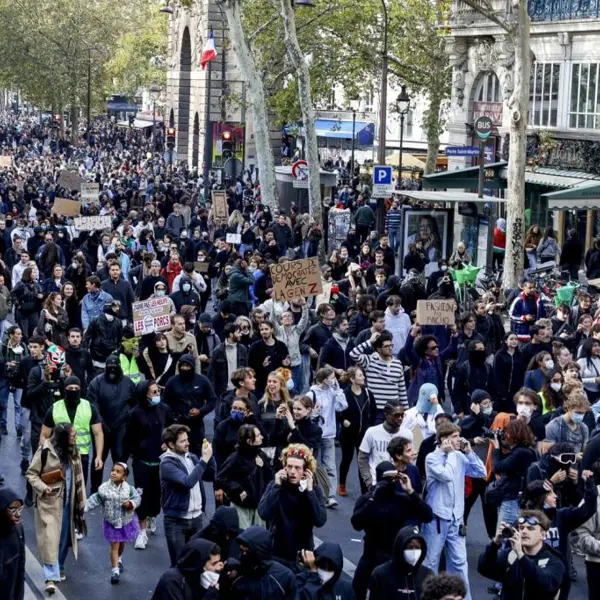
Footage of rioting across France has been all over the media and all over our social feeds. Protests that started over the dire state of schools have escalated into an explosive expression of deep anger against the French state.
On October 17th and 18th about 500,000 people protested in major cities across France. This would be like 40,000 on the streets of Ireland, as the population of France is much bigger than Ireland’s.
The marches earlier in the day had seen over half a million ordinary people take to the streets, fueled by their deep fury over soaring inflation, high energy bills and the erosion of public services.
Unions like the CGT, Yellow Vest activists and student groups protested without any trouble. Less than 1% to 2% of the movement participated in later clashes with the cops and the subsequent rioting and looting. But the ferocity of the rioting caught the system off guard.
French trade unions have distanced themselves from calls for more demonstrations this coming Saturday and instead workers will join a coordinated nationwide day of strikes and rallies on November 5th.
France hasn’t managed to balance a budget in 50 years. French workers are militant so the state has had to provide the highest social wage in Europe. A social wage is the services a worker gets like subsidized public transport, a decent public health system, early retirement and free university education.
But the neoliberal French establishment didn’t want to hit the capitalist class with taxes to fund that social wage, the result has been an indebted French state that can’t balance a budget. The state is afraid of the population, while it stubbornly refuses to take wealth from its masters in the boss class.
This borrowing strategy only worked when interest rates were low and economic growth steady. Pandemic spending, the cost of living and energy crisis and the subsequent spike in interest rates completely smashed this debt driven model.
This is why Prime Minister Sébastien Lecornu unveiled a massive €54 billion “belt-tightening” budget. This followed a multi-billion euro squeeze started under the previous government, all to pacify greedy international bond markets.
School budgets were squeezed, triggering the initial student anger over overcrowded classrooms and teacher shortages. That’s why this round of protests began.
Austerity is looting by the state on behalf of capitalist bondholders. The French state was looting before anyone took to the streets. The French police were rioting when the protests were peaceful, attacking protests.
Forcing teenagers into overcrowded, decaying classrooms with a severe shortage of teachers is violence. Cutting funding for healthcare, targeting sick leave and freezing pensions for old workers is violence. Freezing wages during an inflation crisis is a form of state-sanctioned theft and violence.
The upcoming “Major Inter-Union Day of Strike” on Thursday November 5th will see a total shutdown of the French economy by workers.
Workers have the power to stop work, shut down the economy and do real harm to the bosses. The French Prime Minister met with unions to try to prevent the strike but the day of action is still going ahead.
An alliance of the five largest French union federations has signed up to strike representing almost two million workers. The workers’ demands are to kill the budget, raise wages, fund public services and to stop layoffs.
The movement is evolving away from student and youth protests to conflict with the state using worker power over production. A general strike by workers is the most powerful form of protest as it shows workers have control over the whole economy and can shut it down.
This shift is a double edged sword because while the unions bring the mass might of the working class to bear on the government, union bureaucrats everywhere are inclined to compromise.
But that doesn’t mean falling into the false opposition of street militancy versus big worker strikes in the hands of the bureaucracy. French workers, like workers everywhere, need to fight for control over their unions.
Then a worker strike movement accompanied by mass worker protests can force any government to do what workers want. The May 1968 French strike wave involved over 10 million workers. France isn’t there yet.
The coming 2027 French elections will see the movement on the streets and in the workplaces become a battle at the ballot box. The establishment will try to use the elections to give the system breathing space. Marine Le Pen helps the establishment by repeating law and order soundbites and urging workers to abstain from protests and strikes.
This is why the most militant workers need their own party. So the electoral diversion tactic doesn’t work and elections can then be a platform to re-ignite working class resistance to the French state.
Here in Ireland our establishment can use a big corporate surplus and compliant union leaders to divert anger into safe channels for the system. But the cost of living crisis is escalating here too and the massive strike on Oct 14th 2026 shows the potential and power of workers. We too have a breaking point.
Putting workers in the driving seat of social movements, putting workers in the driving seat of our unions, that’s the only way confrontation with the establishment will lead to our class, the working class, being in the driving seat of a socialist, planned economy where we call the shots and the cost of living crisis is a distant memory.
*..........*..........*..........*..........*..........*..........*..........*
*..........*..........*..........*..........*..........*..........*..........*
*..........*..........*..........*..........*..........*..........*..........*
*..........*..........*..........*..........*..........*..........*..........*
*..........*..........*..........*..........*..........*..........*..........*
*..........*..........*..........*..........*..........*..........*..........*
*..........*..........*..........*..........*..........*..........*..........*
*..........*..........*..........*..........*..........*..........*..........*
*..........*..........*..........*..........*..........*..........*..........*
*..........*..........*..........*..........*..........*..........*..........*
*..........*..........*..........*..........*..........*..........*..........*
*..........*..........*..........*..........*..........*..........*..........*
*..........*..........*..........*..........*..........*..........*..........*
*..........*..........*..........*..........*..........*..........*..........*
*..........*..........*..........*..........*..........*..........*..........*
*..........*..........*..........*..........*..........*..........*..........*
*..........*..........*..........*..........*..........*..........*..........*
*..........*..........*..........*..........*..........*..........*..........*
*..........*..........*..........*..........*..........*..........*..........*
*..........*..........*..........*..........*..........*..........*..........*
*..........*..........*..........*..........*..........*..........*..........*
*..........*..........*..........*..........*..........*..........*..........*
*..........*..........*..........*..........*..........*..........*..........*
*..........*..........*..........*..........*..........*..........*..........*
*..........*..........*..........*..........*..........*..........*..........*
*..........*..........*..........*..........*..........*..........*..........*
*..........*..........*..........*..........*..........*..........*..........*
*..........*..........*..........*..........*..........*..........*..........*
*..........*..........*..........*..........*..........*..........*..........*
*..........*..........*..........*..........*..........*..........*..........*
*..........*..........*..........*..........*..........*..........*..........*
*..........*..........*..........*..........*..........*..........*..........*
*..........*..........*..........*..........*..........*..........*..........*
*..........*..........*..........*..........*..........*..........*..........*
*..........*..........*..........*..........*..........*..........*..........*
*..........*..........*..........*..........*..........*..........*..........*
*..........*..........*..........*..........*..........*..........*..........*
*..........*..........*..........*..........*..........*..........*..........*
*..........*..........*..........*..........*..........*..........*..........*
