
We Support Dockworkers Blocking Weapons on October 30, 2026
Unions representing workers at 40 ports in Europe and the Mediterranean are calling for an international day of action on October 30. Read more here. |
| World Federation of Trade Unions |
We Support Dockworkers Blocking Weapons on October 30, 2026
Unions representing workers at 40 ports in Europe and the Mediterranean are calling for an international day of action on October 30. Read more here.
Statement from the World Federation of Trade Unions:
Ports For Peace – Jobs With Dignity
Following the Third International Meeting of Mediterranean and European Dockworkers’ and Port Workers’ Unions, held in Istanbul in May 2026, the participating unions have launched a common international day of action on 30 October 2026.
The meeting focused on the struggle against wars, genocide and military aggression, while also addressing the challenges facing dockworkers and port workers, including wages, working conditions, automation projects, and occupational health and safety.
The participating organizations, CGT Ports and Docks (France), ENEDEP (Greece), LAB (Basque Country), Liman-İş (Turkey), ODT (Morocco), and USB (Italy), representing workers in more than 40 Mediterranean and European ports, are calling on dockworkers and port workers to mobilize together on 30 October 2026.
This mobilization is based on the Istanbul Declaration, adopted unanimously by the participating organizations and now fully endorsed by ORSA Porti of Gioia Tauro (Italy), which has joined our international network.
The declaration sets out the following demands:
· An immediate end to the genocide of the Palestinian people and recognition of an independent Palestinian state, recognized by the international community, within the 1967 borders and with East Jerusalem as its capital.
· An end to the US-Israeli wars of aggression in the West Asia and against Iran, and full solidarity with the peoples of Cuba, Venezuela and Sudan, alongside support for the right of all peoples to resist occupation and to self-determination.
· Ports must not be used for the transport of arms, ammunition, military equipment or troops destined for war zones.
· They must not become military bases for NATO, the United States or the European Union, nor serve as tools for shipowners and monopoly groups.
· No to the war economy, government rearmament plans, and the project of militarization of ports and strategic infrastructure from EU. Public resources must be used to meet people’s social needs, not to finance war.
· Collective agreements must guarantee real wage increases, secure employment, reduced working hours, and fair pension provisions.
· Technological progress, mechanization, automation and artificial intelligence must not be used to eliminate jobs or undermine workers’ rights. Dockworkers and port workers say NO to automation.
On October 30, all actions will be united as part of a common international struggle to stop wars, genocide and the militarization of ports at a very critical moment in history, while defending workers’ rights and better working conditions. Each union will decide the most appropriate form of mobilization according to its national circumstances, starting from strike action and from a shared commitment to prevent the loading of death and destruction.
The signatory trade unions of the Istanbul Declaration call on ALL dockworkers’ and port workers’ unions to join this international mobilization. We are ready to meet with organized groups of dockworkers and port workers from any other ports interested in becoming part of this common struggle.
CGT FNPD France – ENEDEP Greece – LAB Basque Country – LIMAN-IS Turkey – ODT Maroc – ORSA Porti Italy – USB Italy
*..........*..........*..........*..........*..........*..........*..........*

NOVEMBER 1-7
WEEK of GLOBAL RESISTANCE
to STOP U.S. IMPERIALISM & GENOCIDE
This year SHUT DOWN DRONE WARFARE (SDDW) Fall Actions will be a "Kick Off for A New Campaign": We want to help build a stronger network of global communities working in coordination to STOP U.S Imperialism & Genocide. Several other national organizations are already co-sponsors. (see below) This global call to action in the fall is only the beginning. We invite national and international organizations to sign on as sponsors/endorsers of the week and to plan simultaneous actions at U.S. Bases, Weapons Industries and AI Data Centers around the world. Organize actions for one day, or numerous days during or near the Week of Global Resistance. We recommend planning actions during weekday commute hours, if possible, when personnel are going into and out of military bases, weapons industry workplaces, AI Data Centers, etc. Educate, educate, educate and encourage resistance from within. Please spread the word: Help us get more sponsors & endorsers! More details to come soon.
"Week of Global Resistance" Co-sponsors: ShutDownDroneWarfare.org, BanKillerDrones.org, Global Network Against Weapons & Nuclear Power in Space, and Witness Against Empire.
Will your organization sponsor or endorse? Please contact: toby4peace@sonic.net
The above global call to action is part of SDDW Fall Action Week:
SHUT DOWN DRONE WARFARE! (SDDW)
ShutDownDroneWarfare.org
SDDW Fall Action Week:
NEW: Simultaneous Actions at both Creech AFB & Holloman AFB!
November 1-7, 2026
Nov.1-7, Creech AFB Fall Action, Indian Springs, NV
Nov. 4-6, Holloman AFB Fall Action, Alamogordo, NM
17 years of persistent resistance! Come for all or part of Fall Actions!
Shut Down Drone Warfare (SDDW) Campaign is Co-Sponsored by Veterans For Peace, Ban Killer Drones & CODEPINK
*..........*..........*..........*..........*..........*..........*..........*

We need as many people there as possible to carry our message - no more of our tax dollars for endless wars. Can we count you in? Sign up here:
https://www.codepink.org/novdc26
*..........*..........*..........*..........*..........*..........*..........*

To Iran’s Political Prisoners, trapped “Between Two Blades of a Scissors”
Open letter
August marks the anniversary of the 1988 mass executions in Iran, a horror that echoes in the country’s current surge in death sentences. It also marks the August 19 anniversary of the UK- and U.S.-orchestrated coup against the prime minister Mohammad Mosaddegh in 1953. Amid the current, indiscriminate waves of U.S.-Israeli military assaults against Iran, this letter of solidarity denounces the repression of the Iranian people and their political prisoners by forces both at home and abroad.
To our fellow activists, students, thinkers, workers, artists, and other prisoners of conscience held behind the walls of all detention centers across Iran:
We write to you from a place of deep solidarity, our hearts heavy with the knowledge of the struggle you face within Iran’s prisons: the torture, the systematic neglect, the enforced silence, and the brutal reality of sham trials and executions. As former and current political prisoners, activists, and scholars committed to the global project of abolition, anti-authoritarianism and anti-imperialism, we see you across the distances of geography and the silence of censorship and internet blackouts. And we stand in solidarity with you, as you are at the intersection of two sources of oppression.
On one side, you face the Islamic Republic that, from its inception, enforced absolute social and political control based on an exclusionary ideology. It is a system that claims to counter imperial power while using its very logic of domination and systems of carcerality, torture and execution. On the other side, you face the aggression and violence of the very imperialist and Zionist forces the Islamic Republic purports to stand against. The U.S. and Israel instigate brutal wars, destroy civilian infrastructure, kill innocent schoolgirls, and treat you as collateral damage in their pursuit of regional dominance. We remember the horror of June 23, 2025, when Israel struck the Evin prison complex, flattening its hospital ward, transgender section, and visitor center. You best exposed this dual oppression when you voiced that you “feel stuck between the two blades of a scissors, the evil regime that imprisons and tortures [you] and a foreign force dropping bombs on [your] heads in the name of freedom.”
In the past year, we witnessed both blades of the scissor sharpen. We see the arbitrary arrests and the horrific wave of state executions. We see the deepening criminalization of the working class and unemployed, the targeting of Kurds, Arabs, and Baloch, and the scapegoating of Afghan migrants: all desperate attempts to kill the spirit of people they cannot contain. This is the logic of carceral states everywhere: when they fail to address the crises people face, they simply attempt to criminalize or disappear the people themselves.
We see the same logic of domination when Israel uses “administrative detention” to hold Palestinian political prisoners for years without charge. We see it when Israeli authorities celebrate a new law that allows them to execute the Palestinian political prisoners they cannot dominate. We see it in the ICE detention centers where the U.S. government imprisons our people in the pursuit of a political agenda of racist exclusion or detains our political activists for daring to speak against the U.S.-backed Israeli genocide. We see it in the history of the U.S. targeting freedom fighters, particularly Black, Indigenous, Puerto Rican and other anticolonial organizers, locking them away for decades to crush movements for national liberation and sovereignty. And we see the connections between these carceral systems sharing intelligence and governance techniques, such as when the USP Marion prison in Illinois became a blueprint for prisons built in Iran and Israel in the 1960s. Whether it is a border wall or a prison gate, the goal is the same: to silence people through fear, domination, and isolation.
Your struggle is as global as our collective dreams of freedom and dignity. We stand with you, and we reject the false binary of imperialism and hollow anti-imperialism. We invite global civil society and anti-imperialist activists and organizations to extend their unconditional support and solidarity to all incarcerated kin fighting for our collective liberation, to build relationships with Iranian political prisoners and uplift their voices, to put pressure on the Islamic Republic by challenging its narrative, and to call upon that government to immediately stop all the executions and free all political prisoners.
The Iranian authorities must stop their inhumane practice of death and incarceration now. And the U.S. and Israel must end their barbaric wars and brutal sanctions that knowingly devastate our communities.
In solidarity and with love,
Alberto Toscano, emeritus professor of critical theory, Goldsmiths, *University of London
Angela Davis, former political prisoner, distinguished professor emerita, *University of California, Santa Cruz
Bernardine Dohrn, retired professor of law, *Northwestern University
Bill Ayers, professor, *College Unbound
Cherríe L Moraga, distinguished professor emerita, University of California, Santa Barbara, Chicana feminist writer, and activist
Dan Berger, professor of comparative ethnic studies, *University of Washington Bothell
Hossam el-Hamalawy, Egyptian socialist, scholar and former political prisoner
Jairus Banaji, historian, research professor, SOAS, *University of London
Jason Stanley, professor of philosophy, *University of Toronto
Judith Butler, distinguished professor in the Graduate School, *University of California, Berkeley
Keeanga-Yamahtta Taylor, author, From #BlackLivesMatter to Black Liberation, professor of African American studies, *Princeton University
Michael Löwy, emeritus research director of sociology at the* Centre National de la Recherche Scientifique, Paris
Michael Mansfield, human rights and civil liberties Bbarrister
Mumia Abu-Jamal, current political prisoner, educator, journalist and activist
Ricardo Jiménez, social activist, former Puerto Rican political prisoner
Ruha Benjamin, professor of African American studies, *Princeton University
Ruth Wilson Gilmore, Graduate Center, *CUNY
Walden F Bello, international adjunct professor of sociology, *State University of New York at Binghamton
Yasin al-Haj Saleh, Syrian writer, political dissident, and former political prisoner in Syria
* Organizations for identification purposes only
** Signatories are sorted alphabetically
—The Guardian, August 20, 2026
https://www.theguardian.com/commentisfree/ng-interactive/2026/aug/20/iran-political-prisoners
*..........*..........*..........*..........*..........*..........*..........*

*..........*..........*..........*..........*..........*..........*..........*

The Trump administration is escalating its attack on Cuba, cutting off the island’s access to oil in a deliberate attempt to induce famine and mass suffering. This is collective punishment, plain and simple.
In response, we’re releasing a public Call to Conscience, already signed by influential public figures, elected officials, artists, and organizations—including 22 members of the New York City Council, Kal Penn, Mark Ruffalo, Susan Sarandon, Alice Walker, 50501, Movement for Black Lives, The People’s Forum, IFCO Pastors for Peace, ANSWER Coalition, and many others—demanding an end to this brutal policy.
The letter is open for everyone to sign. Add your name today. Cutting off energy to an island nation is not policy—it is a tactic of starvation.
*..........*..........*..........*..........*..........*..........*..........*
VIDEO:
What Cubans Really Think About Trump
By Jeff Seal, May 28, 2026
Mr. Seal is a comedian and a visual journalist.

End Texas Torture of Revolutionary Elder Xinachtli
Organization Support Letter
Letter to demand the immediate medical treatment and release of Chicano political prisoner Xinachtli (Alvaro Hernandez #00255735)
To the Texas Department of Criminal Justice,
We, the undersigned organizations, write to urge immediate action to protect the life, health, and human rights of Xinachtli (legal name Alvaro Hernandez). Xinachtli is 73-year-old Chicano community organizer from Texas who has spent 23 years in solitary confinement and 30 years incarcerated as part of a 50-year sentence. His health is now in a critical and life-threatening state and requires prompt and comprehensive medical intervention.
Since his conviction in 1997, Xinachtli has spent decades in conditions that have caused significant physical and psychological harm. As an elder in worsening health, these conditions have effectively become a de facto death sentence.
Xinachtli’s current medical condition is severe. His physical, mental, and overall well-being have declined rapidly in recent weeks. He now requires both a wheelchair and a walker, has experienced multiple falls, and is suffering from rapid weight loss. He is currently housed in the McConnell Unit infirmary, where he is receiving only palliative measures and is being denied a medical diagnosis, access to his medical records, and adequate diagnostic testing or treatment.
A virtual clinical visit with licensed medical doctor Dr. Dona Kim Murphey underscores the severity of his condition. In her report of the visit, she wrote: "Given the history of recent neck/back trauma and recurrent urinary tract infections with numbness, weakness, and bowel and bladder incontinence, I am concerned about nerve root or spinal cord injury and/or abscesses that can lead to permanent sensorimotor dysfunction."
Despite his age and visible disabilities, he remains in solitary confinement under the Security Threat Group designation as a 73-year-old. During his time in the infirmary, prison staff threw away all of his belongings and “lost” his commissary card, leaving him completely without basic necessities. He is experiencing hunger, and the lack of consistent nutrition is worsening his medical condition. McConnell Unit staff have also consistently given him incorrect forms, including forms for medical records and medical visitation, creating further barriers to care and communication.
A family visit on November 29 confirmed the seriousness of his condition. Xinachtli, who was once able to walk on his own, can no longer stand without assistance. He struggled to breathe, has lost more than 30 pounds, relied heavily on his wheelchair, and was in severe pain throughout the visit.
In light of these conditions, we, the undersigned organizations, demand that TDCJ take immediate action to save Xinachtli’s life and comply with its legal and ethical obligations.
We urge the immediate implementation of the following actions:
Immediate re-instatement of his access to commissary to buy hygiene, food, and other critical items. Immediate transfer to the TDCJ hospital in Galveston for a full medical evaluation and treatment, including complete access to his medical records and full transparency regarding all procedures. Transfer to a geriatric and medical unit that is fully accessible under the Americans with Disabilities Act. Xinachtli requests placement at the Richard P LeBlanc Unit in Beaumont, Texas. Approval of Medical Recommended Intensive Supervision, the release program for individuals with serious medical conditions and disabilities, in recognition of the severity and progression of his current health issues. Failure to act will result in the continued and foreseeable deterioration of Xinachtli’s health, amounting to state-sanctioned death. We urge TDCJ to take swift and decisive action to meet these requests and to fulfill its responsibility to safeguard his life and well-being.
We stand united in calling for immediate and decisive action. Xinachtli’s life depends on it.
Signed, Xinachtli Freedom Campaign and supporting organizations
Endorsing Organizations:
Al-Awda Houston; All African People’s Revolutionary Party; Anakbayan Houston; Anti-Imperialist Solidarity; Artists for Black Lives' Equality; Black Alliance for Peace - Solidarity Network; Columbia University Students for a Democratic Society; Community Liberation Programs; Community Powered ATX; Contra Gentrificación; Diaspora Pa’lante Collective; Down South; DSA Emerge; Entre nos kc; Fighting Racism Workshops; Frontera Water Protectors; GC Harm Reductionists; JERICHO MOVEMENT; Jericho Movement Providence; Montrose Anarchist Collective; NYC Jericho Movement; OC Focus; Palestine Solidarity TX; Partisan Defense Committee; Partido Nacional de la Raza Unida; PDX Anti-Repression; Red Star Texas; Root Cause; San Francisco Solidarity Collective; Shine White Support Team; Sunrise Columbia; UC San Diego Faculty for Justice in Palestine; Viva Palestina, EPTX; Water Justice and Technology Studio; Workshops4Gaza.
Sign the endorsement letter for your organization here:
https://cryptpad.fr/form/#/2/form/view/MiR1f+iLiRBJC7gSTyfhyxJoLIDhThxRafPatxdbMWI/
IMPORTANT LINKS TO MATERIALS FOR XINACHTLI FREEDOM CAMPAIGN:
PHONE BLAST: Your community can sign up for a 15-minute-long call shift here: bit.ly/xphoneblast
FUNDRAISER: Here is the link to Jericho's fundraiser for Xinachtli: http://givebutter.com/jerichomovement
CASE HISTORY: Learn more about Xinachtli and his case through our website: https://freealvaro.net
CONTACT INFO:
Follow us on Instagram: @freexinachtlinow
Email us:
xinachtlifreedomcampaign@protonmail.com
COALITION FOLDER:
https://drive.proton.me/urls/SP3KTC1RK4#KARGiPQVYIvR
In the folder you will find: Two pictures of Xinachtli from 2024; The latest updated graphics for the phone blast; The original TRO emergency motion filing; Maria Salazar's declaration; Dr. Murphy's report from her Dec. 9 medical visit; Letter from Amnesty International declaring Xinachtli's situation a human rights violation; Free Xinachtli zine (which gives background on him and his case); and The most recent press release detailing who Xinachtli is as well as his medical situation.
Write to:
Alvaro Hernandez CID #00255735
TDCJ-W.G. McConnell Unit
PO Box 660400
Dallas, TX 75266-0400
*..........*..........*..........*..........*..........*..........*..........*
*..........*..........*..........*..........*..........*..........*..........*
 ‘Freedom Zone’ launches important human rights event October 30 Global Festival in Support of Russian Political Prisoners _________________________________________________________ THE LOCATIONS: Berlin, Munich, Warsaw, New York, Minnesota, Budva, Melbourne, Helsinki, Haifa, Amsterdam, Stockholm, Vilnius, São Paulo, Florianópolis, Batumi, Tbilisi, Belgrade, Riga, Paris, Yerevan, Milan, Vienna, London, Madrid THE AUDIENCE: Anyone concerned about political prisoners in Russia
Lectures, auctions, letter evenings, film screenings and other events will take place in more than 20 countries, including the US, Brazil and Australia, demonstrating worldwide solidarity with the prisoners of the Russian regime. Speakers in different cities will include such well-known opponents of the Putin regime as Daria Serenko, Mikhail Lobanov, Sasha and Nadezhda Skochilenko, Ivan Philippov, Alexey Ponomaryov and other prominent Russian exiles. Funds raised will go towards supporting political prisoners, covering the costs of legal representation, visits from loved ones and other needs. It is also possible to join the international campaign by making an online donation. This global festival will be a tangible expression of opposition to lawlessness in Russia and support for its victims. Let’s show that we stand shoulder to shoulder with those who have been unjustly convicted! ______________________________________________ ‘Freedom Zone’ was founded by Kseniia Kagarlitskaia, daughter of political prisoner Boris Kagarlitsky. Since 2024, the organisation has been holding charity events (festivals) abroad to raise funds for political prisoners in Russia, raising awareness of the unlawful persecution and inhumane prison conditions faced by people in the Russian Federation, as well as campaigning for the release of political prisoners. Website: https://freedom-zone.com/festival Contact: Kseniia Kagarlitskaiazona.svobody@gmail.com +38268347993 Telegram @pruesha ___________________________________________________________________ Donation link: https://buymeacoffee.com/zonasvobodk Russia Confirms Jailing of Antiwar Leader Boris Kagarlitsky In a secret trial on June 5, 2024, the Russian Supreme Court’s Military Chamber confirmed a sentence of five years in a penal colony for left-wing sociologist and online journalist Boris Kagarlitsky. His crime? “Justifying terrorism” — a sham charge used to silence opponents of Putin’s war on Ukraine. The court disregarded a plea for freedom sent by thirty-seven international luminaries. Kagarlitsky, a leading Marxist thinker in Russia’s post-Soviet period, recently addressed socialists who won’t criticize Putin: “To my Western colleagues, who…call for an understanding of Putin and his regime, I would like to ask a very simple question. [Would] you want to live in a country where there is no free press or independent courts? In a country where the police have the right to break into your house without a warrant? …In a country which…broadcasts appeals on TV to destroy Paris, London, Warsaw, with a nuclear strike?” Thousands of antiwar critics have been forced to flee Russia or are behind bars, swept up in Putin’s vicious crackdown on dissidents. Opposition to the war is consistently highest among the poorest workers. Recently, RusNews journalists Roman Ivanov and Maria Ponomarenko were sentenced to seven, and six years respectively, for reporting the military’s brutal assault on Ukraine. A massive global solidarity campaign that garnered support from thousands was launched at Kagarlitsky’s arrest. Now, it has been revived. This internationalism will bolster the repressed Russian left and Ukrainian resistance to Putin’s imperialism. To sign the online petition at freeboris.info —Freedom Socialist Party, August 2024 https://socialism.com/fs-article/russia-jails-prominent-antiwar-leader-boris-kagarlitsky/#:~:text=In%20a%20secret%20trial%20on,of%20Putin's%20war%20on%20Ukraine. Petition in Support of Boris KagarlitskyWe, the undersigned, were deeply shocked to learn that on February 13 the leading Russian socialist intellectual and antiwar activist Dr. Boris Kagarlitsky (65) was sentenced to five years in prison. Dr. Kagarlitsky was arrested on the absurd charge of 'justifying terrorism' in July last year. After a global campaign reflecting his worldwide reputation as a writer and critic of capitalism and imperialism, his trial ended on December 12 with a guilty verdict and a fine of 609,000 roubles. The prosecution then appealed against the fine as 'unjust due to its excessive leniency' and claimed falsely that Dr. Kagarlitsky was unable to pay the fine and had failed to cooperate with the court. In fact, he had paid the fine in full and provided the court with everything it requested. On February 13 a military court of appeal sent him to prison for five years and banned him from running a website for two years after his release. The reversal of the original court decision is a deliberate insult to the many thousands of activists, academics, and artists around the world who respect Dr. Kagarlitsky and took part in the global campaign for his release. The section of Russian law used against Dr. Kagarlitsky effectively prohibits free expression. The decision to replace the fine with imprisonment was made under a completely trumped-up pretext. Undoubtedly, the court's action represents an attempt to silence criticism in the Russian Federation of the government's war in Ukraine, which is turning the country into a prison. The sham trial of Dr. Kagarlitsky is the latest in a wave of brutal repression against the left-wing movements in Russia. Organizations that have consistently criticized imperialism, Western and otherwise, are now under direct attack, many of them banned. Dozens of activists are already serving long terms simply because they disagree with the policies of the Russian government and have the courage to speak up. Many of them are tortured and subjected to life-threatening conditions in Russian penal colonies, deprived of basic medical care. Left-wing politicians are forced to flee Russia, facing criminal charges. International trade unions such as IndustriALL and the International Transport Federation are banned and any contact with them will result in long prison sentences. There is a clear reason for this crackdown on the Russian left. The heavy toll of the war gives rise to growing discontent among the mass of working people. The poor pay for this massacre with their lives and wellbeing, and opposition to war is consistently highest among the poorest. The left has the message and resolve to expose the connection between imperialist war and human suffering. Dr. Kagarlitsky has responded to the court's outrageous decision with calm and dignity: “We just need to live a little longer and survive this dark period for our country,” he said. Russia is nearing a period of radical change and upheaval, and freedom for Dr. Kagarlitsky and other activists is a condition for these changes to take a progressive course. We demand that Boris Kagarlitsky and all other antiwar prisoners be released immediately and unconditionally. We also call on the auth *..........*..........*..........*..........*..........*..........*..........* *..........*..........*..........*..........*..........*..........*..........* |

Self-portrait by Kevin Cooper
Funds for Kevin Cooper
Kevin was transferred out of San Quentin and is now at a healthcare facility in Stockton. He has received some long overdue healthcare. The art program is very different from the one at San Quentin but we are hopeful that Kevin can get back to painting soon.
For 41 years, an innocent man has been on death row in California.
Kevin Cooper was wrongfully convicted of the brutal 1983 murders of the Ryen family and houseguest. The case has a long history of police and prosecutorial misconduct, evidence tampering, and numerous constitutional violations including many incidences of the prosecution withholding evidence of innocence from the defense. You can learn more here .
In December 2018 Gov. Brown ordered limited DNA testing and in February 2019, Gov. Newsom ordered additional DNA testing. Meanwhile, Kevin remains on Death Row at San Quentin Prison.
The funds raised will be used to help Kevin purchase art supplies for his paintings . Additionally, being in prison is expensive, and this money would help Kevin pay for stamps, books, paper, toiletries, supplies, supplementary food, printing materials to educate the public about his case and/or video calls.
Please help ease the daily struggle of an innocent man on death row!
An immediate act of solidarity we can all do right now is to write to Kevin and assure him of our continuing support in his fight for justice. Here’s his address:
Kevin Cooper #C65304
Cell 107, Unit E1C
California Health Care Facility, Stockton (CHCF)
P.O. Box 213040
Stockton, CA 95213
www.freekevincooper.org
Call California Governor Newsom:
1-(916) 445-2841
Press 1 for English or 2 for Spanish,
press 6 to speak with a representative and
wait for someone to answer
(Monday-Friday, 9:00 A.M. to 5:00 P.M. PST—12:00 P.M. to 8:00 P.M. EST)
*..........*..........*..........*..........*..........*..........*..........*
*..........*..........*..........*..........*..........*..........*..........*

Dr. Alter Still Needs Our Help!
Please sign the petition today!
https://www.change.org/p/texas-state-university-give-tom-alter-his-job-back
What you can do to support:
—Donate to help Tom Alter and his family with living and legal expenses: https://gofund.me/27c72f26d
—Sign and share this petition demanding Tom Alter be given his job back: https://www.change.org/p/texas-state-university-give-tom-alter-his-job-back
—Write to and call the President and Provost at Texas State University demanding that Tom Alter be given his job back:
President Kelly Damphousse: president@txstate.edu
President’s Office Phone: 512-245-2121
Provost Pranesh Aswath: xrk25@txstate.edu
Provost Office Phone: 512-245-2205
For more information about the reason for the firing of Dr. Tom Alter, read:
"Fired for Advocating Socialism: Professor Tom Alter Speaks Out"
Ashley Smith Interviews Dr. Tom Alter
—CounterPunch, September 24, 2025
*..........*..........*..........*..........*..........*..........*..........* *..........*..........*..........*..........*..........*..........*..........* |

Mumia Abu-Jamal is Innocent!
FREE HIM NOW!
Write to Mumia at:
Smart Communications/PADOC
Mumia Abu-Jamal #AM-8335
SCI Mahanoy
P.O. Box 33028
St. Petersburg, FL 33733
Join the Fight for Mumia's Life
Since September, Mumia Abu-Jamal's health has been declining at a concerning rate. He has lost weight, is anemic, has high blood pressure and an extreme flair up of his psoriasis, and his hair has fallen out. In April 2021 Mumia underwent open heart surgery. Since then, he has been denied cardiac rehabilitation care including a healthy diet and exercise.

He still needs more complicated treatment from a retinal specialist for his right eye if his eyesight is to be saved:
Donate to Mumia Abu-Jamal's Emergency Legal and Medical
Defense Fund
Mumia has instructed PrisonRadio to set up this fund. Gifts donated here are designated for the Mumia Abu-Jamal Medical and Legal Defense Fund. If you are writing a check or making a donation in another way, note this in the memo line.
Send to:
Mumia Medical and Legal Fund c/o Prison Radio
P.O. Box 411074, San Francisco, CA 94103
*..........*..........*..........*..........*..........*..........*..........*
*..........*..........*..........*..........*..........*..........*..........*
Resources for Resisting Federal Repression
https://www.nlg.org/federalrepressionresources/
Since June of 2020, activists have been subjected to an increasingly aggressive crackdown on protests by federal law enforcement. The federal response to the movement for Black Lives has included federal criminal charges for activists, door knocks by federal law enforcement agents, and increased use of federal troops to violently police protests.
The NLG National Office is releasing this resource page for activists who are resisting federal repression. It includes a link to our emergency hotline numbers, as well as our library of Know-Your-Rights materials, our recent federal repression webinar, and a list of some of our recommended resources for activists. We will continue to update this page.
Please visit the NLG Mass Defense Program page for general protest-related legal support hotlines run by NLG chapters.
Emergency Hotlines
If you are contacted by federal law enforcement, you should exercise all of your rights. It is always advisable to speak to an attorney before responding to federal authorities.
State and Local Hotlines
If you have been contacted by the FBI or other federal law enforcement, in one of the following areas, you may be able to get help or information from one of these local NLG hotlines for:
Portland, Oregon: (833) 680-1312
San Francisco, California: (415) 285-1041 or fbi_hotline@nlgsf.org
Seattle, Washington: (206) 658-7963
National Hotline
If you are located in an area with no hotline, you can call the following number:
National NLG Federal Defense Hotline: (212) 679-2811
*..........*..........*..........*..........*..........*..........*..........*
*..........*..........*..........*..........*..........*..........*..........*
Articles
*..........*..........*..........*..........*..........*..........*..........*
*..........*..........*..........*..........*..........*..........*..........*
1) Protesters March in France Amid Heavy Security
In Marseille, clashes broke out between protesters and the police, who fired tear gas. As many as 70,000 police and security officers will try to avert the arson and looting that shocked the country last weekend.
By Mark Landler, Reporting from Paris, Oct. 24, 2026

The authorities deployed large-scale security forces across France on Saturday to prevent a repeat of last weekend’s mass protests, which degenerated into arson, looting and other violence.
By midday local time, the police had arrested 135 people, according to Laurent Nuñez, the interior minister. He estimated that 35,000 people were on the streets nationwide, fewer than at the same time last Saturday, when more than a half million people demonstrated by the end of the day.
The lone protest permitted in Marseille, where looters ravaged a commercial avenue last week, drew thousands of people, including students and some parents with young children. Close to where the authorized protest was intended to end, clashes broke out between protesters and the police, who fired tear gas at one point.
In Orléans, south of Paris, a protest against France’s main far-right party, the National Rally, which is holding its convention in the city, ended peacefully in the afternoon. The local authorities said 11,000 protesters had gathered, while organizers in the crowd said 26,000 had joined.
Thousands of people turned out on the southeast edge of Paris, even after organizers were forced to change the protest location at the last minute.
With rallies also planned in other cities, France will face a test of whether it can get a grip on the outbreak of urban violence that has shocked the public and thrown the country’s leaders on the defensive.
What began as a student-led protest movement has mutated into something darker — a nationwide cycle of violence that raises basic questions about France’s ability to preserve law and order. On Oct. 14, the police failed to control marauding bands as they shattered shop windows, looted merchandise, incinerated vehicles and besieged public buildings.
On Saturday, as many as 70,000 police officers and gendarmes, reinforced by elite military troops, armored vehicles, drones and helicopters, filled streets and the skies in Paris, Marseille, Lyon and other cities. Several cities, including Le Havre, Toulon and Nice, banned all demonstrations in their downtown areas.
The scene in Paris has grown more chaotic in the last hour as the police have tried to disperse protesters with tear gas and a water cannon truck. This follows a familiar pattern: a mostly peaceful march ends in clashes between protestors and the police.
The protest in Paris has drawn an estimated 110,000 people, according to the authorities, roughly the same number as turned out last weekend. That is a strong showing, given the rainy weather and fears of another outbreak of violence. Though the protests in Paris have been mainly peaceful, police just began dispersing protesters with a water cannon. Unrest has also broken out in other cities: Marseille, Lyon, Bordeaux and Lille.
*..........*..........*..........*..........*..........*..........*..........*
*..........*..........*..........*..........*..........*..........*..........*
2) They Were Accused of Illegal Fishing. They Ended Up in ICE Detention.
In states like Florida, officers who hand out fishing citations and inspect produce have been deputized by Immigration and Customs Enforcement, expanding the reach of President Trump’s deportation campaign.
By Madeleine Ngo and David Ovalle, Oct. 24, 2026
Madeleine Ngo covers immigration policy and the Department of Homeland Security. David Ovalle is a Florida correspondent and reported from Fort Lauderdale, Fla.

A canal in Dania Beach, Fla., in September. The canal was the site of an encounter that led Florida Fish and Wildlife Conservation Commission officers to contact federal immigration authorities. Alfonso Duran for The New York Times
Standing along the edge of a canal near Fort Lauderdale, Fla., Edguin Morales Aguirre had just cast a line when officers with the Florida Fish and Wildlife Conservation Commission approached him and two of his friends. They spotted a bucket holding egg-bearing blue crabs, which are illegal to have in the state.
After running checks on their IDs, the officers summoned immigration agents to detain Mr. Morales and one of his friends, who were surprised to learn that the officers were working with federal immigration authorities.
“This never used to happen,” Mr. Morales said. “Before, if they caught you fishing in a place you weren’t supposed to, they would just issue you a citation.”
In Republican-led states, officers who hand out fishing licenses, inspect produce and investigate financial crimes have been deputized by Immigration and Customs Enforcement, using their contact with local residents on a day-to-day basis to broaden the reach of President Trump’s mass deportation campaign.
The increased cooperation among states that have embraced Mr. Trump’s immigration agenda is part of a federal program known as 287(g), which pays state and local agencies to assist with immigration enforcement. Once largely reserved for local police and sheriffs’ offices to increase ICE’s access to local jails, it has expanded under Mr. Trump to include unusual agencies like state agriculture departments, gaming commissions, fish and wildlife agencies, and alcohol control offices.
But these agencies have little experience carrying out immigration arrests, which can get contentious and even violent. Some incidents involving ICE officers have led to fatal shootings. Advocates have criticized the enlistment of the agencies, saying it increases the risk of officer misconduct and deepens fears in immigrant communities that people could be detained by seemingly innocuous authorities.
“We have really serious concerns that these state agencies that have traditionally not been accountable to local communities would see themselves as accountable only to ICE’s agenda,” said Naureen Shah, who leads the American Civil Liberties Union’s immigration policy and advocacy work. “What is it about their training that they receive as fish and wildlife regulation experts or agricultural experts that leads ICE to believe it should entrust them with really fraught situations?”
Civil rights advocates have long denounced the 287(g) program, questioning the qualifications of state and local officers for conducting immigration enforcement. Although the federal government previously required several weeks of in-person training, the Trump administration scaled back to 40 hours of virtual training for deputized officers making immigration arrests in their communities.
The Department of Homeland Security said in a statement that those officers “undergo ICE background investigations and clearances.” The department added that it had been having “tremendous success” in making arrests with the help of local law enforcement.
Trump administration officials have urged agencies to sign up, and have called the 287(g) program a “force multiplier.” More than 2,600 agreements have been signed across the country as of late October, up from about 130 at the start of Mr. Trump’s second term.
More than 29,300 state and local officers have been granted the authority to question people about their immigration status and make arrests, according to the Department of Homeland Security. That is nearly five times the number of deportation officers that ICE had before Mr. Trump’s return to office.
The program has become another point of partisan division. Many Democratic-led states, including New York and California, have restricted local law enforcement from cooperating with ICE, drawing the ire of Trump administration officials who say the limits make it harder to arrest people.
Still, the state and local partnerships have become a potent tool for the administration, making up a growing share of ICE arrests, which have hit record highs in recent months. The 287(g) program has also helped Markwayne Mullin, the homeland security secretary, achieve his goal of carrying out immigration enforcement in a quieter way.
“We’re still on track pushing as hard as we can,” Mr. Mullin said in a Newsmax interview in May. “We just are doing it in a different way by using local law enforcement to work with us.”
In Louisiana and Mississippi, fish and wildlife departments have similarly partnered with ICE. Even agencies that regulate alcohol and tobacco have signed up in Louisiana and Florida. Nationally, the bulk of immigration arrests are still carried out by ICE, in part because many officers have been deputized in Republican states with fewer immigrants, including West Virginia.
But the partnerships have been especially effective in Florida, which has tallied more than 16,000 arrests through the 287(g) program since August 2025, according to state data. ICE’s most prolific partner in Florida has been the state’s highway safety department, whose troopers have rooted out unauthorized immigrants during traffic stops. The agency has assisted with more than 8,300 immigration arrests.
The state’s fish and wildlife commission has also been one of ICE’s top partners. About 500 federal immigration arrests were made after its officers encountered immigrants, according to state data. The commission referred requests for comment to ICE.
Mr. Morales, a 51-year-old native of Guatemala, said his brush with fish and wildlife officers led to weeks in immigration detention before he was released on bond. He added that he had a pending asylum application at the time of his arrest last year.
Marlene Velazquez Moreno, who was with Mr. Morales when he was arrested, said that she was not detained, because she had a green card. Although she was charged with a misdemeanor, Ms. Velazquez said that someone else unknown to her had left the crabs behind, and that a Broward County judge ultimately dismissed the charge. But she said their friend spent months in immigration detention before he was deported to his native Nicaragua.
In a statement, the Department of Homeland Security said Mr. Morales illegally entered the country and had a prior conviction for driving under the influence. Mr. Morales said the arrest happened more than 15 years ago, and he went to traffic school and paid fines.
Fairuze Sofia, a Fort Lauderdale-based lawyer who represents Ms. Velazquez, said she now regularly hears about immigrants in Florida being arrested by fish and wildlife officers. Another one of her clients, Alfonso Mendoza Perez, is still in immigration detention after he was questioned by them at Lake Okeechobee nearly a year ago. Mr. Mendoza said that he and his brother-in-law frequently caught catfish and tilapia at the popular fishing spot in Central Florida.
“You relax and you catch food for your family,” Mr. Mendoza said in a phone interview from a Mississippi detention facility.
After he was approached by the officers, Mr. Mendoza said he handed over his fishing license, which was valid. But after they checked his driver’s license, he said he was detained on the suspicion that he was in the country illegally. ICE agents later picked him up from the local county jail.
Mr. Mendoza, a native of Mexico, said he lived in Florida for about 17 years and worked as a roofer. Dulce Cruz, his wife, said she and her five children had lost their source of income and now lived in a mobile home with her mother and brothers in South Carolina.
In a statement, the Department of Homeland Security said Mr. Mendoza had been previously arrested for the felony sale of opium drugs. Ms. Cruz denied that her husband had a felony record, and a New York Times search of public records only found traffic-related charges for Mr. Mendoza.
Florida’s agriculture department has also assisted with more than 480 federal immigration arrests, according to state data.
Joshua Chavez, 21, said that he and his father, Mario Chavez Walle, drove to Florida from their hometown in Georgia to sell watermelons at the Jacksonville farmer’s market in late July. They pulled over at one of the state’s agricultural stations to let officers inspect their produce.
According to an incident report from the state’s agriculture department, Mr. Chavez’s father presented his expired Mexican ID to an officer, who then contacted ICE. After ICE confirmed that he had entered the United States illegally, the agriculture officer arrested him and took him to the local jail.
“Undocumented — turned over,” the report says under “offense description.”
Mr. Chavez said the officer questioned them about their immigration statuses, even though he is a U.S. citizen and has a valid driver’s license.
In a statement, the Department of Homeland Security said that Mr. Chavez Walle had been convicted of three D.U.I.s, and had “accepted incentivized departure.” Mr. Chavez disputed that his father agreed to voluntarily depart the country.
The partnerships with ICE have faced intense pushback in local communities across the nation. But some sheriffs said there were clear benefits to signing up. Michael J. Chitwood, the sheriff in Volusia County, Fla., said his office had been awarded $2.7 million in federal funding for making immigration arrests, which it had used to buy new equipment.
He added that officers were not rounding up immigrants, but rather encountering them during their routine work. His officers were scrutinized last year after they arrested a woman who was walking her pug in an area of the beach where dogs were prohibited. After contacting ICE to check her immigration status, the officers detained her, according to an incident report.
Mr. Chitwood noted that sheriffs’ offices in Florida were required to cooperate with ICE under state law, and that the partnership was helping remove some criminals from his community. Although he questioned the need to deport unauthorized immigrants who were not causing trouble, he said his officers were upholding the law.
“If the law says that you should be detained and deported, then we should follow the law,” Mr. Chitwood said.
Sheelagh McNeill and Seamus Hughes contributed research.
*..........*..........*..........*..........*..........*..........*..........*
*..........*..........*..........*..........*..........*..........*..........*
3) French Workers Call General Strike For Nov 5th
By Francis O'Reilly, October 21, 2026
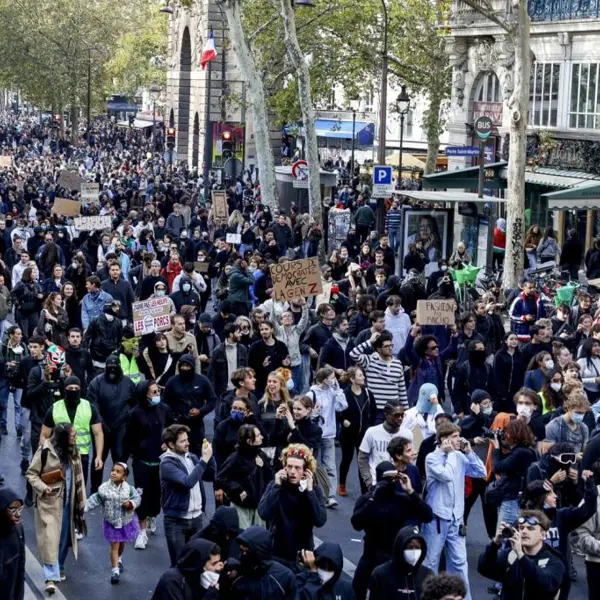
Footage of rioting across France has been all over the media and all over our social feeds. Protests that started over the dire state of schools have escalated into an explosive expression of deep anger against the French state.
On October 17th and 18th about 500,000 people protested in major cities across France. This would be like 40,000 on the streets of Ireland, as the population of France is much bigger than Ireland’s.
The marches earlier in the day had seen over half a million ordinary people take to the stre
ets, fueled by their deep fury over soaring inflation, high energy bills and the erosion of public services.
Unions like the CGT, Yellow Vest activists and student groups protested without any trouble. Less than 1% to 2% of the movement participated in later clashes with the cops and the subsequent rioting and looting. But the ferocity of the rioting caught the system off guard.
French trade unions have distanced themselves from calls for more demonstrations this coming Saturday and instead workers will join a coordinated nationwide day of strikes and rallies on November 5th.
France hasn’t managed to balance a budget in 50 years. French workers are militant so the state has had to provide the highest social wage in Europe. A social wage is the services a worker gets like subsidized public transport, a decent public health system, early retirement and free university education.
But the neoliberal French establishment didn’t want to hit the capitalist class with taxes to fund that social wage, the result has been an indebted French state that can’t balance a budget. The state is afraid of the population, while it stubbornly refuses to take wealth from its masters in the boss class.
This borrowing strategy only worked when interest rates were low and economic growth steady. Pandemic spending, the cost of living and energy crisis and the subsequent spike in interest rates completely smashed this debt driven model.
This is why Prime Minister Sébastien Lecornu unveiled a massive €54 billion “belt-tightening” budget. This followed a multi-billion euro squeeze started under the previous government, all to pacify greedy international bond markets.
School budgets were squeezed, triggering the initial student anger over overcrowded classrooms and teacher shortages. That’s why this round of protests began.
Austerity is looting by the state on behalf of capitalist bondholders. The French state was looting before anyone took to the streets. The French police were rioting when the protests were peaceful, attacking protests.
Forcing teenagers into overcrowded, decaying classrooms with a severe shortage of teachers is violence. Cutting funding for healthcare, targeting sick leave and freezing pensions for old workers is violence. Freezing wages during an inflation crisis is a form of state-sanctioned theft and violence.
The upcoming “Major Inter-Union Day of Strike” on Thursday November 5th will see a total shutdown of the French economy by workers.
Workers have the power to stop work, shut down the economy and do real harm to the bosses. The French Prime Minister met with unions to try to prevent the strike but the day of action is still going ahead.
An alliance of the five largest French union federations has signed up to strike representing almost two million workers. The workers’ demands are to kill the budget, raise wages, fund public services and to stop layoffs.
The movement is evolving away from student and youth protests to conflict with the state using worker power over production. A general strike by workers is the most powerful form of protest as it shows workers have control over the whole economy and can shut it down.
This shift is a double edged sword because while the unions bring the mass might of the working class to bear on the government, union bureaucrats everywhere are inclined to compromise.
But that doesn’t mean falling into the false opposition of street militancy versus big worker strikes in the hands of the bureaucracy. French workers, like workers everywhere, need to fight for control over their unions.
Then a worker strike movement accompanied by mass worker protests can force any government to do what workers want. The May 1968 French strike wave involved over 10 million workers. France isn’t there yet.
The coming 2027 French elections will see the movement on the streets and in the workplaces become a battle at the ballot box. The establishment will try to use the elections to give the system breathing space. Marine Le Pen helps the establishment by repeating law and order soundbites and urging workers to abstain from protests and strikes.
This is why the most militant workers need their own party. So the electoral diversion tactic doesn’t work and elections can then be a platform to re-ignite working class resistance to the French state.
Here in Ireland our establishment can use a big corporate surplus and compliant union leaders to divert anger into safe channels for the system. But the cost of living crisis is escalating here too and the massive strike on Oct 14th 2026 shows the potential and power of workers. We too have a breaking point.
Putting workers in the driving seat of social movements, putting workers in the driving seat of our unions, that’s the only way confrontation with the establishment will lead to our class, the working class, being in the driving seat of a socialist, planned economy where we call the shots and the cost of living crisis is a distant memory.
*..........*..........*..........*..........*..........*..........*..........*
*..........*..........*..........*..........*..........*..........*..........*
4) A New Level of Threat and Fear Risks Pushing the U.S. and Iran Back to Full War
With new intelligence and the possibility of all sides seeking pretexts for action, the war in Iran is entering a dangerous phase ahead of elections in the United States and Israel.
By David E. Sanger, Julian E. Barnes, Jonathan Swan, Maggie Haberman, Farnaz Fassihi and Eric Schmitt, Published Oct. 24, 2026, Updated Oct. 25, 2026
The team of Times reporters has covered Iran’s confrontations with the United States for decades, particularly during President Trump’s two terms.

A senior official in Iran took to social media in recent days to say the country was preparing to take on its adversaries with surprise attacks. Credit...Arash Khamooshi/Polaris for The New York Times
More than 6,000 miles away, the Iranians appear convinced that Israel and the United States are preparing to unleash their third major attack in 16 months, a final push to force Iran to surrender to U.S. demands.
The conflict in the Middle East has entered a new phase in which a maelstrom of factors, from the political calendars in the United States and Israel to the potential for all sides to be seeking pretexts for action, are creating heightened levels of tension and risk.
This is how countries can escalate into full-scale war, several diplomats and outside experts noted. If the U.S. intelligence disclosed this week is right that Iran has credible plans to attack Americans at home and abroad, one senior European official said — “and it probably is,” the official added — one gunshot that appears aimed at a U.S. official could touch off a conflagration. So could a stray explosion near a bunker sheltering Iranian leaders, who already survived their predecessors’ deaths in a decapitation strike in the opening hours of the war on Feb. 28.
The fact that Prime Minister Benjamin Netanyahu of Israel and President Trump are facing critical elections that could dramatically affect the balance of power in their countries feeds into the complex set of calculations that all sides are making. Even if he is defeated on Tuesday, Mr. Netanyahu could decide to launch one last strike that he may believe his successor would hesitate to execute. Similarly, Mr. Trump, who knows how unpopular the war is even among his strongest supporters, may want to show that at least when it comes to his powers as commander in chief, his authority is undiminished.
And, as in other moments of global peril — the Cuban Missile Crisis and the decision to invade in Iraq, as examples — partial or faulty intelligence, or just a failure to understand the adversary’s true motives, can carry deadly consequences. Iraq poses another cautionary tale, when selective intelligence can be used as an actual pretext for military action.
U.S. officials say they are focused on elements of the most recent intelligence suggesting that the Iranians may seek to kill U.S. ambassadors in the Middle East and American officials on U.S. soil — a longtime ambition of Iran’s elite Unit 840, which has carried out kidnappings and assassinations around the globe. But history suggests Iran’s desires often outstrip its capabilities. It has at times hired hapless hit men who have been arrested before they could do harm.
Still, those incidents are a reminder that U.S. and Iranian fears are rooted in bitter experience. And while Mr. Trump has said he would not attack before the midterm elections in 10 days, he has also hinted that all bets are off after that. Senior U.S. officials say that in private, Mr. Trump appears to be leaning toward another round of major strikes inside Iran. Plans developed by Central Command detail an expanded list of bombing targets, including energy infrastructure and other sites vital to the Iranian economy, according to an official with direct knowledge of the planning.
Echoing Mr. Trump’s bombast, a senior official in Iran took to social media in recent days to say the country was preparing to take on its adversaries with surprise attacks, with “zero red lines.”
A Rising Threat
U.S. officials and European allies said the intelligence about potential attacks had been rising in recent weeks, since a suspected Iranian plot against a military base in Britain used by the U.S. military.
The intelligence reviewed by senior officials included Iranian plotting of how to respond to an attack by either the United States or Israel with an assassination campaign, as well as other attacks Iran could carry out in retaliation for earlier U.S. attacks, officials said.
The intelligence about the plots remains highly classified, so it is hard to judge. Only the most senior U.S. lawmakers — members of the so-called Gang of 8 — had been briefed before the warning in a memo from Jay Clayton, the director of national intelligence, became public on Friday. Some officials have been puzzled by why Trump administration officials released the memo, given that they knew they could not back it up by discussing evidence of specific plots.
The gap between what Mr. Trump and most of his advisers say about the war publicly and the intelligence they are receiving is wide, and neither the White House team nor Pentagon leadership has given a briefing on the conflict in months. The president prefers to keep information closely held, but that has merely heightened the risks.
But the essence of the intelligence findings is that several Iranian plots have moved from the aspiration stage toward execution. And a Western official compared the U.S. reaction with the response to the warnings of the Iranian threats to attack American personnel and bombers at R.A.F. Fairford, a base in southern England, earlier this month. A dozen B-1 Air Force bombers were withdrawn, and Iranian officials said that if they returned, it would be taken as a sign of imminent attack.
Mr. Trump said nothing to reporters on Saturday about the intelligence, but did say he would decide soon whether to take renewed military action. He has been briefed regularly on the new intelligence, which some officials say is being taken more seriously than any warnings since the war began.
There is some evidence the Iranians have operatives inside the United States who are “not just simply Iranian nationals,” one official said. But even if Iranians are plotting attacks from the United States, it is not clear they can.
They note that Iranian officials, in their communications with colleagues, often exaggerate their ability to carry out covert overseas attacks.
Still, Iran almost always finds criminals and hit men to hire for assassination plots, particularly in Europe and the United States. The danger of any specific attack plan, U.S. officials cautioned, depends on the competence of the criminal hired to carry out an assassination, U.S. and Western officials said.
Haunting Memories From 2024
This is not the first time Washington has gone through this exercise.
The mix of real threats from Iran against Mr. Trump and some of his top advisers, along with other potential assassination attempt scenarios, created a climate of fear and paranoia for the president’s team throughout the 2024 campaign. Those threats had grown in intensity throughout Mr. Trump’s four years out of office, and were animated in part by Mr. Trump’s decision in January 2020 to order a strike on the head of Iran’s elite Quds force, Maj. Gen. Qassim Suleimani.
The Biden administration tracked an increase in threats, and the F.B.I. arrested a Pakistani nationalist on July 12, 2024, charging him with a murder-for-hire plot directed by the Islamic Revolutionary Guard Corps against Mr. Trump.
Separately, President Joseph R. Biden Jr.’s senior advisers had tracked what was described as a credible threat against Mr. Trump from Iran, and sent countersnipers to his outdoor rally in Butler, Pa., on July 13 that year. One of those snipers shot an attempted assassin, Thomas Matthew Crooks, who officials said was acting on his own and had no connection to a foreign plot.
But the back-to-back incidents — along with a hacking of campaign officials’ emails that was said to have been led by Iran — generated constant fear inside the Trump campaign.
Other perceived threats and anxieties were comical. A small item was discovered in the campaign headquarters in South Florida, prompting a 9-1-1 call and fears it was a listening device. It turned out to be a device that could be purchased online, a prank carried out by someone on the campaign.
The Trump team has continued to sift through threats, including against senior White House officials. They pay close attention to the names of officials mentioned by Iranians in intercepted chatter.
In Iran, Telegraphing the Reaction
Iranian officials believe their most inspired moves after the Feb. 28 attack included striking U.S. bases across the Middle East and closing the Strait of Hormuz, which caught U.S. officials off guard. They have made no secret about their intentions to expand the scope of the war if a third round of fighting breaks out. In public remarks, senior officials have threatened to target civilian infrastructure, energy sites and underwater fiber optic cables that carry internet and other communications traffic.
Two Iranian officials, one of them a member of the Revolutionary Guards, said in interviews on Saturday that the expansion of targets also included U.S. diplomats and personnel. The officials, who asked not to be named because they were not authorized to speak publicly, confirmed State Department reports about Iran’s plot to target Americans.
The officials defended the plan and noted that Israel and the United States had killed dozens of Iranian officials and some family members. In their view, they said, that made targeting Americans “fair game.” It is not clear whether they have the reach, however.
Iran’s success rate has measurably deteriorated compared with the 1980s, in the earlier years of the revolution, when it carried out a string of assassinations of Iranian political dissidents.
Mahdi Mohammadi, a senior adviser to Mohammad Bagher Ghalibaf, the lead negotiator and speaker of parliament, said on social media that Iran views the coming part of the war as existential.
“We are in a surprise phase of the war, and we will not fight a classic war,” Mr. Mohammadi said. “It will be an asymmetrical, fierce and conclusive war that will target the enemy’s strong points and weak spots.”
*..........*..........*..........*..........*..........*..........*..........*
*..........*..........*..........*..........*..........*..........*..........*
5) Can’t Afford a Home. Can’t Afford a Baby. Can’t Afford Life. This Is 30.
They’re trying to build middle-class lives in New York. But many 30-year-olds in the city feel worse off than their parents. Is it average adult angst? Or something more enduring?
By Troy Closson, Oct. 25, 2026
Troy Closson, who covers young adults, spoke to more than two dozen economists, experts on adulthood and people in their early 30s.

People in their early 30s make up the largest age cohort in the United States. They’re feeling priced out of adulthood. Credit...Todd Heisler/The New York Times
A young woman in Queens celebrated her 30th birthday with cake, champagne — and an existential crisis over still living paycheck to paycheck.
A 30-year-old in Manhattan felt ready to consider marriage, but knew he couldn’t afford a wedding.
And in Brooklyn, a couple, at 32, confronted a generational conundrum: stay in their hometown as their parents age? Or move away to start a family?
Forget the kids.
The 30-somethings are not all right.
“Everyone I know around my age is feeling the weight of the burdens of this economy and what it takes to live a nice, comfortable middle-class life,” said Dan Iammatteo, 31, a marketing director in the Bedford-Stuyvesant neighborhood of Brooklyn.
And their angst is intensifying. People in their early 30s constitute the largest age cohort in the United States, and their frustrations have emerged as a potent force reshaping cities and their politics and demographics.
In New York, this age group turbocharged the ascent of the Democratic Socialists of America, propelling to office Zohran Mamdani, who turned 35 this month, and a slate of progressive allies to congressional primary wins.
With the midterm elections little more than a week away, these voters across the nation — their rage fueled by rent and gas prices that are devouring their paychecks — could prove pivotal in some major contests.
“This is a very real feeling across the U.S.,” said Jason Dorsey, a generational researcher who lives in Austin, Texas. “Thirty-somethings really feel like they have missed out and have been left behind.”
Nearly two dozen people in their early 30s said in interviews that the image of adult life that they had been promised turned out to be a sham.
Many work full time and earn enough to cover the cost of basic groceries (even if it means trips to three stores). But their salaries are losing ground to inflation, and their health care costs are skyrocketing. They’re cutting back on salon visits, social activities and fresh fruit runs — and they feel priced out of adulthood.
On Thursday, the long-running Harvard Youth Poll found for the first time in its history that more young Americans expect to fall behind, rather than surpass, their parents economically.
Adam Crittenden, 30, who lives in Chelsea and does data work, thought about a future wedding (elopement sounds cheap!), children (costlier for an L.G.B.T.Q. couple) or a two-bedroom apartment (median asking rent in Manhattan is $6,000).
“In the past, the idea was that you would check all these boxes by 30, give or take,” Mr. Crittenden said. “But the more I think about it, so much of that is incredibly out of reach.”
‘A Lot of Hurt’
There was a time when the early 30s were described as a turning point.
“Never trust anybody over 30” was a rallying cry of the ’60s; the lead character of “13 Going on 30” awoke to a thriving career and posh apartment; a pop star even used “30” as a meditation on marriage and motherhood.
But so much about the lives of Americans has changed during the last three decades. In 1990, a wedding at 26, a baby shower (or two) by 28 or a first home around 30 was ordinary.
“It’s so crazy,” said Cat Van Holt, 31, a housing attorney in Manhattan who earns about $84,000 a year and lives in a rent-stabilized studio apartment. Many of her clients face eviction; she knows she isn’t poor. But compared with those mythical adults three decades ago, “our two realities are just leagues apart.”
Most Americans across all age groups agree: Financial milestones are harder to meet for today’s young adults than they were for their parents’ generation, according to a survey by the Pew Research Center this summer.
The share of Americans who say raising children is unaffordable jumped 20 percentage points during the last decade. And while people in their 30s today are more highly educated than earlier generations, they are more than twice as likely to remain saddled with steep student loan payments.
In interviews, two people in their early 30s separately described feeling “like a teenager” compared with their parents at this stage.
One woman in Manhattan struggled to fathom how her mother was married with two children by 35 and owned the New England home where she still lives. At the same age, she is single, and the rent on her 275-square-foot studio apartment doubled during the last decade while her take-home pay barely budged.
“You work hard and then you do better than your parents. And then your kids do better than you. And on and on,” said Maria Doulis, a New York State deputy comptroller who has researched this age group. At least, that’s how the story went.
“It almost feels like the slipping away of the American dream,” she said.
Many young professionals in their 30s have reached a breaking point in recent years and moved away in droves to raise families — contributing to an enrollment crisis in New York City’s school system.
Fiona Kearns, 31, who was born and raised in Queens, and her husband are public schoolteachers who consider themselves well paid. She is among the fortunate with no student debt. “Even with all that luck and privilege, I can’t get a two-bedroom apartment,” she said.
The couple planned to upgrade for more space last winter and try for a baby in the summer. But the search for an affordable place proved hopeless.
“I feel a lot of hurt about it as I feel myself aging — and a lot of resentment over being so careful to make responsible choices,” she said. “Am I entitled to have what my parents had? I’m not sure.”
She paused.
“But it’s hard to know that I can’t.”
Promises Dashed
Ali Sousa sometimes feels a gnawing guilt.
Ms. Sousa, 31, who lives in Central Brooklyn, needed to lean on her family to cover the $4,800 out-of-pocket cost of a recent chronic back pain treatment. She barely has savings and sometimes eats French fries for dinner.
“It can really feel like a personal failing,” said Ms. Sousa, who earns about $52,000 a year working in theater administration.
She regularly opens Instagram to a sea of stories from friends, desperate for any extra work to make their monthly bills. “I don’t know how we even begin to fix this,” she said.
In interviews, many people in their 30s felt that they were promised that graduating college, climbing the career ladder and forgoing DoorDash or Uber would put them on the path to whatever a “comfortable life” means these days.
In Manhattan, a 33-year-old nonprofit lawyer was somewhat embarrassed to admit that his parents are purchasing him a home. But it’s the only way that anyone he knows has managed to buy.
A college-educated couple, both 32, in Bay Ridge, Brooklyn, who spoke on the condition of anonymity to avoid reprisal from their employers, were among the many who acknowledged that these pressures have made them reconsider becoming parents.
The husband recently learned that, adjusted for inflation, he earns only about $5,000 more than he made in 2020. The wife’s monthly student loan payment jumped $600 overnight after Congress rewrote the rules for certain loans.
She pointed out that she was born to Soviet refugees who arrived in 1989 and had to learn English. But her parents planted roots in New York with government assistance, bought an apartment and built a fulfilling life.
She worries that starting a family now in Bay Ridge would push them into poverty — and refuses to bring a child into such a world. The two summed up their sense of dismay: We did all the things you’re supposed to do. And it’s not getting us nearly as far.
Still, some researchers saw reasons to feel bullish — or, at least, something other than abject despair over this extended timeline of adulthood.
“We sometimes forget the benefits,” said Jeffrey Jensen Arnett, a senior research scholar at Clark University who has written about emerging adulthood.
Kandice Hill, a 33-year-old working in sales operations, moved in March from North Carolina to a South Brooklyn house. She has 10 roommates.
To her family, it’s a curious arrangement. To her, it’s a relief. Back in Charlotte, she felt the pressure of societal expectations as a single woman; parishioners in her Bible study meetings sometimes prayed that they would find a partner.
In New York, her lifestyle comes with much less shame. At her employer’s Bring Your Child to Work Day, she noticed many parents of young children were in their 40s.
“No one’s like, ‘That’s nuts,’” she said. “They don’t even bat an eye.”
*..........*..........*..........*..........*..........*..........*..........*
*..........*..........*..........*..........*..........*..........*..........*
6) A Day After Renewed Street Clashes in France, Relief and Anxiety Mix
While the police kept a lid on vandalism, the huge number of protesters, and France’s fraught politics, suggest unrest could grow.
By Mark Landler and Ségolène Le Stradic, Oct. 25, 2026
Mark Landler reported from Paris, and Ségolène Le Stradic from Orléans, France.

Protesters shielding themselves from a water cannon in Paris on Saturday. Manu Brabo/Getty Images
For the French government, there was a fleeting sense of relief on Sunday morning as workers in Paris and other cities hauled away charred trash bins and swept up debris after another day of disorder.
Largely peaceful protests on Saturday ended in the evening with clashes between the police and protesters, but as chaotic as the scenes were, they did not escalate into the wholesale arson and looting that engulfed the country a week earlier. A fortified police presence and widespread arrests kept a lid on vandalism, if not preventing it altogether.
Yet the respite could be short-lived. The huge turnout for the demonstrations — 410,000 people nationwide, according to the interior ministry; 800,000, according to the union organizers — suggested that, far from flagging, the protest movement was gaining momentum. Activists called for another day of protests on Oct. 31.
France remains acutely on edge. The killing of a young man in a shooting spree in a suburb of Paris on Friday has only added to the tensions. The authorities have not fully identified the assailant, who was arrested and is awaiting charges. President Emmanuel Macron of France denounced the shooting as a “racist terrorist attack” and described it as a “turning point” for the country.
French politics, too, may be nearing a fateful transition. On Sunday, Marine Le Pen, the leader of the main far-right party, was scheduled to officially begin her campaign to succeed Mr. Macron as president next spring. The unrest has buoyed her prospects, as she has promised to restore law and order and condemned Mr. Macron for what she says is an ineffectual response.
Other critics accused the government of using heavy-handed tactics to suppress the protests on Saturday. Local authorities refused to allow several rallies and, in Paris, changed the route of the main demonstration at the last minute, so that protesters were pushed from the center of the city to its periphery.
The interior minister, Laurent Nuñez, blamed the violence on Saturday evening on “ultraleft” activists, repeating a charge the government has made since the unrest began in France’s high schools last month. But there were signs that the government’s argument was wearing thin, especially given the swelling size of the protests, which now include union members, public workers and protesters who were part of the “Yellow Vest” movement, which convulsed France from 2018 to 2020.
Far-left leaders deny they are fomenting the unrest, and they are now joined by skeptical leaders from the center left as well. The Socialist mayors of Paris and Marseille have aimed their criticism not at far-right agitators but at deeper problems that they say are a legacy of Mr. Macron’s nine years in power.
“Events are conspiring to boost Le Pen and distract from her problems and failures,” said Mujtaba Rahman, an analyst who specializes in Europe at Eurasia Group, a political risk consultancy. He told clients last week that he now expected Ms. Le Pen to win the election, a shift from his view that a centrist candidate would edge her out in the second round of France’s two-round system.
“The centrist candidates are being dragged down by association with Macron,” Mr. Rahman said. While this could change again, he said, “As things stand, everything seems to favor radical change and Le Pen.”
The mood at a two-day congress of Ms. Le Pen’s party, the National Rally, in Orléans, south of Paris, was confident, even jubilant. Even the protests outside were peaceful. Manja Randriamihamina, 18, a high-school student from near Paris, said she had attended the gathering because it was “necessary to represent the youth.”
What attracted her to the National Rally, she said, was the party’s education platform, which emphasizes core subjects like French and mathematics. While Ms. Randriamihamina said she sympathized with some of the students who have been protesting against the education system, she bridled at what she said was their appropriation of other causes, like the plight of the Palestinians or the French far-left party, France Unbowed.
“We should focus on problems here in France,” said Ms. Randriamihamina, who traveled to Orléans on a bus chartered by the National Rally.
That same frustration, though with a different focus, ran through a demonstration of left-wing critics of the far-right party elsewhere in Orléans. Many expressed outrage over last week’s deadly shooting in the Paris suburb, Trappes, and a neighboring village, La Verrière. Though the details of what happened remain incomplete, critics claimed the violence had reflected the nativist language and anti-immigrant policies of the National Rally.
“The reality is that we are witnessing the normalization of far-right rhetoric here,” said Olivier Faure, the head of the Socialist Party. “If the far right were to win next year, it would usher in a state-sponsored xenophobic policy.”
Ali Rabeh, the left-wing mayor of Trappes, who also marched, said the shooting had whipped up “fear and anxiety.” The death toll could have been higher, he said, citing intelligence that the assailant had planned to target two mosques.
“One wonders whether, simply due to the color of one’s skin, one might be targeted on a street corner while out buying a baguette or visiting family,” Mr. Rabeh said.
*..........*..........*..........*..........*..........*..........*..........*
*..........*..........*..........*..........*..........*..........*..........*
7) Public Colleges Are Passing the $50,000-a-Year Mark. For Locals.
At the University of California campuses in Berkeley, Irvine and Santa Barbara, students get an unwitting education in navigating the housing market.
By Ron Lieber, Photographs by Alex Welsh For The New York Times, Oct. 25, 2026
Reporting from Santa Barbara and Berkeley, Calif.

The University of California, Santa Barbara, recently said incoming undergraduates would be guaranteed on-campus housing for just two years, up from one before.
The University of California, Santa Barbara, recently said incoming undergraduates would be guaranteed on-campus housing for just two years, up from one before.
People who graduated from the University of California in the 1960s didn’t pay a dime for tuition. If they have offered to pay for their grandchildren to attend now, they may be in for a shock.
The University of California, Berkeley, posted an all-in price — tuition, room, board, fees and other expenses that make up the full cost of attendance — of $54,674 this year for new in-state students living in a campus residence hall.
The Santa Barbara campus lists a $50,946 price. The cost of attendance has crossed the $50,000 barrier in Irvine, too, where undergraduates are guaranteed only two years of on-campus housing. The all-in price for a student living off campus there is $50,130.
The $50,000-per-year figure is likely to act as a kind of psychological tripwire for families who thought that state schools were supposed to be a bargain.
It does come with asterisks. Plenty of people get financial aid and pay much less. These estimated list prices include health insurance, which many students do not need to buy.
And the price reflects the fact that California is an expensive place to do most anything. According to the College Board, the average list price for tuition and fees at an American four-year public university was $11,950 during the 2025-26 school year. At the California schools in question, that figure was many thousands higher.
Still, there is one big reason that many families there will indeed pay $200,000 over four years, while out-of-state students will shell out over $300,000.
Student housing — even in university-owned residences — can cost more than tuition and related fees.
This, like so many laments about what things cost in America, is a housing story. Public schools that provide a residential undergraduate education are also selling undergraduates an education in what it means to afford a residence.
How much housing should a university provide, and does a state school have a special responsibility to provide cut-rate beds to everyone who wants one?
If you’re a parent shopping for college, you might assume that the answers are “a lot” and “yes.” But if you’re considering Santa Barbara, you would also be wrong, at least some of the time.
The first thing you should know about the University of California’s campus there is that its Blum Center on Poverty, Inequality and Democracy saw fit to publish an 85-page “people’s guide” to the university’s “housing crisis” in 2024.
The second is that the university recently announced that it would guarantee the availability of on-campus housing for incoming undergraduates. But that promise lasts for just two years, up from one before, and it’s possible only because of some long-planned (and delayed) construction of new campus residences.
Plenty of schools don’t guarantee four years of housing. Decades ago, landlords and developers near the Santa Barbara campus rented out single-family homes and built apartments faster than the university could or wanted to on its own land.
But the housing supply both on campus and off did not keep up as the university grew, and the area’s geography is one big reason. The school is hemmed in by an airport and bodies of water, including the Pacific Ocean.
The only real neighborhood within walking distance is an unincorporated area called Isla Vista. When you visit the school’s admissions office, you can pick up a map that calls I.V. “U.C.S.B.’s college town.” It’s roughly 50 square blocks of often dated houses and low-slung apartment buildings, where landlords are effectively in charge.
Rents at the Breakpointe & Coronado, for example, start at a budget-breaking $1,336.65 per month price point, per person (per bed, technically), for a shared room in a small two-bedroom apartment. Interested parties can already join the fall 2027 wait list.
Over at the Penthouse, a climb up the cobwebbed exterior stairway leads to a top-floor landing overlooking electrical wires and a few palm trees. A sign out front directs people to an error-strewn website promising that the company “will begin leasing all 330 of it’s apartments, townhouses and duplex’s on a first come, first served basis in early January.”
If you’re a student, get in line. Seriously.
Isla Vista landlords know that campus housing won’t be available for everyone. By firing the starting gun on the race for off-campus housing for the 2027-28 academic year now, they can profit from the uncertainty.
“After October, you start hearing, ‘Have you found housing for next year?’” said Nicole Meng, the student team leader at the university’s Blum Center. “All of my friends were like: ‘What do we do? We’re 18. We don’t really have any resources. I’m first generation, low income — how am I going to come up with deposits? And I need to find roommates.’”
She did, and she does. Her rent is $2,988, split three ways among roommates who share a 450-square-foot one-bedroom apartment.
It isn’t shopping, either. “This is to find a spot,” said Jasmine Hsieh, external vice president for statewide affairs for the Associated Students of U.C. Santa Barbara. “You’re not selecting. You’re just hoping to be able to continue to go to school.”
Undercutting the Landlords
When universities spend decades ceding their undergraduate housing market to nearby landlords while the student population grows, they lose a certain measure of control. Eventually, it becomes a crisis, the school’s cost of attendance approaches $50,000 and they need to try to regain it.
There are several ways that University of California schools build dorms, according to Kyle Gibson, the director of strategic communications for U.C. Berkeley’s administration division.
You can hope for a big donation, seek grants from the state or borrow money and perhaps team up with a private developer. Then, you build in such a way that student rents will cover the costs.
After decades of debate, Berkeley is building a new dorm in a small park it has owned for decades. In the wake of protests over potential development there, it surrounded the site with unclimbable shipping containers, in lieu of normal fencing, and topped them with barbed wire for good measure.
In 1970, Isla Vista protesters set fire to the Bank of America branch there, in part because of high rents. Presumably students will not take umbrage with new campus housing that will come online in the next two years.
There will be deals. Willie Brown, the Santa Barbara associate vice chancellor for housing, dining and auxiliary enterprises, said rates would be far below rents in Isla Vista. “For us, this works well, because Isla Vista is so overpriced,” he said.
Meanwhile in Berkeley, off-campus rents on older properties have actually fallen in recent years. Does Mr. Gibson take pride in whatever role his new housing has played in creating competition? “I do,” he said.
Stable housing is fundamental to people feeling good and, for students, performing well, said Gaye Theresa Johnson, the Blum Center’s director and a professor of Black studies.
“When you want to propose a solution, whose feet do you hold to the fire?” she said. “The one steady to me is the university.”
Hers isn’t the only school that could use a little foot warming.
Flagship state schools in Colorado, Connecticut, Illinois, Michigan, New Jersey, Pennsylvania and Virginia have all posted prices over $40,000 for in-state students for at least some undergraduate programs.
This is where college shoppers can make schools uncomfortable. Ask questions of expensive public universities, preferably in large rooms in front of other visitors.
“I hear this is a tough real estate market. Why not build more housing and guarantee four years of availability?”
“Does the lack of a guarantee put lower-income students at a disadvantage?”
“Just how hard and expensive will it be to find housing off campus?"
“Does your on-campus housing lottery coincide with lease-signing season off campus, or will I need to go all in on one or the other?”
This is a service to other visitors listening in. Ms. Meng said she and her friends had arrived on campus in Santa Barbara unaware of the intensity of the housing derby that awaited them.
The best students in any state ought to be able to afford the best state schools without fearing insolvency or homelessness. If they decide to go elsewhere, hopefully they’ll tell the schools (and their state legislators) why.
And then, at last, just maybe, the ones that are losing good students will build more, cheaper and faster.
*..........*..........*..........*..........*..........*..........*..........*
*..........*..........*..........*..........*..........*..........*..........*
8) Lula Wins Brazil’s Presidency, in Stunning Blow to Latin America’s Right
President Luiz Inácio Lula da Silva triumphed over Flávio Bolsonaro, the eldest son of the right-wing leader he defeated four years ago.
By Ana Ionova and Adam B. Ellick, Published Oct. 25, 2026, Updated Oct. 26, 2026
Ana Ionova reported from Brasília and Adam B. Ellick from São Paulo.

President Luiz Inácio Lula da Silva of Brazil in São Paulo after winning the presidential runoff election on Sunday. Andre Penner/Associated Press
Brazilian voters on Sunday handed the leftist president, Luiz Inácio Lula da Silva, a fourth term in office and a surprise victory over Flávio Bolsonaro, his right-wing challenger, in a striking rebuke to a conservative surge sweeping Latin America.
Mr. Bolsonaro refused to accept the outcome and said it was the result of foul play, increasing the risk of unrest over the election result.
The rejection by voters of Mr. Bolsonaro, the son of a former president jailed for attempting a coup four years ago, is also a loss for President Trump, who had embraced the Bolsonaro family and the region’s rising right.
Mr. Lula, in contrast to many world leaders, has often and defiantly clashed with Mr. Trump, and his victory highlights that Latin America’s left-wing forces still wield influence despite a string of losses across the hemisphere. This is the first leftist victory following seven straight wins by right-wing leaders in the region over the last 18 months.
“I would like to thank the Brazilian people for the generosity they have shown me for a long time,” Mr. Lula said, during a victory speech in São Paulo, flanked by his wife, running mate and allies.
The result capped a chaotic final stretch of the race, as polling places were ordered to remain open after public transportation delays and torrential rains disrupted voting. The extended polling hours, which both candidates asked for but came right as voting was set to conclude, opened up the possibility that the results would be disputed.
Mr. Bolsonaro called an order by Brazil’s judiciary to extend voting a “dirty trick” and demanded the election be annulled.
“There’s a lot that needs to be cleared up before Brazil simply accepts this foul play that took place in these elections,” he said during a news conference in Brasília, the capital.
Mr. Bolsonaro’s party will now likely petition electoral authorities for a review of the result.
Since Brazil’s return to democracy, no presidential election has ever been annulled. In 2014, the losing party requested an audit, but that review found no evidence of fraud and the results were upheld.
In 2022, Mr. Bolsonaro’s Liberal Party similarly challenged his father’s loss in the election, but the court ultimately fined the party more than $4 million for failing to provide evidence to support its allegations.
Among Mr. Bolsonaro’s supporters on Sunday, the sentiment was one of sadness and indignation. “We know we’ve been robbed again,” said Valéria Maria de Melo, a 49-year-old housewife, bursting into tears.
Mr. Lula headed into Sunday’s vote as the underdog after finishing 2 percentage points behind his opponent in the first round of voting earlier this month.
But on Sunday, Mr. Lula achieved a stunning comeback, winning 51.8 percent of the vote versus 48.2 percent for Flávio Bolsonaro, with nearly all the ballots counted.
Mr. Lula’s margin of victory on Sunday was roughly double the margin four years ago when he narrowly defeated Mr. Bolsonaro’s father. It was the first time in Brazil’s history that a candidate who lost the first round of voting came back to win the second.
Mr. Lula’s victory was even more surprising given that several of the candidates who failed to make it out of the first round were conservatives whose votes were expected to broadly shift to Mr. Bolsonaro.
Mr. Lula, speaking at a hotel surrounded by cheering allies and supporters, thanked those who had voted for him. In an indirect swipe at Mr. Trump, he said the mass rallies in Brazilian cities in the days leading up to the vote were “a demonstration that this country refuses to be anyone’s backyard.”
“I want to thank the generosity of the Brazilian youth, who took to the streets to defend democracy,” he added.
The results showed that far more voters had turned up to cast a ballot on Sunday than in the earlier round, a highly unusual shift. Typically, the number of voters drops from the first round to the second. In total, more than 128 million Brazilians voted on Sunday, compared to 125 million in the first round.
Between voters who did not vote in the first round but voted in the second, and other Brazilians who had supported losing candidates in the first round, Mr. Lula drew 10 million additional votes on Sunday.
An intense social media campaign that included a wildly popular channel on WhatsApp, a platform long dominated by Mr. Bolsonaro’s right-wing movement, played a major role in mobilizing Mr. Lula’s supporters in the final stretch of the race.
As he celebrated in Rio de Janeiro, Fernando Porto said that he and his friends never gave up hope as they took to social media and to the streets to rally support for Mr. Lula over the last three weeks. “This comeback was truly incredible,” said Mr. Porto, 24, a psychology student.
In São Paulo, a massive celebration that had already erupted long before the results came grew quickly with news of Mr. Lula’s victory. Supporters of the president broke down in tears of disbelief and set off fireworks, while cars honked in a deafening chorus of horns.
Mr. Lula’s comeback win capped a roller-coaster career for the president that has traversed soaring popularity, scandal and prison, and now an election that deeply divided Brazil, forcing voters to choose between two starkly different visions for the future of Latin America’s largest nation.
A stalwart of Brazilian politics, Mr. Lula lifted millions out of poverty through social programs in earlier years as president, though his popularity waned in his third term as he failed to address anxieties over crime and the economy.
His political legacy has also been tarnished by links to corruption scandals, including a new one unfolding on his watch that has implicated much of Brazil’s political and judicial elite, including Mr. Bolsonaro himself.
Yet Sunday’s tally makes clear that Mr. Lula, 80, faces a daunting task: leading a polarized nation plagued by a spiraling debt crisis, high grocery prices and growing fears about organized crime. And Mr. Lula is bound to face resistance at every turn, after voters elected an overwhelming number of Mr. Bolsonaro’s political allies to the Legislature.
And the strong showing of Mr. Bolsonaro, 45, highlights that the right-wing leader’s ideas resonate with millions of working-class Brazilians who may have supported Mr. Lula in the past, but have become disillusioned with him.
Ultimately, though, a majority of voters appears to have heeded Mr. Lula’s warnings about handing power to another Bolsonaro, just four years after former President Jair Bolsonaro orchestrated a plan to hold onto the presidency and inspired supporters to storm Brazil’s halls of power.
Last year, the elder Mr. Bolsonaro was sentenced to 27 years in prison for trying to stage a coup after the 2022 election, in a plot that included plans to assassinate Mr. Lula, Mr. Lula’s running mate and a Supreme Court justice.
The younger Mr. Bolsonaro had said he planned to seek amnesty for his father and the rioters, impeach the Supreme Court justice who oversaw their jailing, and change the nation’s constitution.
Mr. Lula’s resounding win on Sunday signals that the majority of Brazilians want to protect their democracy, said Christian Lynch, a political scientist at the State University of Rio de Janeiro.
“People here realized they don’t want to surrender democracy,” he said. “It was a big surprise.”
Mr. Lula’s win will most likely complicate Mr. Trump’s plans for dominance in the region: The Brazilian leader has repeatedly defied Mr. Trump over issues like trade, social media and the treatment of the Bolsonaros.
Mr. Trump remained silent about Mr. Lula’s win on Sunday. While he had not formally endorsed Mr. Bolsonaro, his administration had appeared willing to help him in other ways, such as by labeling Brazil’s largest drug gangs as terror groups. Last year, the American president also tried, and failed, to help Mr. Bolsonaro’s father avoid jail by hitting Brazil with tariffs and sanctions.
Turning Brazilian sovereignty into a rallying cry, Mr. Lula repeatedly urged voters to reject the younger Mr. Bolsonaro, painting him as a puppet of the United States.
Sunday’s result signaled that many Brazilians had rejected Mr. Bolsonaro’s cozy ties with the United States.
Despite Mr. Lula’s disagreements with Mr. Trump, Brazil’s economy was largely unscathed by American tariffs during his third term, and unemployment dropped to record-low rates. But rising food prices and mounting household debt have weighed heavily on Mr. Lula’s approval ratings.
Many Brazilians are also eager to see if Mr. Lula makes good on his promises for a judicial overhaul amid a crisis of confidence in Brazil’s top court. The next president will have unusually broad power to shape the court, which has 11 members, by filling up to four seats freed by justices reaching the mandatory retirement age.
“Most people want change,” said Thomas Traumann, a political analyst who was previously a press secretary for a former leftist Brazilian president, “but not the Bolsonaro change.”
Reporting was contributed by Giovana Sanchez in São Paulo; Thayz Guimarães and Alice Maciel in Brasília; Silvia Ribeiro, Leonardo Coelho, Isabela Cruz and Lis Moriconi in Rio de Janeiro; Naira Hofmeister in Pôrto Alegre.
*..........*..........*..........*..........*..........*..........*..........*
*..........*..........*..........*..........*..........*..........*..........*
9) California’s Potential Quartz Ban Pushes Contractors and Retailers to Alternatives
Manufacturers and their customers are using materials made without the clouds of dust that have sickened workers in quartz-cutting shops.
By Rebecca Davis O’Brien, Oct. 26, 2026

A fabrication shop in Sun Valley, Calif. The state is poised to ban the production and installation of quartz countertops. Brian van der Brug/Los Angeles Times, via Getty Images
When Raphael Metzger, a lawyer in Long Beach, Calif., remodeled his kitchen in 2020, he selected a quartz countertop, tan and white, flecked with gold. He didn’t want anything entirely white or hard to clean.
A year later, Mr. Metzger’s law office took on the case of a man with silicosis, a deadly lung disease, who had worked at a countertop fabrication shop in Los Angeles. It became one of the first lawsuits to claim that quartz kills workers who inhale a toxic dust thrown off when it is cut.
“Now I know,” Mr. Metzger said with a bitter laugh. A quartz countertop poses no risk unless it’s being cut, so removing it could be dangerous. “I only hope the workers who did it are OK.”
Mr. Metzger has filed about 260 cases on behalf of stone workers in California, where public health authorities have identified 668 cases of silicosis tied to quartz cutting. The state is poised to ban the production and installation of quartz countertops, despite pushback from the industry and questions about the feasibility of enforcing the change.
Engineered stone is a growing $30 billion global industry, and quartz is one of its more popular products. But as the dangers of silicosis have become more apparent, the industry has adapted, and so have American consumers.
Quartz is often marketed as “natural stone.” In fact, quartz countertops are made by mixing pulverized quartz — an abundant natural rock made of silicon and oxygen — with resins and pigments and pressing it at high heat into slabs.
Quartz is often mistaken for quartzite, a natural stone, cut from the earth, that is also used for countertops. Quartzite also contains crystalline silica, but because the rock hasn’t been ground to a dust and processed, it hasn’t been linked to the same dangers as man-made quartz.
Quartz became popular in the 1990s as a low-maintenance alternative to granite and marble. Companies like Caesarstone, Cosentino and Cambria manufacture it in an array of colors and patterns, and sell it through dealerships and big box stores.
About a decade ago, health officials began warning about the risks of exposure to silica dust. The plumes from cutting quartz lodge deep in the lungs, forming scar tissue and silicosis.
Lots of jobs entail exposure to dust that can be dangerous — baking, construction, carpentry. Processed crystalline silica, public health experts say, appears to be particularly lethal, possibly because the particles are so tiny.
In pushing to ban quartz countertops, California’s public health authorities said they had concluded that they lacked the resources to inspect all the small, below-the-radar fabrication shops where silicosis cases have emerged.
California’s Occupational Safety and Health Standards Board next meets in November. If it passes the ban, the effect on quartz sales could be quick, because of the state’s large market and because other states often follow its product safety standards.
In 2024, Australia banned engineered stone containing more than 1 percent crystalline silica, citing the risk of silicosis. Cosentino and Caesarstone promote lines of recycled and low-silica slabs. IKEA’s U.S. stores have shifted to alternative materials, including recycled glass composite.
“Glass composite uses a minimum of 80 percent recycled glass (with the remainder made up of resins and pigments) and with that contributes to the IKEA ambition to use recycled and renewable materials, where feasible.,” an IKEA representative said.
Peter Dominguez, the president of California Surfaces, a countertop fabrication and installation company in Santa Fe Springs, has watched in recent years as silicosis cases climbed and lawsuits mounted.
At least 85 percent of the company’s orders were for quartz. California Surfaces does mostly new homes and commercial jobs like airports and hospitals. As one of the larger shops in California, with 65 employees, it has automated machinery, including a robotic saw that cuts slabs with running water, which limits contact between workers and dust, Mr. Dominguez said.
But he saw the way the winds were blowing and decided to stop working with quartz. “It’s good for us, good for our employees,” he said.
Mr. Dominguez has pivoted to amorphous silica products, which have almost all the features of quartz. “If you are meeting the expectations of the vast majority of people who are using it, that’s good enough,” he said.
It has been more difficult to persuade his customers, typically builders or contractors, to change the materials specified in their projects. “It’s a lot of work for them to make that change,” Mr. Dominguez said, but “at a certain point, you become at risk of not being able to complete your project” because of the ban.
California’s occupational safety board received dozens of responses to its proposed ban from public health groups, businesses and industry organizations. Many sought clarifications, including whether natural stone that contains crystalline silica — like quartzite — would also be banned, or if the ban would apply only to man-made slabs.
On Friday, the board posted an edited draft clarifying that the ban would apply to artificial or engineered stone slabs and extend beyond countertops to surfaces including baths, fireplaces and flooring. It said installation included “any alteration that removes material from the slab beyond that necessary for a minor fit adjustment.
The International Surface Fabricators Association, which represents manufacturers and some fabricators, opposed the ban and suggested a licensing system for fabrication shops.
*..........*..........*..........*..........*..........*..........*..........*
*..........*..........*..........*..........*..........*..........*..........*
*..........*..........*..........*..........*..........*..........*..........*
*..........*..........*..........*..........*..........*..........*..........*
*..........*..........*..........*..........*..........*..........*..........*
*..........*..........*..........*..........*..........*..........*..........*
*..........*..........*..........*..........*..........*..........*..........*
*..........*..........*..........*..........*..........*..........*..........*
*..........*..........*..........*..........*..........*..........*..........*
*..........*..........*..........*..........*..........*..........*..........*
*..........*..........*..........*..........*..........*..........*..........*
*..........*..........*..........*..........*..........*..........*..........*
*..........*..........*..........*..........*..........*..........*..........*
*..........*..........*..........*..........*..........*..........*..........*
*..........*..........*..........*..........*..........*..........*..........*
*..........*..........*..........*..........*..........*..........*..........*
*..........*..........*..........*..........*..........*..........*..........*
*..........*..........*..........*..........*..........*..........*..........*
*..........*..........*..........*..........*..........*..........*..........*
*..........*..........*..........*..........*..........*..........*..........*
*..........*..........*..........*..........*..........*..........*..........*
*..........*..........*..........*..........*..........*..........*..........*
*..........*..........*..........*..........*..........*..........*..........*
*..........*..........*..........*..........*..........*..........*..........*
*..........*..........*..........*..........*..........*..........*..........*
*..........*..........*..........*..........*..........*..........*..........*
*..........*..........*..........*..........*..........*..........*..........*
