
Hands Off Rick Toledo, Pro-Palestine Grad Student at Cal Poly Humboldt! Give Him His Electronics Back!
Don't forget to sign this sign-on letter for Toledo here:
https://stopfbi.org/news/hands-off-rick-toledo-pro-palestine-grad-student-at-cal-poly-humboldt-give-him-his-electronics-back/
Please email any statements of solidarity to:
stopfbi@gmail.com
On the night of March 19, 2026, University Police Department returned with a warrant to the apartment of Rick Toledo, Students for a Democratic Society organizer at Cal Poly Tech Humboldt, and seized his laptop, phone, and other electronics such as a camera. They attempted to force him to give up his passcodes, and he told them no. He did the right thing.
This violation of his privacy comes as part of their effort to charge him with four bogus felonies - false imprisonment, conspiracy, battery, and assault - related to the student protest on Feb 27. This is the latest in their string of acts to suppress any campus free speech for Palestine and divestment from Israel, along with suspending and firing him from his university teaching job.
We should be perfectly clear about it: there is nothing wrong with supporting any student action, including building occupations, that is taken to make demands of a university. Our rights to free speech and freedom of assembly are protected by the First Amendment, enshrined in the constitution. College protest is a long-time tradition, and it continues on today. Toledo committed no crime in supporting the student protest, and the university is determined to create lie after lie in order to demonize him.
In our view, what they really want to do is punish Toledo not for the one-day building occupation last month, but for the 9-day building occupation during the encampment movement in spring of 2024. That display of courage by the students in the name of ending university support for a genocide made it to millions of TV screens, and the state of California and university want someone to pay. Toledo is their target of choice, years later.
We demand that he not be charged of any crime, because he didn't do anything wrong. We demand that his devices be returned ASAP. Activists should learn from his example of not telling the police a single thing, including a passcode. The university and police are the criminals here for trying to scare activists out of speaking out against the university's continued financial support to Israeli apartheid. Now is not the time to suffer in silence; it’s the time to speak out. We need to condemn political repression, stand with Rick Toledo, and defend our rights to speak out for Palestine.
Don’t Charge Rick Toledo!
Give Him His Property Back!
Protesting for Palestine Is Not a Crime!
*..........*..........*..........*..........*..........*..........*..........*

The Trump administration is escalating its attack on Cuba, cutting off the island’s access to oil in a deliberate attempt to induce famine and mass suffering. This is collective punishment, plain and simple.
In response, we’re releasing a public Call to Conscience, already signed by influential public figures, elected officials, artists, and organizations—including 22 members of the New York City Council, Kal Penn, Mark Ruffalo, Susan Sarandon, Alice Walker, 50501, Movement for Black Lives, The People’s Forum, IFCO Pastors for Peace, ANSWER Coalition, and many others—demanding an end to this brutal policy.
The letter is open for everyone to sign. Add your name today. Cutting off energy to an island nation is not policy—it is a tactic of starvation.
*..........*..........*..........*..........*..........*..........*..........*

Petition to Force Amazon to Cut ICE Contracts!
https://actionnetwork.org/letters/tell-amazon-end-contracts-with-ice/?source=group-amazon-labor-union&referrer=group-amazon-labor-
Amazon Labor Union
Over 600,000 messages have already been sent directly to Amazon board members demanding one thing: Amazon must stop fueling deportations by ending its contracts with ICE and DHS.
ICE and DHS rely on the data infrastructure provided by Amazon Web Services. Their campaign against immigrants and those who stand with them depends on the logistical, financial, and political support of companies like Amazon.
But workers and communities have real power when we act collectively. That’s why we must expose Amazon’s role in the deportation machine. Help us reach 1 million messages and force Amazon to act by signing our petition with The Labor Force today:
Tell Amazon: End contracts with ICE!
On Cyber Monday 2025, Amazon workers rallied outside of Amazon’s NYC headquarters to demand that Amazon stop fueling mass deportations through Amazon Web Services’ contracts with ICE and DHS.
ICE cannot operate without corporate backing; its campaign against immigrants and those who stand with them depends on the logistical, financial, and political support of companies like Amazon. Mega-corporations may appear untouchable, but they are not. Anti-authoritarian movements have long understood that repression is sustained by a network of institutional enablers and when those enablers are disrupted, state violence weakens. Workers and communities have real power when they act collectively. That is why we must expose Amazon’s role in the deportation machine.
The Department of Homeland Security (DHS) and Immigration and Customs Enforcement (ICE) rely on Amazon Web Services (AWS) as its most commonly used cloud platform. DHS and ICE cannot wage their attack on immigrants without the critical data infrastructure that Amazon Web Services provide, allowing the agencies to collect, analyze, and store the massive amounts of data they need to do their dirty work. Without the power of AWS, ICE would not be able to track and target people at its current scale.
ICE and DHS use Amazon Web Services to collect and store massive amounts of purchased data on immigrants and their friends and family–everything from biometric data, DMV data, cellphone records, and more. And through its contracts with Palantir, DHS is able to scour regional, local, state, and federal databases and analyze and store this data on AWS. All of this information is ultimately used to target immigrants and other members of our communities.
No corporation should profit from oppression and abuse. Yet Amazon is raking in tens of millions of dollars to fuel DHS and ICE, while grossly exploiting its own workers. Can you sign our petition today, demanding that Amazon stop fueling deportations by ending its contracts with DHS and ICE, now?
https://actionnetwork.org/letters/tell-amazon-end-contracts-with-ice/?source=group-amazon-labor-union&referrer=group-amazon-labor-
*..........*..........*..........*..........*..........*..........*..........*

*..........*..........*..........*..........*..........*..........*..........*

End Texas Torture of Revolutionary Elder Xinachtli
Organization Support Letter
Letter to demand the immediate medical treatment and release of Chicano political prisoner Xinachtli (Alvaro Hernandez #00255735)
To the Texas Department of Criminal Justice,
We, the undersigned organizations, write to urge immediate action to protect the life, health, and human rights of Xinachtli (legal name Alvaro Hernandez). Xinachtli is 73-year-old Chicano community organizer from Texas who has spent 23 years in solitary confinement and 30 years incarcerated as part of a 50-year sentence. His health is now in a critical and life-threatening state and requires prompt and comprehensive medical intervention.
Since his conviction in 1997, Xinachtli has spent decades in conditions that have caused significant physical and psychological harm. As an elder in worsening health, these conditions have effectively become a de facto death sentence.
Xinachtli’s current medical condition is severe. His physical, mental, and overall well-being have declined rapidly in recent weeks. He now requires both a wheelchair and a walker, has experienced multiple falls, and is suffering from rapid weight loss. He is currently housed in the McConnell Unit infirmary, where he is receiving only palliative measures and is being denied a medical diagnosis, access to his medical records, and adequate diagnostic testing or treatment.
A virtual clinical visit with licensed medical doctor Dr. Dona Kim Murphey underscores the severity of his condition. In her report of the visit, she wrote: "Given the history of recent neck/back trauma and recurrent urinary tract infections with numbness, weakness, and bowel and bladder incontinence, I am concerned about nerve root or spinal cord injury and/or abscesses that can lead to permanent sensorimotor dysfunction."
Despite his age and visible disabilities, he remains in solitary confinement under the Security Threat Group designation as a 73-year-old. During his time in the infirmary, prison staff threw away all of his belongings and “lost” his commissary card, leaving him completely without basic necessities. He is experiencing hunger, and the lack of consistent nutrition is worsening his medical condition. McConnell Unit staff have also consistently given him incorrect forms, including forms for medical records and medical visitation, creating further barriers to care and communication.
A family visit on November 29 confirmed the seriousness of his condition. Xinachtli, who was once able to walk on his own, can no longer stand without assistance. He struggled to breathe, has lost more than 30 pounds, relied heavily on his wheelchair, and was in severe pain throughout the visit.
In light of these conditions, we, the undersigned organizations, demand that TDCJ take immediate action to save Xinachtli’s life and comply with its legal and ethical obligations.
We urge the immediate implementation of the following actions:
Immediate re-instatement of his access to commissary to buy hygiene, food, and other critical items. Immediate transfer to the TDCJ hospital in Galveston for a full medical evaluation and treatment, including complete access to his medical records and full transparency regarding all procedures. Transfer to a geriatric and medical unit that is fully accessible under the Americans with Disabilities Act. Xinachtli requests placement at the Richard P LeBlanc Unit in Beaumont, Texas. Approval of Medical Recommended Intensive Supervision, the release program for individuals with serious medical conditions and disabilities, in recognition of the severity and progression of his current health issues. Failure to act will result in the continued and foreseeable deterioration of Xinachtli’s health, amounting to state-sanctioned death. We urge TDCJ to take swift and decisive action to meet these requests and to fulfill its responsibility to safeguard his life and well-being.
We stand united in calling for immediate and decisive action. Xinachtli’s life depends on it.
Signed, Xinachtli Freedom Campaign and supporting organizations
Endorsing Organizations:
Al-Awda Houston; All African People’s Revolutionary Party; Anakbayan Houston; Anti-Imperialist Solidarity; Artists for Black Lives' Equality; Black Alliance for Peace - Solidarity Network; Columbia University Students for a Democratic Society; Community Liberation Programs; Community Powered ATX; Contra Gentrificación; Diaspora Pa’lante Collective; Down South; DSA Emerge; Entre nos kc; Fighting Racism Workshops; Frontera Water Protectors; GC Harm Reductionists; JERICHO MOVEMENT; Jericho Movement Providence; Montrose Anarchist Collective; NYC Jericho Movement; OC Focus; Palestine Solidarity TX; Partisan Defense Committee; Partido Nacional de la Raza Unida; PDX Anti-Repression; Red Star Texas; Root Cause; San Francisco Solidarity Collective; Shine White Support Team; Sunrise Columbia; UC San Diego Faculty for Justice in Palestine; Viva Palestina, EPTX; Water Justice and Technology Studio; Workshops4Gaza.
Sign the endorsement letter for your organization here:
https://cryptpad.fr/form/#/2/form/view/MiR1f+iLiRBJC7gSTyfhyxJoLIDhThxRafPatxdbMWI/
IMPORTANT LINKS TO MATERIALS FOR XINACHTLI FREEDOM CAMPAIGN:
PHONE BLAST: Your community can sign up for a 15-minute-long call shift here: bit.ly/xphoneblast
FUNDRAISER: Here is the link to Jericho's fundraiser for Xinachtli: http://givebutter.com/jerichomovement
CASE HISTORY: Learn more about Xinachtli and his case through our website: https://freealvaro.net
CONTACT INFO:
Follow us on Instagram: @freexinachtlinow
Email us:
xinachtlifreedomcampaign@protonmail.com
COALITION FOLDER:
https://drive.proton.me/urls/SP3KTC1RK4#KARGiPQVYIvR
In the folder you will find: Two pictures of Xinachtli from 2024; The latest updated graphics for the phone blast; The original TRO emergency motion filing; Maria Salazar's declaration; Dr. Murphy's report from her Dec. 9 medical visit; Letter from Amnesty International declaring Xinachtli's situation a human rights violation; Free Xinachtli zine (which gives background on him and his case); and The most recent press release detailing who Xinachtli is as well as his medical situation.
Write to:
Alvaro Hernandez CID #00255735
TDCJ-W.G. McConnell Unit
PO Box 660400
Dallas, TX 75266-0400
*..........*..........*..........*..........*..........*..........*..........*
*..........*..........*..........*..........*..........*..........*..........*

Self-portrait by Kevin Cooper
Funds for Kevin Cooper
Kevin was transferred out of San Quentin and is now at a healthcare facility in Stockton. He has received some long overdue healthcare. The art program is very different from the one at San Quentin but we are hopeful that Kevin can get back to painting soon.
For 41 years, an innocent man has been on death row in California.
Kevin Cooper was wrongfully convicted of the brutal 1983 murders of the Ryen family and houseguest. The case has a long history of police and prosecutorial misconduct, evidence tampering, and numerous constitutional violations including many incidences of the prosecution withholding evidence of innocence from the defense. You can learn more here .
In December 2018 Gov. Brown ordered limited DNA testing and in February 2019, Gov. Newsom ordered additional DNA testing. Meanwhile, Kevin remains on Death Row at San Quentin Prison.
The funds raised will be used to help Kevin purchase art supplies for his paintings . Additionally, being in prison is expensive, and this money would help Kevin pay for stamps, books, paper, toiletries, supplies, supplementary food, printing materials to educate the public about his case and/or video calls.
Please help ease the daily struggle of an innocent man on death row!
An immediate act of solidarity we can all do right now is to write to Kevin and assure him of our continuing support in his fight for justice. Here’s his address:
Kevin Cooper #C65304
Cell 107, Unit E1C
California Health Care Facility, Stockton (CHCF)
P.O. Box 213040
Stockton, CA 95213
www.freekevincooper.org
Call California Governor Newsom:
1-(916) 445-2841
Press 1 for English or 2 for Spanish,
press 6 to speak with a representative and
wait for someone to answer
(Monday-Friday, 9:00 A.M. to 5:00 P.M. PST—12:00 P.M. to 8:00 P.M. EST)
*..........*..........*..........*..........*..........*..........*..........*
*..........*..........*..........*..........*..........*..........*..........*

Dr. Atler Still Needs Our Help!
Please sign the petition today!
https://www.change.org/p/texas-state-university-give-tom-alter-his-job-back
What you can do to support:
—Donate to help Tom Alter and his family with living and legal expenses: https://gofund.me/27c72f26d
—Sign and share this petition demanding Tom Alter be given his job back: https://www.change.org/p/texas-state-university-give-tom-alter-his-job-back
—Write to and call the President and Provost at Texas State University demanding that Tom Alter be given his job back:
President Kelly Damphousse: president@txstate.edu
President’s Office Phone: 512-245-2121
Provost Pranesh Aswath: xrk25@txstate.edu
Provost Office Phone: 512-245-2205
For more information about the reason for the firing of Dr. Tom Alter, read:
"Fired for Advocating Socialism: Professor Tom Alter Speaks Out"
Ashley Smith Interviews Dr. Tom Alter
—CounterPunch, September 24, 2025
*..........*..........*..........*..........*..........*..........*..........*
*..........*..........*..........*..........*..........*..........*..........*
 Russia Confirms Jailing of Antiwar Leader Boris Kagarlitsky In a secret trial on June 5, 2024, the Russian Supreme Court’s Military Chamber confirmed a sentence of five years in a penal colony for left-wing sociologist and online journalist Boris Kagarlitsky. His crime? “Justifying terrorism” — a sham charge used to silence opponents of Putin’s war on Ukraine. The court disregarded a plea for freedom sent by thirty-seven international luminaries. Kagarlitsky, a leading Marxist thinker in Russia’s post-Soviet period, recently addressed socialists who won’t criticize Putin: “To my Western colleagues, who…call for an understanding of Putin and his regime, I would like to ask a very simple question. [Would] you want to live in a country where there is no free press or independent courts? In a country where the police have the right to break into your house without a warrant? …In a country which…broadcasts appeals on TV to destroy Paris, London, Warsaw, with a nuclear strike?” Thousands of antiwar critics have been forced to flee Russia or are behind bars, swept up in Putin’s vicious crackdown on dissidents. Opposition to the war is consistently highest among the poorest workers. Recently, RusNews journalists Roman Ivanov and Maria Ponomarenko were sentenced to seven, and six years respectively, for reporting the military’s brutal assault on Ukraine. A massive global solidarity campaign that garnered support from thousands was launched at Kagarlitsky’s arrest. Now, it has been revived. This internationalism will bolster the repressed Russian left and Ukrainian resistance to Putin’s imperialism. To sign the online petition at freeboris.info —Freedom Socialist Party, August 2024 https://socialism.com/fs-article/russia-jails-prominent-antiwar-leader-boris-kagarlitsky/#:~:text=In%20a%20secret%20trial%20on,of%20Putin's%20war%20on%20Ukraine. Petition in Support of Boris KagarlitskyWe, the undersigned, were deeply shocked to learn that on February 13 the leading Russian socialist intellectual and antiwar activist Dr. Boris Kagarlitsky (65) was sentenced to five years in prison. Dr. Kagarlitsky was arrested on the absurd charge of 'justifying terrorism' in July last year. After a global campaign reflecting his worldwide reputation as a writer and critic of capitalism and imperialism, his trial ended on December 12 with a guilty verdict and a fine of 609,000 roubles. The prosecution then appealed against the fine as 'unjust due to its excessive leniency' and claimed falsely that Dr. Kagarlitsky was unable to pay the fine and had failed to cooperate with the court. In fact, he had paid the fine in full and provided the court with everything it requested. On February 13 a military court of appeal sent him to prison for five years and banned him from running a website for two years after his release. The reversal of the original court decision is a deliberate insult to the many thousands of activists, academics, and artists around the world who respect Dr. Kagarlitsky and took part in the global campaign for his release. The section of Russian law used against Dr. Kagarlitsky effectively prohibits free expression. The decision to replace the fine with imprisonment was made under a completely trumped-up pretext. Undoubtedly, the court's action represents an attempt to silence criticism in the Russian Federation of the government's war in Ukraine, which is turning the country into a prison. The sham trial of Dr. Kagarlitsky is the latest in a wave of brutal repression against the left-wing movements in Russia. Organizations that have consistently criticized imperialism, Western and otherwise, are now under direct attack, many of them banned. Dozens of activists are already serving long terms simply because they disagree with the policies of the Russian government and have the courage to speak up. Many of them are tortured and subjected to life-threatening conditions in Russian penal colonies, deprived of basic medical care. Left-wing politicians are forced to flee Russia, facing criminal charges. International trade unions such as IndustriALL and the International Transport Federation are banned and any contact with them will result in long prison sentences. There is a clear reason for this crackdown on the Russian left. The heavy toll of the war gives rise to growing discontent among the mass of working people. The poor pay for this massacre with their lives and wellbeing, and opposition to war is consistently highest among the poorest. The left has the message and resolve to expose the connection between imperialist war and human suffering. Dr. Kagarlitsky has responded to the court's outrageous decision with calm and dignity: “We just need to live a little longer and survive this dark period for our country,” he said. Russia is nearing a period of radical change and upheaval, and freedom for Dr. Kagarlitsky and other activists is a condition for these changes to take a progressive course. We demand that Boris Kagarlitsky and all other antiwar prisoners be released immediately and unconditionally. We also call on the auth *..........*..........*..........*..........*..........*..........*..........* *..........*..........*..........*..........*..........*..........*..........* |

Mumia Abu-Jamal is Innocent!
FREE HIM NOW!
Write to Mumia at:
Smart Communications/PADOC
Mumia Abu-Jamal #AM-8335
SCI Mahanoy
P.O. Box 33028
St. Petersburg, FL 33733
Join the Fight for Mumia's Life
Since September, Mumia Abu-Jamal's health has been declining at a concerning rate. He has lost weight, is anemic, has high blood pressure and an extreme flair up of his psoriasis, and his hair has fallen out. In April 2021 Mumia underwent open heart surgery. Since then, he has been denied cardiac rehabilitation care including a healthy diet and exercise.

He still needs more complicated treatment from a retinal specialist for his right eye if his eyesight is to be saved:
Donate to Mumia Abu-Jamal's Emergency Legal and Medical
Defense Fund
Mumia has instructed PrisonRadio to set up this fund. Gifts donated here are designated for the Mumia Abu-Jamal Medical and Legal Defense Fund. If you are writing a check or making a donation in another way, note this in the memo line.
Send to:
Mumia Medical and Legal Fund c/o Prison Radio
P.O. Box 411074, San Francisco, CA 94103
*..........*..........*..........*..........*..........*..........*..........*
*..........*..........*..........*..........*..........*..........*..........*
Resources for Resisting Federal Repression
https://www.nlg.org/federalrepressionresources/
Since June of 2020, activists have been subjected to an increasingly aggressive crackdown on protests by federal law enforcement. The federal response to the movement for Black Lives has included federal criminal charges for activists, door knocks by federal law enforcement agents, and increased use of federal troops to violently police protests.
The NLG National Office is releasing this resource page for activists who are resisting federal repression. It includes a link to our emergency hotline numbers, as well as our library of Know-Your-Rights materials, our recent federal repression webinar, and a list of some of our recommended resources for activists. We will continue to update this page.
Please visit the NLG Mass Defense Program page for general protest-related legal support hotlines run by NLG chapters.
Emergency Hotlines
If you are contacted by federal law enforcement, you should exercise all of your rights. It is always advisable to speak to an attorney before responding to federal authorities.
State and Local Hotlines
If you have been contacted by the FBI or other federal law enforcement, in one of the following areas, you may be able to get help or information from one of these local NLG hotlines for:
Portland, Oregon: (833) 680-1312
San Francisco, California: (415) 285-1041 or fbi_hotline@nlgsf.org
Seattle, Washington: (206) 658-7963
National Hotline
If you are located in an area with no hotline, you can call the following number:
National NLG Federal Defense Hotline: (212) 679-2811
*..........*..........*..........*..........*..........*..........*..........*
*..........*..........*..........*..........*..........*..........*..........*
Articles
*..........*..........*..........*..........*..........*..........*..........*
*..........*..........*..........*..........*..........*..........*..........*
1) A Lifeline for Cuba
We look at the energy crisis on the Caribbean island.
By Sam Sifton, I am the host of The Morning, March 31, 2026

A tanker off the coast of Cuba yesterday. Agence France-Presse — Getty Images
The Russian oil tanker Anatoly Kolodkin was just offshore the port of Matanzas, Cuba, early this morning, carrying an estimated 730,000 barrels of oil. The delivery offers a critical measure of relief for the island nation, which has struggled to function under crippling, sometimes dayslong electricity blackouts since January, when the Trump administration told the rest of the world to stop providing Cuba with oil.
President Trump eased up on that stance over the weekend. “We don’t mind having somebody get a boatload, because they need — they have to survive,” Trump said on Sunday night. “I told them, if a country wants to send some oil into Cuba right now, I have no problem with that. Whether it’s Russia or not.”
Yesterday, Karoline Leavitt, the White House press secretary, said the United States would evaluate oil shipments to Cuba on a “case-by-case basis.”
Trump says it doesn’t matter anyway. “It’s not going to have an impact — Cuba is finished,” he continued. “They have a bad regime. They have very bad and corrupt leadership. And whether or not they get a boat of oil, it’s not going to matter.”
Simon Romero, who has been covering Cuba, told me yesterday that a boatload of oil might matter quite a bit. “It is one of the most mission-critical moments of the last 67 years in Cuba,” he said. “The regime is under intense pressure from the U.S. — but it is also extremely adept at maneuvering itself out of difficult situations. The arrival of the Russian oil is buying them valuable time.”
Life without oil
In the meantime, life in Cuba is punishing. The blockade has led to severe shortages of oil, gas and diesel fuel. Food is in short supply and difficult to keep refrigerated. The blockade has also incapacitated Cuba’s universal health care system, which was once seen as a jewel of the poor nation but now fights to provide even basic care.
My colleagues Ed Augustin and Jack Nicas wrote about that:
Hospitals are canceling surgeries and sending patients home because doctors and nurses can’t commute to work. Clinics are struggling to administer treatments like chemotherapy and dialysis because of power outages.
Many ambulances are parked because drivers can’t find gas. Pharmacies are largely empty because the virtually bankrupt state is struggling to buy medicine.
Production of medicine has been mostly halted because factories run on diesel. Vaccine makers are searching for ingredients because flights that once carried them are canceled because of a lack of jet fuel. And refrigerated vaccine stocks could soon spoil if the blackouts continue.
I got Jack on the phone yesterday to ask about the fuel in particular. He told me that if you have a private vehicle in Cuba and want to get gas for its tank, you have to enter a virtual queue and wait your turn. That takes more than a month. If you have an official government vehicle, like a taxi, you can fill up once a week. “What we’re learning is that people are siphoning off some of that gas and selling it on the black market,” Jack said. The price is approaching $40 a gallon.
What comes next?
The arrival of Russian oil could be a signal that the U.S. does not want to contribute to a humanitarian crisis, some experts say. The blockade has attracted international criticism, including from the United Nations. “Cuban society and infrastructure is so hampered right now that there is a real risk of a complete breakdown that would not be in anybody’s best interests,” one expert told The Times. “That’s a bridge too far.”
But it also could be that the Trump administration wants time to handle the war in Iran before it turns to Cuba. “There is a palpable delay,” the expert continued.
What might pull the White Houses’s attention back toward the island? “One thing that’s important to remember is that Venezuelan oil propped Cuba up for years,” Jack told me. “And who controls Venezuelan oil now?”
Jack did not want to speculate whether an invasion of Cuba could happen, but he allowed that it is difficult to imagine Trump finding a suitable political partner anywhere in Cuba, certainly not anytime soon. “Cuba is not Venezuela,” he said. “It’s going to be hard to find someone in the government there who is not loyal to the revolution.”
Related: The U.S. military base at Guantánamo Bay is one of the few places in Cuba where power is plentiful. A bowling alley, a sports bar and an arcade are operating without interruption.
*..........*..........*..........*..........*..........*..........*..........*
*..........*..........*..........*..........*..........*..........*..........*
2) Padma Lakshmi: The Decision That Would Create a Permanent American Underclass
By Padma Lakshmi, April 1, 2026
Ms. Lakshmi is the creator and host of “America’s Culinary Cup” and “Taste the Nation,” and the author of the cookbook and memoir “Padma’s All American.”

Chuck Ramirez. Ruiz-Healy Art, New York & San Antonio.
For the past several years, my work has taken me across the nation — into towns and cities, kitchens and community centers, where generations of Indigenous, Black and immigrant Americans share their family recipes with me. I have been warmly given a front-row seat to learn about the cooking that shapes American cuisine and culture.
I encountered not a single story of America, but many, all evolving as newcomers to our country inherited the practices of those who came before — and brought new ones to add to the national treasure.
Underpinning so many of these meals and immigrant stories — including my own family’s — was a centuries-old tradition that children born here are Americans. That guarantee is called birthright citizenship, and it’s been enshrined in our Constitution since 1868.
Birthright citizenship provides certainty, and that certainty is what propels people to invest in their communities, to innovate and ultimately to create traditions that become unmistakably American.
On Wednesday, the Supreme Court will hear a case challenging President Trump’s executive order seeking to end birthright citizenship. At stake is more than a legal case — birthright citizenship gets at the heart of American values and culture.
The Trump administration is arguing that not all children born in the United States should be citizens. Under the president’s executive order, babies born on American soil after Feb. 19, 2025, would be denied citizenship at birth if neither parent is a U.S. citizen or has permanent immigration status. The administration has attempted to justify this order by framing birthright citizenship as a legal loophole, rather than what it is: a constitutional safeguard that has shaped America for generations.
The principle predates the Constitution. Our colonial history brought the tradition over from the British, who recognized that birth on a nation’s soil carried citizenship. Later, after the shameful Dred Scott decision of 1857 denied citizenship to Black Americans, the nation fought a Civil War and corrected that injustice for all future Americans with the 14th Amendment. Designed to reflect America’s diverse identity, it codified birthright citizenship and placed citizenship beyond the whims of any one politician.
The law on birthright citizenship is clear, and a majority of Americans support it. But Mr. Trump refuses to accept limits on his ethnic gatekeeping and his attempts to bend the Constitution to his will. And he fails to recognize that birthright citizenship is American culture.
Our country’s cuisine shows it. I regularly work with chefs who blend their ancestral recipes with local staples to bring us meals that forge a culture for all of us. In the United States, we savor flavors from around the world precisely because birthright citizenship has been the law of the land for generations. I’ve visited the Nigerian American community in Houston, where the suya spice brought me back to the masala of my own childhood. I’ve eaten the cuisine of Cambodian refugees, as well as that of their children and grandchildren, in Lowell, Mass. And I’ve slurped delicious ceviche with Peruvian chefs in hipster Brooklyn. To put it another way: While we often say something is as American as apple pie, neither the apples nor the pie are native to North America.
America is interesting and strong because of the contributions of immigrants and their children, mixing with the ingredients of other cultures and evolving over time, creating both a blend of the world’s cuisines and our own unique food culture all at once.
Pizzerias, Turkish coffee shops, Chinese food, taco trucks — every one of us has directly engaged with the beauty of what immigrants bring to our country and the foods their children turn into the American staples we love.
The guarantee of citizenship is the fundamental American promise. If you are born here, you belong here. And if you feel that you belong here, you are more motivated to contribute to our shared culture here. I struggle to see how tearing this rich tapestry apart would benefit Americans in any way.
If the Supreme Court doesn’t block this executive order, it would create a mess of legal and logistical consequences. Confusion would replace certainty, opening the door to discrimination and a patchwork of rules governing noncitizens’ access to our society. Hundreds of thousands of children born in the United States would be thrown into legal limbo every year. And the harm would compound. Ending birthright citizenship would create a permanent underclass of people born in the country but cut off from the rights that citizenship provides.
I never had to wonder whether my daughter would be recognized as American when she was born. I was brought to the United States when I was 4. I went to school here, worked here, paid taxes here, held my hand on my heart every day and pledged allegiance to our country’s flag. In my 20s, I chose to naturalize so I could vote and fully participate in our democracy. In other words, my family did not need birthright citizenship. Either way, my daughter’s birth on this soil completed a generational path: building a family that fully contributes to this country’s shared promise. It also meant that her roots were firmly planted and never in question.
The path to citizenship of any kind is long, expensive and confusing, but it’s a path so many people are willing to take to build their lives here.
I have sat at dining room tables of grandparents, parents, aunties and uncles who share their meals, traditions and rituals. With them are the stories of their journeys and gratitude to this country for the lives their children have forged as birthright citizens — and their many powerful contributions that serve our culture.
America’s strength comes from the diversity that we have welcomed. The Supreme Court must uphold what the Constitution guarantees. All of us must stand up for the values behind birthright citizenship — it is at the heart of what actually makes America great.
*..........*..........*..........*..........*..........*..........*..........*
*..........*..........*..........*..........*..........*..........*..........*
3) The Birthright Con
By Jamelle Bouie, Opinion Columnist, April 1, 2026

Photo illustration by Allison DeBritz for The New York Times
On Wednesday, the Supreme Court will hear oral argument in Trump v. Barbara, the case that will decide the fate of the birthright citizenship clause of the 14th Amendment.
On his first day back in office, President Trump issued an executive order that tried to redefine birthright citizenship to exclude the children of undocumented immigrants, despite the clear and expansive language of the amendment.
Backing Trump as he tries to rewrite the Constitution by executive fiat is much of the Republican Party and a collection of conservative legal scholars who rushed, in the wake of his decree, to try to give substance to the president’s thin, unpersuasive argument. Against Trump is the weight of Supreme Court precedent, historical consensus and the plain words of the clause itself.
There are few lines in the Constitution that are as straightforward as the citizenship clause of the 14th Amendment: “All persons born or naturalized in the United States, and subject to the jurisdiction thereof, are citizens of the United States and of the state wherein they reside.”
As the framers of the 14th understood it, this meant everyone except the children of most Native tribes, the children of ambassadors and any children produced on territory captured by an invading army. The explicit aim of the clause was to settle the question of American citizenship for good.
The Supreme Court would have its swing at the citizenship clause in 1898, after a string of cases whose results gutted much of the substance of the 14th Amendment, including Plessy v. Ferguson, the 1896 decision that flipped the equal protection clause on its head to allow Jim Crow segregation.
It should not escape our attention that it was this court — the Plessy court — that then issued the majority opinion in United States v. Wong Kim Ark, the case that validated the citizenship of a San Francisco-born Chinese American who had been denied re-entry to the United States on account of the 1882 Chinese Exclusion Act and affirmed the broad language of the citizenship clause.
The 14th Amendment, wrote Justice Horace Gray for the court, was “declaratory in form, and enabling and extending in effect.” Its “opening words, ‘All persons born,’ are general, not to say universal, restricted only by place and jurisdiction, and not by color or race.” Everyone born on American soil — other than members of native tribes and “children born of alien enemies in hostile occupation and children of diplomatic representatives of a foreign state” notwithstanding — was entitled to American citizenship.
Here was a court that wasn’t opposed to racial subordination. But even it could not stretch the meaning of the birthright clause to make the children of Chinese laborers stateless. The words meant, unambiguously, what they said.
Over the next century, American immigration policy would lurch toward virulent nativism in the 1920s and toward something more expansive and egalitarian in the 1960s. The meaning of the birthright clause stayed the same. There is no doubt that there were those who wished it were otherwise. But this was one of the few places where constitutional meaning was nearly incontestable. There was one effort, in the 1980s, to try to read ambiguity into the birthright clause. The book, “Citizenship Without Consent: Illegal Aliens in the American Polity,” was panned. As one critic wrote, “Their argument is seriously flawed, and demonstrably unfaithful to the intent of the framers.”
This was the state of things until 2018, when Trump announced that he would end birthright citizenship by executive fiat. “It was always told to me that you needed a constitutional amendment. Guess what? You don’t,” he said in 2018, falsely asserting that “we’re the only country in the world where a person comes in and has a baby, and the baby is essentially a citizen of the United States — with all of those benefits. It’s ridiculous. It’s ridiculous. And it has to end.”
Legal scholars left and right slammed Trump’s effort as nonsense. “The children born to illegal immigrants are ‘persons born in the U.S.,’ and unlike ambassadors and certain Native Americans, they are ‘subject to the jurisdiction thereof,’” wrote Ilan Wurman, a conservative legal historian, after Trump announced his plans. Wurman, a self-described originalist, would then write a book, “The Second Founding: An Introduction to the Fourteenth Amendment,” that affirmed this view. “By the operation of this sentence,” he wrote of Section 1, “free blacks and the newly freed people (and all others born in the United States) are declared citizens of the United States.”
No matter the interpretive framework you brought to the question, the answer was the same: The birthright clause means what it says.
And so it remained until January 2025, when Trump issued his executive order redefining birthright citizenship. The clause, the president argued, was intended only for the children of enslaved Africans. It was for them and them alone. The Black Americans who fought for expansive citizenship were wrong. The men who drafted the amendment were wrong. Wong Kim Ark was wrong. The words were wrong.
In 2018, Trump seemed to be a fluke — an ultimately marginal figure who would leave politics soon enough. In 2025, he appeared to be dominant — the defining figure of modern American life. What had been met with disdain and ridicule in the previous administration was received, on this attempt, with curiosity and open arms.
Wurman, who argued previously that his originalism compelled the traditional reading of the birthright clause, said after the executive order was issued that the meaning of birthright citizenship was less settled than the consensus supposed. The president, he suggested, might be right.
Randy Barnett, a conservative scholar whose previous work on the 14th Amendment emphasized the monumental influence of abolitionists on the birthright clause, also agreed that there was more to the question than traditionally understood, despite co-writing a book that never challenged the consensus view.
Yet another conservative scholar, Kurt Lash — whose 2021 essay on the subject affirmed the traditional reading and whose edited volume on the Reconstruction amendments contains hundreds of pages of primary sources, not one of which questions it — also made an apparent about-face to insist that there was something to the president’s executive order.
In the absence of any new evidence regarding the drafting of the 14th Amendment, the intent of its framers or the public meaning as understood at ratification, these scholars have advanced a set of views that purport to exclude the children of undocumented immigrants from the citizenship clause — or at least leave the question up for debate. They say that birthright citizenship hinges on the status of the parents: Are they domiciled in the United States? Do they owe allegiance to the national government? They suggest, as well, that “subject to the jurisdiction” carries an esoteric, highly technical meaning that ought to control the meaning of the citizenship clause.
In the face of this sudden burst of revisionism, several legal scholars — once again, on both the left and the right — have stood up to defend the traditional view and bring the weight of generations of scholarship to bear on the question. Their conclusion is the same as those who came before them: The birthright citizenship clause means what it says, and it has always meant what it says.
Surveying the revisionist arguments, Keith Whittington, an originalist legal scholar working from the political right, concludes that “children born under the protection of American law are citizens by virtue of the 14th Amendment, as they are citizens by virtue of the longstanding common-law principles that the 14th Amendment recognized and declared.”
Applying an originalist methodology from the political left, the legal scholars Evan Bernick and Jed Shugerman find that “the plain meaning at the time of ratification, the Reconstruction debates and the common law history all demonstrate that children of transient aliens or unlawful entrants are citizens.”
In his brief for the court, the constitutional scholar Akhil Reed Amar observes that “nowhere does the text use the word ‘parent,’ ‘parents’ or ‘domicile’ ”; that “these words and concepts were no part of the Amendment’s letter or spirit”; and that revisionists have abused common law history to “twist the jurisdiction clause into a pretzel, torturing it to carry meanings that its words and history cannot bear.”
And in their contribution to the debate, the historians Martha Jones and Kate Masur — whose work describes, among other things, the efforts of antebellum Black Americans to establish birthright citizenship for themselves — show that the record supports the traditional, inclusive view of birthright citizenship. In the words of Senator John Conness of California, himself an immigrant from Ireland, spoken in 1866: “The children of all parentage whatever … should be regarded and treated as citizens of the United States entitled to equal civil rights with other citizens of the United States.”
A common thread in each brief is the fact that the drafters wrote the citizenship clause to repudiate the Supreme Court’s decision in Dred Scott v. Sandford, a ruling that wrote Black Americans out of the national community and defined American citizenship in terms of race and nationality. For Chief Justice Roger Taney, who wrote the majority opinion, some Americans could never belong to the American nation. No matter the place of their birth, they would never have the right to have rights.
The abolitionist vision of a national and egalitarian citizenship that the radical Republicans embedded into the Constitution was forged in direct opposition to this logic — to the notion that citizenship was a privilege bestowed by the dominant class rather than a natural right bestowed by birth.
It is not so much that revisionism is on its face outrageous, but that any alternative reading of the citizenship clause must strike at the heart of the rejection of Dred Scott. On this count, Trump and his defenders fail. Their vision of citizenship — which would plunge countless children into statelessness as a permanently subordinate class — would bring Dred Scott back from the dead. And it would do this in support of a political agenda that seeks nothing less than the reconstruction of race hierarchy and the rank domination of despised minorities.
The evidence in favor of the traditional view of the citizenship clause is overwhelming. To rule otherwise is to say, in essence, that two plus two equals five. Which is to say that if the Supreme Court decides in favor of Trump, it will have less to do with law or history than the political power of the president and his movement.
Trump v. Barbara, then, is a stark reminder that the struggle over constitutional meaning involves the entire nation. The revisionist case rests less on new evidence than it does on Trump’s claim to embody the nation and its desires. If he is ascendant, then the people must want a closed, cloistered society.
We know this isn’t true. The task ahead for the president’s opponents is to recover the egalitarian substance of the 14th Amendment and wield it against his narrow and exclusive vision of American society. This is the work of history, it is the work of law and it is the work, as always, of politics.
*..........*..........*..........*..........*..........*..........*..........*
*..........*..........*..........*..........*..........*..........*..........*
4) This Energy Crisis Is Going to Change the World
By Jonathan Mingle, April 1, 2026
Mr. Mingle is a journalist and the author of books on climate, energy and air pollution.

Mark Pernice
Sri Lanka and Myanmar are rationing fuel. The Philippines has instituted four-day workweeks to conserve gasoline and electricity. Bangladesh briefly closed its universities to reserve power for homes and businesses. Across India, families and restaurants are cooking over wood fires for want of gas. Airlines are canceling flights.
As painful as the first phase of the energy crisis set off by the war with Iran has been, what comes next will be worse. This week, the final deliveries of oil and liquefied natural gas to Asia that passed through the Strait of Hormuz before it was closed are expected to arrive. The last tanker shipments to Europe should land by mid-April. After that, many countries’ reserves of gasoline, diesel, liquid petroleum gas and natural gas will dwindle. The price of oil could soar as high as $200 a barrel if the war drags on.
Fatih Birol, the head of the International Energy Agency, has called this “the greatest global energy security threat in history” — much worse than the 1970s oil crisis, the Covid pandemic or Russia’s invasion of Ukraine in 2022. This conflict has disrupted a bigger share of the global oil and gas trade, and there is no way to quickly fill the gap.
Countries such as India, Indonesia and Vietnam are responding to higher gas prices by burning more coal. But over the long term, this shock will accelerate a turn toward cleaner technologies, especially in Asia and Europe. This is the first oil crisis in which clean alternatives to oil and gas — solar panels, wind turbines, electric vehicles and batteries — are both inexpensive and widely available.
The fuel supply crunch has already spurred consumers to embrace these technologies. As the Philippines declared a national energy emergency on March 24, car shoppers in Manila were crowding into showrooms of the Chinese carmaker BYD and purchasing E.V.s . Solar vendors and installers are reporting a sharp rise in interest from German customers. Heat pump installations are on the rise in Britain. Electric rickshaw sales are booming in Pakistan. Induction cooktops are selling out at online retailers in India. In Vietnam, a conglomerate reportedly wants to abandon plans to build the country’s biggest liquefied natural gas-fired power plant and instead pursue a renewables and battery storage project.
Since the war started, the stock market valuation of each of China’s three biggest battery companies has increased by roughly 20 percent, or $70 billion altogether.
For governments weighing how quickly to pivot to clean energy, Pakistan’s recent history may offer some lessons. The country was hit hard by the energy shock that followed Russia’s invasion of Ukraine in 2022. It was unable to afford suddenly exorbitant gas imports, so many of its scheduled shipments were rerouted to wealthier European buyers.
But a deluge of inexpensive solar panels from China has transformed Pakistan’s energy system and helped insulate it from the current scarcity of liquefied natural gas. Solar now generates nearly 30 percent of its electricity, up from just 3 percent in 2020. The Center for Research on Energy and Clean Air has estimated that the solar boom will help Pakistan avoid $7 billion in fossil fuel imports this year. That’s shielding Pakistanis from real pain.
With solar, “you can make a major dent on your fossil fuel reliance in a matter of a couple of years,” Lauri Myllyvirta, the research center’s lead analyst, told me.
That’s important because it could be years before the oil and gas supply is restored to prewar levels. After Iranian missiles struck the Ras Laffan liquefied natural gas export facility in Qatar, the country ceased production of the fuel entirely, suddenly taking 20 percent of the world’s supply off the market. Officials predict it will take three to five years to bring that plant, the world’s largest, fully online again. Other operators in the region also cut back on producing oil and gas because they are running out of places to store it all. Those wells can’t just be flipped back on like a light switch; it will take months to ramp production back up, creating more pressure to find alternatives.
The war will, in some ways, strain the clean energy sector, too. As inflation and interest rates go up, some project developers may struggle to finance new energy installations and grid projects. Supply chains for key items, such as transformers, aluminum and copper wire, now face their own bottlenecks and disruptions. Chaos makes everything — whether you’re building polluting energy infrastructure or clean — harder and more expensive.
Countries such as India will have to make electric grids built for coal flexible enough to incorporate large amounts of wind and solar. To meet the surge in demand for clean tech, governments must decide how much to invest in their own factories to churn out all those solar panels, heat pumps and E.V.s and what tariffs to levy on imported versions, according to Tim Sahay, the co-director of the Net Zero Industrial Policy Lab at Johns Hopkins. But countries and firms can build out renewables much faster than they can construct, say, huge gas liquefaction terminals, pipelines and power plants.
Achieving energy security is now an overwhelming imperative. That means not just installing more wind, solar and batteries but developing domestic clean tech manufacturing capacity and electrifying home heating and transportation. As their energy autonomy improves, more countries will see drastic reductions in health-damaging air pollution and climate-warming emissions.
China has made the most progress along this path: Over the last decade it electrified large shares of its transportation and industrial sectors and cut its oil consumption by over a million barrels per day, giving it a good-sized cushion during the Iran crisis. Chinese companies have pledged to invest more than $227 billion in other countries’ capacity to manufacture E.V.s, chargers, batteries, solar, wind and other clean technologies, according to a recent report by Mr. Sahay’s lab at Johns Hopkins.
China’s reduced exposure to energy turmoil is the fruit of careful planning, Mr. Sahay pointed out, dating back to the 2003 U.S. invasion of Iraq, which prompted a long-term rise in oil prices. Future oil shocks are inevitable. “Electrification will be seen as the shock absorber,” he said.
That option remains available to American consumers, too, who may soon find themselves eyeing electric vehicles and heat pumps — even though the Trump administration has ripped away the incentives that made them more affordable.
Just last week, I listened as the U.S. energy secretary, Chris Wright, speaking in Houston at the world’s biggest annual energy conference, framed the Trump administration’s efforts to encourage oil and gas production as a kind of humanitarian project. “The truth is simple: Energy is life and the world needs massively more of it,” he declared.
If there’s irony here, it’s the tragic kind. The administration’s war of choice has made energy dangerously expensive in nearly every corner of the globe, causing needless suffering. The most fossil fuel-friendly government in recent U.S. history has shown us all just how risky reliance on oil and gas can be — and taught the world that true energy security lies in accelerating toward a cleaner, electrified future.
*..........*..........*..........*..........*..........*..........*..........*
*..........*..........*..........*..........*..........*..........*..........*
5) Bruce Springsteen Brings Fiery Speeches and Songs to Minneapolis
The E Street Band opened its Land of Hope and Dreams tour on Tuesday night, where the musician asked the crowd to choose “unity over division and peace over war.”
By Evelyn McDonnell, Reporting from Minneapolis, April 1, 2026

Bruce Springsteen and the E Street band onstage in Minneapolis on Tuesday night, where the group opened its Land of Hope and Dreams tour. Galen Fletcher for The New York Times
Bruce Springsteen has a rare talent for capturing cultural flash points and crystallizing them in song. The proud son of New Jersey did it in 2001 with “American Skin (41 Shots),” about the killing of Amadou Diallo, an unarmed Black man, by police. He did it in 2002 with “The Rising,” an album about recovery and resilience after the attack on the World Trade Center, and again in 2006, when his performance of songs including “We Shall Overcome” and “My City in Ruins” in New Orleans after Hurricane Katrina brought the audience at the Jazz & Heritage Festival to tears.
And in 2026, he has tapped the zeitgeist with “Streets of Minneapolis,” a Dylanesque ode written and released just days after ICE officers fatally shot Renee Nicole Good and Alex Pretti in the Twin Cities.
Springsteen and the E Street Band played the new tune Tuesday at the first night of their Land of Hope and Dreams tour in Minneapolis, as part of a blistering five-song opening salvo that ended in “Darkness on the Edge of Town,” the title track of his 1978 album about oppression and depression.
“This past winter, federal troops brought death and terror to the streets of Minneapolis,” Springsteen, 76, said to the packed Target Center. “Well they picked the wrong town. The power, the solidarity of the people of Minneapolis, of Minnesota, was an inspiration to the entire country. Your strength and your commitment told us this is still America. And this will not stand.”
Sprinsgsteen said at the Target Center that the concerts had not been planned, but were inspired by the Minnesota resistance. Fans showed up showing their pride in their city, and love for the musician.
The crowd of nearly 18,000 held lighted cellphones aloft, creating a sea of stars as they shouted along to the lyrics “ICE out now!” once, twice, three times, and then four, louder each time. They booed the names Noem and Miller and cheered for Good and Pretti. Nearby, a man stood weeping.
Springsteen had come out swinging, telling the crowd, “Tonight we ask all of you to join with us in choosing hope over fear, democracy over authoritarianism, the rule of law over lawlessness, ethics over unbridled corruption, resistance over complacency, unity over division and peace over war.”
The last, shouted word was the first of the opening song, the 1970 protest anthem “War” by Edwin Starr. The cover was immediately followed by another antiwar song, Springsteen’s own “Born in the USA.” The 1984 hit offered a doubly timely message: It is currently being used by the American Civil Liberties Union in its campaign to support the birthright citizenship case, which is being argued in the Supreme Court beginning on Wednesday.
Since Springsteen opened his European tour last May by calling on “the righteous power of art, of music, of rock ’n’ roll, in dangerous times,” the 20-time Grammy winner has had a momentous year. A boxed set of previously unreleased albums, a biopic, a protest anthem, an entire academic conference about his work, and now this tour. He said at the Target Center that the concerts had not been planned, but were inspired by the Minnesota resistance. The final date is May 27 in Washington.
The 17-member group was joined on several songs by the Rage Against the Machine guitarist Tom Morello, who has toured with Springsteen before. (Patti Scialfa did not perform; the musician, who is married to Springsteen, announced she has cancer in 2024.) Morello, a Gen X-er, provides the most dynamic counterpart to Springsteen’s old-school heroics since the E Streeters lost the sax player Clarence Clemons to cancer in 2011. On “The Ghost of Tom Joad,” a 1995 protest ballad based on John Steinbeck’s novel about Dust Bowl migrants, “The Grapes of Wrath,” Morello played a punk-metal-hip-hop soliloquy on a guitar painted with the message “Arm the Homeless.” As he swirled around the stage, ripping note after incendiary note, the crowd rose to its feet.
The E Streeters next slammed into the opening riff of “Badlands,” another song from “Darkness,” but this one about escape and redemption. Like so many of the tunes Springsteen performed, the lyrics took on new meaning in 2026: “Poor man wanna be rich, rich man wanna be king / And a king ain’t satisfied, ’til he rules everything,” Springsteen sang just three days after having performed at the No Kings rally at the Minnesota state capitol.
For almost three hours Bruce never left the stage. After turning off the lights briefly, he came back to the front to the sound of notes that probably everyone there recognized. “For the maestro,” he said, and the band played “Purple Rain.” No kings, but yes, Prince.
He gave a final speech, speaking about the freedom to disagree. “Now I go back to thinking about Renee Good’s last words before she died, he said. “To the man who she was protesting against, the man who would take her life, she said, ‘That’s fine dude, I’m not mad at you.’ I’m not mad. God bless her.”
Then Springsteen closed with a song by another Minnesota legend, Bob Dylan’s “Chimes of Freedom.”
*..........*..........*..........*..........*..........*..........*..........*
*..........*..........*..........*..........*..........*..........*..........*
6) Five Takeaways From Trump’s Address on Iran
President Trump did not define a clear path out of the conflict, which he estimated would end within three weeks.
By Luke Broadwater and Tyler Pager, Published April 1, 2026, Updated April 2, 2026
“Over the next two to three weeks, we’re going to bring them back to the Stone Ages, where they belong.”

More than a month into the war in Iran, President Trump gave a prime-time address to the nation on Wednesday to make the case for why he believes the conflict is necessary.
In a 19-minute speech from the White House, Mr. Trump said Iran’s missiles and drone systems have been “dramatically curtailed and their weapons factories and rocket launches are being blown to pieces.”
Although the U.S. and Israeli militaries have destroyed many of Iran’s ballistic missiles and launchers in airstrikes, Iran continues to fire missiles in the region.
Still, Mr. Trump described the military action as a major success and called on Americans, who are uneasy about its costs, to keep things in perspective. He estimated that the war should wind down within three weeks.
Trump did not define a clear path out.
Mr. Trump oscillated between endorsing negotiations to end the war and promising an escalation of violence.
“We are on track to complete all of America’s military objectives shortly, very shortly,” he said. “We are going to hit them extremely hard. Over the next two to three weeks, we’re going to bring them back to the Stone Ages, where they belong. In the meantime, discussions are ongoing.”
Iran has said there are no direct talks with the United States, and U.S. intelligence agencies have assessed that the Iranians are willing to keep channels of communication open but not to make concessions at this point.
He urged Americans to keep the war in perspective.
Mr. Trump seemed sensitive to criticism that he has bogged the United States down in a protracted conflict that is hurting the American economy and alienating voters who want a focus on domestic issues.
He listed the lengths of World War I, World War II, Vietnam, and the Korean and Iraq wars to argue that his military campaign has been far shorter than past wars.
“It’s very important that we keep this conflict in perspective,” Mr. Trump said.
He did not explicitly empathize with the economic pain Americans are feeling, but Mr. Trump maintained that the war was worth it to eliminate what he argued was the threat from Iran.
“This is a true investment in your children and your grandchildren’s future,” he said.
He appeared to rule out a raid to capture Iran’s enriched uranium.
Mr. Trump has been weighing whether to authorize a mission to extract the highly enriched uranium that is secured under Iran’s nuclear site at Isfahan.
But on Wednesday, Mr. Trump said that Iran’s nuclear sites have been hit so hard that “it would take months to get near the nuclear dust.” He said the United States has satellites monitoring the sites and would attack if Iran made a move to retrieve the material.
It’s possible that Mr. Trump is deceiving Iran after weeks of telegraphing his interest in securing the material. If not, he will have left the nuclear material exactly where it was before the war started — deep underground, but theoretically within Iran’s reach — leaving open the question of what the conflict would have accomplished on that front.
He said the Strait of Hormuz is not America’s problem.
The president repeated his demands that the countries that import oil from the Persian Gulf via the strait take the lead in forcing Iran to reopen it.
He asserted that “we don’t need” the oil that goes through the artery off Iran’s southern coast. It’s true that the United States imports very little oil from the Gulf, but Mr. Trump’s stance ignores the economic reality that oil prices are set globally and that supply disruptions in the Middle East will filter through to the United States.
Less oil on global markets means higher gas prices for Americans. Other key commodities, like fertilizers, are also exported via the Strait of Hormuz, meaning that if Iran chokes off most shipping, the greater the risk of inflation in food prices and other goods.
He hailed the Venezuela operation as a model for Iran, again.
In the opening minutes of his speech, Mr. Trump bragged about the success of the U.S. mission to capture the country’s leader, Nicolás Maduro.
Aides say Mr. Trump sees that operation as a model for what he wants to accomplish in Iran. But the two situations are very different. In Venezuela, U.S. forces quickly dropped into Caracas and left with Mr. Maduro in custody. There were no U.S. military deaths.
“That hit was quick, lethal, violent and respected by everyone all over the world,” Mr. Trump said Wednesday night. He added that the United States and Venezuela were “joint venture partners” and “getting along incredibly well.”
In Iran, the war so far has left a hostile regime in place and more than a dozen U.S. troops have been killed and hundreds have been injured.
*..........*..........*..........*..........*..........*..........*..........*
*..........*..........*..........*..........*..........*..........*..........*
7) Medical Examiner Rules That a Rohingya Refugee’s Death Was a Homicide
An autopsy showed that the man suffered dehydration and hypothermia after Border Patrol agents dropped him off on a cold night in Buffalo. Gov. Kathy Hochul condemned their actions as cruel and inhumane.
By Ana Ley, April 1, 2026

The medical examiner in Buffalo has ruled that the death of a nearly blind man left alone by Border Patrol agents on a frigid night was a homicide, a finding that could lead to criminal charges.
Nurul Amin Shah Alam, a Rohingya refugee from Myanmar, died in February after the agents dropped him off outside a closed Tim Hortons doughnut shop. His death triggered outrage in Buffalo and around the nation.
Dr. Gale R. Burstein, the Erie County Department of Health commissioner, said that Mr. Shah Alam’s death was caused by complications from an ulcer that bored through his intestines. The ulcer formed when hypothermia decreased blood flow, weakening the lining of his intestines, while dehydration led to a buildup of stomach acid that eroded his digestive system, she said.
“The symptoms of a perforated ulcer are severe pain,” Dr. Burstein said during a news conference on Wednesday. “It’s a medical emergency.”
U.S. Customs and Border Protection officials said that their agency was not culpable.
“Another hoax being peddled by the media and sanctuary politicians to demonize our law enforcement,” the officials said in a statement. “This death had NOTHING to do with Border Patrol. Mr. Shah Alam passed almost A WEEK AFTER he was released by Border Patrol.”
The state attorney general, Letitia James, said in a statement that her office was reviewing the case. The Erie County district attorney was also investigating.
“Mr. Shah Alam fled genocide to build a life in this country,” Ms. James said. “Instead, he was abandoned and left to suffer alone in his final hours. No New Yorker should be treated this way.”
Mark C. Poloncarz, the Erie County executive, said that homicide designations by the medical examiner may imply negligence but do not address intent to cause harm or death.
“Manner of death determinations are neutral, nonlegal and exist for vital statistical purposes only,” Mr. Poloncarz said. “They do not indicate criminality, which is the purview of the justice system.”
In a statement on Wednesday evening, Gov. Kathy Hochul condemned the actions of the Border Patrol agents and said that “the cruelty and inhumanity of these actions should shock the conscience of every American.”
Ms. Hochul, who is a native of Buffalo, said that she welcomed the investigation by the district attorney.
“As more details of this case emerge, I want to be crystal clear: Every individual involved in the death of Mr. Shah Alam must be held fully accountable,” Ms. Hochul said.
Mr. Shah Alam had spent a year in jail after trespassing onto a woman’s property on Feb. 15, 2025, damaging her shed door. When the police arrived, Mr. Shah Alam was holding two long black poles and swinging them at the officers, police said. A scuffle ensued, and the officers were injured.
His family posted bail in February, and upon Mr. Shah Alam’s release, the Erie County Sheriff’s Office notified federal officials that they had freed him. Border Patrol agents arrived and took Mr. Shah Alam to the closed doughnut shop, apparently without notifying his family. His son had been waiting outside the jail to take him home, and his wife had set his clothes out for him. Customs and Border Protection officials said at the time that the officers had given Mr. Shah Alam a courtesy ride to the shop, which they described as a “warm, safe location near his last known address.”
He was found dead five days later, miles away, on a city street.
Members of the Rohingya community and other Buffalo residents expressed outrage after Mr. Shah Alam’s death. In addition to being visually impaired, he had trouble walking, couldn’t understand English and was wearing thin, jail-issued footwear.
Mr. Poloncarz said that state law precludes officials from releasing Mr. Shah Alam’s autopsy report to the public. Only prosecutors and his family can access the records. Attempts to reach the Erie County medical examiner on Wednesday were unsuccessful.
In expressing condolences to Mr. Shah Alam’s family, Mr. Poloncarz said that their suffering was needless.
“It should not have happened,” Mr. Poloncarz said. “Simple as that.”
Grace Ashford contributed reporting.

*..........*..........*..........*..........*..........*..........*..........*
*..........*..........*..........*..........*..........*..........*..........*
8) Mahmoud Khalil Asks Emil Bove to Recuse Himself From Immigration Case
Mr. Khalil, who is fighting his deportation, and Judge Bove were on opposite sides of President Trump’s crackdown on campus protesters when the judge was a Justice Department official.
By Jonah E. Bromwich, April 1, 2026

Emil Bove III, a federal judge in New Jersey, formerly worked in a key role in the Justice Department. Pool photo by Angela Weiss
Mahmoud Khalil, a Columbia University graduate facing the threat of deportation, on Wednesday asked a federal judge in New Jersey who was formerly a top Justice Department official to recuse himself from weighing in on Mr. Khalil’s case.
In March of last year, Mr. Khalil became the first campus protester to be arrested during President Trump’s crackdown on pro-Palestinian demonstrations at American colleges. His lawyers wrote Wednesday that the judge in New Jersey, Emil Bove III, was probably involved in high-level decision-making related to Mr. Khalil’s case while still at the Justice Department.
They said it would be a conflict of interest for Judge Bove to weigh in on a high-stakes legal issue related to Mr. Khalil’s release from detention last June. Mr. Khalil, 31, a legal permanent resident whose wife and infant son are U.S. citizens, was held in Louisiana for months before a different federal judge ordered him released.
While at the Justice Department, “Judge Bove wrote memoranda about and directed immigration enforcement investigations and decisions against student protesters on college campuses — particularly at Columbia University, where Mr. Khalil was enrolled,” Mr. Khalil’s lawyers wrote in a brief filed in the U.S. Court of Appeals for the Third Circuit, where Mr. Bove has been a judge since September.
Mr. Khalil’s lawyers said the department had conveyed to them that it “sees no basis for recusal but defers to Judge Bove.”
It is not unusual for judges to recuse themselves, particularly if a case before them involves work they did before they took the bench. But the situation in which Judge Bove and Mr. Khalil find themselves is unusual: The two were on opposite sides of the early phase of President Trump’s second-term crackdown on college campuses, with Mr. Khalil becoming the face of an aggressive approach to immigration enforcement that Mr. Bove pushed at the Justice Department.
At the time, Mr. Bove, a former defense lawyer for the president, was becoming known as his enforcer at the department. In May, The New York Times reported that Mr. Bove had ordered an investigation of student protesters at Columbia, prompting alarm from career prosecutors at the department and pushback from a federal magistrate judge.
Mr. Bove was said to have pushed prosecutors to obtain a membership list of a coalition of student groups called Columbia University Apartheid Divestment, or CUAD, so that the information could be shared with immigration agents who were targeting foreign-born protesters.
Todd Blanche, the deputy attorney general, said then that the story was false, “fabricated by a group of people who allowed antisemitism and support of Hamas terrorists to fester.”
The federal government has accused Mr. Khalil of being a leader of CUAD. Mr. Khalil has consistently said he was not; that the group is not an organization unto itself but rather a coalition of student groups; and that his role was to act as a mediator between the university administration and pro-Palestinian demonstrators.
In January, a Third Circuit panel said the district judge who freed Mr. Khalil in June, Michael E. Farbiarz, had not had the authority to do so, or to weigh in on the constitutional issues in his case. The panel said that those decisions should have been made in immigration court, which is under the control of the Justice Department.
Mr. Khalil has asked the full Third Circuit to reconsider that decision, which could have profound implications not just for his case but for similar immigration cases across the country. Mr. Khalil’s request that Judge Bove recuse himself came the day after his request to the full court. Judge Bove is one of 14 judges on the court who would normally weigh in.
The court has no obligation to consider the case and it is unclear whether it will do so. If it does not, Mr. Khalil’s lawyers could appeal the panel’s decision to the Supreme Court.
Judge Bove is no stranger to recusal motions. While he was working as a personal lawyer for Mr. Trump, he asked three separate times for the Manhattan judge who oversaw the criminal case against Mr. Trump to recuse himself, saying that the judge was compromised by his daughter’s work as a Democratic consultant.
The judge, Juan Merchan, declined each time.
Seamus Hughes contributed reporting.
*..........*..........*..........*..........*..........*..........*..........*
*..........*..........*..........*..........*..........*..........*..........*
9) Nutrition Is In and D.E.I. Is Out as Medical Schools Bow to Kennedy
As Robert F. Kennedy Jr. calls for medical schools to redesign curriculums, an agency that oversees dozens has deleted diversity standards and added nutrition.
By Alan Blinder and Alice Callahan, April 2, 2026
Alan Blinder covers higher education, and Alice Callahan, who has a doctorate in nutrition, writes about health.

Mr. Kennedy announced in March that more than 50 medical schools would embrace a federal framework for nutrition education. Credit...Pete Marovich for The New York Times
The accrediting agency for dozens of medical schools is stripping diversity standards from its curriculum requirements and adding a focus on nutrition that tracks with Health Secretary Robert F. Kennedy Jr.’s agenda.
Academia has typically guarded its independence ferociously. But the decision by the accrediting agency, the Commission on Osteopathic College Accreditation, shows how the Trump administration is shaping academic life across the country.
The osteopathic commission, which accredits 46 schools serving more than a quarter of medical students in the United States, had previously said that a college “must incorporate diversity, equity, and inclusion into its curriculum to the extent permitted by law.”
According to documents the commission recently published online, the group is substituting that provision for one that schools “ensure that comprehensive evidence-based nutrition education” is part of their curriculums.
The commission did not respond to requests for comment.
Students may not use federal financial aid unless their school holds accreditation from a group approved by the Department of Education. President Trump and his allies have wielded tools like investigations and funding cuts to threaten colleges and universities. But Mr. Trump has called the accreditation system a “secret weapon” to change schools regarded as hostile to conservative values.
“A lot of the things that we’ve seen the administration target individual colleges for, it appears that they’re hoping to accomplish those things writ large through accrediting agencies,” said Antoinette Flores, a senior Department of Education official during the Biden administration who is now director of higher education accountability and quality at New America, a think tank.
The osteopathic accrediting commission decided last April to suspend its D.E.I. rules until May 2026. At the time, a top official told deans in an email that the commission was “confident” that the standards did not violate federal law but that state laws and Trump administration efforts were making it “increasingly complicated” for schools to comply.
The osteopathic commission’s standing as a federally recognized accreditor is up for review this year, and the Education Department has recently leaned on some agencies to abandon — not simply suspend — D.E.I. standards.
Ellen Keast, an Education Department spokeswoman, declined to discuss the osteopathic commission and whether the government had directly pressured it “as this matter may come before the department as part of the recognition process.”
But, she added in an email, D.E.I. rules had “politicized higher education and diverted attention away from core missions like teaching, research and student success.”
To be accredited, osteopathic schools will no longer have to commit to advancing diversity, equity and inclusion, have an office for D.E.I., or have plans to recruit diverse student populations, according to commission documents. Instead, the standards include a requirement, for example, for “community engagement.”
“I saw it as neutralizing all of the politics, maintaining the learning objectives that produce quality physicians and, finally, talking about community engagement and nutrition,” said Dr. Barbara Ross-Lee, an osteopathic physician who was the first Black woman to be dean of an American medical school.
Others, however, saw the commission’s decisions as unusual, particularly the one to substitute the diversity curriculum requirement for one centered on nutrition. But Mr. Kennedy announced in March that more than 50 medical schools had agreed to teach more about nutrition, after months of carrot-and-stick lobbying that included a threat to cut off federal money.
Graduates of osteopathic medical schools become licensed physicians, just like their counterparts at allopathic medical schools. At a March event with Mr. Kennedy, the president of the American Association of Colleges of Osteopathic Medicine, Dr. Robert A. Cain, argued that the “the job of the physician is to help the patient find health, not merely manage disease.”
“We teach our students that lifestyle, environment and social conditions influence health just as powerfully as prescriptions and procedures,” Dr. Cain said.
But the word “nutrition” was not in the osteopathic commission’s standards until now.
The Liaison Committee on Medical Education, which accredits scores of other medical schools, is also adjusting its guidelines. Mr. Trump named that group in an executive order last year, when he asserted that “the standards for training tomorrow’s doctors should focus solely on providing the highest quality care, and certainly not on requiring unlawful discrimination.”
The L.C.M.E.’s curriculum standards currently include one focused on “cultural competence and health inequities.”
A revised version, expected to take effect in 2027, eliminates that standard but tucks some of its wording into other aspects of the curriculum. The standards do not include language about health inequities. The Trump administration did not pressure the L.C.M.E. to make those changes, said Dr. Veronica Catanese, a co-secretary for the group.
The latest standards also include a new requirement that medical schools train students in nutrition. That language was added after demands from Mr. Kennedy and Education Secretary Linda McMahon, according to L.C.M.E. documents posted online.
Neither the allopathic nor the osteopathic standards specify what, exactly, schools should teach about nutrition, beyond covering its role in maintaining health and preventing and managing disease.
*..........*..........*..........*..........*..........*..........*..........*
*..........*..........*..........*..........*..........*..........*..........*
10) ‘The rope is for Arabs only’: Israel’s new death penalty law for Palestinians recycles a colonial playbook
The passing of the recent Israeli death penalty law legalizes an already existing policy of executions within a set schedule. The same colonial logic governs how Israel launches its wars: first Gaza, then Lebanon, now Iran. Resistance in this region is refusing Israel's timetable of death.
By Abdaljawad Omar, April 2, 2026
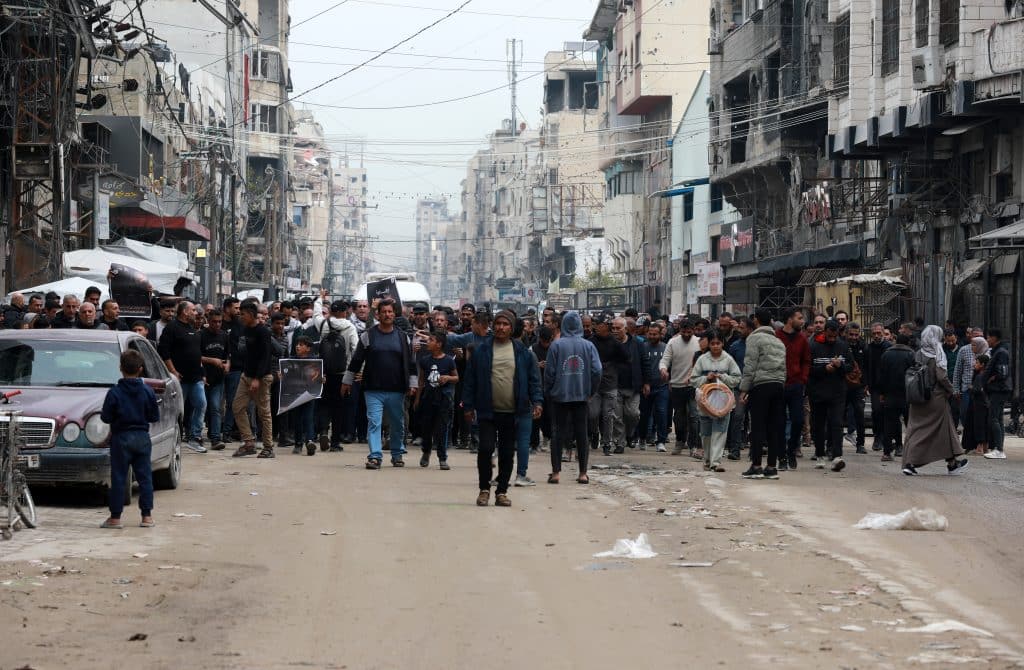
Palestinians protesting the Knesset’s passing of the death penalty law exclusively for Palestinians, Gaza City on April 1, 2026. (Photo: Hashem Zimmo/APA Images)
The picture of Israeli National Security Minister Itamar Ben-Gvir jubilantly trying to open a champagne bottle on the Knesset floor over the passing of a death penalty law for Palestinians will be anchored in history as one of those photographs that needs no caption.
It’s the image of a country that has never truly left the colonial moment into which it was born. It didn’t simply inherit British practices, but kept them alive for over 70 years. It now reaches back to retrieve one of the darkest of these practices.
Israel’s new death penalty law, which exclusively targets Palestinians, did not come out of nowhere. It was passed down from a scaffold the British had already built on the same land, testing it on the same people under the same sky. In his study of Britain’s “pacification” of Palestine, Matthew Hughes, a military historian at Brunel University, shows how the military courts established by the British Mandate in November 1937 were built for speed above all else — a terror performed so quickly that no one had time to appeal or look away. Shaykh Farhan al-Sa’di, an elderly Qassamite revolutionary leader and one of the principal field commanders of the 1936 uprising, was captured on a Monday, tried on a Wednesday, and hanged on a Saturday. It’s the same law Israel reintroduced today.
What those courts also reveal is that British execution policy was, from the beginning, applied differently depending on who stood before the judge. Palestinians were hanged for carrying four bullets; Jews received prison sentences for firing weapons. The courts were equal on paper and unequal in practice, and everyone living under them knew it.
Bahjat Abu Gharbiyya, a Palestinian nationalist and resistance fighter who lived through the British Mandate and left some of the most detailed firsthand accounts of that period, documented this disparity plainly: in his account, the capital sentence fell on Arabs, while Jews charged with the same or graver offenses walked away with prison sentences. The rope, in practice, was for Arabs only.
The new Israeli law carries this same racism forward, entering a prison system where Palestinians make up the vast majority of political prisoners, and where the definition of who is dangerous has been stretched until it fits almost anyone who refuses to disappear quietly. The rope, as it always has been in Palestine, is for Arabs only.
There is something else that legalizing execution does, something beneath the law’s stated purpose that may be its more consequential effect. Hughes shows that in Mandate Palestine, official policy and unofficial violence never operated separately. As British courts hanged men with increasing speed and confidence, the threshold for what soldiers felt permitted to do in the field quietly fell. At Miska, a Palestinian village in the coastal area, British police tortured four captured Palestinian rebels in May 1938, killing them once interrogation was complete — not in a courtroom, but in the open.
Law and lawlessness were not opposites in that system: they fed each other. The widened application of capital punishment in the courts gave license to soldiers in the field. What we are watching in Gaza, Lebanon, and the West Bank today follows the same pattern, pushing the boundaries of permissible conduct.
For years, Israeli forces already operated under rules that permitted the shooting and killing of unarmed persons, so long as they could nominally be deemed a threat. But Israel’s current war has expanded this category to the point that nearly everyone can now be made into a target.
A codification of existing practice
In this sense, Israel is not doing something new with this law. It is catching up with itself. The execution law is largely a shield designed to protect soldiers from even the limited threat of accountability, and to formalize what the field has already made routine. According to Israeli rights group Yesh Din, of the 1,260 complaints filed against soldiers for harming Palestinians between 2017 and 2021, soldiers were prosecuted in less than 1% of cases — 0.87%, to be precise. The law does not create impunity, but guarantees it. Once enshrined, it pushes the violence further, each legal expansion making extrajudicial killing easier to justify, and each unjustified killing creating pressure for new legal cover. They drive each other.
For decades, Israel maintained a public performance of conscience. The language of democracy, the announcements of investigations, the carefully worded regret after each killing — none of this changed what was happening, but it served a purpose: it kept Western governments comfortable enough to provide diplomatic and military cover, and gave Israeli liberal society a way to say: this is not who we are, this is an exception, this will be looked into. The champagne bottle ends that performance — not because Ben Gvir has changed what Israel does, but because he has decided it no longer needs to be explained or excused.
What Israel does and what Israel is willing to admit to doing are now the same thing. And when a political project stops apologizing for itself, it rarely goes back. The frankness becomes normal, the normal becomes policy, and the policy becomes law — until what was once unsayable is written into statute, and what was written into statute becomes the last thing a family sees through a car window on the way home, or what two wanted Palestinian men see before being executed while surrendering to Israeli soldiers. That is what happened in Tammoun and Jenin in recent months.
Refusing Israel’s timetable for death
Execution is scheduled death — the state’s claim that it alone decides when a life ends, that the moment of dying belongs to power and not to the one who dies. The British knew this when they hanged al-Sa’di on a Saturday, moving fast enough that no appeal, no intercession, and no calendar could intervene. Israel knows it now, writing the hour of execution into law so the decision becomes permanent.
And the logic of this law is the same logic driving Israel’s war, both depending on controlling the sequence and deciding not only who is targeted, but when, in what order, and on whose terms. Israel’s war has moved through its fronts one at a time: Gaza decimated, Lebanon engaged and paused, Iran struck twice, and later the West Bank. Each front is kept separate from the others, each managed in its own contained interval so that no single front becomes the moment that breaks the timetable. The war machine, like the military court, works best when it holds to the schedule.
But Ibrahim Tuqan, Palestine’s foremost poet of the Mandate era and the man who turned the gallows into the defining image of Palestinian resistance, wrote the oldest answer to this belief in his poem, “The Red Tuesday.” It has aged well.
The poem recounted the death of three Palestinian revolutionaries who had participated in a precursor event to the 1936 uprising, hanged by the British on Tuesday, June 17, 1930. Fouad Hijazi, Muhammad Jamjoum, and Atta al-Zir were set to be executed in three consecutive hours in Acre prison, each execution timed so that each death arrived alone, and that each grief was absorbed before the next. And this is exactly what Israel’s war planners are doing today: sequencing death, containing resistance, and managing the intervals.
Tuqan’s poem is structured around this very fact. Rather than narrating the executions from the outside, he gives each of the three hours its own voice — the first hour speaks, then the second, then the third, each one personifying the martyr whose death it contains. The hour is not a passive unit of time in the poem; it is a claimant. By doing this, Tuqan takes the executioner’s instrument — the scheduled interval, the managed sequence — and hands it back to the men who died inside it. Each hour becomes the martyr’s own declaration rather than the state’s mechanism of elimination.
But what the empire had not written into its schedule was what the condemned men did next. They began to fight each other for the right to die before their comrades, collapsing three managed hours into a single racing will to be the first martyr. Tuqan captures this by giving the second hour its own voice, letting it speak its impatience directly:
زاحمتُ مَنْ قَبْلي لأَسبِقَها إلى شَرَفِ الخلودِ
I jostled the one standing in front of me to reach the honor of immortality first
What resistance across this region is attempting to do, unevenly and at enormous cost, is exactly this: to refuse the sequencing, to sync its fronts, and to make the hours run together faster than the war machine can pull them apart. It is a fight for time as much as for land — a struggle to take the clock from the hand that has held it for a century and insists, with champagne and statute and strikes from the air, that the hour of every reckoning belongs to it alone.
It is, in Tuqan’s image, the attempt to jostle — to refuse the order the scaffold imposes, to race toward the hour rather than wait for it to arrive, in the hope that when enough hands reach for it at once, the schedule itself breaks down.
*..........*..........*..........*..........*..........*..........*..........*
*..........*..........*..........*..........*..........*..........*..........*
11) Jobs and Workers Are in Balance. Nobody Is Happy About It.
Lower immigration has brought labor supply in line with shaky demand, but economists worry that such a slow-moving job market is at risk of toppling over.
By Lydia DePillis, April 3, 2026

Cesar Zapata, who owns four restaurants in Miami, said that when news of immigrant arrests across the city spread, staff departures quickly increased.
In a healthy labor market, enough jobs are being created to soak up all the new people looking for work. But what if those numbers are essentially zilch?
That’s the conundrum facing Federal Reserve officials, as they eye employment reports that have registered in the red for five of the last 12 months. The economy has added 156,000 jobs over the past year, the slowest pace since the Covid-19 pandemic and, before that, the aftermath of the financial crisis. The rate of hiring has fallen to lows from April 2020 and early 2010.
And yet, in contrast to those economic cataclysms, the jobless are not lining up at unemployment offices. Because of President Trump’s hard turn toward deportations and clampdown on legal immigration channels, there just aren’t that many new job seekers.
“You’ve got a sort of a zero employment growth equilibrium,” said Jerome H. Powell, the Fed’s chair, at the central bank’s meeting last month. “Now that’s balance, OK, but I would say it does have a feel of downside risk, and it’s not kind of a really comfortable balance.”
The unease reflects the unfamiliar nature of a no-growth U.S. job market. The labor force has slowed down before, including during the Great Recession, when many immigrants who had come for construction jobs during the housing boom left after those opportunities evaporated. Their departures served as something of a safety valve, preventing unemployment from rising even higher.
But labor force growth has never come to such a standstill outside that kind of downturn. And it is accelerating the reality that now faces many developed countries: As birthrates dip, the working-age population flatlines and may shrink, unless foreigners come in to refresh it. The United States was supposed to reach that point a few decades hence. Now, it’s already here.
“There is so much angst about the state of the economy right now, and that’s because it’s so different from what we’ve seen in recent decades,” said Luke Pardue, policy director at the Aspen Institute’s Economic Strategy Group. “What we’re seeing right now is a strong hint of what we will see in the future given the current and projected demographic trends.”
The new equilibrium creates some challenges. Surmounting them — if the federal government remains committed to keeping foreigners out — would require some very focused effort.
Harder Questions
As long as a country has basic preconditions for prosperity, like a functional government and universal education system, moderate population growth is a tailwind for living standards. More people mean more customers for goods and services, more available workers to execute on good ideas and more opportunities to move around and grow.
Think about the economy as a company. If it’s growing, employees have an easier time moving to different roles as they learn and try new things, since the firm is able to backfill what they were doing before. When the business stays the same size, it’s harder to maintain that trajectory, and workers may not fulfill their potential.
It’s possible to maintain a certain amount of churn and dynamism without adding workers; it’s just more difficult. One person moving out of a position to take another job leaves a vacancy that may be tough to fill.
“For these big developed economies that have relatively stagnant populations, it makes all these trade-offs way more tangible,” said Dietrich Vollrath, a professor of economics at the University of Houston. “You very much have to make choices that some places are going to shrink and do worse, and some places are going to do better. The growing, expanding population allows you to skip past the hard questions.”
At the same time, the composition of the labor force is changing, adding more people in their 50s and 60s while fewer 20-somethings are getting started. Although age brings some benefits, such as knowledge and experience, older people tend to be less likely to take the kinds of risks that create new ideas and businesses. They also are less well equipped for physical jobs, like nursing and construction.
Also, as workers retire, that labor force has to support a larger nonworking population. That creates two problems.
One, Social Security is designed around adding taxpayers faster than they age out of the system. The equation has also long depended on immigrants, who typically contribute payroll taxes and rarely get benefits in return. Slowing immigration has already moved up the date by which Social Security will become insolvent, which would force benefit cuts, tax increases or both.
And two, older people consume far more health care, which is inherently labor intensive. The sector is already essentially the only source of employment growth, and probably could be growing faster if there were enough qualified workers. With a constrained labor force, satisfying health care demand means that some other part of the economy will need to make do with less.
Finally, for both businesses and policymakers, there is something psychologically unnerving to the number zero. When the economy isn’t creating more jobs, employers may worry that people will have less disposable income, and start to shrink their own payrolls in anticipation.
“Does Walmart say, ‘We have less demand in our stores — let’s extrapolate that out and assume we’re going to have less demand in 2026 than in 2025, and we’re going to build less, hire less, expand less’?” said Wendy Edelberg, a former chief economist at the Congressional Budget Office. “All of that can create its own momentum for a downturn.”
Wealth Without Growth?
A flatlining population is by no means an economic death sentence. Plenty of countries are already dealing with it.
The prototypical example is Japan, where even though the population has been sinking since 2008, the labor force has been rebounding after a concerted effort to help women stay employed with more robust child care and parental leave. Older people are working longer as well. When humans aren’t available, robots fill many menial positions, like making coffee and stocking shelves.
Another policy lever that can help places with low or negative population growth is helping people retrain and find new positions quickly if they lose a job. The United States spends far less as a share of its economic output on these “active labor market policies” than other wealthy nations, and might benefit from trying a bit harder to keep people in productive employment. Continuous education also helps make workers as productive as they can be, compensating for losses in manpower.
Perhaps the best way to maintain a healthy economy, even as work force growth slows, is to make sure prosperity is widely shared, with high minimum wages and adequate health care. If people on the low end of the income spectrum are able to go to the movies and remodel their homes, money keeps circulating and creating the demand for new goods and services. Other countries with stable or shrinking populations, including Japan as well as Scandinavian nations, have much lower rates of inequality than in the United States.
“Distribution can be an element that drives growth, because it spreads out and creates a larger market,” Mr. Vollrath of the University of Houston said. People starting businesses want to know if there are enough customers with the wherewithal to buy what they’re selling. “We all benefit from that,” he said. “A more equitable distribution can create some scale for us that didn’t exist before.”
But the easiest policy fix is one that America is currently rejecting: Allow more immigration.
It’s not just the size and the age structure of the work force that matter. New arrivals have historically been willing to take jobs that native-born workers haven’t wanted because — with the benefits of language and cultural fluency — they have better options. In that way, immigrants are like complementary ingredients in a recipe: If you don’t have enough sugar, you can’t make as many pies as you’d like, so you use less flour.
Natural experiments have buttressed this conclusion. In 2021 and 2022, U.S. companies that missed out on getting visas for seasonal workers saw reduced revenues and employed fewer native-born workers. And in South Korea, when a migrant worker program was suspended during the pandemic, companies went out of business and wages for Korean workers fell.
“It’s not like you take away the migrant worker and you can replace them with a native worker,” said Charles Kenny, a senior fellow at the Center for Global Development who has argued that wealthy countries should welcome more migrants. “Really what happens is the business closes down.”
This recipe math is accentuated by the potential dislocation of artificial intelligence, which appears very likely to destroy desk jobs for which there is no shortage of native-born workers. The occupations that have depended the most on immigrants, like home health care and landscaping, will scarcely be affected.
That’s why some countries without a long tradition of integrating people from many other places have stepped up their efforts to recruit immigrants, if not as full citizens, at least to supplement their labor forces. That includes Japan as well as Italy, where even as the conservative premier, Giorgia Meloni, battles unauthorized migrants on land and on sea, she has quietly opened the door to 500,000 foreigners to work on farms, as caretakers for older people and in other essential settings.
“You have to balance the social and political implications against the economic need,” said Lant Pritchett, a professor at the London School of Economics who has studied ways to make migration more palatable in destination countries. “Even a right-wing government who came to power on the premise that it was anti-immigrant realized that you can’t be anti-worker.”
*..........*..........*..........*..........*..........*..........*..........*
*..........*..........*..........*..........*..........*..........*..........*
12) Economists Once Dismissed the A.I. Job Threat, but Not Anymore
Artificial intelligence hasn’t disrupted the labor market, economists say, but they are increasingly convinced that it will — and that policymakers are unprepared.
By Ben Casselman, April 3, 2026

“I was hoping that at this stage, I would have something lined up,” said Erin Torres, who has been searching for a job for months. Marisa Chafetz for The New York Times
Among tech evangelists in Silicon Valley, it has become conventional wisdom that artificial intelligence will rapidly reshape the labor market, for better or worse. Economists, however, have often discussed A.I.’s impact with a skepticism bordering on dismissiveness.
Rising unemployment among young college graduates? The result of high interest rates and macroeconomic uncertainty. Dire predictions of widespread job losses? A failure to understand the lessons of past technological revolutions. Even the layoffs that companies themselves blamed on artificial intelligence were often chalked up to “A.I.-washing” from executives looking for something to blame other than their own mismanagement.
Recently, however, the message from economists has undergone a subtle change. Most still do not see much evidence that A.I. is disrupting the job market. But they are starting to take seriously the possibility that it could someday soon. If it does, they are worried that policymakers are not ready to respond.
“I don’t think A.I. has hit the labor market yet, and I don’t think it’s radically changed corporate productivity yet, either, but I think it’s coming,” said Daniel Rock, a University of Pennsylvania economist who has studied the economic impact of artificial intelligence.
In a working paper published this week, a team of researchers surveyed economists about their outlook over the next five and 25 years. Most expect the economy to grow a bit more quickly as A.I. improves, but not to diverge substantially from historical patterns. If the technology improves rapidly — a possibility they consider unlikely but plausible — they envision a far more drastic scenario with faster growth but also greater inequality and the disappearance of millions of jobs.
“Economists are certainly taking A.I. seriously,” said Ezra Karger, an economist at the Federal Reserve Bank of Chicago who was one of the study’s authors.
Economists’ expectations for the future looked relatively similar to those of A.I. industry insiders, who were also surveyed for the study. Both groups agree the future is uncertain: A.I. could either wipe out whole categories of jobs or cause few job losses. Its effects could be concentrated among entry-level white-collar workers or spread to more experienced workers and those in blue-collar jobs. The changes could upend the economy within years or take decades to play out.
Given the potential scale of the disruption, economists say it is time to start considering the policies that could help workers displaced or otherwise harmed by the changing economy — something that societies often failed to accomplish in past technological transitions.
“There’s enough conversation around this that we certainly should, as a country, be talking about what sorts of policies make sense in a world where the way employment and careers work now changes a lot in the next two to five years,” said Robert Seamans, an economist at New York University.
A Paradigm Shift
When OpenAI released ChatGPT to the public in November 2022, Alex Imas, an economist at the University of Chicago, did not necessarily see it as an economic game changer, he said. The technology was powerful but limited, prone to mistakes and incapable of producing work with the quality and consistency necessary for most professional applications.
“I knew it was important, but I was definitely on the more skeptical side when it first came out,” Mr. Imas recalled.
For Mr. Imas, the real shift came in late 2024, when OpenAI released a model capable of “reasoning,” meaning it could work through a question step by step before producing an answer. That ability greatly expanded the type of problems the model could tackle, and made it more reliable at solving them.
“It was just a paradigm shift for me,” Mr. Imas said. “And then I started thinking, ‘This is potentially an industrial revolution-scale event, if not more.’”
For other economists, the shift came just in the past few months, with the release of Claude Code — a tool from the A.I. company Anthropic that writes computer code from users’ prompts — and the widespread rollout of A.I. “agents,” autonomous systems capable of performing tasks directly.
Molly Kinder, a senior fellow at the Brookings Institution who studies A.I., said that as she experimented with the new tools, she had a realization: She no longer needed anyone to do the kind of basic research that she ordinarily hired college students and recent graduates to perform — and that she had performed herself early in her career.
“I really don’t know anything a college student can bring to my team that Claude can’t do,” she said. More senior jobs — ones that require interacting with clients and investors, or making strategic decisions — may be safe for now, she said. But “if you can do your job locked in a closet with a computer, ultimately you’re going to be in trouble.”
Everywhere but the Statistics
Technological advancement alone will not reshape the economy. For that to happen, companies need to adopt the tools and figure out how to use them productively.
History shows that the process almost always takes longer than the inventors expect. Legal and regulatory hurdles slow things down. Companies have to retrain workers or hire new ones. Corporate leaders have to develop new processes and overcome resistance from reluctant managers and cautious information technology departments.
“These conversations have been, in my opinion, overly focused on what the technology can do,” said Martha Gimbel, the executive director of the Budget Lab at Yale University. “There’s plenty of technology that could have changed things and didn’t.”
Many hospitals kept patients’ health records on paper for decades after the technology existed to digitize them, Ms. Gimbel noted. Videoconferencing tools have existed for years, but it took a pandemic to force companies to embrace them.
There are signs that A.I. could flow through the economy more quickly than past innovations. Already, nearly one in five companies reports having used A.I. in the last two weeks, according to data from the Census Bureau, and in some industries the rate is twice as high. Workers report using A.I. at even higher rates, suggesting many may be experimenting with the tools on their own initiative.
And while A.I. has not yet had a big impact on aggregate statistics, some economists argue its effects are visible beneath the surface. In a paper published last year, researchers at Stanford University found that employment was declining for entry-level workers in jobs that were highly exposed to A.I.
Technological advancements “sometimes take decades” to appear in the economy in the form of increased productivity, said Erik Brynjolfsson, one of the authors of the Stanford paper. “I don’t think it’s going to be decades this time.”
‘How Painful Is It Going to Be?’
Mr. Brynjolfsson stands out among economists for his confidence in A.I.’s impact. But his forecasts look sober compared with many coming out of Silicon Valley.
Dario Amodei, the head of Anthropic, has warned that A.I. could eliminate 50 percent of entry-level white-collar jobs within years. The tech investor Vinod Khosla predicted last year that A.I. would replace 80 percent of jobs by 2030. Elon Musk has said the technology will render work “optional.”
Many economists dismiss such predictions, arguing that the A.I. debate should focus less on where the economy will wind up in the end and more on the potentially difficult period of transition.
“The pressing question is, ‘You’re going to have a technological shock — how painful is it going to be?’” said Ms. Gimbel of the Yale Budget Lab.
The spread of A.I. does not have to mean large-scale job losses, economists argue. As much as 70 percent of jobs, by some estimates, are in some way exposed to A.I. But that does not necessarily mean those workers are about to be laid off.
In a report published on Friday, researchers at Boston Consulting Group estimated that more than half of the jobs in the United States would be “reshaped” by artificial intelligence over the next two to three years but that far fewer would be replaced entirely. Most workers perform a range of tasks in their jobs, only some of which can be done reliably by A.I. And even where it may be possible to replace a worker, companies are proceeding cautiously because the stakes are higher if humans are no longer signing off on the computer’s work.
“What we’re actually seeing is that full-scale replacement of jobs is much, much slower because the implementation is harder,” said Greg Emerson, the report’s lead author. “Whereas the augmentation and the reshaping of jobs is happening much, much faster.” Still, A.I. will almost certainly cause job losses in specific industries as companies adapt. How painful that transition turns out to be, economists say, depends on two factors: speed and breadth.
If the A.I. revolution plays out gradually, it will give workers time to adapt. Older workers can finish out careers, while younger ones can learn relevant skills or change careers entirely. If A.I.’s impact is limited to certain sectors, that will make it easier for workers to find opportunities in other parts of the economy.
But a broad, rapid change will give workers little time to adapt, and few places to hide.
“If speed is slow, then you have time for employment to adjust, for new roles to be created,” said Mr. Imas, the University of Chicago economist. “There’s disruption, but not something we haven’t seen before. But if it’s fast, you can get really wacky things start happening.”
How to Prepare
However A.I. affects the labor market, economists say policymakers should act now to modernize programs that could help displaced workers.
The unemployment insurance system, for example, excludes many of the new graduates who are likely to be hit first by A.I. Retraining programs are often slow-moving and poorly funded.
But some economists worry that such tools are not up to the challenge.
“In the past, our social safety net was designed to help people over transitory shocks,” said Anton Korinek, an economist at the University of Virginia. “This one might actually be a more permanent shock.”
Mr. Korinek was an early convert to the idea that A.I. could prove to be a uniquely transformative technology. He remains an outlier among his peers in his willingness to consider more extreme scenarios, such as the possibility that A.I. becomes better than humans at every task.
Many economists shy away from such discussions, Mr. Korinek said, an impulse he called “emotionally understandable but practically a really bad idea.”
“As economists, part of our job is to worry about what are the biggest risks,” he said. “What could cause disruptions, and how should we prepare for those disruptions?”
Mr. Korinek will continue to make those arguments, but not from an academic perch. At the end of the semester, he will take a leave from the University of Virginia to join Anthropic.
*..........*..........*..........*..........*..........*..........*..........*
*..........*..........*..........*..........*..........*..........*..........*
13) Trump’s defense spending request would be offset in part by steep cuts to domestic programs
By Tony Romm, Reporting from Washington, April 3, 2026
https://www.nytimes.com/live/2026/04/03/us/trump-news#section-859387654

With the United States at war with Iran and embroiled in conflicts around the world, the White House said on Friday that it would ask Congress to approve about $1.5 trillion for defense in the 2027 fiscal year. If enacted, that amount would set military spending at its highest level in modern history.
The request, which arrived on Friday as part of President Trump’s new budget, would amount to a roughly 40 percent bump from what the United States spent on the Pentagon this fiscal year. The administration said it would couple the proposed increase with a call for $73 billion in cuts across domestic agencies, including the elimination of some climate, housing and education programs.
By Friday morning, the White House had released only a summary of its budget request, which covers the period beginning Oct. 1, with fuller details expected later. Together, the ideas sum to a fiscal blueprint that could add trillions of dollars to the brimming federal debt over the next decade, if lawmakers translate the president’s full vision into law without other changes to federal spending.
Mr. Trump urged Congress to approve most of the new defense money, more than $1.1 trillion, as part of its work to fund the government, and to enact the remaining $350 billion using the same legislative tactic that allowed Republicans to clinch their tax cuts last year. He also asked lawmakers to increase federal funding to aid with border enforcement and mass deportations.
In the days before releasing the initial details of his plan, the president and his aides framed the proposed increase for defense in urgent terms, citing a need to restock munitions and other supplies as the war with Iran continues. At one point, Mr. Trump indicated at a private lunch that military spending needed to be a national priority, even at the expense of federal safety-net programs and other government aid, though his budget is not expected to address Medicare and Medicaid.
“It’s not possible for us to take care of day care, Medicaid, Medicare, all of these individual things,” he said. “They can do it on a state basis.” He added that the focus had to be “military protection.”
But Democrats and Republicans have expressed a shared unease recently about raising military spending to the extent that Mr. Trump has suggested, fretting that the administration had failed to keep them updated about the status of the Iran war, which is now in its fifth week.
Nor have lawmakers always responded favorably to some of the president’s proposed cuts for agencies and programs that serve American families and businesses. Only months ago, Democrats and Republicans approved spending packages for the current fiscal year that rejected most of the reductions that Mr. Trump had endorsed as part of his 2026 submission.
For the next fiscal year, the White House appeared to back off from some of those most sweeping changes. But it still asked Congress to slash domestic spending by about 10 percent, targeting a wide array of once core government services, some of which have historically had bipartisan support.
Some of the proposed cuts would target programs that serve minority groups and their communities, under the presumption that the spending — meant to expand access to lending, bolster minority-owned businesses and combat housing discrimination — is “woke,” “weaponized” or facilitates “cultural Marxism.”
The Trump administration also proposed to slash some funding for teacher training on the grounds that the money helped to “indoctrinate” them. And the White House asked Congress to cancel about $15 billion in clean energy and other green funds adopted as part of the 2021 infrastructure law, including money for renewable energy and electric vehicle chargers.
The administration signaled it would reserve its most significant increases for law enforcement, including more than $40 billion for the Justice Department, a 13 percent increase.
Nevertheless, the president’s blueprint does not carry the force of law; only lawmakers have the authority under the Constitution to set the nation’s spending levels. But Mr. Trump has at times upset that balance by claiming that he possesses vast powers to control the nation’s purse strings and carry out his budgetary vision, even without the express approval of Congress.
Over the first year of his second term, the president closed agencies and programs he disliked; dismissed thousands of federal workers across the bureaucracy; and halted billions in congressionally enacted funds for health, education, foreign aid, public broadcasting and more. The actions frequently drew widespread political rebukes and hundreds of legal challenges, many of which have not resolved in the president’s favor.
The roughly $1.5 trillion sought for the Pentagon would amount to about 4.5 percent of the nation’s gross domestic product, a measure of its economic output, according to Jessica Riedl, a budget and tax fellow at the Brookings Institution. By that measure, it would be the largest year-over-year increase for defense since the Korean War, her analysis showed, after adjusting for inflation.
The request comes less than a year after Mr. Trump secured about $150 billion in extra funding for the Pentagon as part of Republicans’ sweeping tax cut package. The government has raced to disburse those funds in recent months while pursuing additional money to help fund the war with Iran.
Marc Goldwein, a senior vice president at the Committee for a Responsible Federal Budget, which advocates deficit reduction, said the president’s increases could exacerbate the federal debt, now at nearly $39 trillion.
Without other substantial changes to federal spending and tax revenue, another half trillion in new military spending could total about $5 trillion to $6 trillion to that imbalance over the next decade, according to his analysis before the budget was released, after accounting for interest on what the government already owes.
*..........*..........*..........*..........*..........*..........*..........*
*..........*..........*..........*..........*..........*..........*..........*
*..........*..........*..........*..........*..........*..........*..........*
*..........*..........*..........*..........*..........*..........*..........*
*..........*..........*..........*..........*..........*..........*..........*
*..........*..........*..........*..........*..........*..........*..........*
*..........*..........*..........*..........*..........*..........*..........*
*..........*..........*..........*..........*..........*..........*..........*
*..........*..........*..........*..........*..........*..........*..........*
*..........*..........*..........*..........*..........*..........*..........*
*..........*..........*..........*..........*..........*..........*..........*
*..........*..........*..........*..........*..........*..........*..........*
*..........*..........*..........*..........*..........*..........*..........*
*..........*..........*..........*..........*..........*..........*..........*
*..........*..........*..........*..........*..........*..........*..........*
*..........*..........*..........*..........*..........*..........*..........*
*..........*..........*..........*..........*..........*..........*..........*
*..........*..........*..........*..........*..........*..........*..........*
*..........*..........*..........*..........*..........*..........*..........*
*..........*..........*..........*..........*..........*..........*..........*
*..........*..........*..........*..........*..........*..........*..........*
*..........*..........*..........*..........*..........*..........*..........*
*..........*..........*..........*..........*..........*..........*..........*
*..........*..........*..........*..........*..........*..........*..........*
*..........*..........*..........*..........*..........*..........*..........*
*..........*..........*..........*..........*..........*..........*..........*
*..........*..........*..........*..........*..........*..........*..........*
*..........*..........*..........*..........*..........*..........*..........*
*..........*..........*..........*..........*..........*..........*..........*
*..........*..........*..........*..........*..........*..........*..........*
