
The Trump administration is escalating its attack on Cuba, cutting off the island’s access to oil in a deliberate attempt to induce famine and mass suffering. This is collective punishment, plain and simple.
In response, we’re releasing a public Call to Conscience, already signed by influential public figures, elected officials, artists, and organizations—including 22 members of the New York City Council, Kal Penn, Mark Ruffalo, Susan Sarandon, Alice Walker, 50501, Movement for Black Lives, The People’s Forum, IFCO Pastors for Peace, ANSWER Coalition, and many others—demanding an end to this brutal policy.
The letter is open for everyone to sign. Add your name today. Cutting off energy to an island nation is not policy—it is a tactic of starvation.
*..........*..........*..........*..........*..........*..........*..........*

Petition to Force Amazon to Cut ICE Contracts!
https://actionnetwork.org/letters/tell-amazon-end-contracts-with-ice/?source=group-amazon-labor-union&referrer=group-amazon-labor-

Amazon Labor Union
Over 600,000 messages have already been sent directly to Amazon board members demanding one thing: Amazon must stop fueling deportations by ending its contracts with ICE and DHS.
ICE and DHS rely on the data infrastructure provided by Amazon Web Services. Their campaign against immigrants and those who stand with them depends on the logistical, financial, and political support of companies like Amazon.
But workers and communities have real power when we act collectively. That’s why we must expose Amazon’s role in the deportation machine. Help us reach 1 million messages and force Amazon to act by signing our petition with The Labor Force today:
Tell Amazon: End contracts with ICE!
On Cyber Monday 2025, Amazon workers rallied outside of Amazon’s NYC headquarters to demand that Amazon stop fueling mass deportations through Amazon Web Services’ contracts with ICE and DHS.
ICE cannot operate without corporate backing; its campaign against immigrants and those who stand with them depends on the logistical, financial, and political support of companies like Amazon. Mega-corporations may appear untouchable, but they are not. Anti-authoritarian movements have long understood that repression is sustained by a network of institutional enablers and when those enablers are disrupted, state violence weakens. Workers and communities have real power when they act collectively. That is why we must expose Amazon’s role in the deportation machine.
The Department of Homeland Security (DHS) and Immigration and Customs Enforcement (ICE) rely on Amazon Web Services (AWS) as its most commonly used cloud platform. DHS and ICE cannot wage their attack on immigrants without the critical data infrastructure that Amazon Web Services provide, allowing the agencies to collect, analyze, and store the massive amounts of data they need to do their dirty work. Without the power of AWS, ICE would not be able to track and target people at its current scale.
ICE and DHS use Amazon Web Services to collect and store massive amounts of purchased data on immigrants and their friends and family–everything from biometric data, DMV data, cellphone records, and more. And through its contracts with Palantir, DHS is able to scour regional, local, state, and federal databases and analyze and store this data on AWS. All of this information is ultimately used to target immigrants and other members of our communities.
No corporation should profit from oppression and abuse. Yet Amazon is raking in tens of millions of dollars to fuel DHS and ICE, while grossly exploiting its own workers. Can you sign our petition today, demanding that Amazon stop fueling deportations by ending its contracts with DHS and ICE, now?
https://actionnetwork.org/letters/tell-amazon-end-contracts-with-ice/?source=group-amazon-labor-union&referrer=group-amazon-labor-
*..........*..........*..........*..........*..........*..........*..........*

*..........*..........*..........*..........*..........*..........*..........*

*..........*..........*..........*..........*..........*..........*..........*

*..........*..........*..........*..........*..........*..........*..........*

End Texas Torture of Revolutionary Elder Xinachtli
Organization Support Letter
Letter to demand the immediate medical treatment and release of Chicano political prisoner Xinachtli (Alvaro Hernandez #00255735)
To the Texas Department of Criminal Justice,
We, the undersigned organizations, write to urge immediate action to protect the life, health, and human rights of Xinachtli (legal name Alvaro Hernandez). Xinachtli is 73-year-old Chicano community organizer from Texas who has spent 23 years in solitary confinement and 30 years incarcerated as part of a 50-year sentence. His health is now in a critical and life-threatening state and requires prompt and comprehensive medical intervention.
Since his conviction in 1997, Xinachtli has spent decades in conditions that have caused significant physical and psychological harm. As an elder in worsening health, these conditions have effectively become a de facto death sentence.
Xinachtli’s current medical condition is severe. His physical, mental, and overall well-being have declined rapidly in recent weeks. He now requires both a wheelchair and a walker, has experienced multiple falls, and is suffering from rapid weight loss. He is currently housed in the McConnell Unit infirmary, where he is receiving only palliative measures and is being denied a medical diagnosis, access to his medical records, and adequate diagnostic testing or treatment.
A virtual clinical visit with licensed medical doctor Dr. Dona Kim Murphey underscores the severity of his condition. In her report of the visit, she wrote: "Given the history of recent neck/back trauma and recurrent urinary tract infections with numbness, weakness, and bowel and bladder incontinence, I am concerned about nerve root or spinal cord injury and/or abscesses that can lead to permanent sensorimotor dysfunction."
Despite his age and visible disabilities, he remains in solitary confinement under the Security Threat Group designation as a 73-year-old. During his time in the infirmary, prison staff threw away all of his belongings and “lost” his commissary card, leaving him completely without basic necessities. He is experiencing hunger, and the lack of consistent nutrition is worsening his medical condition. McConnell Unit staff have also consistently given him incorrect forms, including forms for medical records and medical visitation, creating further barriers to care and communication.
A family visit on November 29 confirmed the seriousness of his condition. Xinachtli, who was once able to walk on his own, can no longer stand without assistance. He struggled to breathe, has lost more than 30 pounds, relied heavily on his wheelchair, and was in severe pain throughout the visit.
In light of these conditions, we, the undersigned organizations, demand that TDCJ take immediate action to save Xinachtli’s life and comply with its legal and ethical obligations.
We urge the immediate implementation of the following actions:
Immediate re-instatement of his access to commissary to buy hygiene, food, and other critical items. Immediate transfer to the TDCJ hospital in Galveston for a full medical evaluation and treatment, including complete access to his medical records and full transparency regarding all procedures. Transfer to a geriatric and medical unit that is fully accessible under the Americans with Disabilities Act. Xinachtli requests placement at the Richard P LeBlanc Unit in Beaumont, Texas. Approval of Medical Recommended Intensive Supervision, the release program for individuals with serious medical conditions and disabilities, in recognition of the severity and progression of his current health issues. Failure to act will result in the continued and foreseeable deterioration of Xinachtli’s health, amounting to state-sanctioned death. We urge TDCJ to take swift and decisive action to meet these requests and to fulfill its responsibility to safeguard his life and well-being.
We stand united in calling for immediate and decisive action. Xinachtli’s life depends on it.
Signed, Xinachtli Freedom Campaign and supporting organizations
Endorsing Organizations:
Al-Awda Houston; All African People’s Revolutionary Party; Anakbayan Houston; Anti-Imperialist Solidarity; Artists for Black Lives' Equality; Black Alliance for Peace - Solidarity Network; Columbia University Students for a Democratic Society; Community Liberation Programs; Community Powered ATX; Contra Gentrificación; Diaspora Pa’lante Collective; Down South; DSA Emerge; Entre nos kc; Fighting Racism Workshops; Frontera Water Protectors; GC Harm Reductionists; JERICHO MOVEMENT; Jericho Movement Providence; Montrose Anarchist Collective; NYC Jericho Movement; OC Focus; Palestine Solidarity TX; Partisan Defense Committee; Partido Nacional de la Raza Unida; PDX Anti-Repression; Red Star Texas; Root Cause; San Francisco Solidarity Collective; Shine White Support Team; Sunrise Columbia; UC San Diego Faculty for Justice in Palestine; Viva Palestina, EPTX; Water Justice and Technology Studio; Workshops4Gaza.
Sign the endorsement letter for your organization here:
https://cryptpad.fr/form/#/2/form/view/MiR1f+iLiRBJC7gSTyfhyxJoLIDhThxRafPatxdbMWI/
IMPORTANT LINKS TO MATERIALS FOR XINACHTLI FREEDOM CAMPAIGN:
PHONE BLAST: Your community can sign up for a 15-minute-long call shift here: bit.ly/xphoneblast
FUNDRAISER: Here is the link to Jericho's fundraiser for Xinachtli: http://givebutter.com/jerichomovement
CASE HISTORY: Learn more about Xinachtli and his case through our website: https://freealvaro.net
CONTACT INFO:
Follow us on Instagram: @freexinachtlinow
Email us:
xinachtlifreedomcampaign@protonmail.com
COALITION FOLDER:
https://drive.proton.me/urls/SP3KTC1RK4#KARGiPQVYIvR
In the folder you will find: Two pictures of Xinachtli from 2024; The latest updated graphics for the phone blast; The original TRO emergency motion filing; Maria Salazar's declaration; Dr. Murphy's report from her Dec. 9 medical visit; Letter from Amnesty International declaring Xinachtli's situation a human rights violation; Free Xinachtli zine (which gives background on him and his case); and The most recent press release detailing who Xinachtli is as well as his medical situation.
Write to:
Alvaro Hernandez CID #00255735
TDCJ-W.G. McConnell Unit
PO Box 660400
Dallas, TX 75266-0400
*..........*..........*..........*..........*..........*..........*..........*
*..........*..........*..........*..........*..........*..........*..........*

Self-portrait by Kevin Cooper
Funds for Kevin Cooper
Kevin was transferred out of San Quentin and is now at a healthcare facility in Stockton. He has received some long overdue healthcare. The art program is very different from the one at San Quentin but we are hopeful that Kevin can get back to painting soon.
For 41 years, an innocent man has been on death row in California.
Kevin Cooper was wrongfully convicted of the brutal 1983 murders of the Ryen family and houseguest. The case has a long history of police and prosecutorial misconduct, evidence tampering, and numerous constitutional violations including many incidences of the prosecution withholding evidence of innocence from the defense. You can learn more here .
In December 2018 Gov. Brown ordered limited DNA testing and in February 2019, Gov. Newsom ordered additional DNA testing. Meanwhile, Kevin remains on Death Row at San Quentin Prison.
The funds raised will be used to help Kevin purchase art supplies for his paintings . Additionally, being in prison is expensive, and this money would help Kevin pay for stamps, books, paper, toiletries, supplies, supplementary food, printing materials to educate the public about his case and/or video calls.
Please help ease the daily struggle of an innocent man on death row!
An immediate act of solidarity we can all do right now is to write to Kevin and assure him of our continuing support in his fight for justice. Here’s his address:
Kevin Cooper #C65304
Cell 107, Unit E1C
California Health Care Facility, Stockton (CHCF)
P.O. Box 213040
Stockton, CA 95213
www.freekevincooper.org
Call California Governor Newsom:
1-(916) 445-2841
Press 1 for English or 2 for Spanish,
press 6 to speak with a representative and
wait for someone to answer
(Monday-Friday, 9:00 A.M. to 5:00 P.M. PST—12:00 P.M. to 8:00 P.M. EST)
*..........*..........*..........*..........*..........*..........*..........*
*..........*..........*..........*..........*..........*..........*..........*

Dr. Atler Still Needs Our Help!
Please sign the petition today!
https://www.change.org/p/texas-state-university-give-tom-alter-his-job-back
What you can do to support:
—Donate to help Tom Alter and his family with living and legal expenses: https://gofund.me/27c72f26d
—Sign and share this petition demanding Tom Alter be given his job back: https://www.change.org/p/texas-state-university-give-tom-alter-his-job-back
—Write to and call the President and Provost at Texas State University demanding that Tom Alter be given his job back:
President Kelly Damphousse: president@txstate.edu
President’s Office Phone: 512-245-2121
Provost Pranesh Aswath: xrk25@txstate.edu
Provost Office Phone: 512-245-2205
For more information about the reason for the firing of Dr. Tom Alter, read:
"Fired for Advocating Socialism: Professor Tom Alter Speaks Out"
Ashley Smith Interviews Dr. Tom Alter
—CounterPunch, September 24, 2025
*..........*..........*..........*..........*..........*..........*..........*
*..........*..........*..........*..........*..........*..........*..........*
 Russia Confirms Jailing of Antiwar Leader Boris Kagarlitsky In a secret trial on June 5, 2024, the Russian Supreme Court’s Military Chamber confirmed a sentence of five years in a penal colony for left-wing sociologist and online journalist Boris Kagarlitsky. His crime? “Justifying terrorism” — a sham charge used to silence opponents of Putin’s war on Ukraine. The court disregarded a plea for freedom sent by thirty-seven international luminaries. Kagarlitsky, a leading Marxist thinker in Russia’s post-Soviet period, recently addressed socialists who won’t criticize Putin: “To my Western colleagues, who…call for an understanding of Putin and his regime, I would like to ask a very simple question. [Would] you want to live in a country where there is no free press or independent courts? In a country where the police have the right to break into your house without a warrant? …In a country which…broadcasts appeals on TV to destroy Paris, London, Warsaw, with a nuclear strike?” Thousands of antiwar critics have been forced to flee Russia or are behind bars, swept up in Putin’s vicious crackdown on dissidents. Opposition to the war is consistently highest among the poorest workers. Recently, RusNews journalists Roman Ivanov and Maria Ponomarenko were sentenced to seven, and six years respectively, for reporting the military’s brutal assault on Ukraine. A massive global solidarity campaign that garnered support from thousands was launched at Kagarlitsky’s arrest. Now, it has been revived. This internationalism will bolster the repressed Russian left and Ukrainian resistance to Putin’s imperialism. To sign the online petition at freeboris.info —Freedom Socialist Party, August 2024 https://socialism.com/fs-article/russia-jails-prominent-antiwar-leader-boris-kagarlitsky/#:~:text=In%20a%20secret%20trial%20on,of%20Putin's%20war%20on%20Ukraine. Petition in Support of Boris KagarlitskyWe, the undersigned, were deeply shocked to learn that on February 13 the leading Russian socialist intellectual and antiwar activist Dr. Boris Kagarlitsky (65) was sentenced to five years in prison. Dr. Kagarlitsky was arrested on the absurd charge of 'justifying terrorism' in July last year. After a global campaign reflecting his worldwide reputation as a writer and critic of capitalism and imperialism, his trial ended on December 12 with a guilty verdict and a fine of 609,000 roubles. The prosecution then appealed against the fine as 'unjust due to its excessive leniency' and claimed falsely that Dr. Kagarlitsky was unable to pay the fine and had failed to cooperate with the court. In fact, he had paid the fine in full and provided the court with everything it requested. On February 13 a military court of appeal sent him to prison for five years and banned him from running a website for two years after his release. The reversal of the original court decision is a deliberate insult to the many thousands of activists, academics, and artists around the world who respect Dr. Kagarlitsky and took part in the global campaign for his release. The section of Russian law used against Dr. Kagarlitsky effectively prohibits free expression. The decision to replace the fine with imprisonment was made under a completely trumped-up pretext. Undoubtedly, the court's action represents an attempt to silence criticism in the Russian Federation of the government's war in Ukraine, which is turning the country into a prison. The sham trial of Dr. Kagarlitsky is the latest in a wave of brutal repression against the left-wing movements in Russia. Organizations that have consistently criticized imperialism, Western and otherwise, are now under direct attack, many of them banned. Dozens of activists are already serving long terms simply because they disagree with the policies of the Russian government and have the courage to speak up. Many of them are tortured and subjected to life-threatening conditions in Russian penal colonies, deprived of basic medical care. Left-wing politicians are forced to flee Russia, facing criminal charges. International trade unions such as IndustriALL and the International Transport Federation are banned and any contact with them will result in long prison sentences. There is a clear reason for this crackdown on the Russian left. The heavy toll of the war gives rise to growing discontent among the mass of working people. The poor pay for this massacre with their lives and wellbeing, and opposition to war is consistently highest among the poorest. The left has the message and resolve to expose the connection between imperialist war and human suffering. Dr. Kagarlitsky has responded to the court's outrageous decision with calm and dignity: “We just need to live a little longer and survive this dark period for our country,” he said. Russia is nearing a period of radical change and upheaval, and freedom for Dr. Kagarlitsky and other activists is a condition for these changes to take a progressive course. We demand that Boris Kagarlitsky and all other antiwar prisoners be released immediately and unconditionally. We also call on the auth *..........*..........*..........*..........*..........*..........*..........* *..........*..........*..........*..........*..........*..........*..........* |

Mumia Abu-Jamal is Innocent!
FREE HIM NOW!
Write to Mumia at:
Smart Communications/PADOC
Mumia Abu-Jamal #AM-8335
SCI Mahanoy
P.O. Box 33028
St. Petersburg, FL 33733
Join the Fight for Mumia's Life
Since September, Mumia Abu-Jamal's health has been declining at a concerning rate. He has lost weight, is anemic, has high blood pressure and an extreme flair up of his psoriasis, and his hair has fallen out. In April 2021 Mumia underwent open heart surgery. Since then, he has been denied cardiac rehabilitation care including a healthy diet and exercise.

He still needs more complicated treatment from a retinal specialist for his right eye if his eyesight is to be saved:
Donate to Mumia Abu-Jamal's Emergency Legal and Medical
Defense Fund
Mumia has instructed PrisonRadio to set up this fund. Gifts donated here are designated for the Mumia Abu-Jamal Medical and Legal Defense Fund. If you are writing a check or making a donation in another way, note this in the memo line.
Send to:
Mumia Medical and Legal Fund c/o Prison Radio
P.O. Box 411074, San Francisco, CA 94103
*..........*..........*..........*..........*..........*..........*..........*
*..........*..........*..........*..........*..........*..........*..........*
Resources for Resisting Federal Repression
https://www.nlg.org/federalrepressionresources/
Since June of 2020, activists have been subjected to an increasingly aggressive crackdown on protests by federal law enforcement. The federal response to the movement for Black Lives has included federal criminal charges for activists, door knocks by federal law enforcement agents, and increased use of federal troops to violently police protests.
The NLG National Office is releasing this resource page for activists who are resisting federal repression. It includes a link to our emergency hotline numbers, as well as our library of Know-Your-Rights materials, our recent federal repression webinar, and a list of some of our recommended resources for activists. We will continue to update this page.
Please visit the NLG Mass Defense Program page for general protest-related legal support hotlines run by NLG chapters.
Emergency Hotlines
If you are contacted by federal law enforcement, you should exercise all of your rights. It is always advisable to speak to an attorney before responding to federal authorities.
State and Local Hotlines
If you have been contacted by the FBI or other federal law enforcement, in one of the following areas, you may be able to get help or information from one of these local NLG hotlines for:
Portland, Oregon: (833) 680-1312
San Francisco, California: (415) 285-1041 or fbi_hotline@nlgsf.org
Seattle, Washington: (206) 658-7963
National Hotline
If you are located in an area with no hotline, you can call the following number:
National NLG Federal Defense Hotline: (212) 679-2811
*..........*..........*..........*..........*..........*..........*..........*
*..........*..........*..........*..........*..........*..........*..........*
Articles
*..........*..........*..........*..........*..........*..........*..........*
*..........*..........*..........*..........*..........*..........*..........*
1) ‘I Just Want to Get Out of Here’: ICE Is Detaining Hundreds of Children
The number of children in immigration detention has spiked since last year. Families describe poor conditions and little education.
By Miriam Jordan, Sarah Mervosh and Allison McCann, Feb. 13, 2026

As of mid-January, about 1,400 people were detained at the Dilley Immigration Processing Center in Texas, including Edison, a 13-year-old from Chicago. Jamie Kelter Davis for The New York Times
A 7-year-old in Oregon was seeking treatment for a nosebleed last month when immigration agents detained her and her parents outside a hospital emergency room. They were taken to a federal detention center in Texas for three weeks.
In Chicago, a 5-year-old was at a laundromat with her mother last fall when they were surrounded by agents and flown to Texas.
And a teenager who had been living in the United States for a decade was getting ready for school one morning last year when the police showed up at his family’s door. He, too, ended up confined in Texas with his mother, even though she had begged for him to be allowed to stay with family members who are American citizens, according to court records.
The number of children in federal custody has climbed sharply since President Trump revived the practice of detaining families last year, as part of his promise to deport immigrants who are in the country illegally. The most prominent example came last month, when 5-year-old Liam Conejo Ramos, still wearing his Spider-Man backpack, was detained along with his father on their way home from school in suburban Minneapolis.
Under the Trump administration’s mass deportation campaign, hundreds of children have been detained, usually with a parent. Nearly all pass through one place: a sprawling detention center in Dilley, Texas, that is a jumble of trailers and soft-sided tents in a desolate expanse about 70 miles south of San Antonio.
Known as the Dilley Immigration Processing Center — or just Dilley — it has been the main site for family detentions since it was built in 2014 during the Obama administration, which at one point held more than 1,000 children there during a surge of migrants fleeing Central America.
The Biden administration stopped using the facility to detain families in 2021 and closed it in 2024. The Trump administration reopened it last year.
In the past, Dilley was used mainly to hold women and children who had just crossed the border. But now, many of the children sent there had been living in the United States and attending American schools, sometimes for years.
“There are many, many Liams,” said Elora Mukherjee, a professor at Columbia Law School who runs the school’s immigration clinic.
The children who end up at Dilley are generally immigrants themselves, brought to the United States by a parent. It is unclear if any American citizens, such as babies born recently to immigrant parents, have been detained there.
All told, about 3,500 adults and children have passed through Dilley since it reopened, according to lawyers and legal aid organizations that represent families. Some are held for only a few days, others for months. Some are deported, voluntarily or not. Accounts of their stays come from court affidavits written by parents and children, recent interviews with families and reports from lawyers and members of Congress who have spoken with them.
Trump resumes family detention
The Biden administration allowed hundreds of thousands of migrants to enter the country seeking asylum. Trump officials have said that migrants took advantage of a system where asylum cases could take years to be decided.
The Trump administration says that migrant families can avoid confinement by voluntarily leaving the country.
“Being in detention is a choice,” the Department of Homeland Security said in a statement, adding that the administration was offering $2,600 and a free flight to people who leave voluntarily.
Many families have refused that offer. They may have pending cases in immigration court, giving them hope that they might be allowed to stay. Some have built lives in the United States, and some fear returning to their home countries.
Federal officials say parents can choose whether to be detained with their children. However, it’s unknown how many parents have been allowed to leave their children with another adult caregiver.
Many families say immigration agents have given them no choice but to bring their children with them.
Until two months ago, Edison, a 13-year-old Guatemalan boy, was a thriving seventh grader in Chicago. He excelled at math, his favorite subject, played on his school’s soccer team and translated for his immigrant parents.
Today, Edison is being held with his mother in Dilley, where his schooling has been reduced to an hour a day.
His father, Ricardo, who spoke on the condition that he and his family be identified only by their first names, said that he came to the United States first, and that Edison and his mother arrived in 2023 and applied for asylum together.
In December, he said, Edison’s mother complied with instructions to visit an ICE office for their case and was told to bring the boy back with her the next day. The two were taken into custody while Ricardo was waiting outside, a moment that has left him in agony, he said.
He said that his wife was not given the option to leave their child behind.
On average, about 175 children a day were held in ICE detention last year, up from about 25 children a day at the end of the Biden administration, according to data from the Deportation Data Project, which is current as of October. (Under President Biden, families taken into custody after entering the United States were sometimes kept temporarily in hold rooms or other facilities for processing.)
As of mid-January, there were about 1,400 people at Dilley, including about 500 children and 450 parents, according to RAICES, a nonprofit organization that provides legal services to families inside Dilley. (About 450 single women are being held there in a separate part of the facility.)
A promotional video by CoreCivic, a private prison company that runs Dilley, depicts a dormlike setting, with bunk beds, an outdoor playground, a volleyball court, a no-frills library and a pantry with animal crackers and other snacks.
Families describe a different reality: inadequate medical care, lights kept on all night, scant drinking water and little education.
The detention center is surrounded by barbed wire, and most families sleep in rooms shared with other families. Children often lose weight and get sick. Recently, there were two confirmed cases of measles. Some children have become suicidal and had panic attacks, families and lawyers say.
“There is a lot of desperation,” said Javier Hidalgo, a legal director with RAICES, who has visited the facility many times.
Christian Rubi, 16, said in a phone interview from Dilley that he has “a lot of anxiety attacks.”
“I start crying, shaking,” said Christian, who arrived in the United States from Mexico when he was 7 and had been living in San Antonio, where he was detained with his mother during a check-in with ICE. They have been held for more than four months. “I just want to get out of here,” he said. “It’s hell.”
A mother seeking asylum from Colombia who spent two months at Dilley this fall wrote that her daughter, 6, had previously been an engaged first grader in New York City. Art was her favorite subject. But she regressed at Dilley.
“She has started to wet her pants again since coming here,” the mother, Kelly Vargas, wrote in an affidavit in October. “She is also asking at night to drink milk from my breasts. She hasn’t had breast milk in four years.”
The Department of Homeland Security said, “Detainees are provided with three meals a day, clean water, clothing, bedding, showers, soap and toiletries.”
“Children have access to teachers, classrooms and curriculum booklets for math, reading, and spelling,” the agency added. “All of this is generously funded by the U.S. taxpayer.”
The government has struggled for many years with the question of how to handle children who enter the country unlawfully with their parents. Many of the complaints about conditions, including extended stays and the emotional distress of children in detention, stretch back to the Obama administration.
During Mr. Trump’s first term, his administration separated children from their parents at the southern border as a way to deter unauthorized entries. His administration also kept children, including infants, in fetid, overcrowded Border Patrol facilities for weeks. Border crossings are now low, and the Trump administration has not used such tactics during his second term.
But lawyers for families say that under President Trump, federal agencies are breaking the terms of a 1997 settlement agreement, which requires the government to provide basic care and education to undocumented children in their custody. It requires age-appropriate instruction in subjects like science, math and reading in a classroom setting.
The agreement has its origins in a class-action lawsuit filed in 1985 against the government over its treatment of detained migrant children. The Clinton administration agreed to settle the lawsuit, establishing standards for the detention of minors.
Under the settlement, children are supposed to be transferred out of immigrant detention within about 20 days. The Trump administration is fighting in court to end the settlement, arguing that it incentivizes unlawful border crossings and undermines immigration enforcement.
Another issue raised by the Trump administration’s enforcement efforts is what happens to children left behind when their parents are detained. Many remain with family and friends; some have ended up in state custody.
‘Not Really Education At All’
At Dilley, children of different ages and grades are grouped together for one-hour classes, which often consist of basic work sheets or coloring. After several weeks, the lessons are repeated, according to families and lawyers.
“In high school, I was taking chemistry, geometry, history and English,” said Christian, the 16-year-old who had been living in San Antonio. At Dilley, he said, “they don’t teach you anything.”
Christian said that high school students were handed a sheet to color in the American flag and another to search for the 50 states. He has quit attending class.
Sometimes, children are turned away, because the class size is limited to 12 to 15 students.
Aury, a Venezuelan mother who was detained along with her three children, 10, 8 and 7, during a scheduled ICE check-in in San Antonio in December and held at Dilley until late January, said her children became upset when they were not allowed into the classroom. There was little stimulation otherwise.
She said they repeatedly asked her whether they had done something wrong to be confined.
The government had seemed to be making plans to set up an in-person school at Dilley by hiring Stride Inc., a for-profit company that primarily offers virtual education, according to public records and job postings.
But that did not happen.
In a statement, Stride said “we are not providing education services at this facility.” The Department of Homeland Security did not respond to questions about Stride, or who is currently providing education at Dilley.
Leecia Welch, who is chief legal counsel at Children’s Rights and represents detained children in a class-action legal case, said that the offerings at Dilley were “not really education at all.”
As more children have been detained, their American schools often must piece together where they have gone.
In Columbia Heights, Minn., a suburb of Minneapolis, several children were taken to Dilley, including 5-year-old Liam, whose release was ordered by a judge. Two brothers were sent there with their mother and later released. While there, school officials said, the brothers recognized another child in the cafeteria: a fifth-grade girl, who had been missing from their school for weeks.
ICE has sporadically released families, sometimes without explanation. In late January, several dozen families were allowed to go free.
Hundreds remain. Edison, the 13-year-old, has now been at Dilley for 58 days. He has been having recurring episodes during which he feels despondent, his father said. He crawls under a bunk bed and weeps uncontrollably.
“You can make all sorts of improvements to Dilley, but it’s still going to be a prison,” said Ms. Welch, the class-action lawyer, who regularly visits Dilley to assess conditions.
“You can improve education, and they should,” she added, but “it will still be a place with sick, sad children.”
Edgar Sandoval, Pooja Salhotra, Jessica Silver-Greenberg and Katie Thomas contributed reporting. Susan C. Beachy contributed research.
*..........*..........*..........*..........*..........*..........*..........*
*..........*..........*..........*..........*..........*..........*..........*
2) Beyond the Big Cities, ICE Is Rattling Small-Town and Exurban America
Far from the national spotlight, towns like Cornelius, Ore., and Coon Rapids, Minn., are dealing with President Trump’s expanding mass deportation effort, and the effects can be acute.
By Anna Griffin and Chelsia Rose Marcius, Feb. 13, 2026
Anna Griffin reported from Cornelius, Ore., Chelsia Rose Marcius from Coon Rapids, Minn.

In Cornelius, Ore., population 14,763, town leaders declared a state of emergency and asked the governor for money to pay for more police to monitor federal agents. Jordan Gale for The New York Times
President Trump may be ending the surge of immigration agents in the Twin Cities, but his mass deportation effort has already extended well past large, liberal cities like Minneapolis, to small communities where the national spotlight does not exist but the impact can be at least as acute.
In places like Cornelius, Ore., Danbury, Conn., Biddeford, Maine, and Coon Rapids, Minn., where moderation, not partisanship, might predominate, the arrival of Immigration and Customs Enforcement — and the more aggressive tactics ICE officers often use — have been jarring. In small towns, resources may already stretched, and even a single incident can shatter the tranquillity of neighborhoods unaccustomed to turmoil.
ICE is proud of its reach. The agency is using “data-driven intelligence” to deploy its agents, the agency said in an email, declining to identify a spokesman. It added, “ICE operates everywhere — rural, urban, and suburban.”
In Coon Rapids, an exurb about 15 miles from downtown Minneapolis, Bill Carlson recently watched federal agents as they waited across the street for hours to take away a Vietnamese family he called his neighbors.
“There is a fear here,” he said. “I didn’t think anything like this would happen in America, let alone Coon Rapids.”
Last month, ICE “surge teams” from Philadelphia were sent into West Virginia, hitting the towns of Martinsburg, Moorefield, Morgantown, Beckley, Huntington and Charleston. None of those places have more than 50,000 residents and Moorefield has less than 3,000. Federal officials boasted of arresting more than 650 undocumented immigrants.
At a coffee shop in Hillsboro, Ore., deputies and local police in Washington County responded in October to multiple 911 calls that reported 10 armed men wearing masks who approached a car filled with high school students with weapons drawn in a crowded drive-through lane. Only after a tense encounter — and after the armed men got in their van and left — did the local officers understand they’d been in a standoff with federal immigration agents.
“You’ve got people in that parking lot who want us to arrest the ICE agents,” said Sheriff Caprice Massey, adding that she is worried her deputies could wind up in an accidental gunfight with federal officers. “And you’ve got ICE agents who want us to help them or get out of their way.”
Emergency responders have also fielded a rash of 911 calls about abandoned vehicles. “ICE will just take someone and leave their car, windows smashed, in the middle of the road,” Sheriff Massey said.
ICE officials said they are not responsible for the confusion; federal officers “clearly identify themselves as law enforcement while wearing masks” and notify local agencies when making arrests, the ICE email said.
As for the 911 calls, he said those are “a direct result of sanctuary policies, activist smear campaigns, and dangerous political rhetoric that encourages reporting or recording ICE activity.”
Regardless of who is to blame, the effects are acute.
In Cornelius, Ore., population 14,763, town leaders in late November declared a state of emergency and asked Oregon’s governor, Tina Kotek, for money to pay for more police — specifically so they can have officers monitor ICE.
Community activists said Washington County police and prosecutors have told them there’s nothing they can do even when officers are present for immigration enforcement that turns violent.
"We said, ‘But they’re hurting people,’” said Maria Caballero Rubio, executive director of Centro Cultural, a Cornelius nonprofit that supports the Latino community. “People are being thrown to the ground for no reason, and a police officer is just standing by.”
Washington County is Oregon’s second most populous and home to the headquarters of Nike and Intel’s largest domestic manufacturing campus, but that tells only half the story. Away from U.S. Highway 26, the communities become more rural and heavily Latino. The county is about 18 percent Hispanic, higher than the state as a whole. In several small agricultural towns, Hispanics are a majority.
“We’re the town for the farms, the place with the John Deere dealership, the Bobcat store, the U-Haul dealerships,” said Jeffrey Dalin, mayor of Cornelius, where more than half the 15,000 residents identify as Latino.
Coon Rapids, a city of about 64,000 residents, is similarly in the outer orbit of the Twin Cities, two-and-a-half times less dense than Minneapolis.
Last month, the presence of immigration authorities outside of a Mexican restaurant in Coon Rapids alarmed its employees, most of whom have not returned to work, said Dan Carlson, a City Council member who for years has worked closely with immigrant communities. On a recent Friday, as children prepared for school, at least a dozen federal agents roamed the halls of an apartment complex on University Avenue near 92nd Lane North East, according to the property manager, cellphone footage and residents, many of whom are immigrants.
On Jan. 20, about two dozen residents went before Coon Rapids’ mayor, Jerry Koch, and the City Council, worried about immigration agents roaming the streets where their children play.
As they spoke, Mayor Koch grew more and more frustrated.
“We’re not Minneapolis or St Paul; we’re not a sanctuary city; we cooperate,” he said later in an interview.
He also made clear he was frustrated with the reaction of some of his constituents to the growing presence of federal agents.
“I get emails that say, ‘ICE has been spotted three times in town today, here at this house, at this house, that house,’” he said. “It’s like, ‘Oh, come on, get off whatever tracking site you’re on and put the whistles away.’”
There are also questions of shattered trust between immigrant communities and law enforcement, a worry echoed by big-city and small-town mayors across the country.
In Oregon, Sheriff Massey’s office provides police service for Cornelius, and local law enforcement officials said they have worked hard, particularly after George Floyd’s murder in 2020, to build trust with a population that has often felt ignored or outright abused by prosecutors and police.
They have hired Spanish-speaking officers, held forums and town halls, and worked closely with nonprofits and social service agencies that serve immigrant and Latino populations. The Washington County Sheriff’s Office recently began using body-camera technology for real-time translation.
All of that would be for nothing if Hispanic residents stop cooperating out of fear for ICE.
“People who are victims or witnesses of crimes and reluctant to come forward,” said Kevin Barton, the district attorney in Washington County, Ore., seen at top left.Jordan Gale for The New York Times
“Right now we are seeing — not anecdotally, but repeatedly — people who are victims or witnesses of crimes and reluctant to come forward,” said Kevin Barton, Washington County’s district attorney.
That’s bad for everyone, he added.
“If your loved one was a victim of a violent crime and the only witness was undocumented, wouldn’t you want them to call 911?” he asked. “Wouldn’t you want them to come testify in court?”
A town hall late last month hosted by Oregon’s attorney general and several area state legislators turned into an airing of frustration by Latino attendees, many of whom said they were desperate for elected officials to do more to protect them. Latino community leaders said they now have to reassure people that it is safe to call for help if your spouse hits you.
“People are coming to us instead of the police,” said Nansi Lopez, policy director for the advocacy and organizing group Centro Cultural, which is based in Cornelius. “I’m having to tell them, ‘No, really, it’s OK. You can trust them.’”
The sheriff’s office in Washington County has not seen an overall drop in requests for service. But the work of many civil servants has gotten harder. Undercover officers working drug cases have had their cars blocked in parking lots and have been filmed by residents who mistook them for ICE agents.
Mayor Dalin said, “We have teachers walking kids to school because their parents are afraid of getting grabbed off the street.”
The Department of Homeland Security said their enforcement efforts in Washington County had led to the arrests of five men who they say were in the country illegally and had been convicted of violent crimes.
Local leaders still said the immigration surge here has not made their communities safer.
Sheriff Massey said she and other law enforcement leaders have met with regional and national officials from the Department of Homeland Security to ask for what they consider basic changes in how ICE operates — including wearing visible badges identifying themselves as federal officers and notifying local police before making arrests in public places.
“We’ve talked a lot,” she said. “Nothing has changed.”
*..........*..........*..........*..........*..........*..........*..........*
*..........*..........*..........*..........*..........*..........*..........*
3) ‘Worse Than the Pandemic’: Restaurants Say ICE Presence Imperils Business
In several cities where immigrants are being detained, owners say they’re struggling to stay open as fear keeps customers and workers from leaving home.
By Priya Krishna, Feb. 13, 2026

The dining room at Suya Joint, a Nigerian restaurant in Boston, one of many places that say they have lost business since ICE stepped up immigration enforcement. Tony Luong for The New York Times
Even as the Covid pandemic shut down every dining room across the country in April 2020, Americans were still ordering takeout, and millions of restaurant employees were getting paychecks funded by government assistance.
Now, as that same government is rounding up immigrants it believes to be in the country illegally — about 70,000 are currently in detention — Cecelia Lizotte, the owner of two Nigerian restaurants called Suya Joint, in Boston and Providence, R.I., says many of her customers are afraid to come in. She can’t even get people in her neighborhood to pick up free meals.
Several of her employees are nervous about coming to work, though Ms. Lizotte says they are in the country lawfully. Her brother, Paul Dama, a Nigerian immigrant who is the restaurant’s manager and was in the process of applying for asylum, was detained on the way to church by U.S. Immigration and Customs Enforcement in June and held for three months at a detention center in New Hampshire.
He has since been granted asylum and returned to work, but the job has changed drastically. Sales are down more than 20 percent at the restaurant’s Boston location since the raids began, and 50 percent in Providence, Ms Lizotte said. The streets of her Boston neighborhood, Roxbury, which has a sizable foreign-born population, are often deserted.
“I wake up every day thinking, ‘Should I just close and wait to see if everything settles down?’” Ms. Lizotte said.
In interviews over the past few weeks, restaurant owners in several cities where ICE agents are out on the streets echoed that sentiment: Their businesses are not only teetering on insolvency, they said, but feel even more vulnerable than during the pandemic.
Some of that plight is the result of other forces that have hit restaurants hard, like rising ingredient prices, the growing cost of food delivery and this winter’s brutal weather. None of these businesses have been raided by ICE agents, who need a judicial warrant to enter private areas of a business, like a kitchen or office.
But most of the owners said that ICE has become a constant and alarming presence in their neighborhoods. The fear of detention among customers and employees — in an industry in which more than one-fifth of the work force nationwide was born abroad — has taken a toll.
That fallout is felt especially in immigrant neighborhoods that have been targeted for ICE enforcement. In the Little Village area of Chicago, known as the “Mexico of the Midwest,” a spokeswoman for the neighborhood Chamber of Commerce estimated that local business sales have fallen 50 to 70 percent since 2024.
“No one is coming out in the daytime because of the continued visuals of seeing the arrests and protesters,” said Christina Gonzalez, who runs Los Comales, a taqueria with 19 locations in the Chicago area, including Little Village, where her business is hardest hit. “We have always had 30 to 40 percent of our sales from foot traffic. We don’t have any foot traffic.”
Asked about the economic effects of ICE’s actions, a Department of Homeland Security spokesperson responded in an email: “Our brave law enforcement officers are delivering on President Trump’s and the American people’s mandate to arrest and deport criminal illegal aliens to make America safe. Removing dangerous criminals from our streets makes it safer for everyone — including business owners and their customers.” A White House spokeswoman said this week that while ICE is focused on deporting violent criminals, anyone in the country illegally is eligible for removal.
The restaurant industry continues to rebound from the pandemic; the report released this week by the U.S. Bureau of Labor Statistics showed that full-service restaurants gained about 130,000 jobs in January.
The reverse is happening at Los Comales, whose Little Village location employed 120 people last summer. Now there are just 28, as opening hours have been cut back. The neighborhood’s restaurants depend on outside visitors for business, Ms. Gonzalez said, but the tense atmosphere “may revert our community back to 25 or 30 years ago, when not one English-speaking person would come out of fear of gang violence, or not being attended to by someone who speaks English.”
With so many of her workers afraid to even leave home, she said, “it’s worse than the pandemic.”
Threats and Slurs
Much of the attention paid to the Trump administration’s mass deportation campaign has centered on Minneapolis, where more than 4,000 people have been arrested by immigration officials since Operation Metro Surge began in December. Tom Homan, the White House border czar, said Thursday that the operation would end, but city officials have estimated the cost to the local economy at $20 million a week.
Manny González, who co-owns Manny’s Tortas in Minneapolis, said his sales have dropped 40 percent since before the surge began, and four of his seven employees have stopped coming to work.
“We are just surviving,” he said, adding, “It’s very scary even for me, and I’m a citizen. I carry my passport.”
But restaurant owners far from the Twin Cities said they’re also grappling with customers’ and workers’ anxieties about leaving home.
Annie Bennett runs Annie’s Cafe, a counter-service restaurant just outside Salt Lake City. Last summer, she said, she received repeated calls from someone claiming to be an ICE agent, threatening to arrest her Latino employees and smash her windows.
Since then, customer traffic has been so slow as ICE enforcement in the area has grown — revenues are down 40 percent since this time last year — that Ms. Bennett worries she may have to close if things don’t turn around in the next few months.
“They put a monitor in my heart because I am so stressed,” she said.
During the pandemic, locals united to help one another. “We are divided now,” she said. “Because I am Latina, I am being targeted as a criminal.”
A Salt Lake City restaurant worker named Montse, who asked that her surname not be published, said her employers now lock all the doors except the main entrance, so they can screen out anyone they suspect might be an ICE agent. Customers, she said, have accosted her with racial slurs and threatened to call ICE on her.
Along Pico Boulevard in Los Angeles’s Koreatown, several restaurants have closed for lack of business since ICE began a series of enforcement sweeps in June, said Maria Morales, an organizer at the Koreatown Immigrant Workers Alliance. Their former employees were already hurting because of the wildfires, she said. Now, “these people cannot afford rent.”
Even more affluent, predominantly white communities have been swept up in the tumult.
In December, residents of Palm Beach, Fla., held vigils and signed petitions to protest the detention of José Gonzalez, a beloved manager at the upscale Bice Ristorante. He was detained at the state-run immigration center in the Everglades known as Alligator Alcatraz before his release just before Christmas.
On a recent Friday evening, though, there was no sign of the trouble. The dining room was full, and Mr. Gonzalez was back at his post, rushing around to greet regulars at the host stand and shake hands at the bar.
Down the street at Pizza Al Fresco, employees are bicycling rather than driving to work because they don’t want to be pulled over and asked for identification, said Javier Gonzalez, a manager and José’s brother.
But they also believe that their regulars are on their side — and possess powerful government connections in the town that President Trump has made his Florida base.
“Everyone is trying to be extremely nice to customers,” Javier Gonzalez said. “They are like, ‘If they can help José, they can help anyone.’”
Restaurants as Refuge
Even some restaurant owners facing rough times feel they are in a position to help. Many restaurants have become refuges, at a time when ICE agents have broad authority to detain people elsewhere — at traffic stops, parks and school parking lots.
“ICE Not Welcome Here” signs hang outside many restaurants. Immigrant-rights training sessions are common at preshift meetings. Whistles are now part of some staff uniforms.
Santos, a restaurant worker in Austin, Texas, who asked that his surname not be published, was detained at a traffic stop on the way to work last March and sent to a detention center near the border. His boss wrote letters of support and served as an obligor, offering to pay his bail if needed.
Santos, who was released last summer, said he planned to go back to the restaurant soon. “I feel most comfortable with these people that I know,” he said in Spanish.
As community hubs, restaurants have the power to mobilize locals in a way few other businesses can, said Diana Dávila, the chef and owner of Mi Tocaya, a Mexican restaurant in Chicago. She helped organize a fund-raiser last month that collected $115,000 to buy groceries for families facing food insecurity because of ICE actions.
“Restaurants put a face to what is happening,” she said.
Just as they rushed to buy gift cards during pandemic lockdowns, many diners are now visiting their favorite restaurants more frequently, out of a worry that they will close.
“It’s the smallest thing we can do,” said Hahn Chang, who was dining with his wife at Manny’s Tortas in Minneapolis. He added, “It’s devastating for Lake Street,” long lined with immigrant-run businesses. “I think this is the best street in the state.”
When Ms. Lizotte, of the Suya Joint restaurants in New England, was struggling to keep business afloat after her brother’s detention, customers volunteered to work free as servers. Hundreds more attended her brother’s court hearing over Zoom to show their support.
“People cried with me, they called me to pray with me,” she said. “They told me to not give up.”
Sheila Eldred contributed reporting from Minneapolis.
*..........*..........*..........*..........*..........*..........*..........*
*..........*..........*..........*..........*..........*..........*..........*
4) Something Surprising Happens When Bus Rides Are Free
By Emily Galvin Almanza, Feb. 13, 2026
Ms. Almanza is the executive director of Partners for Justice, a nonprofit organization that seeks to transform public defense.

Brian Blomerth
Free buses? Really? Of all the promises that Zohran Mamdani made during his New York City mayoral campaign, that one struck some skeptics as the most frivolous leftist fantasy. Unlike housing, groceries and child care, which weigh heavily on New Yorkers’ finances, a bus ride is just a few bucks. Is it really worth the huge effort to spare people that tiny outlay?
It is. Far beyond just saving riders money, free buses deliver a cascade of benefits, from easing traffic to promoting public safety. Just look at Boston; Chapel Hill, N.C.; Richmond, Va.; Kansas City, Mo.; and even New York itself, all of which have tried it to excellent effect. And it doesn’t have to be costly — in fact, it can come out just about even.
As a lawyer, I feel most strongly about the least-discussed benefit: Eliminating bus fares can clear junk cases out of our court system, lowering the crushing caseloads that prevent our judges, prosecutors and public defenders from focusing their attention where it’s most needed.
I was a public defender, and in one of my first cases I was asked to represent a woman who was not a robber or a drug dealer — she was someone who had failed to pay the fare on public transit. Precious resources had been spent arresting, processing, prosecuting and trying her, all for the loss of a few dollars. This is a daily feature of how we criminalize poverty in America.
Unless a person has spent real time in the bowels of a courthouse, it’s hard to imagine how many of the matters clogging criminal courts across the country originate from a lack of transit. Some of those cases result in fines; many result in defendants being ordered to attend community service or further court dates. But if the person can’t afford the fare to get to those appointments and can’t get a ride, their only options — jump a turnstile or flout a judge’s order — expose them to re-arrest. Then they may face jail time, which adds significant pressure to our already overcrowded facilities. Is this really what we want the courts spending time on?
Free buses can unclog our streets, too. In Boston, eliminating the need for riders to pay fares or punch tickets cut boarding time by as much as 23 percent, which made everyone’s trip faster. Better, cheaper, faster bus rides give automobile owners an incentive to leave their cars at home, which makes the journey faster still — for those onboard as well as those who still prefer to drive.
How much should a government be willing to pay to achieve those outcomes? How about nothing? When Washington State’s public transit systems stopped charging riders, in many municipalities the state came out more or less even — because the money lost on fares was balanced out by the enormous savings that ensued.
Fare evasion was one of the factors that prompted Mayor Eric Adams to flood New York City public transit with police officers. New Yorkers went from shelling out $4 million for overtime in 2022 to $155 million in 2024. What did it get them? In September 2024, officers drew their guns to shoot a fare beater — pause for a moment to think about that — and two innocent bystanders ended up with bullet wounds, the kind of accident that’s all but inevitable in such a crowded setting.
New York City tried a free bus pilot program in 2023 and 2024 and, as predicted, ridership increased — by 30 percent on weekdays and 38 percent on weekends, striking figures that could make a meaningful dent in New York’s chronic traffic problem (and, by extension, air and noise pollution). Something else happened that was surprising: Assaults on bus operators dropped 39 percent. Call it the opposite of the Adams strategy: Lowering barriers to access made for fewer tense law enforcement encounters, fewer acts of desperation and a safer city overall.
If free buses strike you as wasteful, you’re not alone. Plenty of the beneficiaries would be people who can afford to pay. Does it make sense to give them a freebie? Yes, if it improves the life of the city, just as free parks, libraries and public schools do. Don’t think of it as a giveaway to the undeserving. Think of it as a gift to all New Yorkers in every community. We deserve it.
Emily Galvin Almanza is a founder and the executive director of Partners for Justice, a nonprofit organization that seeks to transform public defense. She is the author of “The Price of Mercy: Unfair Trials, a Violent System, and a Public Defender’s Search for Justice in America.”
*..........*..........*..........*..........*..........*..........*..........*
*..........*..........*..........*..........*..........*..........*..........*
5) Iran Turns to Digital Surveillance Tools to Track Down Protesters
As Iranian authorities restore some online services after crushing antigovernment demonstrations, they are using a technological dragnet to target attendees of the protests.
By Adam Satariano, Paul Mozur and Farnaz Fassihi, Feb. 13, 2026

Antigovernment protesters blocked a road last month in Tehran. Iran is using facial recognition and phone data to track and detain people involved in political opposition activities. Getty Images
When Iranians began protesting their government in late December, an ominous text message landed in some of their phones.
Their “presence at illegal gatherings” had been noted and they were under “intelligence monitoring,” the Iranian authorities texted them. “It is advised that you refrain from attending such illegal gatherings, which are desired by the enemy.”
Iran’s government most likely tracked the protesters through location data emitting from their phones, researchers later concluded. The move was part of a new phase by the authorities to combat opposition by tapping a vast digital surveillance infrastructure to track down dissenters who participated in the recent antigovernment demonstrations, according to human rights groups, researchers and documents.
Iran, like China, has some of the world’s most expansive known surveillance abilities. Technology to monitor mobile devices, apps and web traffic has been integrated throughout communications and internet networks, along with facial recognition and other tracking methods, according to groups that have studied Iran’s capabilities.
These digital surveillance abilities have received less attention than the internet blackouts that the government imposed during the violent crackdown to end the protests last month. But as authorities slowly restore some online access, they have detained people who were believed to have attended protests and subjected them to hours of interrogation based on facial recognition and phone data, according to accounts from Iranians and a government security official in the country.
Some people who posted on social media about the protests and other political topics have had their phone SIM cards suspended — effectively shutting off access to mobile networks — while others received warning phone calls and faced banking service interruptions, according to a report that was released this week by Holistic Resilience, a digital rights group focused on Iran.
The authorities’ hope was to hunt down the “leaders of the riots” and arrest them, according to the government security official, who declined to be identified.
“They can follow you to the streets,” said Mahdi Saremifar, a researcher with Holistic Resilience. “The government ends up with a long list of names of people. They can visit every single one of those people, maybe a month later or two months later.”
Iran began constructing its digital censorship and surveillance system around 2013. That was when the country’s internet and telecommunications infrastructure, known as the National Information Network, began being developed so that the government could more easily filter the internet and surveil people.
In the years since, censorship tools were used to block information and various online services, while surveillance systems let authorities identify and track opponents, according to researchers at Project Ainita, a group focused on Iran’s digital networks.
For the country’s 90 million people, access to the internet was managed like a drawbridge. While blocks were lifted for some services like Google search, global platforms including Instagram, Telegram, WhatsApp and YouTube were banned. In moments of political crisis, the government could also shut down the internet altogether, creating a digital blackout so people could not communicate and spread news of unrest.
Some Iranians have gone to great lengths to sidestep these controls, using services like Elon Musk’s Starlink satellite internet. But the government moved swiftly to plug holes. Iranians using Starlink now risk imprisonment or even the death penalty, according to rights groups.
Since about 2018, the Iranian government has also added a long menu of surveillance abilities such as “targeted spying, tracking and communication interception,” according to Holistic Resilience.
Spyware can be inserted on phones to record private messages and copy files. Security cameras that were installed across the country, including those owned by private property owners, share a live feed with the government. Other systems to evaluate people’s “lifestyle patterns” were also built.
Around 2019, the government created a centralized digital identity that links a citizen’s personal identity and his or her digital behavior, according to researchers. For access to national mobile networks, people must register their phone and SIM card identification numbers, making it easier to track their movements, connections and apps usage.
Another program, called SIAM, reported earlier by The Intercept, lets authorities log user behavior, track movements and slow down a target’s mobile data connection.
By blocking global services, Iran has funneled people toward domestic services that are more easily monitored. Activity on certain online services, including those for banking and commerce, is tied to a state registry.
“People in Iran know these platforms are used for interception and surveillance, but for some things you don’t have any other choice,” said Mr. Saremifar of Holistic Resilience.
Civil society groups and security researchers have raised alarms about the government’s secretly subverting digital tools that Iranians use to avoid censorship and surveillance.
In 2023, cybersecurity researchers identified fake virtual private networking apps, which disguise a person’s location. These apps contained spyware that could be used to log a person’s keystrokes and gain access to files stored on a device. More recently, apps posing as providers of Starlink internet service were also found to include spyware, according to cybersecurity researchers.
Iranian authorities have collaborated with other authoritarian governments, researchers found.
In 2023, Citizen Lab, a watchdog organization affiliated with the University of Toronto, reported that an Iranian telecom company, Ariantel, had consulted with a Russian tech provider, Protei, about tools for monitoring internet traffic and blocking access to certain websites. Chinese companies including Huawei and ZTE have given material and technical support to Iran since at least 2010 to enhance its surveillance and censorship capabilities, said Article 19, a digital rights group.
Iran’s surveillance techniques are far from perfect. During the recent protests, people in the country described being wrongly identified by facial recognition software and location data.
Iranian authorities have also deployed digital surveillance tools in other instances.
In the city of Isfahan last year, the police used devices known as ISMI catchers that trick phones into transmitting device identification numbers, according to researchers at Miaan, a digital security group focused on Iran. The information, which could be matched against telecom records and state registries, was used to identify and intimidate women who refused to wear a hijab.
Officers stationed around the city also used contactless card readers that could grab identifying data from people’s national ID cards as they walked by. Many women in Isfahan then received threatening text messages from the government about not wearing appropriate clothing, according to Miaan.
*..........*..........*..........*..........*..........*..........*..........*
*..........*..........*..........*..........*..........*..........*..........*
6) Meta Plans to Add Facial Recognition Technology to Its Smart Glasses
In an internal memo last year, Meta said the political tumult in the United States would distract critics from the feature’s release.
By Kashmir Hill, Kalley Huang and Mike Isaac, Feb. 13, 2026
Kashmir Hill reported from New York, and Kalley Huang and Mike Isaac from San Francisco.
https://www.nytimes.com/2026/02/13/technology/meta-facial-recognition-smart-glasses.html

The maker of Meta’s smart glasses said it sold more than seven million pairs last year. Lucia Vazquez for The New York Times
Five years ago, Facebook shut down the facial recognition system for tagging people in photos on its social network, saying it wanted to find “the right balance” for a technology that raises privacy and legal concerns.
Now it wants to bring facial recognition back.
Meta, Facebook’s parent company, plans to add the feature to its smart glasses, which it makes with the owner of Ray-Ban and Oakley, as soon as this year, according to four people involved with the plans who were not authorized to speak publicly about confidential discussions. The feature, internally called “Name Tag,” would let wearers of smart glasses identify people and get information about them via Meta’s artificial intelligence assistant.
Meta’s plans could change. The Silicon Valley company has been conferring since early last year about how to release a feature that carries “safety and privacy risks,” according to an internal document viewed by The New York Times. The document, from May, described plans to first release Name Tag to attendees of a conference for the blind, which the company did not do last year, before making it available to the general public.
Meta’s internal memo said the political tumult in the United States was good timing for the feature’s release.
“We will launch during a dynamic political environment where many civil society groups that we would expect to attack us would have their resources focused on other concerns,” according to the document from Meta’s Reality Labs, which works on hardware including smart glasses.
Facial recognition technology has long raised civil liberty and privacy concerns for its potential use by governments to monitor citizens and suppress dissent, by corporations to track unwitting customers or by creeps at bars. Some cities and states have restricted or banned use of the technology by the police over concerns about its accuracy. Democratic lawmakers recently asked Immigration and Customs Enforcement to stop using facial recognition technology on American streets.
“Face recognition technology on the streets of America poses a uniquely dire threat to the practical anonymity we all rely on,” said Nathan Freed Wessler of the American Civil Liberties Union. “This technology is ripe for abuse.”
Meta considered adding facial recognition to the first version of its Ray-Ban smart glasses in 2021 but pulled back over technical challenges and ethical concerns. It has renewed its efforts as the Trump administration has aligned closely with big tech companies and as Meta’s smart glasses have become an unexpected commercial success.
EssilorLuxottica, which works with Meta to make the glasses, said this week that it sold more than seven million of them last year.
Meta’s smart glasses are expected to face fresh competition from companies, like OpenAI, that have teased their own wearable A.I. devices. Mark Zuckerberg, Meta’s chief executive, wants to add facial recognition to differentiate the devices and to make the A.I. assistant in the glasses more useful, three of the people involved with the plans said.
Meta is exploring who should be recognizable through the technology, two of the people said. Possible options include recognizing people a user knows because they are connected on a Meta platform, and identifying people whom the user may not know but who have a public account on a Meta site like Instagram.
The feature would not give people the ability to look up anyone they encountered as a universal facial recognition tool, two people familiar with the plans said.
“We’re building products that help millions of people connect and enrich their lives,” Meta said in a statement. “While we frequently hear about the interest in this type of feature — and some products already exist in the market — we’re still thinking through options and will take a thoughtful approach if and before we roll anything out.”
The Information reported last year that Meta had renewed work on facial recognition in its smart glasses.
Meta’s smart glasses have been used to identify people before. In 2024, two Harvard students used Ray-Ban Metas with a commercial facial recognition tool called PimEyes to identify strangers on the subway in Boston, and released a viral video about it. At the time, Meta pointed to the importance of a small white LED light on the top right corner of the frames “that indicates to people that the user is recording.”
Meta’s smart glasses require a wearer to activate them to ask the A.I. assistant a question or to take a photo or video. The company is also working on glasses, internally called “super sensing,” that would continually run cameras and sensors to keep a record of someone’s day, similar to how A.I. note takers summarize video call meetings, three people involved with the plans said.
Facial recognition would be a key feature for “super sensing” glasses so they could, for example, remind wearers of tasks when they saw a colleague. Mr. Zuckerberg has questioned if the glasses should keep their LED light on to show people they are using the “super sensing” feature, or if they should use another signal, one person involved with the plans said.
Meta has worked on facial recognition technology for more than a decade. Mr. Zuckerberg supported the company’s Fundamental A.I. Research lab, or FAIR, in developing ways to use A.I. and facial recognition technology to help people who are blind or have low vision, three people familiar with the work said. That includes working with outside organizations like Be My Eyes, an accessibility technology company.
Mike Buckley, the chief executive of Be My Eyes, said he had talked “for a year” with Meta about face-recognizing glasses for people with low or no vision. “It is so important and powerful for this group of humans,” he said.
Mark Riccobono, president of the National Federation of the Blind, said he was not aware of a specific plan to offer the glasses to attendees at the group’s conference this July but would support it.
Meta has a history of expensive privacy missteps. In recent years, the company paid $2 billion to settle lawsuits in Illinois and Texas that accused it of collecting the facial data of users without their permission for a since-shuttered facial recognition system on Facebook that let users tag their friends in photos more easily. In 2019, Facebook paid $5 billion to the Federal Trade Commission to settle a lawsuit that accused it of violating user privacy, including with its facial recognition software.
As part of the F.T.C. settlement, Meta agreed to review every new or modified product for potential risks to the privacy of the company’s users. In January 2025, Meta relaxed that process for reviewing privacy risks, according to an internal post viewed by The Times. The company’s privacy teams have less influence over product releases, and there are new limits on how long the risk review process takes.
Around that time, employees who worked on risk review questioned whether Meta would still be in compliance with its F.T.C. settlement under the changes. Andie Millan, a director of risk review in Reality Labs, told them that she believed the changes would “push the bounds” of Meta’s agreement with the F.T.C., according to a recording of an internal meeting obtained by The Times.
“Mark wants to push on it a little bit,” Ms. Millan said, referring to Mr. Zuckerberg.
*..........*..........*..........*..........*..........*..........*..........*
*..........*..........*..........*..........*..........*..........*..........*
7) What It Means to Be a White ‘Race Traitor’
From Schwerner and Goodman to Good and Pretti, white people putting themselves in harm’s way has helped galvanize Americans for justice.
By Nikole Hannah-Jones, Feb. 13, 2026

Demonstrators in Greenville, Miss., in 1964 after the disappearance of three civil rights workers, who were later found dead.Tracy Sugarman/Jackson State University, via Getty Images

Following the killings of Renee Good and Alex Pretti in Minneapolis in January, right-wing commentators and administration officials attacked their character. Credit...Julia Demaree Nikhinson/Associated Press

In August 1964, the Federal Bureau of Investigation found the bodies of three murdered civil rights workers in an earthen dam on a farm outside Philadelphia, Miss., following their disappearance a month and a half before. The slaying of civil rights activists was not unusual in Mississippi. Its white population had lynched more Black people than any other state. Black activists trying to register Black voters were routinely brutalized and killed. Medgar Evers, the NAACP Mississippi field secretary, was assassinated on his front steps the year before, and no one had been brought to justice.
But this was different. One of the slain civil rights activists, James Chaney, was Black. But the other two, Andrew Goodman and Michael Schwerner, were white. The national response reflected that. The F.B.I. operated no central office in Mississippi, as it did in many other Southern states, yet more than 150 agents from outside the state swarmed the Delta looking for the missing men. Northern newspapers sent contingents of journalists, and all the major networks covered the story, with Walter Cronkite calling it “the focus of the whole country’s concern.” President Lyndon B. Johnson met with Schwerner’s and Goodman’s parents
The response to the deaths confirmed a cold calculus made by Mississippi’s civil rights strategists when they decided to recruit elite white college students and young professionals to help in the struggle to democratize the state: In America, white lives matter.
But in daring to risk their lives and fight on the side of Black Americans against racial apartheid, Goodman and Schwerner crossed a deadly line. To white supremacists, they were race traitors. And throughout American history, race traitors not only lose the protections of whiteness, but also often become the targets of a particular type of violence, one designed to warn other white people against the costs of fighting — and therefore, delegitimizing — white hegemony.
Last month, Renee Good and Alex Pretti joined this long but seldom spoken-of American tradition when they were killed by federal agents in Minneapolis while standing up for people of color ensnared in the Trump administration’s racialized deportation campaign.
While Trump officials moved to sully their reputations, Nick Fuentes, a white supremacist who in 2022 dined with President Trump at Mar-a-Lago, characterized the pair as betraying their whiteness by standing up for immigrants of color. “We are outnumbered by nonwhites,” he said on his livestreaming show. “And you feel bad about this race traitor? That’s what they are. You feel bad about this lesbian poet and Alex Pretti, the male nurse? You feel sorry for these race traitors that laid down their life in defense of this scheme?”
America’s racial caste system, which places white people on top, has existed since before the country was founded. And yet there have always been white people who have worked against and betrayed notions of racial hierarchy, rejecting the fictions that undergird them and the illegitimate power that racial caste justifies. These people are perhaps the most powerful weapon against these systems.
That’s why, like so many of the archetypal race traitors before them, the willingness of Good and Pretti to put themselves in danger for the cause of racial justice proved an unparalleled galvanizing force, one that simultaneously affirms the best about America, and the worst.
The first person to be executed for treason in the United States was not a spy or someone who sold secrets to a foreign government. It was not a Confederate general who took up arms against his government. It was an abolitionist named John Brown.
A religious man, Brown had long opposed slavery on moral grounds, becoming a conductor on the Underground Railroad and training Black communities in free states how to arm themselves against slave catchers. But as slavery continued to expand across the West and with the passage of the Fugitive Slave Act of 1850, Brown came to believe that the only way to end slavery was to overthrow it by force.
In October 1859, Brown led a raid on the federal armory at Harpers Ferry in what was then Virginia, intending to arm enslaved people to rise up against their enslavers. Brown’s group killed several people before he was captured and charged with murder and conspiracy to incite the revolt. The Commonwealth of Virginia considered a white man’s taking up arms to liberate Black people an act of treason, punishable by death.
A true believer, Brown understood the costs. “If it is deemed necessary that I should forfeit my life for the furtherance of the ends of justice,” he wrote as he awaited trial, “and mingle my blood further with the blood of my children and with the blood of millions in this slave country whose rights are disregarded by wicked, cruel and unjust enactments, I submit; so let it be done!”
He was convicted by a jury and hanged from the gallows. “To have this white man saying, I will speak truth to power that slavery is fundamentally wrong and it needed to be abolished, and I do not want this racial entitlement because it is based on something as heinous as owning human beings,” says Carol Anderson, a historian in the African American Studies department at Emory University. “Lord have mercy, that is dangerous.”
One hundred and five years later, Schwerner and Goodman joined the realm of martyred race traitors working on behalf of the descendants of people who had been enslaved in John Brown’s time. The following year, weeks apart in 1965, James Reeb, a white father of four and Unitarian minister living in Boston, and Viola Liuzzo, a white mother of five from Detroit, were murdered by white supremacists in Selma, Ala. They’d come to support the fight for voting rights after police officers brutally beat Black marchers there in what became known as Bloody Sunday.
As would the deaths of Good and Pretti, the deaths of these white people shocked the conscience of white Americans, drawing national news coverage and widespread condemnation even from many who had been silent. Liuzzo had not been the first mother to die in the civil rights struggle, but after her death, five women’s organizations issued a joint statement saying that Liuzzo’s murder as she sought to help “make the promises of democracy a reality for citizens of all races, was cruel beyond relief.” They urged their members to get involved and assure Liuzzo’s family that “the sacrifice of this mother was not in vain.” A Michigan reverend expressed hope that after her death, more white people would be compelled to act, saying, “Today America hurts.”
Vice President Hubert Humphrey went to pay his respects to Liuzzo’s family, telling them that President Johnson had declared that the “whole country” grieved with them. In a news conference later that day, Humphrey said that a “turning point had been reached in the civil rights struggle” and that voting rights legislation, which countless Black Americans had lost their lives trying to achieve, would most likely pass by May.
The white Southern power structure understood something that research has since supported: Small numbers of mobilized people — perhaps as little as 3.5 percent of the population — can force transformative structural change.
So white Southern officials tried to overcome the spectacle and power of white death by calling the disappearance of Goodman and Schwerner a hoax. After the killings of Liuzzo and Reeb, white officials moved to smear them, claiming they were communists and accusing Liuzzo of being a drug user and sexually promiscuous.
After the killings in Minneapolis, administration officials followed a similar playbook, claiming — without evidence — that Good and Pretti were far-left domestic terrorists whose deaths were justified because they had intentions of harming immigration officials. Homeland Security Secretary Kristi Noem accused Pretti, who had a legal gun on his body but was holding just a cellphone when tackled and shot multiple times, of wanting to “massacre” agents. Stephen Miller, the White House deputy chief of staff, called Pretti a “would-be assassin.” Neither has offered proof of these claims.
Good and Pretti were not the first people to be killed by federal immigration agents since Trump began his deportation dragnet and their shootings were not the first to be caught on camera. According to the Marshall Project, federal officers have shot and killed at least three other people in recent months. The Times found that since September, ICE agents opened fire on at least nine people, killing a Mexican immigrant whose shooting was also caught on video that challenged the official government narrative justifying the agents’ actions. But Pretti and Good were gunned down on crowded streets as fellow protesters were filming. The shocking circumstances of their deaths made them impossible to ignore. As did their whiteness.
And like the slain white activists before them, their deaths provoked a response that other deaths had not. Mass protests swept the nation. Democrats threatened to impeach Noem. The right-wing podcaster Joe Rogan called ICE “the Gestapo.” And the conservative columnist Bill Kristol posted two words that would have been unthinkable, even for many Democrats, just a few weeks before: Abolish ICE.
While white nationalists like Fuentes see race traitors as threats to their agendas, others see them as assets. Noel Ignatiev is a whiteness scholar who studied the way racial identity was constructed to create a hierarchy that privileged white people in our political, social and economic order. He also founded the journal Race Traitor, believing the term was aspirational for white Americans like himself. He encouraged white people to reject power structures that used racial oppression to erode democracy and divide working-class people from one another in ways that hurt not just Black and other racial minorities, but white people themselves.
For activists and organizers and everyday people struggling against this administration’s policies, the race traitor label evokes an inspiring and hopeful lineage: white people who are willing to give up the protection whiteness offers to stand for justice with those who are fewer in number and have far less power.
After the election of 2024, many Black Americans and members of other marginalized groups felt deeply betrayed by a white majority (and a near Latino majority) that sent Trump back to the White House. As Trump has done what they had warned he would do — eviscerate civil rights protections, target L.G.B.T.Q. Americans, round up immigrants, erode democratic institutions — Black activists have largely moved their organizing underground, leaving it to white people to get in the streets this time.
One of those activists is Alicia Garza, who co-founded the Black Lives Matter Global Network in 2013 following the acquittal of the man who killed 17-year-old Trayvon Martin. After the murder of George Floyd in 2020, she watched the movement ascend when for the first time a majority of white Americans supported it. Since then she has seen solidarity and racial justice efforts crushed by the “anti-woke” frenzy that has swept the nation and helped usher in the second Trump administration.
But the response in Minneapolis seems to have shifted something, inciting masses of people to action around the country. After months of silence and capitulation across industries and institutions, Garza said, many white Americans are determining that for all the backlash against diversity efforts and civil rights, they don’t like that their neighbors are being targeted simply for how they look, that they are rejecting the unchecked power they are witnessing even if it is supposed to be to their benefit. They are, she said, realizing that their safety and liberation is tied to the safety and liberation of society’s most marginalized.
Of course, Garza is struck by what it took to push many to decide they must fight back. “I get why people might be mad that it took white people being executed for folks to turn up, I get that, I really do,” Garza told me. “We don’t make the rules of racism, OK? So as long as this country is organized in this way, then there has to be a clear strategy around how to interrupt it, and part of that strategy has to be white people defecting.”
*..........*..........*..........*..........*..........*..........*..........*
*..........*..........*..........*..........*..........*..........*..........*
8) San Francisco Teachers End Strike After 4 Days
Public schools are expected to reopen on Wednesday for 50,000 students in the city. Teachers demanded higher wages and health care benefits.
By Soumya Karlamangla, Reporting from San Francisco, Feb. 13, 2026

San Francisco teachers went on strike for the first time since 1979 in pursuit of higher wages and health care benefits. Carlos Barria/Reuters
San Francisco teachers ended their strike early Friday, allowing all public schools in the city to reopen next week for 50,000 students.
While staff will return to campuses on Friday, classes are not scheduled to resume until Wednesday morning because closures had already been announced for Friday and the district had holidays scheduled on Monday and Tuesday.
The teachers’ union, United Educators of San Francisco, formed picket lines on Monday for its first walkout since 1979 after a lengthy dispute with the San Francisco Unified School District over raises and health care costs. The union represents about 6,000 teachers, librarians, social workers and nurses who work in more than 100 schools in the city.
Unlike some strikes, the teachers’ walkout had no set end date, making parents anxious and frustrated at the prospect of a long shutdown. Teachers said that they understood the hardships that families faced during the closures but felt that they needed to strike in pursuit of higher compensation in one of the world’s most expensive cities.
For four days, teachers donned red attire and rattled tambourines as they marched outside their schools across the city. They demanded that the district fully pay for medical premiums for the union’s members and their dependents, as well as provide a 9 percent raise over two years.
San Francisco Unified teachers earned an average salary of $103,472 in the last school year, and pay ranged from $69,525 to $131,654 based on experience and education, according to state data.
Six-figure schoolteacher salaries might be considered high in other parts of the nation. But the median salary for all workers in San Francisco last year was $186,600, and the state considered anything below $109,700 for a one-person household in the city as “low-income” for the purpose of qualifying for public benefits.
The teachers’ union and the school district announced just before sunrise on Friday that they had reached a tentative agreement. The union said in a statement that the deal included fully funded health care for employees and their families starting in 2027, with “meaningful relief” from health care costs this year.
The union said that it had also secured 5 percent raises over two years for teachers and 8.5 percent raises over two years for the other school workers it represents.
“Our campaign was never just about our contract; it was a battle for the future of public education,” the union said in a statement.
Maria Su, the district superintendent, did not provide details of the agreement on Friday but said that she was “grateful” that a deal had been reached. “This is a new beginning, and I want to celebrate our diverse community of educators, administrators, parents and students as we come together and heal,” she said in a statement.
The district is using Friday as a transition day for staff, and schools will be closed on Monday for Presidents’ Day and on Tuesday for Lunar New Year.
Union officials said that rising health care premiums had driven many employees to leave the school district, California’s sixth largest, resulting in vacancies that hurt student instruction. Dr. Su said that she was trying to balance paying teachers competitively with the district’s ongoing structural deficit.
While the district had completely paid for individual coverage for educators, those with family coverage had been paying about $1,200 a month on average. Union officials said they expected that to increase to $1,500 a month.
The district initially offered to pay about 75 percent of family health care costs for three years, using funds from a local tax. After three years, the district could either stop paying the additional coverage or secure funding to extend it. The union initially rejected that offer.
The union wanted the district to use some of its reserves to pay higher wages and benefits now, which district officials resisted because they said they needed a healthy rainy-day fund in case revenues were to decline.
“We believe today’s dollars are for today’s students,” Cassondra Curiel, the president of the union, said at a rally this week.
Cindy Castillo, an ethnic studies teacher at Mission High School, said she went on strike to improve conditions for teachers so that there would be less turnover and disruption for students.
“I know what stability looks like in our schools, what it looks like for them and what it looks like for us,” Ms. Castillo said.
San Francisco’s closure could be a harbinger in California, as teachers’ unions have made a concerted effort to pressure districts for more compensation in recent months. Besides the walkout in San Francisco, educators in Los Angeles, San Diego and two Sacramento-area school districts have authorized strikes as part of their ongoing contract negotiations.
San Francisco parents said they empathized with teachers struggling to make ends meet in one of the nation’s most expensive cities. But some said the strike brought back memories of closures during the Covid pandemic. San Francisco Unified had one of the nation’s longest shutdowns, and students did not have full in-person instruction for more than an entire school year.
*..........*..........*..........*..........*..........*..........*..........*
*..........*..........*..........*..........*..........*..........*..........*
9) In Blow to Starmer, U.K. Ban on Pro-Palestinian Group Is Ruled Unlawful
The High Court said the ban on Palestine Action as a terrorist group was disproportionate and breached free speech rights. The government said it would appeal, and the ban remained in place for now.
By Lizzie Dearden and Stephen Castle, Reporting from London, Feb. 13, 2026

Supporters of Palestine Action protesting on Friday outside the Royal Court of Justice in London. Kin Cheung/Associated Press
The British government’s decision to ban a pro-Palestinian protest group as a terrorist organization was ruled unlawful on Friday by senior judges, who said the measure was disproportionate and breached fundamental free speech rights.
The decision, by the High Court in London, is a setback for the government of Prime Minister Keir Starmer, which has faced significant criticism over the ban and its implications for free expression and the right to protest.
The court said that the ban would remain in place for now to allow legal arguments from both sides on whether it should still be enforced, given the government’s right to appeal. However, the Metropolitan Police, which is responsible for law enforcement across London, said it would no longer arrest people for expressing support for the group, though it would continue “gathering evidence” for possible enforcement “at a later date.”
The government said it would contest the ruling at the Court of Appeal.
The protest group, Palestine Action, does not promote violence against individuals. But its members have damaged facilities linked to an Israeli weapons manufacturer and last June broke into R.A.F. Brize Norton, Britain’s largest air force base, in Oxfordshire, and vandalized two aircraft.
The government’s ban put Palestine Action on the same legal footing as terrorist organizations including Al Qaeda; Atomwaffen Division, a neo-Nazi group; and Hezbollah.
The ban was the first time the British government had used such powers against a group for “serious damage to property,” rather than because of the use or threat of violence, prompting criticism from a broad range of human rights groups and international bodies.
Since the ban took effect in July, at least 2,000 people have been arrested for expressing support for the group, including by holding signs or wearing T-shirts saying “I oppose genocide, I support Palestine Action.”
In a statement, Huda Ammori, co-founder of Palestine Action, described the ruling on Friday as “a monumental victory for our fundamental freedoms here in Britain and in the struggle for freedom for the Palestinian people.”
Ms. Ammori called for the ban to be lifted without delay.
In a summary of its ruling, the High Court said that Palestine Action was an organization that promoted its political cause “through criminality and the encouragement of criminality.”
But the court ruled that “even discounting Palestine Action’s non-peaceful activities, the ban did result in a very significant interference with the right to freedom of speech and the right to freedom of assembly.”
That put the ban in conflict with the Human Rights Act of 1998, the judges said — legislation in Britain which protects fundamental rights.
The judges also said that banning Palestine Action was disproportionate because very few of the group’s activities amounted to acts of terrorism as defined by British law.
“The nature and scale of Palestine Action’s activities falling within the definition of terrorism had not yet reached the level, scale and persistence to warrant proscription,” the court summary said, referring to the government ban.
Shabana Mahmood, Britain’s home secretary, said in a statement that the court had acknowledged that Palestine Action had “carried out acts of terrorism.” The group’s actions were not consistent with democratic values and the rule of law, she said.
“For those reasons, I am disappointed by the court’s decision and disagree with the notion that banning this terrorist organization is disproportionate,” she said, adding: “I intend to fight this judgment in the Court of Appeal.”
In its statement, the Metropolitan Police said officers would continue gathering evidence if people expressed support for Palestine Action but “for enforcement at a later date, rather than making arrests at the time.”
The statement added: “This is the most proportionate approach we can take, acknowledging the decision reached by the court while recognizing that proceedings are not yet fully concluded.”
The decision to ban Palestine Action under terrorism legislation was made by Ms. Mahmood’s predecessor, Yvette Cooper. It made it illegal to be a member of the group, raise money for it, organize meetings or express support in any way, whether in person, online or by carrying signs or wearing items of clothing.
At a hearing in November, lawyers representing Ms. Ammori said that many Palestine Action protesters had been prosecuted for crimes committed during protests, such as property damage, before the ban and that activating “draconian” legal powers by declaring the group a terrorist organization was not proportionate or necessary.
An assessment drawn up by a security body led by Britain’s MI5 domestic intelligence agency in March last year found that only three out of 385 actions then carried out by Palestine Action met the legal test of “committing acts of terrorism.” All of those involved property damage although the intelligence agencies provided the High Court with further evidence in hearings that were closed to the public and press.
*..........*..........*..........*..........*..........*..........*..........*
*..........*..........*..........*..........*..........*..........*..........*
10) Homeland Security Wants Social Media Sites to Expose Anti-ICE Accounts
The department has sent Google, Meta and other companies hundreds of subpoenas for information on accounts that track or comment on Immigration and Customs Enforcement, officials and tech workers said.
By Sheera Frenkel and Mike Isaac, Feb. 13, 2026
Sheera Frenkel and Mike Isaac report on Silicon Valley tech companies.

The Department of Homeland Security is expanding its efforts to identify Americans who oppose Immigration and Customs Enforcement by sending tech companies legal requests for the names, email addresses, telephone numbers and other identifying data behind social media accounts that track or criticize the agency.
In recent months, Google, Reddit, Discord and Meta, which owns Facebook and Instagram, have received hundreds of administrative subpoenas from the Department of Homeland Security, according to four government officials and tech employees privy to the requests. They spoke on the condition of anonymity because they were not authorized to speak publicly.
Google, Meta and Reddit complied with some of the requests, the government officials said. In the subpoenas, the department asked the companies for identifying details of accounts that do not have a real person’s name attached and that have criticized ICE or pointed to the locations of ICE agents. The New York Times saw two subpoenas that were sent to Meta over the last six months.
The tech companies, which can choose whether or not to provide the information, have said they review government requests before complying. Some of the companies notified the people whom the government had requested data on and gave them 10 to 14 days to fight the subpoena in court.
“The government is taking more liberties than they used to,” said Steve Loney, a senior supervising attorney with the American Civil Liberties Union of Pennsylvania. “It’s a whole other level of frequency and lack of accountability.” Over the last six months, Mr. Loney has represented people whose social media account information was sought by the Department of Homeland Security.
The department said it had “broad administrative subpoena authority” but did not address questions about its requests. In court, its lawyers have argued that they are seeking information to help keep ICE agents in the field safe.
Meta, Reddit and Discord declined to comment.
“When we receive a subpoena, our review process is designed to protect user privacy while meeting our legal obligations,” a Google spokeswoman said in a statement. “We inform users when their accounts have been subpoenaed, unless under legal order not to or in an exceptional circumstance. We review every legal demand and push back against those that are overbroad.”
The Trump administration has aggressively tried tamping down criticism of ICE, partly by identifying Americans who have demonstrated against the agency. ICE agents told protesters in Minneapolis and Chicago that they were being recorded and identified with facial recognition technology. Last month, Tom Homan, the White House border czar, also said on Fox News that he was pushing to “create a database” of people who were “arrested for interference, impeding and assault.”
Silicon Valley has long had an uneasy relationship with the federal government and how much user information to provide it. Transparency reports published by tech companies show that the number of requests for user information from different governments around the world has climbed over the years, with the United States and India among those submitting the most.
Some social media companies previously fought government requests for user information. In 2017, Twitter (now X) sued the federal government to stop an administrative subpoena that asked it to unmask an account critical of the first Trump administration. The subpoena was later withdrawn.
Unlike arrest warrants, which require a judge’s approval, administrative subpoenas are issued by the Department of Homeland Security. They were only sparingly used in the past, primarily to uncover the people behind social media accounts engaged in serious crimes such as child trafficking, said tech employees familiar with the legal tool. But last year, the department ramped up its use of the subpoenas to unmask anonymous social media accounts.
In September, for example, it sent Meta administrative subpoenas to identify the people behind Instagram accounts that posted about ICE raids in California, according to the A.C.L.U. The subpoenas were challenged in court, and the Department of Homeland Security withdrew the requests for information before a judge could rule.
Mr. Loney of the A.C.L.U. said avoiding a judge’s ruling was important for the department to keep issuing the subpoenas without a legal order to stop. “The pressure is on the end user, the private individual, to go to court,” he said.
The Department of Homeland Security also sought more information on the Facebook and Instagram accounts dedicated to tracking ICE activity in Montgomery County, Pa., outside Philadelphia. The accounts, called Montco Community Watch, began posting in Spanish and English about ICE sightings in June and, over the next six months, solicited tips from their roughly 10,000 followers to alert people to the locations of agents on specific streets or in front of local landmarks.
On Sept. 11, the Department of Homeland Security sent Meta a request for the name, email address, post code and other identifying information of the person or people behind the accounts. Meta informed the two Instagram and Facebook accounts of the request on Oct. 3.
“We have received legal process from law enforcement seeking information about your Facebook account,” the notification said, according to court records. “If we do not receive a copy of documentation that you have filed in court challenging this legal process within ten (10) days, we will respond to the requesting agency with information.”
The account owner alerted the A.C.L.U., which filed a motion on Oct. 16 to quash the government’s request. In a hearing on Jan. 14 in U.S. District Court for the Northern District of California, the A.C.L.U. argued that the government was using administrative subpoenas to target people whose speech it did not agree with.
Sarah Balkissoon, a Department of Justice lawyer representing the government, said the Department of Homeland Security’s position was that it was “within their power to investigate threats to its own officers or impediments to their officers,” according to a court transcript viewed by The Times.
Two days later, the subpoena was withdrawn.
The Montco Community Watch accounts continue to post almost every day. The Times emailed a request for comment to the address associated with the accounts but did not receive a reply.
On Monday, the Instagram account posted an alert for ICE activity in the Eagleville area of Montgomery County. “Montco ICE alert,” the post said. “This is confirmed ICE activity.”
On Friday, the account posted a video of students at Norristown Area High School protesting against ICE. “We stand with you and are proud you made your voices heard!” the post said.
*..........*..........*..........*..........*..........*..........*..........*
*..........*..........*..........*..........*..........*..........*..........*
11) ‘We Are Sailing to Cuba’: Humanitarian Coalition Announces Flotilla to Break US Blockade
“Together, we can break the siege, save lives, and stand up for the cause of Cuban self-determination,” said the mission’s organizers.
By Brett Wilkins, Feb. 13, 2025

Members of CodePink protest the United States embargo of Cuba and Cuba’s inclusion on the US state sponsors of terrorism list in Los Angeles on October 29, 2022. CodePink/X.
“Together, we can break the siege, save lives, and stand up for the cause of Cuban self-determination,” said the mission’s organizers.
As the Trump administration tightens an already devastating economic embargo of Cuba by targeting the island’s fuel imports in a bid to topple the country’s socialist government, a coalition of progressive groups on Thursday announced plans for a flotilla to deliver food, medicine, and other essential supplies to the besieged Cuban people.
Members of Progressive International, CodePink, and other direct action and advocacy groups plan to set sail for Cuba next month in the Nuestra América—or Our America—Flotilla, which they said is inspired by the Global Sumud Flotilla missions to break Israel’s illegal blockade of Gaza amid the ongoing genocide in the Palestinian exclave.
“We are sailing to Cuba, bringing critical humanitarian aid for its people,” the flotilla organizers said on their website. “The Trump administration is strangling the island, cutting off fuel, flights, and critical supplies for survival. The consequences are lethal, for newborns and parents, for the elderly and the sick.”
“That is why we are launching the Nuestra América Flotilla, setting sail from across the Caribbean Sea in solidarity with the Cuban people,” the organizers continued. “And we are asking for your support, to help us prepare the mission and purchase the food and medicine that we will bring to the Cuban people.”
“Together, we can break the siege, save lives, and stand up for the cause of Cuban self-determination,” they added.
The announcement of the flotilla came as the Trump administration ratchets up pressure on Cuba’s socialist government by further suffocating the island’s economy via an oil embargo similar to the one imposed on Venezuela before last month’s US invasion and abduction of Venezuelan President Nicolás Maduro.
At the time, President Donald Trump threatened the leaders of Colombia, Cuba, and Mexico that they could be next.
Trump reversed former President Joe Biden’s eleventh-hour move in January 2025 to remove Cuba from the US state sponsors of terrorism list, a designation utterly divorced from reality. Trump officials have cited Cuba’s baseless inclusion on the list as justification for measures taken against the country’s government and people.
The US embargo on Cuba dates to the early 1960s when the Eisenhower and Kennedy administrations responded to the successful revolution that overthrew a brutal US-backed dictatorship with a blockade accompanied by a decadeslong campaign of state-sponsored terrorism against the Cuban people that left thousands dead and more than $1 trillion in economic damages, according to the Cuban government.
Every year since 1992—with the exception of the Covid-19 pandemic year of 2020—the United Nations General Assembly has voted overwhelmingly to condemn and call for an end to the US blockade of Cuba.
Progressive International co-general coordinator David Adler told El País’ Veronica Garrido Thursday, “The US government is drowning the Cuban people, who are running out of light, have no food, no medicine, no energy.”
“I do not exaggerate when I say that we are seeing in Cuba the same playbook that Israel applied to the people of Gaza: an encirclement, an act of collective punishment that violates every aspect of international law,” he continued.
“We hope that [the flotilla] will be a mechanism of popular pressure to the governments of the world that have the responsibility, before international law, to protect the fundamental rights of the Cuban people and export the energy required by the island,” Adler said.
“There is nothing illegal about what we are doing,” he added. “We are coming to a sovereign country and delivering humanitarian aid. We are ready to take risks in the name of humanity and the fundamental right of the Cuban people.”
*..........*..........*..........*..........*..........*..........*..........*
*..........*..........*..........*..........*..........*..........*..........*
12) New U.S. Boat Strike Kills 3 in the Caribbean
The attacks since early November had specifically targeted suspected drug smuggling boats in the Pacific Ocean.
By Carol Rosenberg, Feb. 14, 2026

A U.S. military strike killed three people and blew up a boat in the Caribbean Sea on Friday, the U.S. Southern Command said, raising the death toll in the Trump administration’s five-month-old campaign against suspected drug smugglers at sea to 133.
The attack was the first known strike in the Caribbean Sea since early November and the 39th disclosed by the U.S. government in the campaign, according to a tracker maintained by The New York Times.
The announcement on Friday was accompanied by an 11-second video clip that appeared to show a missile striking the middle of the boat as it traversed open waters, and destroying it.
The command said, citing unspecified intelligence, that the boat had been following “known drug-trafficking routes in the Caribbean” and that it was engaged in narco-trafficking operations.
Whatever its activities may have been, a broad array of legal specialists on the use of lethal force have said that the U.S. strikes are illegal, extrajudicial killings — because the military cannot deliberately target civilians who do not pose an imminent threat of violence, even if they are suspected of engaging in criminal acts.
*..........*..........*..........*..........*..........*..........*..........*
*..........*..........*..........*..........*..........*..........*..........*
13) ICE Tried to Justify a Minneapolis Shooting. Its Story Unraveled.
The collapse of the Trump administration’s version of events in the case was only the most recent instance in which officials gave an account of a shooting that was later contradicted.
By Mitch Smith and Hamed Aleaziz, Feb. 14, 2026

Federal agents, law enforcement and protesters clashed after an immigration agent shot Julio C. Sosa-Celis in Minneapolis on Jan. 14. Jamie Kelter Davis for The New York Times
When an immigration agent shot Julio C. Sosa-Celis in the leg last month in Minneapolis, touching off hours of tense protests, the Trump administration rushed to sell a version of events that demonized the wounded man and defended the agent.
About two hours after the gunfire, a Department of Homeland Security spokeswoman claimed that three people had attacked an agent with a broom and snow shovel. She said the agent “fired a defensive shot to defend his life” as he was “being ambushed.” The next day, Kristi Noem, the homeland security secretary, accused the men of trying to kill the agent.
But the federal government’s account soon shifted. And by Friday, it had fully unraveled.
When assault charges were filed days after the shooting against Mr. Sosa-Celis and one of the other men, Alfredo A. Aljorna, officials changed their narrative, saying it was not three people who attacked the agent, but two. Several other details revealed in court records also differed from the original account.
Then on Thursday, the top federal prosecutor in Minnesota asked a judge to drop the case, saying that “newly discovered evidence in this matter is materially inconsistent with the allegations.” On Friday, the acting director of Immigration and Customs Enforcement, Todd Lyons, said two agents had been placed on leave for providing accounts that appeared to conflict with video footage of what happened. Those agents, he said, could eventually face termination and prosecution.
“Lying under oath is a serious federal offense,” Mr. Lyons said in a statement. “The U.S. Attorney’s Office is actively investigating these false statements.”
The collapse of the government’s narrative, which came just as the administration was ending its more than two-month surge of immigration agents to Minnesota, was the latest instance of the Department of Homeland Security providing an account of a shooting that later proved questionable or outright wrong. For many, especially those already skeptical of the Trump administration’s deportation agenda, the repeated emergence of evidence that undermines official accounts has cast doubt on almost anything the government says about immigration enforcement.
In Chicago, where a Border Patrol agent shot and wounded a woman last year, prosecutors dropped the charges against her after concerns about evidence were raised. The woman, Marimar Martinez, has since sought to clear her name and has pushed back against the Trump administration’s description of her as a domestic terrorist.
And after two fatal shootings by immigration agents in Minneapolis this year, Mr. Trump and his allies rushed to cast the people who were killed, Renee Good and Alex Pretti, both U.S. citizens, as domestic terrorists. Administration officials persisted in those claims even after some of their accounts were contradicted by videos.
Deborah Fleischaker, a former senior ICE official during the Biden administration, described the latest false narrative as “indicative of the Trump administration’s rush to defend ICE officers before they understand the facts.”
“The rush to charge the victim in this case is sadly in line with the administration’s never-back-down, more-is-more ethos,” she said, “and diminishes even further the trust and respect that should or will be granted the government moving forward.”
Brian D. Clark, a lawyer for Mr. Sosa-Celis and Mr. Aljorna, said in a statement that his clients were vindicated by the latest development.
“They are so happy justice is being served by the government’s request to dismiss all charges,” he said, adding that the identity “of the ICE agent should be made public and he should be charged for his crime.”
Judge Paul A. Magnuson granted the prosecutor’s request and dismissed the charges on Friday with prejudice, meaning the case cannot be refiled.
The names of the federal agents who were placed on leave have not been released, and it was not clear whether they had hired lawyers. A leader of the National ICE Officers Association did not respond to a request for comment.
The details of what happened on Jan. 14, when Mr. Sosa-Celis was shot on the North Side of Minneapolis, remain unclear. While federal officials have acknowledged that their initial narrative appears to be false, they have not provided an updated account. The video evidence that Mr. Lyons referenced has not been made public.
For weeks, prosecutors pushed ahead with felony cases against Mr. Sosa-Celis and Mr. Aljorna, both of whom the administration has described as undocumented Venezuelans, and sought to keep them detained ahead of trial. Mr. Sosa-Celis, who was shot in the leg, had injuries that were not life-threatening. They were both arrested, officials have said, after agents used tear gas to force them out of a building.
A third man was arrested after the shooting and was accused by the Department of Homeland Security of attacking the agent. Charges were never filed against that man, Gabriel Hernandez Ledezma, and court records gave no indication that he was involved in any attack. Still, Mr. Hernandez Ledezma, who is Venezuelan, was detained by immigration officials and sent to Texas.
In a petition seeking release from detention, Mr. Hernandez Ledezma’s lawyer wrote that his client believed he was being held out of state because he was “a key witness that undermines the federal government’s narrative of what occurred.”
By Thursday, Daniel N. Rosen, the U.S. attorney in Minnesota, had agreed that the federal narrative in the criminal case was wrong.
“Accordingly,” Mr. Rosen wrote to the judge, “dismissal with prejudice will serve the interests of justice.”
More on the Unrest in Minneapolis
· An ICE Story Unravels: The collapse of the Trump administration’s version of events in the case of Julio Sosa-Celis was only the most recent instance in which officials gave an account of a shooting that was later contradicted.
· Menacing Protesters at Home: Demonstrators in Minneapolis and St. Paul said in sworn statements that they were singled out by agents who found the addresses of their homes and showed up there.
· Don Lemon Pleads Not Guilty: The broadcast journalist appeared in federal court with four others charged with disrupting a Minnesota church service to protest the behavior of immigration agents.
· Renee Good’s Partner: Becca Good attended a memorial for Renee Good, offering words of compassion and resilience to the crowd gathered in a snow-covered Minneapolis park.
· Minnesota Detainees: A judge ordered the Trump administration to give detainees at an immigration facility near Minneapolis adequate access to lawyers, saying the government could have isolated thousands from legal services.
*..........*..........*..........*..........*..........*..........*..........*
*..........*..........*..........*..........*..........*..........*..........*
14) Sick Detainees Describe Poor Care at Facilities Run by ICE Contractor
Problems at detention centers operated by CoreCivic extend far beyond recent measles outbreaks.
By Katie Thomas, Jessica Silver-Greenberg and Melena Ryzik, Feb. 14, 2026
"Two families and one immigration lawyer said in interviews that when several children fell ill with stomach ailments at Dilley, CoreCivic’s medical staff refused to treat them unless they had already vomited at least eight times. ...A Department of Homeland Security spokesperson said that immigrants are in detention by 'choice,' because they are allowed to exit if they agree to voluntarily leave the country."
"
https://www.nytimes.com/2026/02/14/business/ice-health-care-corecivic-immigrants-detention.html

Amalia, a young girl who became dangerously ill at a CoreCivic detention center, with her parents after she was released last week. Elizabeth Weinberg for The New York Times
Cases of measles — a highly contagious virus that spreads in close quarters — cropped up in two centers for unauthorized immigrants in Arizona and Texas last month.
The centers are almost 1,000 miles apart, yet they have one thing in common: They are operated by CoreCivic. The publicly traded detention company has secured contracts worth hundreds of millions of dollars since President Trump took office last year, but it has a checkered track record of providing medical care to the people in its facilities.
In recent years, it has been accused of falsifying records to disguise unsafe conditions, failing to provide lifesaving medications, and being slow to take critically ill people to the hospital, according to court records, government audits, sworn declarations and interviews with lawyers and people who were detained.
CoreCivic disputes those accusations and says it provides quality medical care at Central Arizona Florence Correctional Center in Florence and at the Dilley Immigration Processing Center in Texas. Health officials said this week that the spread of measles was limited and appears to have stopped.
But aside from the outbreaks, more than a dozen detainees and immigration lawyers in both states detailed unsanitary conditions and lax care.
They described hourslong waits to see a nurse, only to be turned away and told they were not sick enough to receive care. People with injuries often wait days or weeks to receive X-rays, diabetes patients lack regular access to insulin and people hoping to see outside specialists such as cancer doctors or dentists are frequently denied, many of the detainees and their lawyers said. Those lucky enough to see a doctor and get prescription drugs sometimes must wait days or weeks before the medication arrives, they said.
Illnesses spread rapidly throughout the facilities, the detainees and their lawyers said, accelerated by sleeping quarters that are often cramped and communal bathrooms that are often filthy. Two families and one immigration lawyer said in interviews that when several children fell ill with stomach ailments at Dilley, CoreCivic’s medical staff refused to treat them unless they had already vomited at least eight times.
Last month, an 18-month-old at Dilley was taken to a regional children’s hospital with dangerously low blood-oxygen levels after her parents had begged for weeks for someone at the facility to address her illness, the parents said in an emergency petition for her release. A 35-year-old woman released last week said medical staff initially refused to see her after she began hemorrhaging profusely, soaking through six sanitary pads in an hour; she was ultimately taken to a hospital. And last summer, a 32-year-old man died at the Florence center after being detained at the facility for roughly three weeks. The man had been detained even though he was seriously ill with diabetes and had recently been hospitalized with dangerously high blood sugar.
The federal government issues national standards that require that detainees receive access to appropriate medical, dental and mental health care, including emergency services. But an influx of detainees under Mr. Trump has aggravated the problems with medical care in CoreCivic’s facilities, legal records, inspection documents and interviews show.
In a statement Thursday, a spokesman for CoreCivic, Steven Owen, said that “nothing matters more to CoreCivic than the health and safety of the people in our care.” He noted that its facilities routinely pass government inspections, and said the reports of substandard care “simply do not reflect the hard work our staff does every day to help people in our facilities get the care they need.” He said children who have gastrointestinal symptoms such as vomiting are evaluated and given appropriate medical care.
A Department of Homeland Security spokesperson said that immigrants are in detention by “choice,” because they are allowed to exit if they agree to voluntarily leave the country. The Trump administration has been offering $2,600 and a free flight to people who do so. Detainees receive comprehensive medical care from the moment they enter custody, the spokesperson said. “This is the best health care that many aliens have received in their entire lives.”
Founded as the Corrections Corporation of America in 1983, CoreCivic was one of the first for-profit prison companies in the country. In 2016, it changed its name as it pivoted away from prisons. On Thursday, CoreCivic executives told investors that 23 percent of Immigration and Customs Enforcement detainees are in facilities run by the company, and that ICE is the company’s largest customer.
The Trump administration’s push to arrest and deport millions of people is reshaping the makeup of the country’s more than 200 immigration detention facilities. The detainee population ballooned to about 68,000 people in early February, compared with about 40,000 one year ago, according to ICE.
The surge includes more people with chronic diseases, as well as pregnant women and older people who need intensive, round-the-clock care, according to interviews with detainees, their lawyers and Congressional reports. More than a dozen pregnant women were being housed in a facility in Basile, La., when Senate staff visited last spring, according to a subsequent report. For decades, including during Mr. Trump’s first term, many immigrants facing deportation were not put in detention but allowed to live in their communities until their cases were resolved.
“We are seeing a dramatic increase in people who are being detained despite serious medical conditions,” said Laura St. John, the legal director of the Florence Immigrant and Refugee Rights Project, a group that represents people in detention. Ms. St. John said one of their clients was being treated for cancer when he was detained, and “he is far from the only one.”
Complaints about medical care at CoreCivic facilities predate the second Trump administration.
In 2016, a measles outbreak at a CoreCivic detention center in Eloy, Ariz., infected 31 people. Many workers were not vaccinated, health officials said, and nine employees got sick.
In 2022, the Department of Homeland Security’s inspector general found “critical staffing shortages” at a CoreCivic facility in Torrance, N.M., and recommended that all detainees be removed immediately. That never happened. Last February, lawyers representing whistle-blowers who had worked at the facility told Congress that the company had “grossly mismanaged” its medical operations.
“CoreCivic leadership chronically maintained severe understaffing at the medical, dental and mental health units at Torrance, jeopardizing patient health and safety,” according to the letter the lawyers wrote to Congress. The whistle-blowers also claimed that the company had falsified records to make it look as if they were complying with safety standards.
Mr. Owen said that ICE had disputed the inspector general’s findings from 2022, and he noted that since then, the facility has “not been cited for any deficiencies in care.”
A nurse at another CoreCivic facility in San Diego has raised similar claims. In February 2024, the nurse sued CoreCivic for wrongful termination. In her lawsuit, she claimed that she had faced retaliation after raising alarms about medical care. She accused the company of operating with skeletal staffing — sometimes just two nurses for 1,500 detainees — that led one man to develop a dangerous infection and another to go into multiple organ failure. The lawsuit was settled confidentially. Mr. Owen, the spokesman for CoreCivic, denied that the nurse was fired because she raised concerns about medical care.
Family members and a local Democratic state representative have raised questions about the death in August of Lorenzo Antonio Batrez Vargas, a 32-year-old man who died in CoreCivic’s Florence facility. Mr. Vargas had multiple health problems, including diabetes, elevated blood sugar and a foot wound, and contracted Covid while he was in the detention center, according to an initial ICE summary of his death. Mr. Vargas was found unresponsive and was later pronounced dead. The summary details how medical staff checked Mr. Vargas’s blood sugar levels on multiple occasions until he was isolated with Covid. There is no mention of those checks continuing after that. The D.H.S. spokesperson said Mr. Vargas was provided with proper medical care, and said the cause of death was still being investigated.
In a GoFundMe page to raise money for funeral expenses, Mr. Vargas’s family described his death as a “tragedy compounded by the circumstances under which he died; alone, likely from complications of Covid-19, and without the medical attention he deserved.” The family declined to comment.
Mr. Owen, the spokesman for CoreCivic, referred comment on individual detainees’ cases to ICE. He said all detainees can sign up for medical or mental health care. Emergency care is always available, he said, and the company coordinates access to outside specialists and hospitals.
Mr. Trump’s immigration crackdown has been good for CoreCivic, which has opened a number of detention facilities in the past year. One of those is at a former state prison about 75 miles from Bakersfield, Calif., which started taking detainees last summer.
Just months later, lawyers with the American Civil Liberties Union brought a class-action lawsuit against ICE on behalf of sick immigrants at the facility. The lawyers said that detainees were denied insulin, cancer treatment and heart medications. The company has said the facility will bring in revenue of $130 million a year. Earlier this week, a judge ruled that ICE must install a monitor at the facility and provide “timely access to prescribed medications.”
At Dilley, which is about 70 miles south of San Antonio, immigration lawyers have logged more than 1,000 complaints of poor medical care since the facility was reopened by the Trump administration last April, according to Faisal Al-Juburi, the co-chief executive at the Refugee and Immigrant Center for Education and Legal Services, or Raices, which represents immigrant and refugee families in Texas.
As of January, more than 1,200 people were detained at Dilley, according to ICE.
Elora Mukherjee, an immigration lawyer who represents families at Dilley, said her clients are constantly sick. “They are coughing, they have fevers, they are not feeling well.”
One mother and father from Russia, who have been at Dilley since October, said in a sworn declaration and in an interview that when they arrived, their 11-year-old daughter had an earache, but the medical staff did a cursory examination and dismissed them. They returned repeatedly as their daughter developed a fever of 104 degrees, only to be told her problems were caused by allergies, they said. She was eventually given ear drops and antibiotics, but she lost some of her hearing and was still in pain as her family noticed pus coming from her ear. As of last week, her hearing had still not fully returned, they said.
The mother, whose name is Oksana, said that patients at Dilley who need medicine often must wait in long lines, outside in the evening. One worker mocked the children crying in line, she said. Oksana and other detainees spoke on the condition that their last names be withheld because they were afraid of retaliation.
In other cases, families reported that staff downplayed their concerns until they became medical emergencies. In January, 18-month-old Amalia developed a fever that lasted for nearly 19 days and lost two pounds, according to a medical review provided by her lawyer. She spent several days in the hospital and was diagnosed with Covid, pneumonia and other infections. The D.H.S. spokesperson said that Amalia received “proper medical care.”
Anastasia, the 35-year-old mother whose hemorrhaging led her to bleed through six sanitary pads, said she was eventually taken to a hospital after pleading with staff and after they demanded proof, and she complied by showing them her bloody pads. She was prescribed medication that took weeks to arrive, and said the bleeding continued.
Late last week, she and her family were released after spending more than 120 days at Dilley. Days later, CoreCivic reported its fourth-quarter earnings: Revenue from ICE more than doubled, and the company’s chief executive boasted that 2026 was already shaping up “to be another year of strong growth.”
Edgar Sandoval and Albert Sun contributed reporting and Susan Beachy contributed research.
*..........*..........*..........*..........*..........*..........*..........*
*..........*..........*..........*..........*..........*..........*..........*
15) Social Security Workers Are Being Told to Hand Over Appointment Details to ICE
By Zoë Schiffer, Vittoria Elliott and Leah Feiger, Feb. 14, 2026
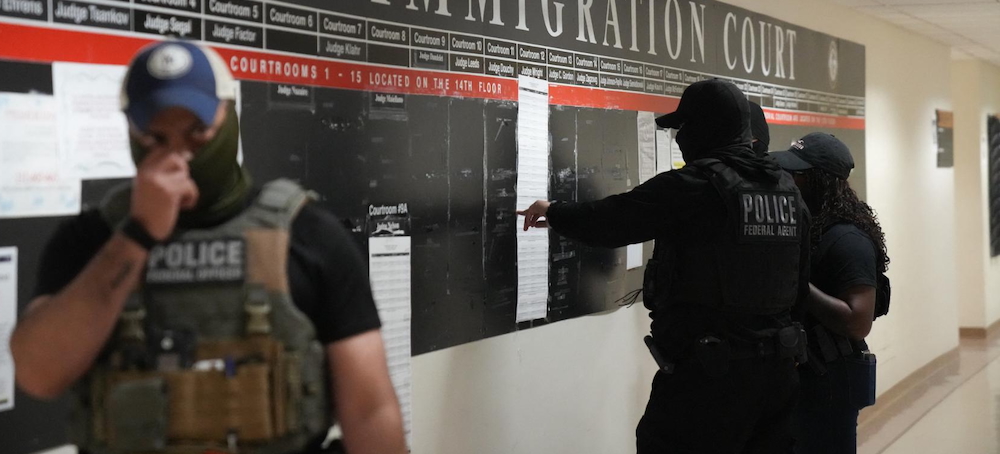
US Immigration and Customs Enforcement (ICE) agents look over lists of names and their hearing times and locations inside a courthouse. (photo: Bryan R. Smith/AFP/Getty Images)
Workers at the Social Security Administration have been told to share information about in-person appointments with agents of Immigration and Customs Enforcement, WIRED has learned.
“If ICE comes in and asks if someone has an upcoming appointment, we will let them know the date and time,” an employee with direct knowledge of the directive says. They spoke on the condition of anonymity for fear of retaliation.
While the majority of appointments with SSA take place over the phone, some appointments still happen in person. This applies to people who are deaf or hard of hearing and need a sign language interpreter, or if someone needs to change their direct deposit information. Noncitizens are also required to appear in person to review continued eligibility of benefits.
Social Security numbers are issued to US citizens but also to foreign students and people legally allowed to live and work in the country. In some cases, when a child or dependent is a citizen and the family member responsible for them is not, that person might need to accompany the child or dependent to an office visit.
The order to share information, which was recently communicated verbally to workers at certain SSA offices, marks a new era of collaboration between SSA and the Department of Homeland Security, ICE’s parent agency.
The SSA and DHS did not reply to requests for comment.
The SSA has been sharing data with ICE for much of President Donald Trump’s second term. In April, WIRED reported that the Trump administration had been pooling sensitive data from across the government, including from the the SSA, DHS, and the Internal Revenue Service. By November, WIRED learned that the SSA had made the arrangements official and had updated a public notice that said the agency was sharing “citizenship and immigration information” with DHS. “It was shockingly clear that there was interest in getting access to immigration data by [the] Trump administration,” a former SSA official tells WIRED. The official spoke on the condition of anonymity due to concerns of retaliation.
This data sharing hasn’t been without contention: Last week, a district judge in Massachusetts ruled that the IRS and SSA could not share taxpayer data with DHS or ICE.
“You're seeing SSA becoming an extension of Homeland Security,” says Leland Dudek, the former acting commissioner for the Social Security Administration.
Dudek says a directive to share details about in-person appointments would be “highly unusual,” particularly because the SSA is meant to be a “safe space” for people to come to, regardless of immigration status. “If a person is due a benefit, SSA is there for them and no harm will come to them,” he says. Cooperating with ICE in such a way, Dudek says, “diminishes the value of what SSA is to the public. Why would the public trust SSA anymore?”
Questions regarding how SSA workers can communicate with the public have been ongoing throughout Trump’s first term. As part of its incursion into the federal government, the so-called Department of Government Efficiency sought to end the SSA’s phone-based services but rolled the decision back after public backlash.
The SSA works with law enforcement officials on investigations, typically related to fraud or identity theft. It has publicly disclosed data-sharing agreements with DHS, but someone’s appointment time or schedule does not appear to be included in those arrangements.
Dudek says that the only time someone might be arrested at an SSA office historically is if the person had threatened the agency or staff members. “Anything that would normally involve apprehension of someone at an office or something like that would have been communicated through the office manager and to the representative from DHS as part of that,” says Dudek. “On multiple occasions I’ve had to hand over information to law enforcement, but there’s a process, paperwork, multiple people signing off. This appears to tell us to ignore that policy without actually updating it. It’s really worrying.”
In December, the SSA updated its Program Operations Manual System to allow for as-needed disclosures of “non-tax return information” to law enforcement that is outside of existing data sharing agreements. These disclosures are meant to be approved by the SSA’s general counsel on a case-by-case basis. Dudek says that the new instructions could pose complications, because it’s unclear where a “one-off request from law enforcement becomes a routine request from law enforcement.”
The news comes as ICE’s footprint drastically expands across the United States. A recent report by WIRED shows that the agency has plans to lease offices throughout the US as part of a secret, monthslong expansion campaign.
*..........*..........*..........*..........*..........*..........*..........*
*..........*..........*..........*..........*..........*..........*..........*
*..........*..........*..........*..........*..........*..........*..........*
*..........*..........*..........*..........*..........*..........*..........*
*..........*..........*..........*..........*..........*..........*..........*
*..........*..........*..........*..........*..........*..........*..........*
*..........*..........*..........*..........*..........*..........*..........*
*..........*..........*..........*..........*..........*..........*..........*
*..........*..........*..........*..........*..........*..........*..........*
*..........*..........*..........*..........*..........*..........*..........*
*..........*..........*..........*..........*..........*..........*..........*
*..........*..........*..........*..........*..........*..........*..........*
*..........*..........*..........*..........*..........*..........*..........*
*..........*..........*..........*..........*..........*..........*..........*
*..........*..........*..........*..........*..........*..........*..........*
*..........*..........*..........*..........*..........*..........*..........*
*..........*..........*..........*..........*..........*..........*..........*
*..........*..........*..........*..........*..........*..........*..........*
*..........*..........*..........*..........*..........*..........*..........*
*..........*..........*..........*..........*..........*..........*..........*
*..........*..........*..........*..........*..........*..........*..........*
*..........*..........*..........*..........*..........*..........*..........*
