

*..........*..........*..........*..........*..........*..........*..........*

Minneapolis Regional Labor Federation Endorses Day of Truth and Freedom January 23, 2026
January 16, 2026
For Immediate Release
Contact: Stacie Balkaran:
stacie@minneapolisunions.org / 971.291.9486
Minneapolis Labor Union Delegation and Local Regional Labor Bodies Endorse January 23: Day of Truth and Freedom—No Work, School, or Shopping
Minneapolis—The Minneapolis Regional Labor Federation, AFL-CIO along with regional bodies throughout the state, including the Saint Paul Regional Labor Federation, the West Area Labor Council, the North East Area Labor Council and the East Central Labor Council, have joined in solidarity to endorse a powerful unified statewide action on January 23: Day of Truth and Freedom. The Minnesota labor movement is united against the violent ICE occupation of our beloved cities that has directly impacted union members, our workplaces and our families.
Workers are essential for our communities to function. Since the ICE campaign of terror began, both immigrant and non-immigrant workers have feared for their safety when going to work, being at work, and coming home from work. Union members and our families are being illegally detained at alarming rates, with workplaces and schools facing increased challenges.
Chelsie Glaubitz Gabiou, President of the Minneapolis Regional Labor Federation, AFL-CIO, shared why union federations are joining this call:
“Working people, our schools and our communities are under attack. Union members are being detained commuting to and from work, tearing apart families. Parents are being forced to stay home, students held out of school, fearing for their lives, all while the employer class remains silent. Our labor federations are encouraging everyone to participate on January 23rd. It’s time for every single Minnesotan who loves this state and the notion of truth and freedom to raise their voices and deepen their solidarity for our neighbors and coworkers living under this federal occupation.”
Unions join the demands for the day that call for:
· ICE must leave Minnesota now.
· The agent who killed Renee Good must be held legally accountable.
· No additional federal funding for ICE in the upcoming Congressional budget and ICE be investigated for human and constitutional violations of Americans and our neighbors.
· Minnesotan and national companies to become 4th Amendment Businesses—cease economic relations with ICE and refuse ICE entry or using their property for staging grounds.
The Minneapolis Regional Labor Federation, AFL-CIO is the umbrella organization of Minneapolis-area local unions and includes 175+ affiliated unions representing over 80,000 working people across seven Minnesotan counties. www.minneapolisunions.org
*..........*..........*..........*..........*..........*..........*..........*


DROP THE CHARGES
AGAINST NICK TILSEN
In 2022, an incident took place where a Native unhoused relative was being harassed and assaulted by Rapid City Police (RCPD) in Rapid City, South Dakota. Nick Tilsen, CEO and Founder of NDN Collective, pulled over to conduct a routine cop watch. One officer accused Nick of assaulting him despite no physical contact being made with the officer. During the interaction, Nick remained in his vehicle because he felt unsafe surrounded by several police cars. Nick communicated with an officer, who then got approval from someone off-site and allowed Nick to leave.
Despite no immediate action being taken at the time, more than a year later, the officer involved accused Nick of attempting to run him over, leading to a complaint and warrant for Tilsen’s arrest being filed on June 30, 2023 – the same day NDN Collective announced they would host a July 4th March Towards Justice.
Nick was originally charged with aggravated assault and obstruction of a police officer. But just a few weeks before the trial date (January 12, 2026), Nick was notified that the Pennington County Grand Jury added a “simple assault” to the list of charges.
Nick is being systematically targeted as local prosecutors intentionally sought out the police officer named in this case and encouraged him to press charges. The charges brought against Nick are false and inflated to criminalize, silence, and ultimately isolate him from his community through imprisonment. Nick is being targeted by RCPD because he has unapologetically stood on his values and has called for accountability and justice for people harmed by police in Rapid City.
NDN Collective has been pushing for a federal investigation into the Rapid City Police Department for over 3 years. This fight is bigger than just Nick Tilsen. It’s about protecting movement leaders, movement organizations, our right to free speech, and to demand justice for those harmed by colonial white supremacist systems and structures.
NDN Collective believes this to be a politically motivated effort to silence a movement leader by criminalizing his actions and misusing the legal system. If found guilty of these charges, Nick could face up to 26 years in prison.
Nick’s trial is set to begin January 26, 2026, at 9 am MT at the Pennington County Courthouse in Rapid City, SD.
As we see continued targeting of movement leaders, including Nick, we need your support to continue fighting these legal battles. Trials are expensive and are tactics used to drain movement resources. We need resources to continue this fight against legal repression and to continue our work.
This fund safeguards our organization against legal attacks aiming to suppress our leaders, imprison our people, and obstruct our movement’s objectives.
DONATE TO NDN LEGAL FUND HERE:
https://ndnlegalfund.org
SIGN PETITION: DROP THE CHARGES:
Support for the charges against Nick to be dropped is clear, with over 16,500 signatures on a petition to the Pennington County State’s Attorney’s office. If you haven’t already, please add your name to our petition:
https://www.instagram.com/p/DTdap1GFD-1/?utm_source=ig_web_copy_link&igsh=MzRlODBiNWFlZA%3D%3D
*..........*..........*..........*..........*..........*..........*..........*
*..........*..........*..........*..........*..........*..........*..........*

End Texas Torture of Revolutionary Elder Xinachtli
Organization Support Letter
Letter to demand the immediate medical treatment and release of Chicano political prisoner Xinachtli (Alvaro Hernandez #00255735)
To the Texas Department of Criminal Justice,
We, the undersigned organizations, write to urge immediate action to protect the life, health, and human rights of Xinachtli (legal name Alvaro Hernandez). Xinachtli is 73-year-old Chicano community organizer from Texas who has spent 23 years in solitary confinement and 30 years incarcerated as part of a 50-year sentence. His health is now in a critical and life-threatening state and requires prompt and comprehensive medical intervention.
Since his conviction in 1997, Xinachtli has spent decades in conditions that have caused significant physical and psychological harm. As an elder in worsening health, these conditions have effectively become a de facto death sentence.
Xinachtli’s current medical condition is severe. His physical, mental, and overall well-being have declined rapidly in recent weeks. He now requires both a wheelchair and a walker, has experienced multiple falls, and is suffering from rapid weight loss. He is currently housed in the McConnell Unit infirmary, where he is receiving only palliative measures and is being denied a medical diagnosis, access to his medical records, and adequate diagnostic testing or treatment.
A virtual clinical visit with licensed medical doctor Dr. Dona Kim Murphey underscores the severity of his condition. In her report of the visit, she wrote: "Given the history of recent neck/back trauma and recurrent urinary tract infections with numbness, weakness, and bowel and bladder incontinence, I am concerned about nerve root or spinal cord injury and/or abscesses that can lead to permanent sensorimotor dysfunction."
Despite his age and visible disabilities, he remains in solitary confinement under the Security Threat Group designation as a 73-year-old. During his time in the infirmary, prison staff threw away all of his belongings and “lost” his commissary card, leaving him completely without basic necessities. He is experiencing hunger, and the lack of consistent nutrition is worsening his medical condition. McConnell Unit staff have also consistently given him incorrect forms, including forms for medical records and medical visitation, creating further barriers to care and communication.
A family visit on November 29 confirmed the seriousness of his condition. Xinachtli, who was once able to walk on his own, can no longer stand without assistance. He struggled to breathe, has lost more than 30 pounds, relied heavily on his wheelchair, and was in severe pain throughout the visit.
In light of these conditions, we, the undersigned organizations, demand that TDCJ take immediate action to save Xinachtli’s life and comply with its legal and ethical obligations.
We urge the immediate implementation of the following actions:
Immediate re-instatement of his access to commissary to buy hygiene, food, and other critical items. Immediate transfer to the TDCJ hospital in Galveston for a full medical evaluation and treatment, including complete access to his medical records and full transparency regarding all procedures. Transfer to a geriatric and medical unit that is fully accessible under the Americans with Disabilities Act. Xinachtli requests placement at the Richard P LeBlanc Unit in Beaumont, Texas. Approval of Medical Recommended Intensive Supervision, the release program for individuals with serious medical conditions and disabilities, in recognition of the severity and progression of his current health issues. Failure to act will result in the continued and foreseeable deterioration of Xinachtli’s health, amounting to state-sanctioned death. We urge TDCJ to take swift and decisive action to meet these requests and to fulfill its responsibility to safeguard his life and well-being.
We stand united in calling for immediate and decisive action. Xinachtli’s life depends on it.
Signed, Xinachtli Freedom Campaign and supporting organizations
Endorsing Organizations:
Al-Awda Houston; All African People’s Revolutionary Party; Anakbayan Houston; Anti-Imperialist Solidarity; Artists for Black Lives' Equality; Black Alliance for Peace - Solidarity Network; Columbia University Students for a Democratic Society; Community Liberation Programs; Community Powered ATX; Contra Gentrificación; Diaspora Pa’lante Collective; Down South; DSA Emerge; Entre nos kc; Fighting Racism Workshops; Frontera Water Protectors; GC Harm Reductionists; JERICHO MOVEMENT; Jericho Movement Providence; Montrose Anarchist Collective; NYC Jericho Movement; OC Focus; Palestine Solidarity TX; Partisan Defense Committee; Partido Nacional de la Raza Unida; PDX Anti-Repression; Red Star Texas; Root Cause; San Francisco Solidarity Collective; Shine White Support Team; Sunrise Columbia; UC San Diego Faculty for Justice in Palestine; Viva Palestina, EPTX; Water Justice and Technology Studio; Workshops4Gaza.
Sign the endorsement letter for your organization here:
https://cryptpad.fr/form/#/2/form/view/MiR1f+iLiRBJC7gSTyfhyxJoLIDhThxRafPatxdbMWI/
IMPORTANT LINKS TO MATERIALS FOR XINACHTLI FREEDOM CAMPAIGN:
PHONE BLAST: Your community can sign up for a 15-minute-long call shift here: bit.ly/xphoneblast
FUNDRAISER: Here is the link to Jericho's fundraiser for Xinachtli: http://givebutter.com/jerichomovement
CASE HISTORY: Learn more about Xinachtli and his case through our website: https://freealvaro.net
CONTACT INFO:
Follow us on Instagram: @freexinachtlinow
Email us:
xinachtlifreedomcampaign@protonmail.com
COALITION FOLDER:
https://drive.proton.me/urls/SP3KTC1RK4#KARGiPQVYIvR
In the folder you will find: Two pictures of Xinachtli from 2024; The latest updated graphics for the phone blast; The original TRO emergency motion filing; Maria Salazar's declaration; Dr. Murphy's report from her Dec. 9 medical visit; Letter from Amnesty International declaring Xinachtli's situation a human rights violation; Free Xinachtli zine (which gives background on him and his case); and The most recent press release detailing who Xinachtli is as well as his medical situation.
Write to:
Alvaro Hernandez CID #00255735
TDCJ-W.G. McConnell Unit
PO Box 660400
Dallas, TX 75266-0400
*..........*..........*..........*..........*..........*..........*..........*
*..........*..........*..........*..........*..........*..........*..........*

Funds for Kevin Cooper
Kevin was transferred out of San Quentin and is now at a healthcare facility in Stockton. He has received some long overdue healthcare. The art program is very different from the one at San Quentin but we are hopeful that Kevin can get back to painting soon.
For 41 years, an innocent man has been on death row in California.
Kevin Cooper was wrongfully convicted of the brutal 1983 murders of the Ryen family and houseguest. The case has a long history of police and prosecutorial misconduct, evidence tampering, and numerous constitutional violations including many incidences of the prosecution withholding evidence of innocence from the defense. You can learn more here .
In December 2018 Gov. Brown ordered limited DNA testing and in February 2019, Gov. Newsom ordered additional DNA testing. Meanwhile, Kevin remains on Death Row at San Quentin Prison.
The funds raised will be used to help Kevin purchase art supplies for his paintings . Additionally, being in prison is expensive, and this money would help Kevin pay for stamps, books, paper, toiletries, supplies, supplementary food, printing materials to educate the public about his case and/or video calls.
Please help ease the daily struggle of an innocent man on death row!
An immediate act of solidarity we can all do right now is to write to Kevin and assure him of our continuing support in his fight for justice. Here’s his address:
Kevin Cooper #C65304
Cell 107, Unit E1C
California Health Care Facility, Stockton (CHCF)
P.O. Box 213040
Stockton, CA 95213
www.freekevincooper.org
Call California Governor Newsom:
1-(916) 445-2841
Press 1 for English or 2 for Spanish,
press 6 to speak with a representative and
wait for someone to answer
(Monday-Friday, 9:00 A.M. to 5:00 P.M. PST—12:00 P.M. to 8:00 P.M. EST)
*..........*..........*..........*..........*..........*..........*..........*
*..........*..........*..........*..........*..........*..........*..........*

Dr. Atler Still Needs Our Help!
Please sign the petition today!
https://www.change.org/p/texas-state-university-give-tom-alter-his-job-back
What you can do to support:
—Donate to help Tom Alter and his family with living and legal expenses: https://gofund.me/27c72f26d
—Sign and share this petition demanding Tom Alter be given his job back: https://www.change.org/p/texas-state-university-give-tom-alter-his-job-back
—Write to and call the President and Provost at Texas State University demanding that Tom Alter be given his job back:
President Kelly Damphousse: president@txstate.edu
President’s Office Phone: 512-245-2121
Provost Pranesh Aswath: xrk25@txstate.edu
Provost Office Phone: 512-245-2205
For more information about the reason for the firing of Dr. Tom Alter, read:
"Fired for Advocating Socialism: Professor Tom Alter Speaks Out"
Ashley Smith Interviews Dr. Tom Alter
—CounterPunch, September 24, 2025
*..........*..........*..........*..........*..........*..........*..........*
*..........*..........*..........*..........*..........*..........*..........*
 Russia Confirms Jailing of Antiwar Leader Boris Kagarlitsky In a secret trial on June 5, 2024, the Russian Supreme Court’s Military Chamber confirmed a sentence of five years in a penal colony for left-wing sociologist and online journalist Boris Kagarlitsky. His crime? “Justifying terrorism” — a sham charge used to silence opponents of Putin’s war on Ukraine. The court disregarded a plea for freedom sent by thirty-seven international luminaries. Kagarlitsky, a leading Marxist thinker in Russia’s post-Soviet period, recently addressed socialists who won’t criticize Putin: “To my Western colleagues, who…call for an understanding of Putin and his regime, I would like to ask a very simple question. [Would] you want to live in a country where there is no free press or independent courts? In a country where the police have the right to break into your house without a warrant? …In a country which…broadcasts appeals on TV to destroy Paris, London, Warsaw, with a nuclear strike?” Thousands of antiwar critics have been forced to flee Russia or are behind bars, swept up in Putin’s vicious crackdown on dissidents. Opposition to the war is consistently highest among the poorest workers. Recently, RusNews journalists Roman Ivanov and Maria Ponomarenko were sentenced to seven, and six years respectively, for reporting the military’s brutal assault on Ukraine. A massive global solidarity campaign that garnered support from thousands was launched at Kagarlitsky’s arrest. Now, it has been revived. This internationalism will bolster the repressed Russian left and Ukrainian resistance to Putin’s imperialism. To sign the online petition at freeboris.info —Freedom Socialist Party, August 2024 https://socialism.com/fs-article/russia-jails-prominent-antiwar-leader-boris-kagarlitsky/#:~:text=In%20a%20secret%20trial%20on,of%20Putin's%20war%20on%20Ukraine. Petition in Support of Boris KagarlitskyWe, the undersigned, were deeply shocked to learn that on February 13 the leading Russian socialist intellectual and antiwar activist Dr. Boris Kagarlitsky (65) was sentenced to five years in prison. Dr. Kagarlitsky was arrested on the absurd charge of 'justifying terrorism' in July last year. After a global campaign reflecting his worldwide reputation as a writer and critic of capitalism and imperialism, his trial ended on December 12 with a guilty verdict and a fine of 609,000 roubles. The prosecution then appealed against the fine as 'unjust due to its excessive leniency' and claimed falsely that Dr. Kagarlitsky was unable to pay the fine and had failed to cooperate with the court. In fact, he had paid the fine in full and provided the court with everything it requested. On February 13 a military court of appeal sent him to prison for five years and banned him from running a website for two years after his release. The reversal of the original court decision is a deliberate insult to the many thousands of activists, academics, and artists around the world who respect Dr. Kagarlitsky and took part in the global campaign for his release. The section of Russian law used against Dr. Kagarlitsky effectively prohibits free expression. The decision to replace the fine with imprisonment was made under a completely trumped-up pretext. Undoubtedly, the court's action represents an attempt to silence criticism in the Russian Federation of the government's war in Ukraine, which is turning the country into a prison. The sham trial of Dr. Kagarlitsky is the latest in a wave of brutal repression against the left-wing movements in Russia. Organizations that have consistently criticized imperialism, Western and otherwise, are now under direct attack, many of them banned. Dozens of activists are already serving long terms simply because they disagree with the policies of the Russian government and have the courage to speak up. Many of them are tortured and subjected to life-threatening conditions in Russian penal colonies, deprived of basic medical care. Left-wing politicians are forced to flee Russia, facing criminal charges. International trade unions such as IndustriALL and the International Transport Federation are banned and any contact with them will result in long prison sentences. There is a clear reason for this crackdown on the Russian left. The heavy toll of the war gives rise to growing discontent among the mass of working people. The poor pay for this massacre with their lives and wellbeing, and opposition to war is consistently highest among the poorest. The left has the message and resolve to expose the connection between imperialist war and human suffering. Dr. Kagarlitsky has responded to the court's outrageous decision with calm and dignity: “We just need to live a little longer and survive this dark period for our country,” he said. Russia is nearing a period of radical change and upheaval, and freedom for Dr. Kagarlitsky and other activists is a condition for these changes to take a progressive course. We demand that Boris Kagarlitsky and all other antiwar prisoners be released immediately and unconditionally. We also call on the auth *..........*..........*..........*..........*..........*..........*..........* *..........*..........*..........*..........*..........*..........*..........* |

Mumia Abu-Jamal is Innocent!
FREE HIM NOW!
Write to Mumia at:
Smart Communications/PADOC
Mumia Abu-Jamal #AM-8335
SCI Mahanoy
P.O. Box 33028
St. Petersburg, FL 33733
Join the Fight for Mumia's Life
Since September, Mumia Abu-Jamal's health has been declining at a concerning rate. He has lost weight, is anemic, has high blood pressure and an extreme flair up of his psoriasis, and his hair has fallen out. In April 2021 Mumia underwent open heart surgery. Since then, he has been denied cardiac rehabilitation care including a healthy diet and exercise.

He still needs more complicated treatment from a retinal specialist for his right eye if his eyesight is to be saved:
Donate to Mumia Abu-Jamal's Emergency Legal and Medical
Defense Fund
Mumia has instructed PrisonRadio to set up this fund. Gifts donated here are designated for the Mumia Abu-Jamal Medical and Legal Defense Fund. If you are writing a check or making a donation in another way, note this in the memo line.
Send to:
Mumia Medical and Legal Fund c/o Prison Radio
P.O. Box 411074, San Francisco, CA 94103
*..........*..........*..........*..........*..........*..........*..........*
*..........*..........*..........*..........*..........*..........*..........*
Resources for Resisting Federal Repression
https://www.nlg.org/federalrepressionresources/
Since June of 2020, activists have been subjected to an increasingly aggressive crackdown on protests by federal law enforcement. The federal response to the movement for Black Lives has included federal criminal charges for activists, door knocks by federal law enforcement agents, and increased use of federal troops to violently police protests.
The NLG National Office is releasing this resource page for activists who are resisting federal repression. It includes a link to our emergency hotline numbers, as well as our library of Know-Your-Rights materials, our recent federal repression webinar, and a list of some of our recommended resources for activists. We will continue to update this page.
Please visit the NLG Mass Defense Program page for general protest-related legal support hotlines run by NLG chapters.
Emergency Hotlines
If you are contacted by federal law enforcement, you should exercise all of your rights. It is always advisable to speak to an attorney before responding to federal authorities.
State and Local Hotlines
If you have been contacted by the FBI or other federal law enforcement, in one of the following areas, you may be able to get help or information from one of these local NLG hotlines for:
Portland, Oregon: (833) 680-1312
San Francisco, California: (415) 285-1041 or fbi_hotline@nlgsf.org
Seattle, Washington: (206) 658-7963
National Hotline
If you are located in an area with no hotline, you can call the following number:
National NLG Federal Defense Hotline: (212) 679-2811
*..........*..........*..........*..........*..........*..........*..........*
*..........*..........*..........*..........*..........*..........*..........*
Articles
*..........*..........*..........*..........*..........*..........*..........*
*..........*..........*..........*..........*..........*..........*..........*
1) Trump’s Fight With Minnesota Is About More Than Immigration
The state embodies a civic ideal that the administration in Washington wants to discredit.
By Charles Homans, Jan. 16, 2026
Charles Homans grew up in Minnesota and previously covered the state’s congressional delegation for the St. Paul Pioneer Press. He is in Minneapolis covering the state’s clash with the federal government.

Federal agents arresting a protester in South Minneapolis on Tuesday. David Guttenfelder/The New York Times
There are plenty of obvious reasons Minneapolis, despite ranking far down the list of U.S. cities in terms of its immigrant population, is the latest Democratic-led urban area targeted by President Trump’s punitive anti-immigration raids. There is Tim Walz, the governor and Trump’s 2024 rival. There is the genuinely stunning fraud scandal, recently revealed, that happened on Walz’s watch. And there is the long shadow of George Floyd. But to understand both the crackdown and its stakes, it’s also worth revisiting a speech Trump gave in the city in November 2016, two days before the election that would first deliver him to the White House.
“Oh, Minnesota,” Trump told the crowd, dropping into the just-you-and-me-talking mode that has always been one of his greatest assets as a politician. “You know what’s going on. You know what I’m talking about. Do you know what I’m talking about? Be politically correct. Just nod — quietly nod. The whole world knows what’s happening in Minnesota.”
What was happening in Minnesota then was a slow-burning tension surrounding the state’s Somali community, its second-largest immigrant population. In 2008, a young Somalia-born man from Minneapolis was recruited by the Somali Islamist militant group Al Shabab and detonated a car full of explosives outside a government building in his birth country’s Puntland region, the first of dozens of young men from the community who would fight for Al Shabab in Somalia and, later, for the Islamic State in Iraq and Syria over the next decade.
Minnesota had been a haven for refugees since after World War II, when it was an early destination for Holocaust survivors in the United States, and especially since the late 1970s, when it began taking in thousands of South Vietnamese and Hmong people on the wrong side of America’s withdrawal from Southeast Asia.
This hospitality had historically been a point of pride for the state, a piece of the exceptionalism that Minnesotans, performatively modest as they are, have always claimed. It was a product of a broader, deep-rooted civic idealism: the state’s preponderance of religious charities, community-level nonprofit organizations and in particular its Nordic-style social safety net, among the most generous in the country.
But amid the Shabab and ISIS recruitment, Minnesotans had grown ambivalent. A 2014 poll found that while the state’s residents were broadly supportive of immigration, less than half supported welcoming Somali immigrants.
For over half a century, Minnesota has embodied the civic ideal that Trump seems intent on overturning.
At an October 2015 listening session in the small city of St. Cloud, where tensions had run particularly high, the state’s Democratic governor, Mark Dayton, addressed the Somali community. “This is Minnesota, and you have every right to be here,” he said. The state, he said, was “not like it was 30, 50 years ago,” when it’s population was nearly entirely white — and bigots who had a problem with that should “find a state where the minority population is 1 percent or whatever. It’s not that in Minnesota. It’s not going to be again.”
Trump’s message, a year later, was that, in fact, it could be that again. If elected, he promised, his administration would “not admit any refugees without the support of the local community where they are being placed — the least they could do for you. You’ve suffered enough in Minnesota.”
The speech crystallized one of the core themes of Trump’s politics, which has become the overwhelming argument of his second term: that the country’s foundational idea of a civic nation — one whose people are bound by a shared commitment to principles rather than ancestry or cultural identity — is a sort of liberal swindle. In Trump’s America, shared prosperity requires exclusion: a policing, by force if necessary, of the boundaries of who gets to call themselves American based in large part on where they come from.
It is both fitting and not incidental that this agenda has been made so visible this month in Minneapolis, where immigration agents shot a woman dead and, in recent days, fired tear gas and smoke grenades at protesters on residential streets. On Wednesday, after a top Trump Justice Department official declared Minnesota’s resistance to the federal deployment an “insurrection” on social media, Walz posted on X that his state “will remain an island of decency, of justice, of community, and of peace.”
His statement made clear how the state government and many of its citizens see this conflict. Generalizing about any state’s political temperament is impossible in 2026, when practically all of them, including Minnesota, have variations on the same map of highly polarized rural reds and urban blues; rural Minnesotans, whose support for Democrats has collapsed in recent years, likely have a far different view than Minneapolitans do of Trump’s deployment.
Nevertheless, Minnesota is still a Democratic stronghold in presidential elections, and for over half a century, it has more clearly than perhaps any other state embodied the civic ideal that Trump seems intent on overturning. On the ground in Minneapolis, this is very overtly what the city’s residents who are tracking and confronting federal agents see themselves fighting for. Still, the largely unified local response to the flood of federal forces into Minneapolis is remarkable in light of the city’s very recent history, which has involved a deep soul-searching about precisely that ideal.
‘A State That Works’
In 2022, Lance Morrow, a former Time magazine writer and fellow at the conservative Ethics and Public Policy Center, wrote a column for The Wall Street Journal titled “How Minnesota Went From Tom Sawyer to Huck Finn.” Surveying Minneapolis’s grim crime statistics in the wake of the rioting and prolonged malaise that had followed George Floyd’s murder — a near-record number of homicides, a 537 percent year-over-year increase in carjackings — Morrow proclaimed the state to be “a microcosm of an America in crisis.”
Less than two years after the protests over Floyd’s killing, this was hardly an uncommon argument. But coming from Morrow, it carried an unusual sting. In 1973, he had written the ur-text of Minnesotan exceptionalism, a Time cover story called “Minnesota: A State That Works.”
Touring Minneapolis and its suburbs, Morrow, who had covered the 1967 riots in Detroit and the Vietnam War, seemed genuinely in awe of how little Minnesota appeared to have been touched by the traumas and upheavals wracking the country. “It is a state where a residual American secret still seems to operate,” he wrote, surveying Minnesota’s wonders one by one: a thriving and diversified economy; the lowest high-school-dropout rate in the country and the third-lowest crime rate; per capita incomes above the national average; an abundance of outdoor recreational opportunities that its unnervingly hale residents flocked to. (The cover of the issue featured Wendell Anderson, the state’s handsome young governor, on a lake in a plaid shirt, beaming over a freshly caught northern pike.)
But mostly, Morrow was struck by the “extraordinary civic interest” of Minnesotans. Citizens’ lobbies thrived. Minnesota-based companies voluntarily ponied up millions of dollars to improve downtown Minneapolis and build the Mayo Clinic. Voters cheerfully accepted statewide tax increases to better fund underserved local school districts. The state’s elected officials seemed to all be starry-eyed idealists motivated by a genuine commitment to service and little expectation of reward.
Daniel J. Elazar, the Minneapolis-born political scientist and scholar of American federalism, described Minnesota as a “moralistic” political culture, one of three such cultures he identified, along with the “individualistic” and the “traditionalistic.” The moralistic strain in American public life, in Elazar’s definition, saw politics as a noble pursuit, one that did not just guard liberty or identity or pursue interests but could be a tool for actively improving people’s lives. And Minnesota, Elazar argued, embodied the moralistic culture “more so than any other in the Union or perhaps in the world.”
This owed something to history — the state’s civil society was shaped in the 19th century by Yankee antislavery Republicans and later immigrants from Scandinavia and Germany, all deeply moralistic political cultures — and something to politics: The most powerful force in Minnesota politics for decades has been the Democratic-Farmer-Labor Party, a midcentury left-liberal fusion organization shaped in its early years by a cohort of cerebral amateurs, several of them young political science professors.
The D.F.L., in its early history, was particularly preoccupied with race relations: Hubert H. Humphrey, one of the party’s founders, led the campaign to insert the civil rights plank into the national party platform at the 1948 Democratic National Convention, prompting the Dixiecrat walkout and the realignment of American partisan politics that followed. The fact that this commitment existed in one of the least diverse states in the country — as recently as 1980, Minnesota was 96.7 percent white — seemed, to Minnesotan liberals, a further testament to the state’s exceptionalism.
But as race has become a ubiquitous lens for social science analysis, Minnesota has come in for a harder look. For a quarter-century now, researchers, drawing on data from around the world, have noted a clear correlation between the generosity of a country’s welfare state and the homogeneity of its population — a finding that invites a new reading of the idea of moralistic government as just another form of self-interest.
A particular criticism of Minnesota, which rocketed to the foreground following George Floyd’s killing, is that Minnesota’s proud progressivism on race was itself a counterintuitive product of the state’s lack of diversity and pervasive segregation. Beneath its rhetorical commitments, the state possesses some of the country’s most severe racial disparities across a wide range of metrics, from unemployment to homeownership to incarceration to educational attainment.
“African Americans are worse off in Minnesota than they are in virtually every other state in the nation,” the University of Minnesota economist Samuel L. Myers Jr. has written, describing what he has called the “Minnesota Paradox.” Well-off white people, living in neighborhoods surrounded by other well-off white people, could afford to subsidize a generous welfare state and were mostly insulated from its failings, when they were aware of them at all. The self-image the state’s white liberals had drawn from its history of civic idealism had kept them from seeing the many ways in which that idealism had come up short.
‘This Is Not Who We Are’
These are both critiques from the left, but the new right that has ridden into the center of American politics with Trump’s re-election turns them on their head. If diversity seems antithetical to the liberal dream of a welfare state that effectively serves its citizens, the right asks, then why are liberals so hung up on diversity? And if the sort of self-satisfied liberalism that Minnesotans are famous for hasn’t served the people of color that those liberals are so concerned about, then what is the point of it, exactly?
The fraud scandal in Minnesota, in which dozens of members of the state’s Somali community are implicated in stealing over $1 billion from the state’s much-vaunted social services system, has struck bone because it fits so neatly within this line of argument: that liberals’ civic commitments are not just empty and unproductive but also a cover for looting the state by the very people liberals are most preoccupied with protecting.
Walz, addressing the specters of extremism and political violence in the 2024 campaign, often fell back on a well-worn phrase from his gubernatorial candidacy, “This is not who we are.” But who are we, then? Liberalism, in Minnesota and elsewhere, has always struggled more with that question than the right, with its cultural conservatism, or the socialist left, with its appeals to class solidarity. Walz’s predecessor’s response — “This is Minnesota” — is not quite a complete answer. Much of Minnesota’s recent history is the story of a state learning that pluralism in the abstract is less complicated than pluralism in reality.
Minneapolis is still haunted by 2020 and the deep rift it cleaved within its liberal population.
But whatever its misgivings, Minnesota is still Walz’s state more than Trump’s. Much of the political particularity that nurtured Minnesota’s civic culture is gone now. But the state brushed off Trump’s appeal in 2016 and, for good measure, elected Ilhan Omar, the country’s first Somali congresswoman. Predictions that Trump would win the state in 2020 and 2024, after Floyd’s murder and its consequences, proved wrong, too.
Minneapolis is still haunted in many respects by 2020 and the deep rift it cleaved within its overwhelmingly liberal population. But it has been possible to see, in the very different and mostly unified local revolt against Trump’s federal deployment, a sort of foxhole reconciliation — a recognition that the city’s people do still share a broad vision of what the civic ideal means to them.
This has been true nationally, too. The response to Trump’s first year back in office has made clear that ambivalence and opposition are not the same thing. It is hard to think of a federal action that has become more unpopular more quickly than Trump’s immigration raids. Last February, a YouGov poll for The Economist found that a plurality of independent voters — 42 percent of them — had a favorable view of Immigration and Customs Enforcement. In a poll conducted the day of Renee Good’s shooting, 56 percent of independents disapproved of the agency’s work, 44 percent of them strongly.
That is a picture of a country that mostly agrees with Walz that this is not who we are — even if it is not entirely sure who it is instead. If Trump’s candidacy was a sustained attack on the idea of civic nationalism, his second presidency has very quickly become a clarification of what the alternative looks like — and what it looks like for now, in Minneapolis, is a masked federal agent shooting a woman in the head through the windshield of her own car.
*..........*..........*..........*..........*..........*..........*..........*
*..........*..........*..........*..........*..........*..........*..........*
2) Greek Court Acquits Rescue Workers Accused of Smuggling Migrants
The 24 former volunteers, including the refugee turned campaigner Sara Mardini, were prosecuted after helping migrants during the European refugee crisis nearly a decade ago.
By Niki Kitsantonis, Reporting from Athens, Jan. 16, 2026

Some of the aid workers and their lawyers outside the courthouse on Thursday in Lesbos, Greece, after they were acquitted of all charges. Credit...Panagiotis Balaskas/Associated Press
A group of 24 aid workers who had been put on trial in Greece after rescuing migrants at sea was acquitted of all charges on Thursday, according to lawyers who attended the hearing, in a case that had been widely condemned by rights groups as an attempt to criminalize rescue work.
The former volunteers, who included the Syrian refugee turned campaigner Sara Mardini, had faced up to 20 years in prison if convicted on charges including facilitating illegal entry, money-laundering and membership of a criminal organization.
Their prosecution was the latest salvo against both aid workers and migrants across Europe as leaders in Greece and beyond aimed to prevent a repeat of the 2015-2016 crisis that saw hundreds of thousands of people flee war and poverty.
The island of Lesbos, where the trial took place, was the front line of that crisis — and a focal point for volunteers who scrambled from across the world to rescue migrants at sea and help them after they landed. The volunteers included Ms. Mardini and her 23 co-defendants, who worked with the now-defunct Greek nonprofit Emergency Response Center International.
A criminal court in Lesbos cleared the defendants at a hearing on Thursday, saying their aim was not to commit criminal acts but to provide humanitarian aid, according to Zacharias Kesses and Evita Papakiriakidou, defense lawyers present in court. Court officials declined to comment by phone on the verdict because the judges have yet to formally issue it in writing.
Mr. Kesses, who represented several defendants including Ms. Mardini, said the decision was a “courageous ruling.”
“The decision is of particular importance because it prevented the creation of a dangerous precedent that would have threatened the humanitarian and solidarity movement,” he added.
The verdict came amid growing restrictions placed on migrants and their advocates by Greece’s conservative government. Recent legislation means that asylum seekers now face up to five years in prison if they remain in the country after their applications are rejected, and civil society groups face greater limits on their work with refugees. Those moves followed a broader crackdown on migrants trying to reach Greece, with a New York Times investigation in 2023 finding that Greek Coast Guard officers had rounded up asylum seekers and abandoned them at sea.
The aid workers’ exoneration was the culmination of a judicial process that began in 2018 with the arrest and detention of several volunteers, including Ms. Mardini, who is the sister of the Olympic swimmer Yusra Mardini. The sisters drew global attention in 2015 after they escaped the war in Syria and helped to pull their sinking boat — and another 18 refugees — to safety on the shores of Lesbos.
A Greek court threw out previous misdemeanor charges against the activists, including espionage, in early 2023. Their subsequent trial on more serious criminal charges, which began in December, took nearly three more years to get to court, keeping the defendants in legal limbo.
Rights groups welcomed the decision to dismiss those charges but also said it was a reminder that tougher migration policies have virtually stamped out humanitarian work.
“Justice for these 24 individuals is a relief, but the environment for solidarity in Greece remains under siege,” said Eva Cossé, a senior researcher stationed in Athens for Human Rights Watch, a New York-based rights group. “The Greek government’s campaign of criminalization has already achieved its chilling effect, shutting down independent rescue work in the Aegean.”
The verdict, which the lawyers said was final and could not be appealed, appeared to draw little reaction from right-wing groups that had previously been vocal critics of rescue workers. Public interest in the case has diminished, partly because migration levels have dropped significantly since their 2015 peak. In general, Greek court verdicts rarely provoke significant public pushback.
*..........*..........*..........*..........*..........*..........*..........*
*..........*..........*..........*..........*..........*..........*..........*
3) The ‘March of the Fighting People’ Shows Cuban Strength
By teleSUR/JF, January 16, 2026
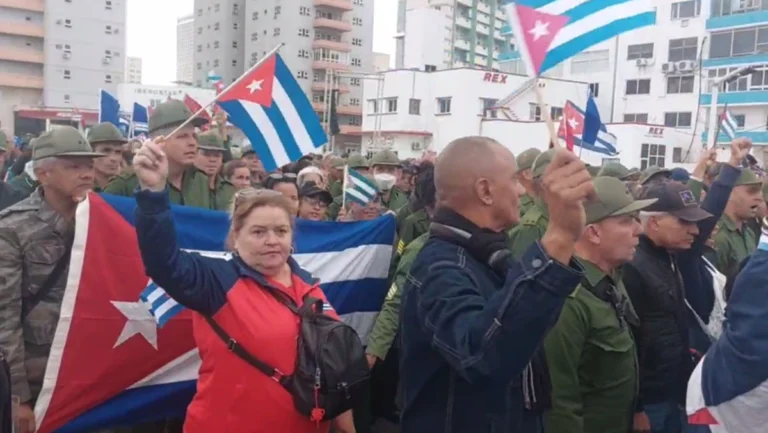
Cubans in the March of the Fighting People, Jan 16, 2026. Photo: teleSUR
As they marched through the streets of Havana, demonstrators sent a clear message to U.S. President Donald Trump: Cuba does not fear imperialism and will defend its independence and sovereignty.
“Down with imperialism,” “Yes to Cuba, no to Yankees,” “Brink President Maduro back,” and “Justice for the fallen” were among the chants voiced by thousands of Cubans as they waved national flags.
Young people, students, workers, scientists, and artists took part in the march, which was led by Cuban President Miguel Diaz-Canel Bermudez and other Revolutionary government officials.
“Cuba does not forget its children. They are heroes. This people march for them, showing their love and respect. Eternal glory!” posted Mayara Rodriguez, a Cuban citizen, on social media.
Before the march set off from the Anti-Imperialist Platform, President Diaz-Canel delivered a speech honoring the 32 fallen fighters, warning the United States that coercion will not bend his nation.
“There is no possible surrender or capitulation, nor any kind of understanding based on coercion or intimidation. Cuba does not have to make any political concessions, nor will that ever be on the negotiating table for an understanding between Cuba and the United States,” he said.
“It is important that this be understood: We will always be willing to engage in dialogue and to improve relations between the two countries, but on equal terms and on the basis of mutual respect. That has been the case for more than six decades. History will not be different now,” Diaz-Canel added.
“Cuba does not threaten or defy. If we were to be attacked, we would fight with the same ferocity shown by several generations of brave Cuban fighters in the 19th century independence wars, in the Sierra Maestra guerilla, in the underground struggle, in Africa, and in Caracas in the 21st century,” he said.
“They will not intimidate us. Their current threats remind us of the threats made by nearly all previous U.S. administrations,” the Cuban president concluded.
Sources: teleSUR – PL
*..........*..........*..........*..........*..........*..........*..........*
*..........*..........*..........*..........*..........*..........*..........*
4) Trump Administration Begins Criminal Inquiry Into Minnesota Leaders
The Justice Department’s investigation is a major escalation in the state-federal battle over the conduct of immigration agents in Minneapolis.
By Glenn Thrush, Alan Feuer, Devlin Barrett and Jonah E. Bromwich, Jan. 16, 2026

Jacob Frey, the mayor of Minneapolis, at a news conference this month. He and Gov. Tim Walz of Minnesota are being investigated by the Justice Department, according to a senior law enforcement official. Credit...Ryan Murphy for The New York Times
The Trump administration has opened a criminal investigation into elected Democrats in Minnesota, according to a senior law enforcement official familiar with the matter, a major escalation in the fight between the federal government and local officials over the aggressive immigration crackdown underway in the city.
The investigation would focus on allegations that Gov. Tim Walz and Jacob Frey, the mayor of Minneapolis, had conspired to impede thousands of federal agents who have been sent to the city since last month. Last week, one of those agents killed a 37-year-old woman, Renee Good.
It remained unclear what investigative steps have been taken. The senior law enforcement official said subpoenas had yet to be issued, but could be in the days to come. Both Mr. Walz and Mr. Frey responded with combative statements on Friday night, denouncing what they said was a weaponized use of law enforcement power and promising to stand firm in the face of the administration’s efforts.
“Weaponizing the justice system and threatening political opponents is a dangerous, authoritarian tactic,” Mr. Walz said in a statement released by his office, which said it had not yet received notice of an investigation. “The only person not being investigated for the shooting of Renee Good is the federal agent who shot her.”
Mr. Frey described the investigation as an “obvious attempt to intimidate” him, but vowed it would not work.
“America depends on leaders that use integrity and the rule of the law as the guideposts for governance,” he said. “Neither our city nor our country will succumb to this fear. We stand rock solid.”
The shooting of Ms. Good, an unarmed mother of three, has led to sustained protests against the agents in Minneapolis. Mr. Frey, in the immediate wake of Ms. Good’s death, used an expletive to demand that the agents leave the city. Mr. Walz has also sharply criticized the agents’ conduct.
Justice Department leaders, in turn, have vowed to arrest anyone impeding federal agents, and the new investigation seeks to determine if senior Democrats in the state conspired to impede law enforcement.
News of the investigation, which was reported earlier by CBS News, came only two days after Todd Blanche, the deputy attorney general, posted an incendiary message on social media, accusing Mr. Walz and Mr. Frey of “encouraging violence against law enforcement” and referring to their actions as “terrorism.”
While both the governor and the mayor have criticized agents involved in the immigration crackdown and have at times urged local residents to document their actions, there is no public evidence that either man has explicitly encouraged violence — let alone engaged in acts of terrorism. Both have urged protesters to remain peaceful.
Still, the growing public protests in Minneapolis have angered President Trump, who has threatened to invoke the Insurrection Act and send the military into the city. In a social media post on Thursday, Mr. Trump called the protesters in Minnesota “professional agitators,” but offered no evidence to support his claims against what by most accounts are ordinary citizens.
On Friday, however, Mr. Trump appeared to back away from his threat.
“I don’t think I need it right now,” he told reporters, referring to the Insurrection Act.
That same day, a federal judge in Minneapolis issued an order putting several restrictions on how federal agents can handle people protesting the crackdown. Hours earlier, Keith Ellison, the Minnesota attorney general, had told the judge, Kate M. Menendez, that Mr. Trump’s vow to use the Insurrection Act was “unjustified.” But Mr. Ellison also said it was “an immediate and pressing threat.”
All of this unfolded as Mr. Blanche and Kash Patel, the F.B.I. director, flew to Minneapolis to direct the federal law enforcement response. Mr. Patel has vowed to crack down on any violent rioters and investigate what he calls the “funding networks” supporting such people.
On Friday night, Mr. Blanche posted a message on social media, saying that he had met with officials in the U.S. attorney’s office in Minneapolis and visited some of the immigration agents.
“We support those performing their lawful duties to protect public safety and will PROSECUTE anyone attacking or obstructing them,” Mr. Blanche wrote, appearing to hint at the investigation. “We will provide ALL resources necessary to support immigration enforcement, charge ANYONE impeding or assaulting federal officers, and combat rampant fraud in MN.”
Federal officials have already signaled that they are not likely to bring criminal charges against Jonathan Ross, the agent who killed Ms. Good. At the same time, the officials have said that law enforcement would most likely investigate Ms. Good’s partner, Becca Good, and any possible connections the women might have had to local activists.
That decision prompted at least six federal prosecutors to resign this week from the U.S. attorney’s office in Minneapolis.
Tyler Pager contributed reporting.
*..........*..........*..........*..........*..........*..........*..........*
*..........*..........*..........*..........*..........*..........*..........*
5) The People of Minneapolis vs. ICE: A Street-Level View
An intense cat-and-mouse game is putting enraged locals face-to-face with heavily armed agents.
By Vivian Yee, Photographs by Todd Heisler, Jan. 17, 2026

Federal agents detained a man along Lake Street in Minneapolis on Wednesday.
The vehicles all jolted to a stop — S.U.V.s full of masked immigration agents and cars carrying activists and journalists who had been tailing them — and in what felt like less than a second, everyone was out on the frozen Minneapolis street corner, facing off.
Car horns and sirens and the screech of whistles from the activists almost drowned out the profanities hurled at the ICE agents. Men in military-style uniforms descended from an S.U.V., pointing cans of pepper spray at the cars. Other federal agents were already surrounding a man in a hoodie who had been standing at a bus stop on Lake Street.
Activists scrambled toward the bus stop, some of them masked as well. Blowing their whistles, they held their phones aloft to shoot video, trying to alert the whole block: ICE is here. ICE is here, arresting someone. Expletives and pepper spray spattered the crowd. The agents stuck the man in the back of a car and were gone.
Fear and fury can explode on any street corner during this charged time in Minneapolis, any time, any place the muscle of the federal government meets the rage of the citizens who reject its tactics.
Thousands of people attended a march last Saturday to mourn Renee Good, the woman an ICE agent had shot and killed days earlier. There have been school walkouts, daily protests outside the federal building where agents take detainees, four-person protests on frigid street corners and an hourslong demonstration after an ICE agent shot a man in the leg while attempting to detain him on Wednesday night.
Signs of the continuing immigration operation in Minneapolis have been nearly inescapable.
But the city’s defiance toward the thousands of federal agents surging into Minneapolis also looks like this: locals using their cars, whistles, phones and local networks to monitor and confront the agents wherever they can, sticking close to them to complicate their efforts, like cornerbacks guarding wide receivers.
It is a cat-and-mouse game with a global audience, high stakes and a looming element of danger. Activists are pressing against a gray zone of legality as they try to confront heavily armed federal agents they accuse of doing far worse.
Many of the protesters are white, though others, including Native Americans, have participated. Several white protesters and volunteers said they felt that they had a special responsibility to stand up for neighbors who they said would be vulnerable to targeting by ICE.
These white volunteers also said they had been motivated to get involved after Ms. Good’s killing on Jan. 7.
The Trump administration has said an immigration crackdown in Minnesota is necessary to combat widespread fraud in the state, especially in Minnesota’s Somali community, which President Trump has repeatedly derided and insulted.
Mr. Trump and other federal officials have asserted that the ICE agent who killed Ms. Good acted “in self-defense,” statements Minnesota officials have rejected. A New York Times analysis of videos of the shooting contradicts the Trump administration’s account.
Driving around in their own cars in shifts, scanning the streets for vehicles they think are suspicious — often large American-made S.U.V.s with out-of-state license plates — the volunteers report sightings to neighborhood group chats.
On a recent day on East Lake Street, a normally busy commercial strip, most of its immigrant-owned businesses were closed: Employees and customers were afraid to leave their homes.
Midmorning, the sound of car horns and whistles interrupted the frozen quiet. A dark S.U.V. came hurtling down the street, followed by two activist cars in hot, loud pursuit. Then another S.U.V. sped in the other direction, pursued by another convoy of activists. Traffic yielded to let them pass.
Activists say they are instructed not to break traffic laws while following ICE and to record interactions and arrests, but not to obstruct the arrests. The point, they say, is to document what they call ICE’s abuses, to identify and record ICE vehicles to make it easier for everyone to spot them and to make ICE aware that agents are being watched. They also want to waste the agents’ time by forcing them to elude activists’ cars — time that agents could otherwise use on detentions.
“Thanks for a lot of American people, because they’re helping us a lot,” said Miguel Sanchez, 57, a florist at one of the few businesses still open at the Mercado Central, a mini-mall of Latino businesses on East Lake Street. The mall’s usual entrances were locked and guarded by a few volunteers who stood on the corner, whistles around their necks. Just inside the door were coffee, Mexican pastries and stacks of beanies for the volunteers.
The ICE-on-activist encounters can quickly turn heated. Videos taken in Minneapolis have shown ICE agents dragging volunteers from their cars or arresting them after they followed ICE vehicles.
A federal judge in Minnesota on Friday ordered agents not to retaliate against people “engaging in peaceful and unobstructive protest activity.” The judge said agents could not use pepper spray on such protesters or stop or detain protesters in vehicles who were not “forcibly obstructing or interfering with” agents.
Not long after the bus stop arrest on Wednesday, at the intersection of two quiet residential streets, a black S.U.V. carrying ICE agents pulled around to block the cars that had been following it. One of the agents got out, touching off a barrage of honking and whistling.
Protesters clashed with law enforcement officers for hours after a federal agent had shot a man while attempting to detain him Wednesday night.
“Quit chasing,” he warned the activists. “Quit running through red lights.”
But by then people were out of their cars, a dozen of them or more, in no mood to back down.
“Get out, get out, get out, get out,” a woman screamed. Her fury had her bent forward, aiming her words at them, fists back. “Get out of our city! Get out of our city! Get! Out! Get! Out!”
Later that night, word spread through social media that ICE agents had shot someone on the north side of the city. A crowd soon gathered there and stayed for hours, slipping over the icy streets and sidewalks, lobbing insults at the ICE agents arrayed behind police tape: “You Nazi pig!” “Bunch of cowards!”
Bullhorns relayed the protesters’ refrain, over and over: “Go! Home!”
The crowd shrank when the agents threw tear-gas canisters and sting ball grenades that set off earsplitting bangs and showers of bright lights, to which protesters responded by throwing fireworks. The crowd then grew again when one of the tear-gas canisters hit a car carrying young children, including an infant, prompting emergency responders to rush the children to the hospital.
The next morning, the city was quiet. Neighborhood group chats had few reported ICE sightings. Two friends who had set out in their car to patrol their neighborhood did laps on East Lake Street for more than two hours without seeing anything.
Then, during their afternoon shift, someone monitoring the area on foot alerted the group chat that an S.U.V. carrying ICE agents had been spotted in an Auto Zone parking lot. The friends arrived just in time to see the S.U.V. pulling out. They did a quick U-turn to follow it.
“Leave them alone!” a woman yelled at the activists.
The driver lobbed an expletive back and tailed the S.U.V. onto the highway. The passenger took down its Idaho license plate number for future reference. But the ICE agents soon ran a red light and disappeared. The volunteers were left stranded at the light.
*..........*..........*..........*..........*..........*..........*..........*
*..........*..........*..........*..........*..........*..........*..........*
6) Can Cuba Survive Without Venezuela’s Oil?
President Trump stopped Venezuelan oil shipments to Cuba, and experts say disaster looms. Oil fuels its electric grid and without alternative supplies the country will plunge into extended darkness.
By Frances Robles, Reporting from Florida, Jan. 17, 2026

A Cuban-flagged oil tanker anchored near the Matanzas terminal this month in Cuba. Norlys Perez/Reuters
Cuba needs 100,000 barrels of oil a day to keep the lights on, experts say, and to keep its buses, trains and factories running.
But because of President Trump, it is not getting nearly enough.
With the Trump administration exerting control over Venezuela’s oil industry, Cuba is receiving only a trickle of the oil it needs — a shortage experts warn is increasingly likely to trigger a humanitarian crisis unlike any the country has ever experienced.
From diesel to operate buses to gasoline for cars to jet fuel to power airplanes, oil is in short supply in Cuba. A nation already enduring prolonged blackouts could come to a grinding halt as reserves run out, the country plunges into darkness and its economy craters, according to energy experts and economists who follow Cuba closely.
A government-run television and radio broadcaster in central Cuba announced Tuesday that it had been off the air for several days because it had run out of diesel to power its station. Without power many people also do not have running water.
More than 20 years ago, Venezuela’s president at the time, Hugo Chávez, struck a deal with his ideological ally, Fidel Castro, to provide oil and help keep Cuba afloat, though the amount has declined sharply over the years.
Lacking cash or lines of credit, Cuba compensated Venezuela by sending doctors, nurses and other professionals. Cubans were also a key part of President Nicolás Maduro’s security detail, and 32 of them died in the United States’ attack to capture him in Venezuela.
But following the U.S. raid, President Trump declared that oil shipments to Cuba would stop.
“THERE WILL BE NO MORE OIL OR MONEY GOING TO CUBA — ZERO!” Mr. Trump wrote on Truth Social.
The plan to cripple — and ultimately topple — Cuba’s government is widely seen as a dream of Secretary of State Marco Rubio, the son of Cuban immigrants.
At its peak, Venezuela sent its ally some 100,000 barrels a day. More recently, that number had dropped to about 35,000 barrels a day, experts say.
“If Cuba loses that, the impact is basically going to be catastrophic,” said Jorge R. Piñon, a former oil executive who is now a researcher for the energy institute at the University of Texas.
“The chain of events is that the Cuban economy literally collapses, there is no food in the markets, the trains are not moving, the buses are not moving,” he said.
Mexico had been sending about 22,000 barrels a day, but that figure dropped to about 7,000 toward the end of 2025, Mr. Piñon said. One shipment from Mexico of about 85,000 barrels arrived this month.
Other countries, like Russia, that have at times supplied oil to Cuba, have not come to their rescue, he said.
The Cuban government has sharply criticized the United States for blocking the Venezuelan oil shipments.
Cuba's foreign minister, Bruno Rodríguez, said Cuba had the right to import oil without interference.
“Law and justice are on Cuba’s side,” he said on X. “The US is behaving like a criminal and uncontrolled hegemon that threatens peace and security not only of Cuba and this hemisphere but of the entire world.”
Cubans are already feeling the abrupt loss of Venezuelan oil.
To avoid long queues at gas stations, the Cuban government is making people use an app to sign up for a spot in line.
Carlos Manuel Vargas, 78, a retired teacher who now works as a security guard, said his turn comes up about every two months. But since Mr. Maduro’s ouster on Jan. 3, Mr. Vargas said his place in line had not budged: He has been No. 10,231 for nearly two weeks.
Mr. Vargas’s spouse has cancer, and he needs gas to go to the hospital, so he said his only other option is buying gasoline at the much more expensive dollar-based gas stations, where lines are shorter.
“If I have to sell my cellphone or my TV, I will,” Mr. Vargas said.
Cuba experienced outages even when Venezuelan oil was flowing, at least two dozen widespread, long-duration blackouts — known as W.L.D.s — in the past two years, said Juan A.B. Belt, an economist who studies the oil industry.
“The blackouts are amazing,” he said. “These are wide-area and long-duration events. They had so many — some lasting several days and quite a few covering the entire country.”
Beyond blackouts, the lack of fuel has also upended the water supply because water pumps require electricity.
A sustained oil shortage that triggers multiple hardships will almost certainly stir discontent in the country of nine million people and place new pressure on a government that has struggled to address the country’s longstanding economic challenges.
The government has responded harshly to popular unrest in the past. During the last wave of huge street demonstrations, in 2021, which was motivated by human rights abuses and pandemic-related economic problems, the government detained more than 1,400 people, according to human rights groups.
President Miguel Díaz-Canel has acknowledged the crisis and responded by railing against the U.S. government and a decades-long trade embargo that limits its ability to do business internationally.
“The very dark object of imperialist desire is Venezuelan oil,” he said in a recent speech.
Mr. Díaz-Canel, a former minister of higher education, party leader and vice president, became president in 2018. He took over from Raúl Castro, the brother of Fidel Castro, a socialist icon who died in 2016. He is the first person outside the Castro family to lead Cuba since its 1959 revolution.
Born in 1960, Mr. Díaz-Canel is not as respected as many older party leaders and is widely believed to hold little sway over his own nation’s affairs. Raúl Castro, 94, still has considerable power over government as well as the powerful military, which manages the economy.
Mr. Díaz-Canel’s tenure in office “almost exactly overlaps with utter economic, logistical, health, migratory, social and political catastrophe,” said Ted Henken, a Cuba scholar at Baruch College in New York. “Cubans associate him with the crisis of the last five years.”
The real power in Cuba rests with GAESA, Cuba’s military-controlled conglomerate, and with the state security agency — not with the president, Mr. Henken said.
The closest parallel to what Cuba is now facing took place 35 years ago when the Soviet Union collapsed, which also meant the end of oil shipments and tumbled Cuba into a major economic crisis known as the “special period.”
That crisis eased after Cuba discovered oil fields of its own, opened the country to tourism and eventually began receiving oil from Venezuela.
But the tourism industry, hit by sanctions by the Trump administration, has never recovered from pandemic shutdowns, and domestic oil production amounts to only about 40 percent of Cuba’s oil needs.
The number of tourists visiting Cuba has declined 68 percent compared with 2019, said Emilio Morales, an economist who owns a consulting company that specializes in Cuba. Cuba invested heavily in tourism, but wound up with white elephant hotels that sit largely empty, he said.
Experts note that the Communist government survived the grim days after the Soviet Union’s dissolution, and it would be premature to predict its collapse now.
Despite the Trump administration’s desire to weaken Cuba’s government, the United States, for now, will not pressure Mexico to reduce or cut off shipments to Cuba to avoid worsening conditions there, according to an administration official who was not authorized to speak publicly.
The Trump administration does not believe the Cuban government has much oil in storage, the official said, and is concerned that the government will use whatever oil it does have on hand to keep its intelligence and security apparatus going.
The State Department recently announced it was sending $3 million in humanitarian aid through the Catholic Church to areas in Cuba affected in the fall by Hurricane Melissa.
Asked whether the Trump administration was risking setting off a humanitarian crisis by cutting off Venezuelan oil shipments, Jeremy P. Lewin, an acting under secretary of state, said that those shipments never benefited Cuban people — an argument belied by those experiencing blackouts in Cuba.
Mr. Trump urged the Cuban government to “make a deal” or suffer the consequences.
“Don’t play games with this president,” Mr. Lewin said.
Carlos Fernández de Cossio, Cuba’s deputy foreign minister, said the United States was making “apocalyptic threats” while Cubans were in the street honoring the 32 intelligence and military officers who died in the U.S. attack against Venezuela.
“There are clear miscalculations,” he wrote on X.
While the two nations’ governments engage in a war of words, Cubans are left in increasingly dire straits.
“It’s been ages since I got my turn to buy gas,” a user of the queuing app, Maritza Fernández, posted last week on it. “How long do I have to wait?”
David C. Adams contributed reporting from Florida, Hannah Berkeley Cohen from Curaçao, and James Wagner from Mexico City.
*..........*..........*..........*..........*..........*..........*..........*
*..........*..........*..........*..........*..........*..........*..........*
7) Inside the Doctors Without Borders Clinics That Israel Is Closing in Gaza
The aid group has refused to comply with new Israeli rules restricting speech and demanding information on staff. Patients are stunned. “I need this place,” says one.
By Bilal Shbair, David M. Halbfinger and Aaron Boxerman, Photographs by Saher Alghorra, Jan. 17, 2026
Bilal Shbair and Saher Alghorra reported from Gaza City and Khan Yunis in the Gaza Strip. David Halbfinger and Aaron Boxerman reported from Jerusalem.

Aseel Hamada, 24, awaiting a physical therapy appointment at a Doctors Without Borders clinic in Gaza City.
Aseel Hamada sat waiting for a physical therapy appointment at a medical clinic in Gaza City.
She’d lost her right leg from above the knee and suffered wounds to her arm and face on Sept. 9, when the apartment she was preparing to evacuate along with her family was hit by tank fire. She is still waiting to undergo plastic surgery on her facial wounds, which she concealed behind a surgical mask.
Now the clinic, run by Doctors Without Borders, may be forced to shut down.
“If M.S.F. stops working, people will lose their lives,” Ms. Hamada, 24, said quietly, using the acronym for Médecins Sans Frontières, the group’s French name.
“There are no alternatives,” she added. “M.S.F. is everywhere in Gaza because the need simply is everywhere.”
The Israeli government has given Doctors Without Borders until the end of February to pull out of the Gaza Strip, and has already cut off its ability to bring in supplies. Under new regulations, Israel demands that international aid groups provide lists of Palestinians on their Gaza payrolls, a measure it says is intended to ensure that militants do not infiltrate the groups.
Israel has produced evidence that one M.S.F. worker killed in an airstrike in 2024 was a member of Palestinian Islamic Jihad and involved in rocket production.
Doctors Without Borders says it vets all new hires but was unaware of the worker’s P.I.J. activity and would never knowingly hire a militant.
It noted that at least 15 of its workers were killed in the war.
Doctors Without Borders is among a few dozen groups that refused to comply with the new policy. It said that doing so would violate European privacy laws and rules.
The new Israeli policy also gives officials the right to bar aid groups for certain categories of political speech. Israeli officials said that the group’s frequent denunciations of the Gaza war as “genocidal” and accusations that Israel was committing war crimes amounted to prohibited efforts to “delegitimize” the country.
In publicly seeking to explain their decision to bar Doctors Without Borders, Israeli officials have also asserted that the group was exaggerating its importance in Gaza.
But visits to several M.S.F. clinics and hospitals showed its vital role in the territory’s medical system.
Busy treatment wards and clinics, overworked nurses and physicians, and waiting rooms crowded with grateful patients all put a human face on the organization’s statistics. Collectively, they make clear that shutting down its operations in Gaza would be a devastating blow to an already ravaged health care system.
Despite a fragile cease-fire, most Gazans are still living in tents or damaged buildings. Getting enough food or clean drinking water can be a daily struggle. Israel rejects accusations that it has starved Palestinians in Gaza and says it allows the flow of international aid, fuel and other supplies to hospitals. It has blamed the United Nations for failing to distribute supplies that are already in Gaza.
Aid groups have said the restrictions imposed by the Israeli military have often made delivering food within Gaza difficult, and see the new Israeli policy as another measure preventing Palestinians from receiving more than the bare minimum.
At the same time, Israeli lawmakers banned the United Nations agency for Palestinian refugees — long the biggest aid provider in Gaza — as part of a yearslong clash with the organization. Only about half of Gaza’s hospitals are running, according to the U.N., and more than 18,500 patients need urgent medical evacuation abroad.
In a ward run by Doctors Without Borders at Nasser Hospital in Khan Younis, the largest functioning hospital, Abdullah al-Belbeisy, 20, was being treated for severe burns on his hands and face. A cooking-gas tank had exploded when neighbors in the next tent were lighting a wood fire — a common accident among displaced families forced to live in makeshift conditions. About 15 patients waited to receive wound care or physical therapy.
“This is a clean, healthy place,” Mr. al-Belbeisy, said “Without M.S.F., many of us wouldn’t survive. ”
Amal Abu Warda, 63, sat with her right hand heavily bandaged, her fingers swollen and stiff. She had been hit by shrapnel in September and had undergone 10 procedures at the group’s facilities, including a skin graft. After 12 physical therapy sessions, she said that she was starting to gain control over her fingers.
Near the ward’s entrance, Mohammed Baraka, 26, worked through leg exercises, after previous operations that left metal plates in his leg. He comes every other day — sometimes making the six-kilometer trip on crutches, he said — “so I don’t lose my ability to walk.”
The cease-fire hasn’t diminished the need for surgery. One orthopedic surgeon, Dr. Mohammed Di’bis, 29, said doctors were performing roughly 20 operations a day.
Dr. Di’bis, whose government salary from the Ministry of Health is supplemented by Doctors Without Borders, said any interruption in the group’s work would be “deeply unjust.”
“Without M.S.F., we’d lose essential medications, dressing materials and even medical devices,” he said. “In many cases, M.S.F. has been the only organization supplying the hospital here.”
Maryam Z. Deloffre, an expert on humanitarian aid at George Washington University, said international law requires all warring parties to facilitate the flow of humanitarian aid to civilians without imposing arbitrary restrictions, though repressive states frequently set barriers that leave relief organizations having to make compromises to do their jobs.
“Humanitarian workers are frequently confronting these kinds of moral dilemmas,” she said. If aid groups agree to comply with such restrictions, they can be seen as complicit but would still be helping people. If they refuse to comply and withdraw, then they’re standing on principle but failing to help those in need, she explained.
“What we need to consider here is, what company does Israel want to keep?” she added. “It tends to be authoritarian, belligerent states who do this.”
Several nonprofits are complying with the new Israeli restrictions. They include more ideologically conservative groups, and others that are less outspoken than Doctors Without Borders. Among them is World Central Kitchen, a relief organization founded by the celebrity chef José Andrés that has taken a leading role in the Gaza aid effort.
Roberta Alves, a spokeswoman for World Central Kitchen, confirmed that it had registered under the new rules but declined to comment further.
Others following the new rules include Samaritan’s Purse, an evangelical group; Catholic Relief Services; and the International Medical Corps, which ran field hospitals in Gaza throughout the war. Samaritan’s Purse declined to comment, and the other two groups did not respond to requests for comment.
At the Doctors Without Borders clinic in Gaza City, Wafaa Zomlot, 39, a physical therapist, was puzzled by Israel’s demands for Palestinian workers’ names.
“Nothing about us is hidden,” she added, adding that staff have long undergone security checks for permission to travel. “The Israeli authorities already know everyone in Gaza.”
With just weeks until the deadline to shut down, workers and patients were filled with despair.
Hunter McGovern, a project coordinator at the clinic, which specializes in wound care for traumatic injuries, recalled what happened when military action in September forced the clinic to shut down temporarily.
“It was heartbreaking,” he said. “Around 270 to 280 patients a day depended on our services. If you do not change the bandages on some of these horrific wounds, people risk serious infections and even death.”
When the clinic reopened over a week later, said Luay Harb, 41, a nursing supervisor, patients immediately returned. “That tells us something important,” he said. “The service we provide is essential.”
In Deir al-Balah, at one of the group’s field hospitals inside a tent, Islam Abu Jabal, 33, brought her 2-year-old daughter, Elaf, who was burned when a pot of water boiling over a wood fire slipped and spilled on her.
Ms. Abu Jabal said she had tried other clinics but kept coming back to this one. “Here, I feel safe,” she said. “My daughter feels safe. The doctors treated her with kindness and patience. They didn’t just dress her wounds, they cared for her.”
Nearby, Ahmed Shaldan, 22, sat in a wheelchair awaiting his fifth physical therapy session for a leg injury from a missile strike
Told that Doctors Without Borders would be forced out, he said he was stunned.
“This care is not extra, it’s essential,” Mr. Shaldan said. He looked down at his leg. “If I want to walk again, I need this place.”
*..........*..........*..........*..........*..........*..........*..........*
*..........*..........*..........*..........*..........*..........*..........*
8) World Leaders Consider Joining Trump’s ‘Board of Peace’ for Gaza
Argentina, Canada, Egypt and Turkey say they are among the countries that have been invited to join.
By Aaron Boxerman, Reporting from Jerusalem, Jan. 17, 2026

A camp for displaced Palestinians, in Gaza City on Tuesday. Saher Alghorra for The New York Times
World leaders on Saturday were weighing whether to join President Trump’s “Board of Peace,” as the Trump administration tries to move ahead with its ambitious postwar vision for the Gaza Strip.
At least four countries — Argentina, Canada, Egypt and Turkey — said they had received invitations to participate. The board, made up of world leaders and chaired by Mr. Trump, is supposed to carry out his peace plan for Israel and Hamas, among other responsibilities.
In a post on Truth Social this week, Mr. Trump called the body “the Greatest and Most Prestigious Board ever assembled at any time, any place.”
But much about its mandate and vision remain unclear, and critics have wondered if Mr. Trump hopes to create a kind of American-dominated alternative to the United Nations Security Council.
Prime Minister Mark Carney of Canada was formally asked on Friday to join the Board of Peace, a senior Canadian official said Saturday. Speaking anonymously in accordance with protocol, the official said Mr. Carney planned to accept the invitation.
President Javier Milei of Argentina wrote on social media that he had accepted Mr. Trump’s invitation. Egypt and Turkey, which helped mediate between Israel and Hamas during the Gaza war, also said they had been asked to join, although neither immediately said whether they would.
Badr Abdelatty, Egypt’s foreign minister, said at a news conference on Saturday that his country was weighing the matter. And Burhanettin Duran, a Turkish government spokesman, said on social media that Mr. Trump had sent a letter to Mr. Erdogan on Friday inviting him to join the board.
Under Mr. Trump’s peace plan — now enshrined in a U.N. Security Council resolution — the Board of Peace is supposed to help carry out the next steps in the cease-fire between Israel and Hamas.
The board’s full membership has not been announced. Instead, over the last week, U.S. officials have focused on announcing a series of committees that will have a key role but that will work beneath the board.
On Friday, the White House named two executive committees that are to be staffed largely by Mr. Trump’s close aides, businessmen, and Middle Eastern officials. One of the committees is specifically focused on overseeing Gaza. It includes Tony Blair, the former British prime minister, and Yakir Gabay, an Israeli businessman — but no Palestinians.
Earlier this week, the United States announced a third committee composed of Palestinian technocrats to oversee public services in Gaza. They will face the difficult task of rebuilding a functioning administration in the enclave, which was devastated by Israel’s two-year military campaign.
While the Trump administration is eager to show that its postwar plans are moving forward, analysts say there has been little tangible progress on many of the toughest roadblocks, more than three months after the truce between Israel and Hamas went into effect.
Israel continues to bomb Gaza on a near-daily basis, at times killing civilians, saying it is responding to cease-fire violations. Hamas has yet to return the body of the final Israeli captive in Gaza. The two sides seem little closer to agreeing on the way forward.
Matina Stevis-Gridneff contributed reporting from Doha, Qatar and Rawan Sheikh Ahmad from Haifa, Israel.
*..........*..........*..........*..........*..........*..........*..........*
*..........*..........*..........*..........*..........*..........*..........*
9) National Anger Spills Into Target Stores, Again
Videos of immigration officers dragging an employee out of a store near Minneapolis, the retailer’s hometown, set off renewed political debate after years of boycotts.
By Kim BhasinJacey Fortin and Sheila M. Eldred, Jan. 17, 2026
Kim Bhasin and Jacey Fortin reported from New York, and Sheila M. Eldred from Richfield, Minn.

Gregory Bovino, center, a Border Patrol official, at a Target store in St. Paul, Minn., this month. Last week, agents detained two employees at a Target in Richfield, Minn. Adam Gray/Associated Press
Target finds itself once again mixed up in America’s latest rancorous political divide as it faces pressure from residents, clergy and others to respond after immigration agents tackled a store worker and shoved him into an S.U.V.
Cellphone videos show that Border Patrol agents detained two employees at the Target store in Richfield, Minn., last week. Both employees appeared to have been filming the agents, and one of them had been directing expletives at them.
“I’m a U.S. citizen!” one of the workers shouted as agents pushed him toward their sport utility vehicle. “U.S. citizen! U.S. citizen!”
In the days since, some residents of Richfield, a suburb just south of Minneapolis, have had mixed feelings about shopping at the store.
“It’s terrible,” said DeAnthony Jones, a shopper who had seen video footage of the episode. “I probably shouldn’t be coming here and giving them my money.”
The retailer can’t seem to stop being boycotted, for one reason or another.
For years, Target’s leaders have been addressed in impassioned petitions, and its stores used for viral videos, as demonstrators of all political stripes have beseeched the company to take a stand on a host of issues, including racism, gay rights and corporate diversity programs.
And now, immigration enforcement. A spokesman for Target declined to comment. The company has yet to issue a public statement about the Richfield incident.
Last year, Mr. Jones, who lives about five minutes from the store, briefly avoided Target for a different reason: The company had announced that it was ending its diversity, equity and inclusion goals. But the store carries products that Mr. Jones said he could not find elsewhere, so he has returned.
There’s little that Target can do to prevent federal agents from operating in its parking lots and store aisles because there’s no reasonable expectation of privacy in those public spaces, said John Medeiros, a corporate immigration lawyer at Nilan Johnson Lewis, a Minnesota law firm. Offices in the back of the store — behind closed doors — are searchable only with a warrant, he added.
“You can ask them to leave, but there’s not necessarily a constitutional violation of them doing that because of the location,” Mr. Medeiros said.
The retailer’s headquarters are in Minneapolis, a city reeling in the wake of furious protests after an immigration officer shot and killed Renee Good, 37, there on Jan 7. (President Trump and other officials defended the shooting as lawful, saying the agent who fired had been acting in self-defense.)
Target is among the most prominent companies that call the Twin Cities home, alongside 3M and UnitedHealth Group. Its stores in Minneapolis became backdrops for protests after the murder of George Floyd by a city police officer in 2020.
Last February, Target became the focus of the most vigorous boycott yet, over its D.E.I. rollback — programs it once championed, including those that benefited Black-owned suppliers. Protesters gathered outside the headquarters with signs that called for a “National Target Boycott.” The Rev. Jamal Bryant, the pastor of New Birth Missionary Baptist Church near Atlanta, called for a 40-day “fast” from shopping at Target.
The impact was immediate. In May, Target’s chief executive, Brian Cornell, pinned much of the company’s problems on the economy, but admitted that the reaction to the D.E.I. rollback was hurting sales.
“We’re not satisfied with this performance,” he said on a call with analysts.
Mr. Cornell said in August that he would step down as chief executive. The company announced two months later that it would cut 1,800 corporate jobs in its first major layoff in a decade, and then lowered its profit forecast for the full year. Mr. Cornell’s successor, Michael Fiddelke, a 20-year Target veteran who ran operations, is set to step into the role on Feb. 1.
Petitioning corporations for change is always an awkward endeavor, as any political stance risks alienating many of their customers. In 2016, conservative activists boycotted Target over a policy that allowed transgender employees and customers to choose the bathroom that corresponded with their gender identity.
In 2023, anti-L.G.B.T.Q. activists called for boycotts over the store’s Pride Month merchandise. A year later, Target partly backed down, removing the goods from some stores. That prompted more boycotts, this time from progressives.
Target is in a difficult position. If it backtracks or tries to play both sides, the situation only worsens, said Dorothy Crenshaw, the head of Crenshaw Communications, a public relations firm. Silence, she added, “might be a legally safe option, but it’s reputational kryptonite.”
On Thursday, dozens of clergy members gathered at Target’s headquarters and asked the company to keep immigration agents off its properties and to pressure Congress to hold immigration officials accountable.
“We know that there’s power there, and it’s not about demonizing Target,” said the Rev. Laura Messer, who was there. “It’s about asking them to use the power they hold for the greater good.”
The Department of Homeland Security said one of the Target workers in the videos had been arrested in connection with “assaulting, resisting or impeding federal officers.” The department did not answer additional questions, and it was unclear on Friday if either employee had been charged.
State Representative Michael Howard, a Democrat whose district includes Richfield, said both workers were U.S. citizens and had been released.
The video footage shows that just before the arrest, the agents had been walking alongside the Border Patrol official Gregory Bovino.
Since Ms. Good’s killing, tensions in the Minneapolis area have been high, as protests have grown larger and there has been an uptick in skirmishes between heavily armed federal agents and residents.
At the Target in Richfield, several employees said on Thursday that what had happened to their colleagues made them fear for their safety. They did not know whether the two young men would return to work. (The employees said they did not want their names published for fear of losing their jobs, but added that their managers had been supportive.)
The situation in Minneapolis is bad all around, said Mr. Jones, the shopper. “If I didn’t have a family,” he added, “I’d be out here protesting, too.”
*..........*..........*..........*..........*..........*..........*..........*
*..........*..........*..........*..........*..........*..........*..........*
10) This Is the Only Card Trump Can Play
By Jamelle Bouie, Opinion Columnist, Jan. 17, 2026

John Locher/Associated Press
Not since the British occupation of Boston on the eve of the Revolutionary War has an American city experienced anything like the blockade of Minneapolis and its surrounding areas by the federal government.
Acting under the pretext of immigration enforcement, the Trump administration has sent both Immigration and Customs Enforcement and Customs and Border Protection to terrorize the people of Minneapolis. Masked paramilitaries stalk streets, schools, businesses and other places of public accommodation in search of anyone deemed “illegal,” regardless of whether they’re citizens or legal residents. Using race as part of their criteria — a now-legal tactic, thanks to a recent opinion from Justice Brett Kavanaugh — armed officers go door to door through neighborhoods searching for Latino, Asian and African people to detain.
And then there is the violence. On Jan. 7, an ICE officer shot and killed Renee Good while she was in her vehicle. A video analysis by The New York Times of the footage from that day “shows no indication that the agent who fired the shots, Jonathan Ross, had been run over,” and “establishes how Mr. Ross put himself in a dangerous position near her vehicle in the first place,” eventually shooting into Good’s S.U.V. three times. Since then, we’ve seen multiple attacks on protesters and citizen observers, with ICE officers using flash grenades, tear gas and rubber bullets to harass and disperse demonstrators. We’ve seen evidence of vicious brutality against detainees; on Jan. 8, two U.S. citizens working at a suburban Target were arrested, with one of them seen bleeding and injured.
All occupations resemble one another in some way, and it is striking to read descriptions and accounts of the occupation of Boston in light of events in Minnesota. “Having to stomach a standing army in their midst, observe the redcoats daily, pass by troops stationed on Boston Neck who occupied a guardhouse on land illegally taken it was said from the town, and having to receive challenges by sentries on the streets, their own streets, affronted a people accustomed to personal liberty, fired their tempers, and gnawed away at their honor,” writes the historian Robert Middlekauff in “The Glorious Cause: The American Revolution, 1763 to 1789.”
“Harrison Gray, a prominent merchant and a member of the council, told soldiers who challenged him one evening that he was not obligated to respond,” writes Richard Archer of the same period in “As if an Enemy’s Country: The British Occupation of Boston and the Origins of Revolution.” “They retaliated by thrusting their bayonets toward his chest and detained him for half an hour.”
Consider the language of occupation authorities as well. Stephen Miller, the White House deputy chief of staff and an architect of the administration’s immigration policies, has called protesters violent agitators and accused Minnesota state officials of fomenting an “insurgency” against the federal government. In the same way, the British general who oversaw the Boston occupation, Thomas Gage, described Bostonians as “mutinous” — “desperadoes” who were guilty of “sedition.”
It is also hard not to hear the echo of the Boston Massacre in the killing of Good.
Occupations are, as Americans should know from our experience in Iraq and Afghanistan, brutally unpopular, too. So it goes for the response to the federal occupation of Minnesota. More than half of Americans, according to a recent CNN poll, say that ICE enforcement actions are making cities less safe rather than safer; 57 percent of Americans, according to a survey from Quinnipiac University, disapprove of how ICE is enforcing immigration laws, and 55 percent of Americans support ending mass ICE raids targeting immigrants, according to a poll conducted by YouGov for the A.C.L.U.
For President Trump, the overall effect of the events of the past two weeks has been to pull his numbers even further into the inky depths of unpopularity. Thirty-eight percent of adults approve of the president’s performance, according to a Marist poll released this week; 56 percent disapprove. The Associated Press finds 40 percent approval and 59 percent disapproval, while Reuters reports 41 percent approval and 58 percent disapproval.
Not only is Trump deeply unpopular, according to a new CNN survey that similarly shows 39 percent approval and 61 percent disapproval — 58 percent of Americans say that the first year of his second term was a failure. On virtually every issue more Americans say that the president has made things worse rather than better, and large majorities say Trump has gone too far in the use of presidential power to pursue his own interests.
One way to read the occupation of Minnesota is as a flex — a demonstration of the government’s power and authority. That, perhaps, is how Miller and Kristi Noem see the situation. I smell, on the other hand, a stench of desperation, an attempt to do with force what they can’t accomplish through ordinary politics. Faced with an angry public but committed to a rigid agenda of nativist brutality, the president and his coterie of ideologues are playing the only move they seem to have: wanton violence and threats of further escalation. They think this will break their opposition.
But looking at the ironclad resolve of ordinary Minnesotans to protect their homes and defend their neighbors, I think the administration is more likely to break on their opposition and learn, as the British did in Boston, that Americans are quite jealous of their liberties.
*..........*..........*..........*..........*..........*..........*..........*
*..........*..........*..........*..........*..........*..........*..........*
11) After Trump Reignites a Trade War Over Greenland, Europe Weighs Going All-Out
Europe’s dependence on the United States for NATO security limits its options. Its strongest response could be retaliating with its own trade “bazooka.”
By Jeanna Smialek, Reporting from Brussels, Jan. 18, 2026
"Greenland shows little sign of wanting to be acquired, by money or by military force. Greenlanders have at times chafed at Danish power, but polls and interviews indicate that most don’t want to give up their free education and universal health care."
https://www.nytimes.com/2026/01/18/world/europe/greenland-us-trade-war.html

A protest against President Trump in Nuuk, the capital of Greenland, on Saturday. Juliette Pavy for The New York Times
In a single post on Saturday night, President Trump upended months of progress on trade negotiations with an ultimatum that puts Europe on a crash course with the United States — long its closest ally and suddenly one of its biggest threats.
In the Truth Social post, Mr. Trump demanded a deal to buy Greenland, saying that otherwise he would slap tariffs on a group of European nations, first 10 percent in February, then 25 percent in June.
It appeared to leave little room for Europe to maneuver or negotiate in a harsh and combative era of geopolitics. It also left Europe with few options to counter Mr. Trump without repercussions.
European leaders are loath to accept the forced takeover of an autonomous territory that is controlled by Denmark, a member of both NATO and the European Union.
Officials and outside analysts increasingly argue that Europe will need to respond to Mr. Trump with force — namely by hitting back on trade. But doing so could come at a heavy cost to both the bloc’s economy and its security, since Europe remains heavily reliant on the United States for support through NATO and in Russia’s war with Ukraine.
“We either fight a trade war, or we’re in a real war,” said Jacob Funk Kirkegaard, a senior fellow at Bruegel, a research institute in Brussels.
Europeans have spent more than a year insisting that Greenland is not for sale and have constantly repeated that the fate of the massive northern island must be decided by its people and by Denmark. Last week, a group of European nations sent personnel to Greenland for military exercises — a show of solidarity that may have triggered Mr. Trump, since the same nations are the ones to be slapped with tariffs.
The exercises were intended to reinforce Europe’s commitment to policing the Arctic. Mr. Trump has insisted that the United States needs to own Greenland to improve security in the region.
In that sense, the exercises were part of an ongoing effort to placate Mr. Trump. For weeks, officials across Europe had dismissed Mr. Trump’s threats to take Greenland, even by military force, as unlikely. Many saw them more as negotiating tactics and hoped that they could satisfy the American president with a willingness to beef up defense and spending on Greenland.
But Mr. Trump’s fixation on owning the island and his escalating rhetoric is crushing European hopes that appeasement and dialogue will work. Scott Bessent, the American Treasury secretary, doubled down on that message in a Sunday morning interview on NBC’s “Meet the Press.”
American ownership of Greenland would be “best for Greenland, best for Europe and best for the United States,” Mr. Bessent said, suggesting that would be the case even if Greenland were taken by military force.
“The European leaders will come around,” he added.
There is little sign of that. Facing the reality that a negotiated compromise is less and less likely, Europeans are now racing to figure out how to respond to Mr. Trump’s pressure campaign.
Within hours of the post, members of the European Parliament announced that they would freeze the ratification of the trade deal that Mr. Trump and Ursula von der Leyen, the president of the European Commission, struck last summer. And members of European Parliament are openly calling for trade retaliation. Ambassadors from across the 27-nation bloc will gather in Brussels for an emergency meeting at 5 p.m. Sunday, diplomats said.
Hitting back is complicated.
Europe has a trade weapon specifically created to defend against political coercion quickly and forcefully, and as Mr. Trump’s threats sank in, policymakers argued that this is the time to wield it.
The tool — officially called the “anti-coercion instrument,” unofficially called Europe’s trade “bazooka” — could be used to slap limitations on big American technology companies or other service providers that do large amounts of business on the continent. But using it would sharply ratchet up trans-Atlantic tensions.
Europe has spent the past year avoiding such escalation, and for a reason. The continent remains deeply reliant on the United States for NATO protection and for support against Russia in the war on Ukraine, so a full-on trade war could have consequences on other fronts.
“The question is — how far do you want to go?” said Penny Naas, an expert on European public policy at the German Marshall Fund think tank.
European leaders are still hoping that they might be able to talk things out. Ms. von der Leyen struck an accommodating tone in a social media post on Saturday night.
“Dialogue remains essential, and we are committed to building on the process begun already last week between the Kingdom of Denmark and the U.S.,” she wrote.
But she also warned that tariffs would “risk a dangerous downward spiral.”
So far, talks have been all but futile. Foreign policy officials from Denmark and Greenland met with Secretary of State Marco Rubio and Vice President JD Vance in Washington last week. Afterward, the Danes and Greenlanders acknowledged that the two sides remained at an impasse, but expressed hope.
The two sides, they noted, had agreed to set up a high-level working group to work through their issues.
That optimism was quickly snuffed out when the White House said that the group was meant to work on America’s “acquisition” of Greenland.
“This is just all brute force,” Ms. Naas said. “The president really wants Greenland, and he’s not backing off of it.”
Greenland shows little sign of wanting to be acquired, by money or by military force. Greenlanders have at times chafed at Danish power, but polls and interviews indicate that most don’t want to give up their free education and universal health care.
As Mr. Trump takes on a more aggressive posture, European leaders are growing blunter.
Ulf Kristersson, the prime minister of Sweden, wrote that “we will not let ourselves be blackmailed.” Emmanuel Macron, the president of France, wrote on social media on Saturday night that “no intimidation nor threat will influence us.”
Mr. Macron will request, on behalf of France, the activation of the anti-coercion trade tool, a senior French official said on Sunday.
Even Keir Starmer, the prime minister of Britain — which, like Norway, is not in the European Union, but was listed among the countries that will be slapped with tariffs — called Mr. Trump’s tariff move “completely wrong.” Mr. Starmer has carefully cultivated a positive relationship with the White House.
“We will of course be pursuing this directly with the U.S. administration,” he said in a statement.
Lisa Nandy, a British government minister, told the BBC on Sunday that Mr. Starmer would discuss the issue with Mr. Trump “at the earliest opportunity,” possibly at the World Economic Forum this week in Davos, Switzerland.
Lizzie Dearden contributed reporting from London, Minho Kim from Washington and Ségolène Le Stradic from Paris.
*..........*..........*..........*..........*..........*..........*..........*
*..........*..........*..........*..........*..........*..........*..........*
12) D.H.S.’s Role Questioned as Immigration Officers Flood U.S. Cities
The Department of Homeland Security was formed after 9/11 amid international terrorism threats. Now, its most visible targets are domestic.
By Hamed Aleaziz, Reporting from Washington, Jan. 18, 2026
“More than two decades after its formation, the Department of Homeland Security is the government’s largest law enforcement agency, with around 250,000 employees. … ICE’s budget increased dramatically because of the sweeping domestic policy bill the president signed into law last July, making it the highest funded law enforcement agency in the federal government.”
https://www.nytimes.com/2026/01/18/us/dhs-cities-bush-sept-11.html

Customs and Border Protection agents deployed a cloud of tear gas against protesters in Minneapolis on Thursday. Jamie Kelter Davis for The New York Times
In November 2002, President George W. Bush signed a bill creating a federal agency devoted to protecting the United States. The country was still reeling from the Sept. 11 attacks on New York and Washington, and the threat of international terrorism permeated public life.
Among the agencies that would be included in the Department of Homeland Security, as it would be called, would be Immigration and Customs Enforcement and Customs and Border Protection — the parts of the government most responsible for enforcing federal immigration laws.
“The new department will analyze threats, will guard our borders and airports, protect our critical infrastructure, and coordinate the response of our nation for future emergencies,” Mr. Bush said at the time, adding that the department would “focus the full resources of the American government on the safety of the American people.”
But more than two decades later, as thousands of ICE and Border Patrol officers flood Minneapolis, some Democratic leaders say the department’s role appears to have strayed far from its original purpose, turning its tools of enforcement away from external threats and toward President Trump’s domestic critics.
They say enforcement has looked more like an occupation, as officers in helmets and tactical gear have faced off against hostile residents and left-wing protesters in Los Angeles, Portland, Chicago and Washington. The interactions, broadcast to the world through social media videos filmed by protesters and federal agents alike, have given the impression of a government at war with the country’s own cities.
The Department of Homeland Security “was designed to protect Americans from threats, and what we’ve essentially done is, in some cases, we’ve turned that agency on Americans,” said Mayor Keith Wilson of Portland, Ore., a Democrat. “It’s deeply unsettling.”
Mr. Wilson said he was concerned that federal immigration enforcement activities could lead to a shooting like the one in Minneapolis that took the life of Renee Good, a 37-year-old protester fatally shot by an ICE officer. Hours after his comments, Border Patrol agents shot two Venezuelan nationals who had rammed their vehicle, the department said. The Venezuelans survived their injuries, and one was charged in connection with the incident.
More than two decades after its formation, the Department of Homeland Security is the government’s largest law enforcement agency, with around 250,000 employees. It includes many functions that are not directly part of the turmoil on the ground, such as the Federal Emergency Management Agency and the agency that oversees airport security.
Yet even those agencies have come under pressure to meet Mr. Trump’s political objectives, with the airport security agency providing information to immigration agents and Mr. Trump trying to redirect disaster funding away from states not cooperating with his deportation goals.
ICE’s budget increased dramatically because of the sweeping domestic policy bill the president signed into law last July, making it the highest funded law enforcement agency in the federal government.
Under Mr. Trump, the department also redirected thousands of agents from their normal duties to focus on arresting undocumented immigrants, a New York Times investigation found last year.
The Trump administration and officials in some of the targeted cities have used militaristic language to describe the conflict unfolding on the ground.
A lawsuit filed this week by Minnesota described the recent deployment of thousands of immigration agents and officers as “a federal invasion of the Twin Cities.”
“I see it as a personal militarized police force for the president to do his bidding against people who don’t see the world through the lens of the ultra rich,” said Mayor Brandon Johnson of Chicago, a Democrat.
Mr. Trump has recently raised the possibility of invoking the Insurrection Act, which would allow him to deploy the military to suppress rebellions and enforce federal laws. On Tuesday, he said on social media that Minnesotans should expect more action in their state, and that the “DAY OF RECKONING & RETRIBUTION IS COMING.”
Kristi Noem, the homeland security secretary, has called Chicago a “war zone,” and said the agency had made parts of the city “much more free.” In recent weeks, the department has described Minnesota as a place where there was “rampant fraud and criminality happening.”
“We would love to have the cooperation of these politicians to remove the worst of the worst from their cities,” Tricia McLaughlin, a Department of Homeland Security spokeswoman, said in a statement. “Instead, they refuse to protect their own citizens and let these criminals roam free on their streets.”
It is a starkly different environment than the one in which the department was created.
In the wake of the Sept. 11 attacks, there was a bipartisan consensus that the United States needed to do more to fend off terrorist threats and protect its citizens. The Department of Homeland Security was created the following year, when Mr. Bush signed the Homeland Security Act of 2002.
Mr. Bush at the time said that the United States would be better equipped to “reduce our vulnerability and, most important, prevent the terrorists from taking innocent American lives.”
Building the agency was a big task, with all or portions of 22 federal agencies, including the Coast Guard and what was then the Immigration and Naturalization Service, to be folded into a single department. Some politicians in Washington initially resisted the creation of a new cabinet-level agency, including Mr. Bush.
Supporters of the department’s stepped-up role on immigration enforcement this year say the surge of officers in cities has made the country safer by rounding up violent criminals. They say voters endorsed decisive action on immigration when they elected Mr. Trump, who has repeatedly criticized “sanctuary cities” that limit cooperation with federal immigration authorities. He has pledged to be more aggressive.
“What these mayors are asking D.H.S. to do is not really an option,” said Chad Wolf, an acting homeland security secretary during the first Trump administration. “The majority of American people said, ‘We don’t want that America. We actually want criminal illegal aliens arrested and removed, as well as others.’”
Some law enforcement officials who have had productive relationships with federal authorities in the past have watched the new D.H.S. approach with concern.
“The biggest question that I’ve been receiving is: How will we intercede if there’s a conflict between community members and D.H.S.?” Shon Barnes, Seattle’s chief of police, said in an interview last fall. “Who will we side with? What will we do?”
The answer, Chief Barnes said, was that the department would “keep the peace.”
Jim McDonnell, the chief of the Los Angeles Police Department, said the city had long had close ties to D.H.S., in particular the agencies focused on criminal matters. But that cooperation became harder last summer, he said, when the agency launched a regionwide immigration operation that ensnared thousands of immigrants.
“This has been something very different — unprecedented — that we’ve seen here,” he said last year.
In many ways, Los Angeles was on the front line of the agency’s incursion into large, Democratic-led cities. Last June, following protests of an ICE operation in downtown Los Angeles, the agency empowered Border Patrol agents to lead immigration enforcement in the area.
Soon, agents were seen raiding carwashes, Home Depot parking lots and other locations. At one point, border agents traveled through a city park as a show of force. It was also the first time the National Guard had showed up to protect the Department of Homeland Security in its immigration work.
“The federal government invaded, intervened and created a problem, and then patted themselves on the back for so-called saving the city, when the city was never at risk of anything,” said Karen Bass, the city’s Democratic mayor.
The recent conflicts with local officials have alarmed some former leaders of the Department of Homeland Security.
When it was created, the agency was not just supposed to connect different parts of the federal government, but also expand its outreach to local and state entities.
“We must open lines of communication and support like never before, between agencies and departments, between federal and state and local entities, and between the public and private sectors,” Tom Ridge, who led the White House Office of Homeland Security, a precursor of the Department of Homeland Security, said when he was sworn in.
Janet Napolitano, who served as homeland security secretary in the Obama administration, has watched recent events with concern.
“Federal law enforcement in general, and D.H.S. in particular, work best and most effectively when they’re in coordination with local and state authorities,” she said, noting that local police know their communities better than anyone. “And when you have a federal force come in, like the recent ICE deployment in Minneapolis, and then just kind of overlay, without coordination, you have all kinds of problems.”
Ms. Napolitano added that “this kind of a disruption and kind of a dissing of the role of state and local law enforcement — it doesn’t help anyone, and it makes overall for a more dangerous situation.”
Andrea Fuller and Madeleine Ngo contributed reporting.
*..........*..........*..........*..........*..........*..........*..........*
*..........*..........*..........*..........*..........*..........*..........*
13) Martin Luther King’s Son: ‘Justice Demands Endurance’
By Martin Luther King III and Norman J. Ornstein, Jan. 18, 2026
Mr. King is chair of the Drum Major Institute and the son of the Rev. Dr. Martin Luther King Jr. Mr. Ornstein is a retired scholar at the American Enterprise Institute.

Lela Harris
The future of the Voting Rights Act hangs in the balance. As the Supreme Court deliberates in Louisiana v. Callais, Times Opinion convened a conversation between the Rev. Dr. Martin Luther King Jr.’s son and Norm Ornstein, a leading scholar of voting rights, to talk about the stakes of this case — and look back on what’s been accomplished since 1965.
Times Opinion: Can you tell us what this Supreme Court case is all about?
Norman Ornstein: In 2024, Louisiana created a new congressional map to remedy racial bias, and the new map created a second majority-Black district. A group of white voters challenged the move as a racial gerrymander, turning the Voting Rights Act on its head. Now, in Louisiana v. Callais, the Supreme Court will decide not just the fate of that district, but whether the part of the Voting Rights Act that forced the redistricting, Section 2, is constitutional.
If the oral arguments are any guide, the court is poised either to eliminate Section 2 of the Voting Rights Act or render it impotent. If that happens, there will be next to no protections left for minority voters. In effect, Section 2 is the remaining core piece of the act that remedies voting discrimination on the basis of race. And it won’t just affect Louisiana. We will be back in the era before Dr. King’s achievement — the dark days of Jim Crow.
Times Opinion: What does Section 2 say?
Ornstein: That if a government limits someone’s voting rights on the basis of their race or minority status, they can sue.
Martin Luther King III: Section 2 is one of the last backstops protecting the right of Black, brown and minority communities to challenge discriminatory election laws and to elect candidates of their choice.
Times Opinion: Mr. King, do you remember your father talking about voting rights when you were growing up?
King: My father was often traveling during the voting rights campaign. But my mother took the time to explain to my siblings and me what each of the Civil Rights movement campaigns was trying to accomplish. “The right to vote is a central goal of our freedom movement,” she’d say. “Without it, we will continue to be oppressed. But with it, we can help change our society and make America better for everyone.”
The vote is the most powerful nonviolent tool that the citizens have at their disposal. As we see an unacceptable increase in political violence, voter intimidation and other barriers that make voting harder, we need to remind all Americans that our political differences must be decided at the ballot box and elections need to be free and fair.
As my dad said, “A voteless people is a powerless people.”
Times Opinion: Tell us a little bit about the Voting Rights Act’s passage.
King: After the Civil Rights Act passed in 1964, Lyndon Johnson told my father that, to pass the Voting Rights Act, he and his movement needed to dramatize the need for the law.
Bloody Sunday in Selma, Ala. showed the nation a brutal and violent reaction to a peaceful group of protesters marching for their right to vote. At that time, Black residents accounted for more than half of the population of Selma, but only 2 percent of its registered voters.
Weeks later, at the conclusion of the voting rights march from Selma to Montgomery, my dad said, “In focusing the attention of the nation and the world today on the flagrant denial of the right to vote, we are exposing the very origin, the root cause, of racial segregation in the Southland.”
Ornstein: Up until that march, because of the Senate filibuster, a minority led by white Southern Democrats had blocked every effort to erase discriminatory measures that demeaned and disempowered Black voters. It was because of the pressure applied by Dr. King and his allies that President Johnson, who feared that he would not have the votes, mobilized. In a historic address to Congress urging the law’s passage, Johnson paid tribute to the voting rights movement and its martyrs, saying, “We shall overcome!” With bipartisan support, including key Republican leaders like Everett Dirksen, they did overcome.
King: Several Black and white volunteers in the struggle were murdered. Many others were beaten, threatened and jailed — including my father. Both my parents received death threats, and because of her lifelong work for voting rights, my mother continued to receive such threats for the rest of her life.
As a child, my parents did their best to protect us from all of this, but I understood very clearly that voting was empowering and that the most important step you can take is that short step to the ballot box.
That said, Dad understood that voting rights were never just about ballots; they were about belonging — about whether Black and brown people are full participants in the promise of America, or whether we’re conditional guests whose access can be narrowed, delayed or denied. Protecting those rights is the measure of whether our democracy lives up to its ideals.
Times Opinion: Was the act popular when it was passed in 1965?
Ornstein: Yes, a poll that year found that 95 percent of Americans approved of it. And over time, it’s continued to be embraced broadly. It was reformed and amended five times, each time to ensure that its key protections would continue. That last revision in 2006 passed the House by 390-33 and passed the Senate unanimously, demonstrating the degree to which a deeply divisive issue had turned into a national consensus.
But its widespread popularity doesn’t seem to extend to Chief Justice John Roberts and a majority of the Supreme Court. After Congress had revised the Voting Rights Act to extend its protections by 25 years, Mr. Roberts and his majority eviscerated a key part of the act in the 2013 case Shelby County v. Holder.
Times Opinion: What exactly was the court’s ruling in Shelby County v. Holder?
Ornstein: The decision removed any way to enforce Section 5, a provision that required governments with a history of voter discrimination to get a federal clearance before changing their voting laws. The clearance process had been an effective deterrent to voter suppression efforts.
In his majority opinion, Mr. Roberts said that pre-clearance was no longer necessary — that the Voting Rights Act had been so successful that discrimination had virtually disappeared. The day of the decision, Texas lawmakers moved to reinstate some of the roadblocks to voting that had been stymied by the Voting Rights Act.
King: In the decade since Section 5 was effectively gutted, we have seen a stark rise in partisan and racially motivated redistricting efforts, the enactment of over 100 restrictive voting laws and state level initiatives across the country that disproportionately disenfranchise voters in the Black, brown, and other minority communities.
To go further now and gut Section 2 would not be merely a legal setback; it would be a moral failure. It reveals, once again, the nation’s recurring temptation to retreat from its highest ideals when justice demands endurance. The court would be stripping away the Voting Rights Act’s last essential safeguards.
Times Opinion: If the court decides to roll back the Voting Rights Act again in Louisiana v. Callais, what could happen?
Ornstein: A report by the Black Voters Matter Fund indicates a ruling could lead to as much as a 30 percent reduction in the size of the Congressional Black Caucus, including the erasure of majority-minority seats in Alabama, Mississippi, Tennessee, South Carolina and Louisiana. It would also eliminate majority-Hispanic districts in Texas and other states.
King: The consequences would be devastating. The Voting Rights Act is the instrument that gives the marginalized a voice.
I urge Chief Justice Roberts and his colleagues to recognize both their moral obligation and the clear reality that many voters continue to be denied fair representation because of partisan gerrymandering and other methods of voter suppression. My mother said it well: “Freedom and justice cannot be parceled out in pieces to suit political convenience. I don’t believe you can stand for freedom for one group of people and deny it to others.”
Martin Luther King Jr. Day stands as a powerful testament to my father’s achievements. A day for all Americans to show their support. The Supreme Court has a choice to make: weaken voter protections, further silencing the voices of Black and brown voters, or honor and preserve my father’s legacy and make real the promise of our democracy. This is a test of whether we will accept the slow erosion of democracy, or rise up — as generations before us did — to redeem it.
Martin Luther King III is the chair of the Drum Major Institute, a nonprofit, progressive think tank that was created by his father. Norman J. Ornstein is a political scientist and a member of the Drum Major Institute’s board.
*..........*..........*..........*..........*..........*..........*..........*
*..........*..........*..........*..........*..........*..........*..........*
14) Lula: This Hemisphere Belongs to All of Us
By Luiz Inácio Lula da Silva, Jan. 18, 2026
Mr. Lula is the president of Brazil.

The New York Times
The United States’ bombings in Venezuelan territory and the capture of its president on Jan. 3 are yet another regrettable chapter in the continuous erosion of international law and the multilateral order established after World War II.
Year after year, major powers have intensified attacks on the authority of the United Nations and its Security Council. When the use of force to resolve disputes ceases to be the exception and becomes the rule, global peace, security and stability are jeopardized. If norms are followed only selectively, anomie sets in and weakens not only individual states but the international system as a whole. Without collectively agreed-on rules, it is impossible to build free, inclusive and democratic societies.
Heads of state or government — from any country — can be held accountable for actions that undermine democracy and fundamental rights. No leaders have monopolies over the suffering of their peoples. But it is not legitimate for another state to arrogate to itself the right to deliver justice. Unilateral actions threaten stability around the world, disrupt trade and investment, increase refugee flow and further weaken the capacity of states to confront organized crime and other transnational challenges.
It is particularly worrying that such practices are being visited on Latin America and the Caribbean. They bring violence and instability to a part of the world that strives for peace through the sovereign equality of nations, the rejection of the use of force and the defense of the self-determination of peoples. In more than 200 years of independent history, this is the first time that South America has come under direct military attack by the United States, though American forces previously intervened in the region.
Latin America and the Caribbean are home to more than 660 million people. We have our own interests and dreams to defend. In a multipolar world, no country should have its foreign relations questioned for seeking universality. We will not be subservient to hegemonic endeavors. Building a prosperous, peaceful and pluralistic region is the only doctrine that suits us.
Our countries must strive for a positive regional agenda that is capable of overcoming ideological differences in favor of pragmatic results. We want to attract investment in physical and digital infrastructure, promote quality jobs, generate income and expand trade within the region and with nations outside it. Cooperation is fundamental to mobilizing the resources that we so desperately need to combat hunger, poverty, drug trafficking and climate change.
History has shown that the use of force will never move us closer to these goals. The division of the world into zones of influence and neocolonial incursions for strategic resources are outdated and damaging.
It is crucial that the leaders of the major powers understand that a world of permanent hostility is not viable. However strong those powers may be, they cannot rely simply on fear and coercion.
The future of Venezuela, and of any other country, must remain in the hands of its people. Only an inclusive political process, led by Venezuelans, will lead to a democratic and sustainable future. This is an essential condition for the millions of Venezuelan nationals, many of whom are temporarily sheltered in Brazil, to be able to safely return home. Brazil will continue working with the Venezuelan government and people to protect the more than 1,300 miles of border that we share and to deepen our cooperation.
It is in this spirit that my government has engaged in constructive dialogue with the United States. We are the two most populous democracies on the American continents. We in Brazil are convinced that uniting our efforts around concrete plans for investment, trade and combating organized crime is the way forward. Only together can we overcome the challenges that afflict a hemisphere that belongs to all of us.
*..........*..........*..........*..........*..........*..........*..........*
*..........*..........*..........*..........*..........*..........*..........*
15) The Biggest Challenge in Venezuela? Forget the Oil, It’s Stocking the Fridge.
Economic instability in Venezuela after the U.S. raid to capture its president is deepening inflation and rattling the currency, sending grocery bills soaring for millions of people.
By Ana Ionova, Camille Rodríguez Montilla and Isayen Herrera, Jan. 18, 2026
Ana Ionova covers Latin America. Camille Rodriguez Montilla reported from Caracas, Venezuela, and Isayen Herrera from Los Teques, Venezuela.

Nair Granado rushed to buy groceries as soon as she got her $60 paycheck.
She knew it wouldn’t be enough to fill the pantry in her home on the eastern fringes of Caracas, Venezuela’s capital. Still, she worried that, before long, her earnings would not be enough to cover even the basics.
“Prices are rising every day,” said Ms. Granado, 33, a lab receptionist living in a sprawling working-class neighborhood with her two children. “It’s completely out of control.”
After more than a decade in crisis, Venezuela is no stranger to food shortages, high prices and economic pain.
But the U.S. military raid that removed Venezuela’s leader, Nicolás Maduro, has plunged the South American nation into a chaotic new chapter of political and economic uncertainty, setting off a new wave of inflation and currency woes pushing basic grocery items out of the reach of many Venezuelans.
Ms. Granado, on a recent weekday, could still afford to buy flour and half a carton of eggs. But she did not even dream of buying meat — at more than $9 per pound, the price had nearly doubled in only a few days.
“You really have to find ways to be frugal, to make your salary stretch,” Ms. Granado said. “It’s getting harder to buy things.”
The economic turmoil is now threatening to deepen a yearslong humanitarian crisis in Venezuela, where more than 70 percent of people already live in poverty, according to a survey by a group of leading universities in the country.
The new affordability crisis is hitting Venezuelans especially hard because many have already been living on the edge of hunger for years, said Phil Gunson, a senior analyst with the International Crisis Group, a research organization, who has lived in Venezuela for over two decades.
“They’ve sold everything they could, they’ve tightened their belts until there are no more holes left,” Mr. Gunson said. “So there’s nothing left to fall back on.”
At the core of the sharp rise in food costs is Venezuela’s dependence on the U.S. dollar, widely used in everyday transactions because it is typically less volatile than the country’s own currency, the bolívar. When Venezuela’s economy, once Latin America’s richest, spiraled deeper into crisis in 2019, driven by government mismanagement and exacerbated by U.S. sanctions, many people began to save, spend and charge in U.S. dollars.
As a result, even though the country’s economy is not formally “dollarized,” Venezuelans today rely on U.S. dollars for their daily spending. Vendors often buy from suppliers in dollars, so they peg prices to the currency. And they typically charge higher prices if buyers want to pay in Venezuelan bolívars.
New U.S. sanctions over the past year have also forced Venezuela to sell less oil on the global market, which has reduced the volume of dollars circulating in its economy and made the currency more valuable. Now, anxiety about Venezuela’s economic future has sent the value of the dollar soaring, effectively doubling local prices of staples like meat, cheese and milk.
The Central Bank of Venezuela sets an official exchange rate, but most people rely on an unofficial rate called the “parallel dollar,” which reflects what dollars actually sell for on the street. This past week, the unofficial value of the dollar peaked at twice the official rate. It has since stabilized, but remains well above the official rate — and grocery store prices have not fallen in step.
At the same time, the incomes of Venezuelans, who are mostly paid in bolívars, “have gone up in smoke” as the value of the bolívar has dropped, said José Guerra, an economist and professor at the Central University of Venezuela.
“So we have a case of an economy that is experiencing extremely high inflation and, at the same time, may be entering an economic recession,” he added, estimating inflation could reach 2,000 percent this year. (The Venezuelan government does not publish official economic statistics and has persecuted economists tracking inflation.)
Venezuela’s minimum monthly wage, eroded by a decade of inflation and not adjusted in years, is now equivalent to roughly 50 cents. The government has tried to plug the gap, in part, by paying public-sector workers bonuses, though these have also diminished in value as the currency continues to wither.
There are signs the United States is already brokering deals for the sale of Venezuelan oil, which could help stave off an economic disaster in the country and inject critical dollars into its economy. But, in the short term, this potential economic lifeline is a long way from helping ordinary Venezuelans.
A survey by Gallup showed that last year, three in five Venezuelans struggled at times to afford food, among the highest rates in Latin America and the Caribbean. Even among the wealthiest 20 percent of Venezuela’s population, more than half said they were finding it difficult to pay for groceries.
Over the past year, soup kitchens and other community projects that once fed those in need have also been forced to close, as Mr. Maduro targeted nongovernmental groups with restrictive new rules. The government does deliver basic food baskets to the poor, but this welfare program is plagued by frequent and lengthy delays that can leave families without provisions for months.
While Venezuela’s interim government is focused on its new client-like relationship with the Trump administration, many Venezuelans are simply trying to figure out ways to stretch their dwindling purchasing power.
Johana Paredes, 30, said she was used to rationing the month’s groceries for her family of four. But the new sharp increase in food prices has made it difficult to buy even essential items that were, until recently, within reach.
“This past week, we couldn’t do any grocery shopping,” Ms. Paredes said, showing the scant supplies in her tin-roofed home in Los Teques, an hour outside Caracas. “That’s why there aren’t even potatoes,” she added. “Before, we were rich and we didn’t even know it.”
In Caracas, shoppers toured the stalls of the city’s most iconic municipal market hunting for a bargain, as vendors shouted prices in dollars and inflated them in bolívars. Leaning on the counter of the butcher shop where he works, Jesús Balza, 50, said customers were buying less.
“People are only spending on necessities,” he said. “Whoever used to buy a kilo of cheese is now buying half.”
This was on full display in Valencia, a city in central Venezuela, as shoppers walked out of supermarkets with half-empty bags. Marilsa Mendoza spent her budget of 13,000 bolívars, the equivalent of $35, on only a few necessities: flour, rice, pasta, oil and butter. Until a few weeks ago, she was able to buy far more for the same amount. “Everything is terrible, more or less double the price,” said Ms. Mendoza, 52, a hot dog vendor.
President Trump has outlined grand plans to revive Venezuela’s oil industry, vowing to strike a series of deals that would bring American investment into the sector. The main engine of the economy has decayed after years of mismanagement.
And while there are early signs that these plans may be taking shape, it is not yet clear whether this financial lifeline will ultimately materialize and fix Venezuela’s broken economy over the long-term.
Many Venezuelans long ago lost faith in their government’s ability to improve their lives.
Will whatever oil deals are in the works “actually benefit Venezuela,” asked Mr. Gunson, the analyst. “Only time will tell,” he added. “Right now, all we have is Trump saying that he’s taking the oil and he’s going to sell it.”
As leaders in Caracas and Washington wrestle over Venezuela’s future, Ms. Paredes said she was holding out hope that real transformation would soon begin to reach people like her.
“We try to stay positive, believing that things will really change,” she said. “Because honestly, we don’t see any improvement. Everything just keeps getting worse.”
Reporting was contributed by Tibisay Romero, María Victoria Fermín, Maria Ramírez and Patricia Sulbarán.
*..........*..........*..........*..........*..........*..........*..........*
*..........*..........*..........*..........*..........*..........*..........*
16) The Screwdriver Salesman Behind Trump’s Airstrikes in Nigeria
Spotty research from a Christian activist has been used by Republican lawmakers to justify U.S. intervention in the country.
By Ruth Maclean, Reporting from Onitsha, in southeast Nigeria, Jan. 18, 2026

Emeka Umeagbalasi, 56, at his home in Onitsha, Nigeria, last month. Taiwo Aina for The New York Times
In a market in southeastern Nigeria, a short man wearing one earbud recently made his way to the tool section, dodging wheelbarrows of sugar cane and porters carrying stacks of hard hats.
The man, Emeka Umeagbalasi, owns a tiny shop selling screwdrivers and wrenches in this market in Onitsha, the commercial hub of southeast Nigeria.
But this screwdriver salesman is also an unlikely source of research that U.S. Republican lawmakers have used to promote the misleading idea that Christians are being singled out for slaughter in Africa’s most populous nation. Senator Ted Cruz of Texas, Representative Riley Moore of Virginia and Representative Chris Smith of New Jersey have all cited his work.
Armed with his ideas, President Trump launched airstrikes on the other side of Mr. Umeagbalasi’s country on Christmas Day.
To Mr. Umeagbalasi, that the American president had taken up a cause he had promoted, was “miraculous.”
“If nothing is done,” he said in an interview from his home, “Nigeria will explode.”
Mr. Umeagbalasi says he has documented 125,000 Christian deaths in Nigeria since 2009, but told The New York Times that he often does not verify his data. He acknowledged that his research was mainly based on “secondary sources,” including Christian interest groups, Nigerian news reports and Google searches.
Mr. Cruz, Mr. Moore and Mr. Smith did not respond to requests for comment. A White House spokeswoman did not address questions about Mr. Umeagbalasi’s data and methods, but said in a statement that “the massacre of Christians by radical, terrorist scum will not be tolerated.”
It is notoriously difficult to collect data on the killings, kidnappings and attacks that have wrought havoc on Nigerians for years.
The Nigerian government does not release comprehensive data on the number of people killed in violent attacks, or their religions. Many attacks in Nigeria go unrecorded because they happen in remote areas and are only heard of long afterward.
While some research shows that Christians are being killed in large numbers in Nigeria, researchers say a lack of security and widespread impunity in the most affected parts of the country endangers both Christian and Muslim Nigerians.
Mr. Umeagbalasi, who is Catholic, founded the International Society for Civil Liberties and the Rule of Law, or Intersociety, in 2008. He runs the organization out of his home. His wife, Blessing, an evangelical Christian, is a board member.
He said he has degrees in security studies and peace and conflict resolution from the National Open University of Nigeria and described himself as a very “powerful” and “knowledgeable” investigator, comparing himself with the veteran CNN journalist Christiane Amanpour.
But when questioned about the accuracy of his data, establishing the religion of victims and determining the intent of perpetrators, he admitted that he rarely travels to the regions where attacks have occurred and usually assumes the victim’s religion.
Mr. Umeagbalasi has said that more than 7,000 Christians were killed in Nigeria in the first seven months of 2025. But an independent conflict-monitoring group, Armed Conflict Location and Event Data, estimates that around 6,700 people, including Islamist insurgents and military personnel, were killed in the same period. Only 3,000 of them were recorded as civilians, but that data is not disaggregated for religion.
Mr. Umeagbalasi explained that he determines the religious identity of victims based on where each attack occurs. If a mass abduction or killing happens in an area where he thinks many Christians live, he assumes the victims are Christians.
“For instance, if killings take place in Borno today, when I look at it, I will just look at the zone where the killings take place,” he said, referring to the majority-Muslim state at the heart of Boko Haram’s deadly insurgency in Nigeria. “Once they take place in southern Borno, there is likelihood of the victims being Christians or many of them or most of them being Christians.”
Many of Boko Haram’s victims are Muslim.
He also gave the example of 25 schoolgirls recently kidnapped in the state of Kebbi. The girls were all Muslim, according to the school principal and local officials. But Mr. Umeagbalasi claimed that they were mostly Christian.
“The girls — a majority of them are Christians, but you know what Nigerian government did?” he said. “They went and Islamized them. Gave them Islamic names just to confuse people.”
Alkasim Abdulkadir, a spokesman for Nigeria’s foreign minister, denied that the government had misrepresented the girls’ religion. “There’s a lot of fallacy to his research, a lot of confirmation bias,” he said of Mr. Umeagbalasi. “He’s very performative.”
Mr. Umeagbalasi said he almost never travels to Nigeria’s Middle Belt, the region where violence against Christians is most intense. Instead, he said, he relies on “secondary sources” like news reports and Open Doors, a Christian advocacy group whose data has been cited by Mr. Trump.
One of his main secondary sources is Truth Nigeria, a project founded by a filmmaker and evangelist from Iowa, Judd Saul.
Like Intersociety and other Christian advocacy groups in Nigeria and the United States, Truth Nigeria frequently identifies the perpetrators of attacks on Christians in the country as “Fulani ethnic militias.” The Fulani are an ethnic group with tens of millions of mostly Muslim members, some of whom are herders whose ancestors have roamed across West Africa for centuries.
Mr. Umeagbalasi called the Fulani “animals” and said all Fulanis should be confined to one Nigerian state, a move that would be tantamount to ethnic cleansing.
Researchers, journalists and prominent Christians regularly dispute Mr. Umeagbalasi’s figures.
Nnamdi Obasi, the Nigeria adviser for the International Crisis Group, described Intersociety’s methodology as “a total blank” and said that the figures in Intersociety’s reports did not add up correctly.
“The basic addition is very, very faulty,” he said.
Bishop Matthew Hassan Kukah, the Catholic bishop of Sokoto, the northwestern Nigerian state that the United States bombed in December, said in an interview that focusing too much on the data about Christians obscured a more important issue. “Focus on the fact that this state is weak and doesn’t have the capacity to protect its people,” he said.
Mr. Umeagbalasi remains undeterred by criticism.
He flipped open his laptop, where he had almost completed work on his next report, titled, “The Situation of Christians in Nigeria Fueled by Jihadist Terrorism Inches a Point of No Return.”
“This is our heavenly marathon,” he said.
He sat in his living room, its walls painted green and black. A bookshelf was crammed with old papers and plaques. One read, “For excellent service to humanity.”
He said close to 20,000 churches were destroyed in the past 16 years, and, he said, 100,000 churches existed in Nigeria.
There is no government data on the number of churches in Nigeria. So where did he get the 100,000 figure?
“Googled it,” he said.
Reporting was contributed by Saikou Jammeh, Dionne Searcey, Ismail Auwal and David Chidi Eleke.
*..........*..........*..........*..........*..........*..........*..........*
*..........*..........*..........*..........*..........*..........*..........*
17) Pentagon Tells 1,500 Troops to Prepare for Possible Deployment to Minnesota
But President Trump has already backed away from a threat to invoke the Insurrection Act in response to protests against the killing of a woman by a federal immigration agent.
By Helene Cooper, Reporting from Washington, Jan. 18, 2026

Federal agents in Minneapolis last week. The use of military force on domestic soil in the United States is rare, and it is usually reserved only for the most extreme situations. Credit...Jamie Kelter Davis for The New York Times
The Defense Department has told 1,500 active-duty troops to prepare for a possible deployment to Minnesota, where President Trump has threatened to invoke the Insurrection Act as a response to protests there against the killing of a Minneapolis woman by a federal immigration officer.
Since threatening to invoke the little-used 1807 law, Mr. Trump has already appeared to back away from actually doing so, as Republican and Democratic lawmakers alike have called for restraint.
Even so, the Pentagon last week put troops with two infantry battalions with the Army’s 11th Airborne Division on alert in case they ended up being called up, two Defense officials said.
“The Department of War is always prepared to execute the orders of the commander in chief if called upon,” Sean Parnell, the Pentagon’s chief spokesman, said in an emailed statement, using the Trump administration’s preferred moniker for the department.
The Pentagon last week also quietly alerted 200 Texas National Guard troops to be ready to deploy to Minnesota in the event that Mr. Trump followed through with his threat. The Texas Guard soldiers have remained on standby since returning home from Chicago late last year.
But the deployment of troops from the 11th Airborne Division, which is based in Alaska, would be a major escalation for Mr. Trump, who has already sent National Guard troops into a number of American cities.
The use of military force on domestic soil in the United States is rare, and it is usually reserved only for the most extreme situations. Active-duty forces are barred from domestic law enforcement unless the president invokes the Insurrection Act, which allows for the use of federal troops on U.S. soil.
The order putting the troops on notice to deploy was reported earlier by ABC News.
On Friday, a day after issuing his Insurrection Act threat, Mr. Trump appeared to walk back his comments. “I don’t think I need it right now,” he told reporters while leaving the White House to spend the weekend in Florida.
Gov. Tim Walz of Minnesota, the Democratic nominee for vice president in 2024, urged Mr. Trump on Thursday to back off the heated rhetoric. “Let’s turn the temperature down,” the governor wrote on social media. “Stop this campaign of retribution.”
The Justice Department has opened an investigation into Mr. Walz and Mayor Jacob Frey of Minneapolis, an escalation in the state-federal battle over the conduct of immigration agents in the city.
Mr. Trump was talked out of invoking the Insurrection Act in 2020 following the protests over the killing of George Floyd by a Minneapolis policeman. At the time, his defense secretary, attorney general and chairman of the Joint Chiefs of Staff all advised him against sending active-duty troops into American cities to battle local citizens.
But Mr. Trump has a much more compliant Pentagon in his second term, and Defense Secretary Pete Hegseth has worked to amplify Mr. Trump’s directives and inclinations, rather than seek to restrain him.
One defense official said on Sunday that the Pentagon was aware that Mr. Trump had appeared to back away from his threat, but also said that Mr. Hegseth wanted to be prepared.
*..........*..........*..........*..........*..........*..........*..........*
*..........*..........*..........*..........*..........*..........*..........*
18) The Message in Renee Good’s Last Words
By Rachel Louise Snyder, Jan. 18, 2026
Ms. Snyder is a contributing Opinion writer.

I know that dude.
That dude is every contractor who’s ever come into my house. That dude is every first date, every mechanic, every guy walking behind me in the dark. When Renee Good said, “That’s fine, dude. I’m not mad,” I heard her addressing every man who would or could or might take advantage of us as women.
That “dude” was a peace offering, a reaching out to show we’re not like those other women, the kind who don’t know about cars or home repairs. We’re not weak or uncool. We’re not hysterical or overly emotional. We’re not into drama. No. We’re just like you, dude.
That “dude” is our signal. Our call for mercy.
That “dude” is a please and thank you. Resistance to an unwanted hug. An unwanted anything.
That “dude” is our negotiation for a world that threatens us.
Did the ICE agent kill Ms. Good because he feared her? Or did he kill her because she didn’t fear him?
The man, with his face covering, his tactical vest, his handgun and his shorn hair, was kitted up to playact in a war against unarmed everybodies. He was frailty wrapped in fatigues.
In the days since Ms. Good was killed, more agents have been caught on camera asking residents questions like “Have y’all not learned from the past couple of days?”
“Learned what?” asks a woman. “What’s our lesson here?”
“Following federal agents,” an agent says, and then lunges for her phone and snatches it out of her hands. It seems he has no words to explain what, exactly, he is doing and why.
Is fascism our lesson? Is male supremacy our lesson? Hatred? Cowardice? That some citizens are more equal than other citizens? That some of us no longer have the right to life, liberty and the pursuit of happiness? That the First Amendment turns out to be as fragile as rice paper? When there is no moral justification, the only tool that remains is to attack.
The violence just seems to expand, as violence so often does. Daily, now, there are videos of tear gas and physical aggression from the foot soldiers of ICE. I watched another video of a woman trying to tell the men who are dragging her, face down, through the street that she has a brain injury and was on her way to a medical appointment. She is detained by federal agents and forced into their car, for what we do not know. Think back to April, when one of the first broken car windows in an ICE arrest made national news. It was in a town in Massachusetts. A couple sat calmly in the car, on the phone with their immigration lawyer. Think how normal it’s become now to see ICE agents shattering car windows.
I wonder why they so often choose escalation over de-escalation. I wonder if they know how those who perpetrate violence can come to be haunted by their past actions, even if that violence is mandated by the state. Recently, I watched a documentary called “In Waves and War” that premiered at Telluride. The film follows three former Navy SEALs with severe PTSD. It is a moving examination of what it means to live in the aftermath of war, of the unbearable moral weight of what these men did and saw and endured. Each new generation, it seems, must relearn how difficult it is to find peace after war.
The three men are racked by trauma. One wife says she could look into her husband’s eyes and see that he was simply not there. The men go to Mexico and use psychedelic drugs to treat their PTSD. They expected, while on the drugs, to see images from the battles they’d faced as Navy SEALs, the battles in which they’d lost friends and been injured and nearly lost their own lives.
But instead, says a man named DJ, what comes are visions from childhood of his father’s rage and violence and humiliations. How terrified he was of his dad. And how he learned to mirror that rage and violence toward his own children.
“If we didn’t abuse children,” a veteran asks in the film, “would we have a military?”
These men release their trauma at least in part through their own wrecked and cathartic sobbing. How rare, I think, to see a grown man drowning and then healing something in himself through anguished tears. Rare and beautiful, because he is finally engaged in the full range of what it means to be human.
I do not know the ICE agent who shot Ms. Good, but I know the impulse for violence tends to come from the experience of pain. If this applies to Ms. Good’s killer, I hope he can find his way out of that pain someday, not because he deserves it or because I want to absolve him, but because no good comes to a world that gets in the way of men like him.
That ICE agent may not have known what Renee Good’s “dude” meant. Someday he may learn. In the meantime, I hope that word is an auditory purgatory, a looped soundtrack — dude, dude, dude — that’s as difficult to escape as a bullet.
*..........*..........*..........*..........*..........*..........*..........*
*..........*..........*..........*..........*..........*..........*..........*
*..........*..........*..........*..........*..........*..........*..........*
*..........*..........*..........*..........*..........*..........*..........*
*..........*..........*..........*..........*..........*..........*..........*
*..........*..........*..........*..........*..........*..........*..........*
*..........*..........*..........*..........*..........*..........*..........*
*..........*..........*..........*..........*..........*..........*..........*
*..........*..........*..........*..........*..........*..........*..........*
*..........*..........*..........*..........*..........*..........*..........*
*..........*..........*..........*..........*..........*..........*..........*
*..........*..........*..........*..........*..........*..........*..........*
*..........*..........*..........*..........*..........*..........*..........*
*..........*..........*..........*..........*..........*..........*..........*
*..........*..........*..........*..........*..........*..........*..........*
*..........*..........*..........*..........*..........*..........*..........*
*..........*..........*..........*..........*..........*..........*..........*
*..........*..........*..........*..........*..........*..........*..........*
*..........*..........*..........*..........*..........*..........*..........*
*..........*..........*..........*..........*..........*..........*..........*
*..........*..........*..........*..........*..........*..........*..........*
*..........*..........*..........*..........*..........*..........*..........*
*..........*..........*..........*..........*..........*..........*..........*
*..........*..........*..........*..........*..........*..........*..........*
*..........*..........*..........*..........*..........*..........*..........*
*..........*..........*..........*..........*..........*..........*..........*
*..........*..........*..........*..........*..........*..........*..........*
*..........*..........*..........*..........*..........*..........*..........*
*..........*..........*..........*..........*..........*..........*..........*
*..........*..........*..........*..........*..........*..........*..........*
