
*..........*..........*..........*..........*..........*..........*..........*


CALL TO DROP THE CHARGES AGAINST NICK TILSEN BEFORE JANUARY 26, 2026
In 2022, an incident took place where a Native unhoused relative was being harassed and assaulted by Rapid City Police (RCPD) in Rapid City, South Dakota. Nick Tilsen, CEO and Founder of NDN Collective, pulled over to conduct a routine cop watch. One officer accused Nick of assaulting him despite no physical contact being made with the officer. During the interaction, Nick remained in his vehicle because he felt unsafe surrounded by several police cars. Nick communicated with an officer, who then got approval from someone off-site and allowed Nick to leave.
Despite no immediate action being taken at the time, more than a year later, the officer involved accused Nick of attempting to run him over, leading to a complaint and warrant for Tilsen’s arrest being filed on June 30, 2023 – the same day NDN Collective announced they would host a July 4th March Towards Justice.
Nick was originally charged with aggravated assault and obstruction of a police officer. But just a few weeks before the trial date (January 12, 2026), Nick was notified that the Pennington County Grand Jury added a “simple assault” to the list of charges.
Nick is being systematically targeted as local prosecutors intentionally sought out the police officer named in this case and encouraged him to press charges. The charges brought against Nick are false and inflated to criminalize, silence, and ultimately isolate him from his community through imprisonment. Nick is being targeted by RCPD because he has unapologetically stood on his values and has called for accountability and justice for people harmed by police in Rapid City.
NDN Collective has been pushing for a federal investigation into the Rapid City Police Department for over 3 years. This fight is bigger than just Nick Tilsen. It’s about protecting movement leaders, movement organizations, our right to free speech, and to demand justice for those harmed by colonial white supremacist systems and structures.
NDN Collective believes this to be a politically motivated effort to silence a movement leader by criminalizing his actions and misusing the legal system. If found guilty of these charges, Nick could face up to 26 years in prison.
Nick’s trial is set to begin January 26, 2026, at 9 am MT at the Pennington County Courthouse in Rapid City, SD.
As we see continued targeting of movement leaders, including Nick, we need your support to continue fighting these legal battles. Trials are expensive and are tactics used to drain movement resources. We need resources to continue this fight against legal repression and to continue our work.
This fund safeguards our organization against legal attacks aiming to suppress our leaders, imprison our people, and obstruct our movement’s objectives.
DONATE TO NDN LEGAL FUND HERE:
https://ndnlegalfund.org
SIGN PETITION: DROP THE CHARGES:
Support for the charges against Nick to be dropped is clear, with over 16,500 signatures on a petition to the Pennington County State’s Attorney’s office. If you haven’t already, please add your name to our petition:
https://www.instagram.com/p/DTdap1GFD-1/?utm_source=ig_web_copy_link&igsh=MzRlODBiNWFlZA%3D%3D
*..........*..........*..........*..........*..........*..........*..........*
*..........*..........*..........*..........*..........*..........*..........*

End Texas Torture of Revolutionary Elder Xinachtli
Organization Support Letter
Letter to demand the immediate medical treatment and release of Chicano political prisoner Xinachtli (Alvaro Hernandez #00255735)
To the Texas Department of Criminal Justice,
We, the undersigned organizations, write to urge immediate action to protect the life, health, and human rights of Xinachtli (legal name Alvaro Hernandez). Xinachtli is 73-year-old Chicano community organizer from Texas who has spent 23 years in solitary confinement and 30 years incarcerated as part of a 50-year sentence. His health is now in a critical and life-threatening state and requires prompt and comprehensive medical intervention.
Since his conviction in 1997, Xinachtli has spent decades in conditions that have caused significant physical and psychological harm. As an elder in worsening health, these conditions have effectively become a de facto death sentence.
Xinachtli’s current medical condition is severe. His physical, mental, and overall well-being have declined rapidly in recent weeks. He now requires both a wheelchair and a walker, has experienced multiple falls, and is suffering from rapid weight loss. He is currently housed in the McConnell Unit infirmary, where he is receiving only palliative measures and is being denied a medical diagnosis, access to his medical records, and adequate diagnostic testing or treatment.
A virtual clinical visit with licensed medical doctor Dr. Dona Kim Murphey underscores the severity of his condition. In her report of the visit, she wrote: "Given the history of recent neck/back trauma and recurrent urinary tract infections with numbness, weakness, and bowel and bladder incontinence, I am concerned about nerve root or spinal cord injury and/or abscesses that can lead to permanent sensorimotor dysfunction."
Despite his age and visible disabilities, he remains in solitary confinement under the Security Threat Group designation as a 73-year-old. During his time in the infirmary, prison staff threw away all of his belongings and “lost” his commissary card, leaving him completely without basic necessities. He is experiencing hunger, and the lack of consistent nutrition is worsening his medical condition. McConnell Unit staff have also consistently given him incorrect forms, including forms for medical records and medical visitation, creating further barriers to care and communication.
A family visit on November 29 confirmed the seriousness of his condition. Xinachtli, who was once able to walk on his own, can no longer stand without assistance. He struggled to breathe, has lost more than 30 pounds, relied heavily on his wheelchair, and was in severe pain throughout the visit.
In light of these conditions, we, the undersigned organizations, demand that TDCJ take immediate action to save Xinachtli’s life and comply with its legal and ethical obligations.
We urge the immediate implementation of the following actions:
Immediate re-instatement of his access to commissary to buy hygiene, food, and other critical items. Immediate transfer to the TDCJ hospital in Galveston for a full medical evaluation and treatment, including complete access to his medical records and full transparency regarding all procedures. Transfer to a geriatric and medical unit that is fully accessible under the Americans with Disabilities Act. Xinachtli requests placement at the Richard P LeBlanc Unit in Beaumont, Texas. Approval of Medical Recommended Intensive Supervision, the release program for individuals with serious medical conditions and disabilities, in recognition of the severity and progression of his current health issues. Failure to act will result in the continued and foreseeable deterioration of Xinachtli’s health, amounting to state-sanctioned death. We urge TDCJ to take swift and decisive action to meet these requests and to fulfill its responsibility to safeguard his life and well-being.
We stand united in calling for immediate and decisive action. Xinachtli’s life depends on it.
Signed, Xinachtli Freedom Campaign and supporting organizations
Endorsing Organizations:
Al-Awda Houston; All African People’s Revolutionary Party; Anakbayan Houston; Anti-Imperialist Solidarity; Artists for Black Lives' Equality; Black Alliance for Peace - Solidarity Network; Columbia University Students for a Democratic Society; Community Liberation Programs; Community Powered ATX; Contra Gentrificación; Diaspora Pa’lante Collective; Down South; DSA Emerge; Entre nos kc; Fighting Racism Workshops; Frontera Water Protectors; GC Harm Reductionists; JERICHO MOVEMENT; Jericho Movement Providence; Montrose Anarchist Collective; NYC Jericho Movement; OC Focus; Palestine Solidarity TX; Partisan Defense Committee; Partido Nacional de la Raza Unida; PDX Anti-Repression; Red Star Texas; Root Cause; San Francisco Solidarity Collective; Shine White Support Team; Sunrise Columbia; UC San Diego Faculty for Justice in Palestine; Viva Palestina, EPTX; Water Justice and Technology Studio; Workshops4Gaza.
Sign the endorsement letter for your organization here:
https://cryptpad.fr/form/#/2/form/view/MiR1f+iLiRBJC7gSTyfhyxJoLIDhThxRafPatxdbMWI/
IMPORTANT LINKS TO MATERIALS FOR XINACHTLI FREEDOM CAMPAIGN:
PHONE BLAST: Your community can sign up for a 15-minute-long call shift here: bit.ly/xphoneblast
FUNDRAISER: Here is the link to Jericho's fundraiser for Xinachtli: http://givebutter.com/jerichomovement
CASE HISTORY: Learn more about Xinachtli and his case through our website: https://freealvaro.net
CONTACT INFO:
Follow us on Instagram: @freexinachtlinow
Email us:
xinachtlifreedomcampaign@protonmail.com
COALITION FOLDER:
https://drive.proton.me/urls/SP3KTC1RK4#KARGiPQVYIvR
In the folder you will find: Two pictures of Xinachtli from 2024; The latest updated graphics for the phone blast; The original TRO emergency motion filing; Maria Salazar's declaration; Dr. Murphy's report from her Dec. 9 medical visit; Letter from Amnesty International declaring Xinachtli's situation a human rights violation; Free Xinachtli zine (which gives background on him and his case); and The most recent press release detailing who Xinachtli is as well as his medical situation.
Write to:
Alvaro Hernandez CID #00255735
TDCJ-W.G. McConnell Unit
PO Box 660400
Dallas, TX 75266-0400
*..........*..........*..........*..........*..........*..........*..........*
*..........*..........*..........*..........*..........*..........*..........*

Funds for Kevin Cooper
Kevin was transferred out of San Quentin and is now at a healthcare facility in Stockton. He has received some long overdue healthcare. The art program is very different from the one at San Quentin but we are hopeful that Kevin can get back to painting soon.
For 41 years, an innocent man has been on death row in California.
Kevin Cooper was wrongfully convicted of the brutal 1983 murders of the Ryen family and houseguest. The case has a long history of police and prosecutorial misconduct, evidence tampering, and numerous constitutional violations including many incidences of the prosecution withholding evidence of innocence from the defense. You can learn more here .
In December 2018 Gov. Brown ordered limited DNA testing and in February 2019, Gov. Newsom ordered additional DNA testing. Meanwhile, Kevin remains on Death Row at San Quentin Prison.
The funds raised will be used to help Kevin purchase art supplies for his paintings . Additionally, being in prison is expensive, and this money would help Kevin pay for stamps, books, paper, toiletries, supplies, supplementary food, printing materials to educate the public about his case and/or video calls.
Please help ease the daily struggle of an innocent man on death row!
An immediate act of solidarity we can all do right now is to write to Kevin and assure him of our continuing support in his fight for justice. Here’s his address:
Kevin Cooper #C65304
Cell 107, Unit E1C
California Health Care Facility, Stockton (CHCF)
P.O. Box 213040
Stockton, CA 95213
www.freekevincooper.org
Call California Governor Newsom:
1-(916) 445-2841
Press 1 for English or 2 for Spanish,
press 6 to speak with a representative and
wait for someone to answer
(Monday-Friday, 9:00 A.M. to 5:00 P.M. PST—12:00 P.M. to 8:00 P.M. EST)
*..........*..........*..........*..........*..........*..........*..........*
*..........*..........*..........*..........*..........*..........*..........*

Dr. Atler Still Needs Our Help!
Please sign the petition today!
https://www.change.org/p/texas-state-university-give-tom-alter-his-job-back
What you can do to support:
—Donate to help Tom Alter and his family with living and legal expenses: https://gofund.me/27c72f26d
—Sign and share this petition demanding Tom Alter be given his job back: https://www.change.org/p/texas-state-university-give-tom-alter-his-job-back
—Write to and call the President and Provost at Texas State University demanding that Tom Alter be given his job back:
President Kelly Damphousse: president@txstate.edu
President’s Office Phone: 512-245-2121
Provost Pranesh Aswath: xrk25@txstate.edu
Provost Office Phone: 512-245-2205
For more information about the reason for the firing of Dr. Tom Alter, read:
"Fired for Advocating Socialism: Professor Tom Alter Speaks Out"
Ashley Smith Interviews Dr. Tom Alter
—CounterPunch, September 24, 2025
*..........*..........*..........*..........*..........*..........*..........*
*..........*..........*..........*..........*..........*..........*..........*
 Russia Confirms Jailing of Antiwar Leader Boris Kagarlitsky In a secret trial on June 5, 2024, the Russian Supreme Court’s Military Chamber confirmed a sentence of five years in a penal colony for left-wing sociologist and online journalist Boris Kagarlitsky. His crime? “Justifying terrorism” — a sham charge used to silence opponents of Putin’s war on Ukraine. The court disregarded a plea for freedom sent by thirty-seven international luminaries. Kagarlitsky, a leading Marxist thinker in Russia’s post-Soviet period, recently addressed socialists who won’t criticize Putin: “To my Western colleagues, who…call for an understanding of Putin and his regime, I would like to ask a very simple question. [Would] you want to live in a country where there is no free press or independent courts? In a country where the police have the right to break into your house without a warrant? …In a country which…broadcasts appeals on TV to destroy Paris, London, Warsaw, with a nuclear strike?” Thousands of antiwar critics have been forced to flee Russia or are behind bars, swept up in Putin’s vicious crackdown on dissidents. Opposition to the war is consistently highest among the poorest workers. Recently, RusNews journalists Roman Ivanov and Maria Ponomarenko were sentenced to seven, and six years respectively, for reporting the military’s brutal assault on Ukraine. A massive global solidarity campaign that garnered support from thousands was launched at Kagarlitsky’s arrest. Now, it has been revived. This internationalism will bolster the repressed Russian left and Ukrainian resistance to Putin’s imperialism. To sign the online petition at freeboris.info —Freedom Socialist Party, August 2024 https://socialism.com/fs-article/russia-jails-prominent-antiwar-leader-boris-kagarlitsky/#:~:text=In%20a%20secret%20trial%20on,of%20Putin's%20war%20on%20Ukraine. Petition in Support of Boris KagarlitskyWe, the undersigned, were deeply shocked to learn that on February 13 the leading Russian socialist intellectual and antiwar activist Dr. Boris Kagarlitsky (65) was sentenced to five years in prison. Dr. Kagarlitsky was arrested on the absurd charge of 'justifying terrorism' in July last year. After a global campaign reflecting his worldwide reputation as a writer and critic of capitalism and imperialism, his trial ended on December 12 with a guilty verdict and a fine of 609,000 roubles. The prosecution then appealed against the fine as 'unjust due to its excessive leniency' and claimed falsely that Dr. Kagarlitsky was unable to pay the fine and had failed to cooperate with the court. In fact, he had paid the fine in full and provided the court with everything it requested. On February 13 a military court of appeal sent him to prison for five years and banned him from running a website for two years after his release. The reversal of the original court decision is a deliberate insult to the many thousands of activists, academics, and artists around the world who respect Dr. Kagarlitsky and took part in the global campaign for his release. The section of Russian law used against Dr. Kagarlitsky effectively prohibits free expression. The decision to replace the fine with imprisonment was made under a completely trumped-up pretext. Undoubtedly, the court's action represents an attempt to silence criticism in the Russian Federation of the government's war in Ukraine, which is turning the country into a prison. The sham trial of Dr. Kagarlitsky is the latest in a wave of brutal repression against the left-wing movements in Russia. Organizations that have consistently criticized imperialism, Western and otherwise, are now under direct attack, many of them banned. Dozens of activists are already serving long terms simply because they disagree with the policies of the Russian government and have the courage to speak up. Many of them are tortured and subjected to life-threatening conditions in Russian penal colonies, deprived of basic medical care. Left-wing politicians are forced to flee Russia, facing criminal charges. International trade unions such as IndustriALL and the International Transport Federation are banned and any contact with them will result in long prison sentences. There is a clear reason for this crackdown on the Russian left. The heavy toll of the war gives rise to growing discontent among the mass of working people. The poor pay for this massacre with their lives and wellbeing, and opposition to war is consistently highest among the poorest. The left has the message and resolve to expose the connection between imperialist war and human suffering. Dr. Kagarlitsky has responded to the court's outrageous decision with calm and dignity: “We just need to live a little longer and survive this dark period for our country,” he said. Russia is nearing a period of radical change and upheaval, and freedom for Dr. Kagarlitsky and other activists is a condition for these changes to take a progressive course. We demand that Boris Kagarlitsky and all other antiwar prisoners be released immediately and unconditionally. We also call on the auth *..........*..........*..........*..........*..........*..........*..........* *..........*..........*..........*..........*..........*..........*..........* |

Mumia Abu-Jamal is Innocent!
FREE HIM NOW!
Write to Mumia at:
Smart Communications/PADOC
Mumia Abu-Jamal #AM-8335
SCI Mahanoy
P.O. Box 33028
St. Petersburg, FL 33733
Join the Fight for Mumia's Life
Since September, Mumia Abu-Jamal's health has been declining at a concerning rate. He has lost weight, is anemic, has high blood pressure and an extreme flair up of his psoriasis, and his hair has fallen out. In April 2021 Mumia underwent open heart surgery. Since then, he has been denied cardiac rehabilitation care including a healthy diet and exercise.

He still needs more complicated treatment from a retinal specialist for his right eye if his eyesight is to be saved:
Donate to Mumia Abu-Jamal's Emergency Legal and Medical
Defense Fund
Mumia has instructed PrisonRadio to set up this fund. Gifts donated here are designated for the Mumia Abu-Jamal Medical and Legal Defense Fund. If you are writing a check or making a donation in another way, note this in the memo line.
Send to:
Mumia Medical and Legal Fund c/o Prison Radio
P.O. Box 411074, San Francisco, CA 94103
*..........*..........*..........*..........*..........*..........*..........*
*..........*..........*..........*..........*..........*..........*..........*
Resources for Resisting Federal Repression
https://www.nlg.org/federalrepressionresources/
Since June of 2020, activists have been subjected to an increasingly aggressive crackdown on protests by federal law enforcement. The federal response to the movement for Black Lives has included federal criminal charges for activists, door knocks by federal law enforcement agents, and increased use of federal troops to violently police protests.
The NLG National Office is releasing this resource page for activists who are resisting federal repression. It includes a link to our emergency hotline numbers, as well as our library of Know-Your-Rights materials, our recent federal repression webinar, and a list of some of our recommended resources for activists. We will continue to update this page.
Please visit the NLG Mass Defense Program page for general protest-related legal support hotlines run by NLG chapters.
Emergency Hotlines
If you are contacted by federal law enforcement, you should exercise all of your rights. It is always advisable to speak to an attorney before responding to federal authorities.
State and Local Hotlines
If you have been contacted by the FBI or other federal law enforcement, in one of the following areas, you may be able to get help or information from one of these local NLG hotlines for:
Portland, Oregon: (833) 680-1312
San Francisco, California: (415) 285-1041 or fbi_hotline@nlgsf.org
Seattle, Washington: (206) 658-7963
National Hotline
If you are located in an area with no hotline, you can call the following number:
National NLG Federal Defense Hotline: (212) 679-2811
*..........*..........*..........*..........*..........*..........*..........*
*..........*..........*..........*..........*..........*..........*..........*
Articles
*..........*..........*..........*..........*..........*..........*..........*
*..........*..........*..........*..........*..........*..........*..........*
1) ICE Agent Charged With Misdemeanor Following Scuffle With an Activist
The police in Brookfield, Ill., filed a battery charge against a federal agent, who was off duty when he scuffled with an immigrant rights activist.
By Danny Hakim, Reporting from Chicago, Jan. 23, 2026

The police in Brookfield, Ill., a community outside of Chicago, charged an agent of U.S. Immigration and Customs Enforcement this week with misdemeanor battery after he was accused of throwing an immigrant rights activist to the ground during a scuffle.
The activist, Robert Held, said he had been filming the agent, Adam Saracco, who was off-duty at the time and filling up his SUV at a gas station after leaving a nearby immigrant detention center. There have been a number of anti-ICE protests at the center in recent weeks.
In an interview, Mr. Held, a 68-year-old trust and estate lawyer, said that he had been using his phone to record the agent from a sidewalk on Dec. 27, when Mr. Saracco approached him seeking to take the phone.
“He had his hands on me and threw me to the ground,” Mr. Held said. “He did grab my phone, but I held onto it with both hands, I had to use all my might. I said, ‘Calm down, you have to de-escalate.’ I heard horns honking and he got off me, he did not get my phone.”
The local police were called to the scene and began their investigation that day. Potential felonies are reviewed by the Cook County State’s Attorney’s Office.
Mr. Held said he had not been injured.
Even as city officials across the country have criticized President Trump’s high-profile ICE deployments, local prosecutions of federal immigration agents remain relatively rare. In a statement, the Brookfield Police Department said that the Cook County State’s Attorney’s Office had reviewed the case and declined to file felony charges, advising that it would more appropriately be charged as a misdemeanor.
The department said the agent had cooperated with local investigators. “He was subsequently charged, cited, and released” on one count of misdemeanor battery, the department said. Mr. Saracco’s court date is in March.
The Cook County State’s Attorney’s Office said its decision against filing felony charges was based on an assessment of “the available facts and relevant law” and “a thorough review of the investigation presented by law enforcement.” It said that it recommended proceeding with the misdemeanor battery charge.
The Department of Homeland Security did not immediately comment on the matter on Friday. Some details of the case were previously reported in the Riverside-Brookfield Landmark.
Mr. Held said he was “pleased beyond belief” at the outcome, “very pleased that there is accountability.”
Mr. Held said he is among the Illinois residents who began protesting immigration roundups in the wake of the Trump administration’s chaotic Operation Midway Blitz sweep in the Chicago area last fall. Many of the protests have occurred at the Broadview Processing Center, a detention facility near Brookfield where hundreds of immigrant detainees have been held.
Mr. Held said he had been detained there for several hours during one protest in September.
He said he has been filming the activities of ICE agents in part because state officials, including Gov. JB Pritzker, have complained about a lack of transparency and accountability surrounding the roundups and protests, and have encouraged people to record ICE agents’ activities with their phones.
“The most that I think we can do is to record what they’re doing,” Mr. Held said.
*..........*..........*..........*..........*..........*..........*..........*
*..........*..........*..........*..........*..........*..........*..........*
2) F.B.I. Agent Who Tried to Investigate ICE Officer in Shooting Resigns
The resignation of the agent, Tracee Mergen, was only the latest shock wave to have emerged from the Justice Department’s handling of the shooting of Renee Good.
By Alan Feuer and Glenn Thrush, Jan. 23, 2026

Police and federal agents at the scene where an Immigration and Customs Enforcement agent fatally shot Renee Good in Minneapolis this month. David Guttenfelder/The New York Times
An F.B.I. agent who sought to investigate the federal immigration officer who fatally shot a 37-year-old woman in Minneapolis this month has resigned from the bureau, according to two people familiar with the matter.
The agent, Tracee Mergen, left her job as a supervisor in the F.B.I.’s Minneapolis field office after bureau leadership in Washington pressured her to discontinue a civil rights inquiry into the immigration officer, Jonathan Ross, according to one of the people. Such inquiries are a common investigative step in similar shootings.
Ms. Mergen’s resignation was only the latest shock wave to have emerged from the Justice Department’s handling of the shooting of Renee Good, an unarmed mother who was killed on Jan. 7 as she was behind the wheel of her Honda Pilot.
After the incident, several Trump administration officials described Ms. Good as a “domestic terrorist,” accusing her of trying to ram Mr. Ross with her vehicle. But a video analysis by The New York Times showed no indication that he had been run over.
Senior Justice Department officials have repeatedly said there are no plans to follow the path normally taken in such situations and pursue an investigation into whether Mr. Ross, who fired multiple shots at Ms. Good, had used excessive force.
Federal investigators have also refused to cooperate with state and local prosecutors in Minnesota, complicating any efforts they might take to open their own investigations into Mr. Ross.
Instead of allowing Ms. Mergen to work with the U.S. attorney’s office in Minneapolis to investigate Mr. Ross, the Justice Department has decided to investigate Ms. Good and her partner, Becca Good, scrutinizing their possible ties to left-wing protest groups in Minneapolis. That decision prompted at least six senior prosecutors in the office to resign in protest.
Cindy Burnham, a spokeswoman for the F.B.I. office in Minneapolis, declined to comment on Ms. Mergen’s resignation.
In a separate move, the Justice Department has opened an investigation into several elected Democrats in Minnesota in an effort to determine whether they may have conspired to impede the Trump administration’s immigration enforcement actions in the state. As part of that inquiry, the department issued subpoenas this week to the offices of Gov. Tim Walz, Mayor Jacob Frey of Minneapolis and Mayor Kaohly Her of St. Paul, among others.
Moreover, the Justice Department has started cracking down on protesters who have opposed the Trump administration’s aggressive immigration enforcement push in Minnesota.
On Thursday, prosecutors filed conspiracy charges against three people who were involved in interrupting a church service in St. Paul to protest a pastor’s apparent work as an Immigration and Customs Enforcement official. According to a criminal complaint, the three defendants — Nekima Levy-Armstrong, Chauntyll Louisa Allen and William Kelly — “intimidated, harassed, oppressed and terrorized the parishioners.”
On Friday, a pair of federal judges who are overseeing the case denied requests by prosecutors to keep the three in custody as they await trial.
Ernesto Londoño contributed reporting.
*..........*..........*..........*..........*..........*..........*..........*
*..........*..........*..........*..........*..........*..........*..........*
3) Videos Showing Aggressive ICE Tactics in Minnesota Fuel a Backlash
By Elena Shao, Arijeta Lajka, Helmuth Rosales and Raj Saha, Jan. 24, 2026

Federal immigration agents have broken windows and dragged occupants out of their vehicles. They have forcefully tackled people to the ground. They have pushed and shoved protesters, and deployed pepper spray directly in their faces.
For weeks, residents have documented the scenes unfolding as federal agents pursue President Trump’s immigration crackdown in Minnesota. The videos have circulated widely and intensified outrage and fear among many Minnesotans.
Marty Kurcias, 76, who was protesting at the airport on Friday, said the aggressive treatment he has seen of Minnesotans was jarring. “It can’t go on like this,” he said, adding, “We don’t abide by cruelty or violence.”
Trump administration officials have defended the tactics as necessary in the face of widespread protests. But the heavy-handed use of force has drawn mounting scrutiny.
The New York Times reviewed dozens of videos taken in recent weeks and identified multiple aggressive tactics that U.S. Immigration and Customs Enforcement and other federal agents used during immigration arrests and in encounters with protesters.
Officers forcibly entered homes without a judge’s warrant.
On Sunday, federal agents were seen dragging a man from his home in St. Paul. The man was later identified as ChongLy Scott Thao, a Hmong immigrant and naturalized U.S. citizen with no criminal record, according to his family. Mr. Thao and his family said that the armed agents did not present a warrant or allow him to show identification at the time of arrest.
The Department of Homeland Security said in a statement that Mr. Thao refused to be fingerprinted or facially identified and that he had matched the description of two sex offenders they were seeking.
An internal memo, leaked by a whistle-blower group, showed that ICE officials had drafted guidance saying that their officers could enter homes without a judicial warrant and that they could rely instead on administrative warrants that are issued by a government agency and do not go through the federal court system.
Tricia McLaughlin, a spokeswoman for the department, acknowledged that officers had relied on administrative warrants to enter homes to conduct arrests.
John Sandweg, who served as an acting director of ICE under President Barack Obama, said the practice of entering homes without a judicial warrant would be a significant departure from decades-old ICE policies and procedures.
They interrogated people because of their ethnicity or accents.
Administration officials have repeatedly said that the operations in Minnesota have targeted violent criminals and people who pose a serious threat to the community. But immigration agents have confronted and interrogated people because of what they assumed their race or ethnicity to be.
A video posted on social media and additional footage provided to The New York Times show one man, Ramon Menera, questioned by immigration agents who told him they were asking for documentation because of his accent.
“I do have my documentation.
You present it to me.”
“Why are you asking me for my paperwork?”
“Because of your accent.”
“I still —
you have an accent too.”
“Where were you born, sir?”
“Where were you born at?”
“Put your hands behind your back.”
Mr. Menera told The Times that he is a U.S. citizen and that the agents released him after he provided them with his passport card.
In July, a federal judge prohibited immigration agents in the Los Angeles area from targeting people based on assumptions about their race or ethnicity, but the Supreme Court lifted the order in September.
They broke windows and dragged occupants from their cars.
Immigration agents are taking sharp measures to detain and arrest people. That includes people who do not appear to be a danger to the community and in some cases people who are not the targets of immigration enforcement operations at all.
A widely shared video taken in Minneapolis shows immigration agents dragging a woman, later identified as Aliya Rahman, from her car, after one agent shattered the window on the passenger side.
*..........*..........*..........*..........*..........*..........*..........*
*..........*..........*..........*..........*..........*..........*..........*
4) Genetic Data From Over 20,000 U.S. Children Misused for ‘Race Science’
The National Institutes of Health failed to protect brain scans that an international group of fringe researchers used to argue for the intellectual superiority of white people.
By Mike McIntire, Jan. 24, 2026

A cartoon promoting the Adolescent Brain Cognitive Development Study. Department of Health & Human Services
The misuse of the children’s data has validated longstanding concerns that hundreds of thousands of Americans’ genetic information held by the N.I.H. could fall into the wrong hands. The agency grants widespread access to stimulate new medical discoveries. But critics say the N.I.H. has failed to address the risks that the data, even with personally identifiable details removed, could be misused in unethical research, for commercial purposes or by foreign adversaries.
At least 63 times since 2007, data from some of the 28 human genomic repositories that the N.I.H. controls was improperly released to researchers, used for unapproved purposes or made vulnerable to theft, according to government records reviewed by The New York Times. In dozens of cases, the N.I.H. suspended researchers’ access and demanded that compromised data be destroyed, but the agency relies heavily on good-faith pledges of compliance.
The misuse of the data for so-called race science is not the only example of a security failure involving the ABCD Study.
The Times learned that in 2024, the same data was improperly obtained by an unidentified researcher in China. The data is not allowed to be shared with people in adversarial countries that could use it for blackmail, spy recruitment or military purposes. But the researcher evaded that prohibition by faking an affiliation with an American university, according to a former N.I.H. official and Dr. Jernigan, who said the agency informed her of the incident.
There has been no official public accounting of how the N.I.H. lost control of the children’s genetic information. The Chronicle of Higher Education in 2022 reported on the mishandling of data from another child brain study by the same American professor, Bryan J. Pesta, who also obtained the ABCD information. But details about the subsequent loss and abuse of the ABCD data have not been previously reported.
Today, the data continues to be twisted to advance an ideological agenda.
When Elon Musk invited X users last June to post politically incorrect “divisive facts” on the social network, one of Dr. Pesta’s collaborators — Jordan Lasker, who often writes about race and intelligence under the name Crémieux — replied with a criticism of affirmative action and said white people had bigger brains than Black people. The post, viewed 670,000 times, included a chart that purported to support his claim about brain size and cited the ABCD Study as its data source.
The conservative commentator Dinesh D’Souza said on X in 2023 that studies showed that Black people, “who are the rock-solid base of the Democratic Party, have the lowest IQ of any ethnic group.” As evidence, he reposted another chart by Mr. Lasker based on ABCD data about American 10-year-olds.
Scientists said the unauthorized use of the data underscored the need for stronger controls. Several families in the ABCD Study said in interviews that they were not told about the misuse of the information and never would have agreed to participate had they known it could be used to promote racial division.
Kevin Bird, a geneticist who complained to the N.I.H. about Dr. Pesta, said the data was made vulnerable because “our scientific institutions sort of assume good faith in people.”
“There needs to be an acknowledgment that there are bad-faith researchers,” he said. “The rules and regulations need to catch up with that.”
In a statement, Lyric Jorgenson, associate director of science policy at the N.I.H., said the agency had taken steps to protect the ABCD Study. It has introduced a new online portal requiring users to complete training on responsible data use and to “pass a knowledge test prior to accessing the data.”
In response to the fraudulent access by a Chinese researcher, she said, the N.I.H. “made enhancements that will prevent this type of incident” from happening again.
“N.I.H. has a longstanding commitment to make the results of N.I.H.-funded research available,” she said, noting that it has approved more than 92,000 access requests since 2007. “At the same time, N.I.H. takes the protection of all human data very seriously and has numerous safeguards in place.”
But the Government Accountability Office, a federal watchdog, reported last April that the N.I.H. did not have the resources to properly monitor all the downloads of genetic data and “may be missing violations that go unreported by researchers.”
‘A Sneaky Way’
The data that Dr. Pesta obtained came from two studies. In the nationwide ABCD Study, more than 11,000 children underwent regular M.R.I.s and clinical tests and had DNA samples taken from their blood or saliva. In a separate study, known as the Philadelphia Neurodevelopmental Cohort, researchers at the University of Pennsylvania collected similar information from about 9,500 children.
Data from the projects has generated hundreds of papers on, among other things, the effects of social media on mental health, genetic links to addiction and the causes of sleep disorders.
The data is maintained by the N.I.H. To gain access, researchers must be tenure-track professors or senior scientists with authorization from their institutions. They also must detail what they plan to do with the information. The N.I.H. can reject proposals that fall outside its guidelines.
The agency discourages “stigmatizing research” that could promote “negative stereotypes” or cause “social detriment.” That is, in part, a nod to eugenics, a discredited field of research asserting that certain races, usually white Europeans, are genetically superior. Such ideas — and the pseudoscientific studies that support them — have been used to justify violence, including by the gunman who killed 10 Black people at a supermarket in Buffalo in 2022.
In April 2018, Dr. Pesta, who at the time was a management professor at Cleveland State University, submitted a proposal to the N.I.H. He said he was researching differences in brain size and cognitive abilities in men and women and wanted access to data from the Philadelphia study.
Emails unearthed in a lawsuit that Dr. Pesta later brought against the university show that he had been working with a group of race researchers who coached him on how to apply for access. One of them was John G.R. Fuerst, a graduate student from North Carolina. In a March 2018 email, he told Dr. Pesta that focusing on gender differences would be “a sneaky way” to get the data to also study disparities in intelligence between races — a topic the group believed the N.I.H. would not greenlight.
Though Dr. Pesta later submitted updates on further research he wanted to do, none explicitly described the group’s true intentions, according to court records. The legal filings also show that another group member, Emil O.W. Kirkegaard, a right-wing blogger in Denmark, suggested Dr. Pesta submit misleading proposals to gain access to additional data sets.
“I reckon that if we mask the nature of the study with usual medical terms, one can ‘get away with’ a lot,” Mr. Kirkegaard wrote in an email. “Getting samples for analyses that one doesn’t publish (to preserve your reputation!) are still useful because they allow us to validate our beliefs privately.”
In an interview, Dr. Pesta denied misleading the N.I.H. and defended his work. “I am not a eugenicist,” he said.
Dr. Pesta’s collaborators had a history of scrounging for data to support their fringe theories and of using unreliable methodologies.
Mr. Kirkegaard has published dozens of pieces in Mankind Quarterly, a journal known for pushing race science. He has studied penis sizes by race and once looked for correlations between intelligence and first names, concluding that people with “non-western Muslim names” had lower I.Q.s. Authorities in Britain blocked Mr. Kirkegaard and his European colleagues from the country’s repository of genetic data because they were “not bona fide researchers,” The Guardian reported in 2024.
Another member of Dr. Pesta’s group was Mr. Lasker, whose frequent posts online mix data analysis with ideological barbs. He dismissed Supreme Court Justices Ketanji Brown Jackson and Sonia Sotomayor as “clearly incompetent” affirmative-action hires. (During the campaign for New York City mayor, Mr. Lasker also shared hacked data with The Times showing that Zohran Mamdani had identified as “Black or African American” on a college application.)
To finance their research, Dr. Pesta and Mr. Fuerst, the North Carolina graduate student, set up a foundation that received tens of thousands of dollars from the Pioneer Fund, which has a history of promoting eugenics-related research and race science. The fund’s president at the time once wrote approvingly about the idea of “phasing out” incompetent cultures by withholding foreign aid and banning migrants “of low genetic quality.”
The N.I.H. approved Dr. Pesta’s access to the Philadelphia data, which he and Mr. Fuerst analyzed on a computer in Dr. Pesta’s home, according to a transcript of his interview with university investigators. Dr. Pesta also told them that he had uploaded the data, without N.I.H. approval, to a foreign DNA lab to try to determine the skin color of children in the study.
In August 2019, Dr. Pesta, Mr. Fuerst, Mr. Kirkegaard and Mr. Lasker produced an analysis of the Philadelphia data. Their paper — which appeared in Psych, an online journal that Dr. Pesta edited — had nothing to do with gender differences and brain size, the topic for which Dr. Pesta had initially obtained the data. Instead, it declared that among people of mixed race, those with greater European ancestry were more intelligent, and that genes were probably the reason.
“These results provide support for a hereditarian model,” they wrote.
‘Playacting’ at Science
The “hereditarian model” is the belief that intelligence is largely inherited and not a result of environmental factors. Race science broadens the theory across ancestral groups, asserting that people with a European background tend to perform better than African Americans on I.Q. tests because they are innately smarter, a view embraced by white supremacists.
This runs counter to the scientific consensus that any correlation between a complex trait like intelligence and genes, let alone social constructs like race, is not the same as causation.
Research has found that the environment in which people are raised can affect their cognitive abilities. In the United States, for example, any serious analysis must consider how Black people endured centuries of slavery and racial discrimination and how they today face disproportionately high poverty rates and a lack of quality education and health care.
But Dr. Pesta and his colleagues did not focus on that.
Dr. Pesta said in the interview that his research was scientifically sound and intended to improve the lives of Black people by determining the cause of I.Q. gaps. Because “I.Q. test scores strongly predict human well-being, and African Americans are on the short end of every well-being stick, I think it’s an important problem,” he said.
Mr. Fuerst, Mr. Kirkegaard and Mr. Lasker did not respond to requests for comment.
Their 2019 paper caused a commotion, with scientists criticizing it for discounting possible nongenetic explanations for the I.Q. gap. Alexander Gusev, a geneticist at Harvard University who has written about the “weaponization of genomic data,” said such an approach was “playacting at doing science.”
“The goal seems to be just to dig through the data and find something that matches a hypothesis about some difference in African Americans versus whites, and then report it without seriously considering any possible caveats,” he said.
Dr. Hakon Hakonarson, a geneticist at the Children’s Hospital of Philadelphia, was the co-leader of the study whose data Dr. Pesta used. When the N.I.H. informed him of Dr. Pesta’s paper, Dr. Hakonarson was outraged, saying its conclusions were not supported by the underlying data.
“It’s most unfortunate that the data you submit in good faith gets abused in this sort of way,” Dr. Hakonarson said.
In September 2019, a month after the paper’s publication, the N.I.H. ordered Dr. Pesta to “immediately cease all work” with the Philadelphia data and began an investigation into his use of it. But about a year later, while the agency was still investigating, it approved Dr. Pesta’s request for the ABCD data. (The N.I.H. did not respond to a question about why.)
In 2021, before Dr. Pesta published anything based on the ABCD Study, the N.I.H. accused him of misconduct with the Philadelphia data and suspended his access to its repositories for three years. It was the most severe penalty the agency had ever issued. Cleveland State fired him the following year.
Dr. Pesta told university investigators that he had destroyed the data as instructed by the N.I.H., but he could not say for certain whether Mr. Fuerst had made a copy from the computer in Dr. Pesta’s home. He said he had distanced himself from Mr. Fuerst, who had “gone a little bit rogue.”
Mr. Fuerst and his colleagues have continued to cite the ABCD data. In 2024, for example, they published a book that compiled many of their papers and mentioned the ABCD Study about 200 times. Mr. Fuerst’s co-authors have included other people ineligible to access the data, such as a professor at a state university in Russia and a freelance researcher in China who has publicly acknowledged having “no formal credentials” in intelligence research.
The papers provide fuel for more forays into race science. Invoking their own previous analyses of the child brain studies, Dr. Pesta, Mr. Kirkegaard and Mr. Fuerst have produced new papers suggesting that Black people earn less than white people because they are less intelligent.
One of those papers, in turn, was cited in a Substack article last April asserting that Black people’s supposed lack of intelligence was the source of the racial income gap. The article was picked up by an online magazine with tens of thousands of viewers.
Another paper, coauthored by Mr. Kirkegaard, was limited by what he acknowledged were small sample sizes and a lack of nongenetic data. Those shortcomings did not stop him from trumpeting the findings online as proof that “genetic ancestry, not social race, explains observed gaps in social status.”
Surprise and Dismay
The scientists leading the ABCD Study decided not to tell participants that their data had been misused for race research.
Parents and their children — who are now adults nearing the end of the decade-long study — reacted with surprise and dismay when The Times told them what had happened. They said they deserved to learn about it from the study’s organizers.
Scientists said they chose not to inform the families because they believed doing so could cause more harm than good.
“We have struggled with the decision,” said Angela Laird at Florida International University, who helps run the ABCD Study in South Florida.
Many of her study participants are Black and Hispanic and “are really the targets of these racist studies,” Dr. Laird said. “I do believe that if we sat our families down and read them the studies, they would be upset — and in many cases, that is likely an understatement.”
The organizers of the Philadelphia study didn’t tell families, either. Dr. Hakonarson said that because children’s identities weren’t disclosed, informing parents “was not something that was felt to be needed.”
While some scientists have pushed the N.I.H. to limit how sensitive genetic data can be used in research, there is little indication the Trump administration agrees — and there are signs it is moving in the opposite direction.
Adam Candeub, the top lawyer at the Federal Communications Commission, wrote a law review article in 2024 criticizing the N.I.H.’s discouragement of stigmatizing research. He compared it to the persecution of Galileo.
“A liberal society should support the search for truth,” Mr. Candeub wrote, “regardless of how uncomfortable and unsettling that truth turns out to be.”
Dr. Pesta has claimed that he faced such persecution. He sued Cleveland State for wrongful termination, saying he was a victim of cancel culture. A federal judge dismissed his lawsuit. He ruled that Dr. Pesta was fired “because of his own misconduct” with the restricted data, not the content of his research. A federal appeals court affirmed the decision in November.
Still, Dr. Pesta and his fellow race researchers have reason for optimism. The pendulum of public policy, Dr. Pesta said, “is swinging in terms of acceptance of even asking the questions.”
A few days after President Trump won the 2024 election, Mr. Kirkegaard happily noted on his website that incoming Vice President JD Vance followed compatriots like Mr. Lasker on social media. His post featured an image of a red “Make Science Great Again” hat.
Within weeks of Mr. Trump taking office, the N.I.H. made a little-noticed revision to the guidelines on access to a large genetic database. Its description of what constituted stigmatizing research no longer included any reference to skin color, ancestry and ethnicity.
Produced by Tina Zhou and Rumsey Taylor.
*..........*..........*..........*..........*..........*..........*..........*
*..........*..........*..........*..........*..........*..........*..........*
5) The Public Face of ICE Is Bad Enough
By Jamelle Bouie, Opinion Columnist, Jan. 24, 2026

Jesse Rieser for The New York Times
The public face of Immigration and Customs Enforcement is a brutal, paramilitary force of masked men who hunt immigrants and terrorize American cities on behalf of the president of the United States.
The not-so-public face is somehow even worse.
ICE operates detention facilities across the country, holding tens of thousands of people arrested on immigration charges. President Trump’s One Big Beautiful Bill included $45 billion for the construction of new detention space, including facilities with tent-like structures meant to house a growing influx of people seized by ICE and Customs and Border Protection agents.
These facilities, human rights researchers and former detainees report, are cramped, squalid and dangerous. “The food they gave us was not edible,” according to one woman initially detained at a Chicago airport along with her 5-year-old daughter. “We didn’t eat anything for days. They didn’t even give us water to drink.” Eventually, the woman and her daughter were transferred to the Dilley Immigration Processing Center in Dilley, Texas, which the woman “described as a living hell.”
“Sometimes my daughter doesn’t want to leave our room because she is so sad and just wants to leave this prison so badly. She cries and cries about all of this. I am so worried that I barely eat,” the woman said.
After conducting two oversight visits to Camp East Montana — an ICE detention facility on the grounds of Fort Bliss in El Paso, which served as an internment camp during World War II — Representative Veronica Escobar of Texas warned of “dangerous and inhumane” conditions in a letter to the homeland security secretary, Kristi Noem:
It is increasingly clear that it is not a safe nor professionally managed facility. Continuing to detain people at Camp East Montana means continually exposing people to risks from bad water, unhygienic conditions, poorly built facilities and a general lack of security and reliable management.
A separate letter to Todd Lyons, the acting director of ICE, sent by the American Civil Liberties Union and other human rights groups, described hellish abuse at the facility: “Detained immigrants are held for weeks at a time with no access to the outdoors in cramped, squalid soft-sided tents with 72 people per unit, where toilets and showers flood eating areas with raw sewage.” Detainees allege that they were threatened, beaten or sexually abused as punishment for conduct ranging from simple requests for basic necessities to refusing to sign deportation orders. Based on interviews with more than 45 detained immigrants, the groups wrote that “Officers have beaten detainees and used threats of violence, criminal charges and imprisonment in attempts to coerce people held at Fort Bliss to leave the United States and cross the border into Mexico, even if they are not subject to a removal order to Mexico.”
One Cuban man detained at Fort Bliss reported that officers crushed his testicles with their fingers, slammed him against a wall and beat him such that he couldn’t touch the left side of his head without pain for about a month, all because he wouldn’t accept deportation to Mexico.
Officers at the same facility beat one detainee, a teenager, so badly that he “sustained injuries across his body, lost consciousness and had to be taken to a hospital in an ambulance.” His offense? He had switched off the overhead light in a housing unit.
At least 32 people died in ICE custody in 2025, making it the agency’s deadliest year since 2004. In just the first ten days of 2026, four people died in ICE custody. One of these deaths — of a Cuban migrant held in solitary confinement at Camp East Montana — was ruled a homicide.
It is worth remembering that immigration enforcement is a civil procedure and that most people detained by ICE do not have criminal records. In the main, these are not violent people threatening the safety and integrity of the nation; they are ordinary men, women and children who have been caught in an authoritarian dragnet. Their treatment is less a necessary part of immigration detention than it is a punishment — deliberate pain inflicted on migrants in order to force them out of the country, whether or not they have a legal right to be here. (And it should go without saying that people found guilty of criminal offenses have an absolute right to fair and humane treatment.)
Back in 2024, I argued that Donald Trump’s plan for mass deportation was an atrocity in the making.
Imagine the conditions that might prevail for hundreds of thousands of people crammed into hastily constructed camps, the targets of a vicious campaign of demonization meant to build support for their detention and deportation. If undocumented immigrants really are, as Trump says, “poisoning the blood of our country,” then how do we respond? What do we do about poison? Well, we neutralize it.
I also noted that any mass deportation effort would involve a “mass campaign of racial and ethnic profiling” that would almost certainly stoke “strife and pervasive civil conflict.”
There is an idea, among those sympathetic to the president’s efforts to reduce illegal immigration, that you could have a more humane program of mass deportation and accomplish the overall goal of increased removals without a surfeit of brutality. This is a fantasy. Mass removal is itself inhumane. There is no way to accomplish it without subjecting countless people to the treatment we are seeing now in the streets and in the jails. And when the architects of mass deportation are themselves motivated by racial contempt for their targets, then — as my friend Adam Serwer once wrote — the cruelty will inevitably be the point.
*..........*..........*..........*..........*..........*..........*..........*
*..........*..........*..........*..........*..........*..........*..........*
6) Gaza Survives Amid Blockade and Hunger as Israel Restricts 2026
By JMVR, January 24, 2026
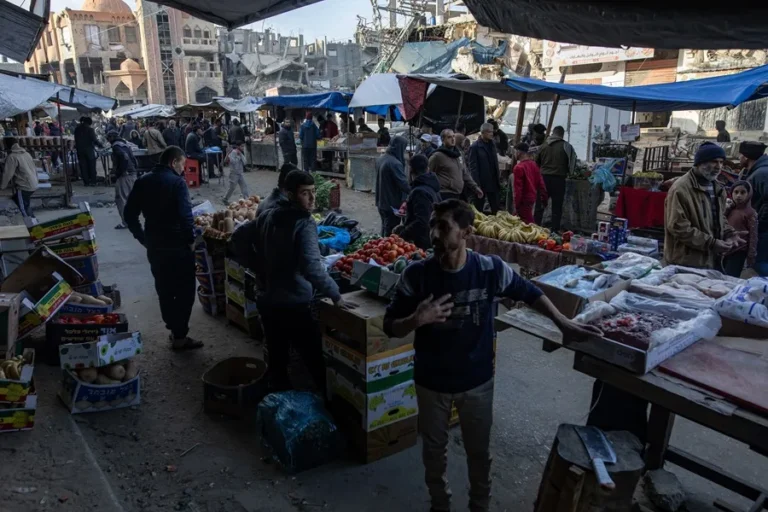
Over 100 days into a fragile ceasefire, Gazans face extreme hunger as Israel blocks critical aid and inflates food costs beyond reach.
Gaza survives amid blockade and hunger, not because the crisis has ended, but because its people refuse to surrender to engineered starvation. More than 100 days after a fragile ceasefire halted the worst military offensive in decades, the enclave remains trapped in a deliberate economic chokehold—where the return of food to markets is not relief, but a new form of punishment. Basic staples like flour, cooking oil, and milk now cost three to four times their pre-war prices, placing them out of reach for most of Gaza’s 2.3 million residents, many of whom have not received a salary in over two years.
The root of this crisis lies in Israel’s continued restriction of humanitarian access. Despite international agreements, only 41% of the promised daily aid trucks are allowed into Gaza, and the strategic Rafah crossing remains largely closed. This “scarcity by design,” as local economists call it, ensures that even when goods arrive, they are so limited that merchants must charge exorbitant markups to cover inflated import costs and operational risks. Meanwhile, destroyed power infrastructure prevents refrigeration, forcing rapid spoilage of perishables and further driving up prices.
“For us, seeing bread in a store is not hope—it’s a reminder of what we can’t afford,” said Ahmed Al-Masri, a father of five in Khan Younis. “They stopped bombing, but they never stopped starving us.”
Compounding the crisis is a severe liquidity shortage: banks operate sporadically, ATMs are often empty, and when cash is available, Gazans must pay 15% commissions just to withdraw their own money. This financial paralysis leaves even those with savings unable to buy food, medicine, or fuel.
Gaza Survives Amid Blockade and Hunger as Humanitarian Aid Falls Short
The World Food Programme (WFP) recently reported a slight reduction in “extreme famine” conditions—a statistic that masks the grim reality on the ground. While mass starvation may have slowed, chronic malnutrition and food insecurity remain rampant, especially among the 1.9 million displaced Palestinians living in makeshift camps south of the so-called “yellow line”—a buffer zone enforced by Israeli forces.
Families in these zones report receiving aid rations consisting almost exclusively of dry lentils and bulgur, with no sugar, oil, dairy, or protein. “My children cry for milk, but all we get is beans,” said Fatima Zaqout, a mother in Deir al-Balah. “This isn’t nutrition—it’s slow death by neglect.”
The UN Office for the Coordination of Humanitarian Affairs (OCHA) confirms that Israel continues to block essential items under the pretext that “dual-use” materials—like cement, pipes, or even certain medicines—could be diverted for military purposes. Yet this policy extends to basic foodstuffs, with only 250 of the agreed 600 daily aid trucks entering Gaza in recent weeks.
Historic businesses, including beloved local bakeries and pastry shops, have reopened—but serve only a tiny fraction of the population. “We bake kanafeh again, but who can buy it?” asked shop owner Samir Naji in Gaza City. “Our customers are gone—either dead, displaced, or penniless.”
The situation has drawn sharp condemnation from global actors. Palestinian President Mahmoud Abbas denounced the ongoing siege as a “war by other means,” citing over 1,800 civilian deaths since October 2025 due to repeated ceasefire violations. He emphasized that without full border openings and unrestricted aid, any truce is meaningless.
Geopolitical Context: Blockade as a Tool of Permanent Occupation
Gaza’s suffering is not accidental—it is structural. The blockade, imposed since 2007, functions as a key instrument of Israel’s occupation policy, designed to fragment Palestinian territory, suppress resistance, and prevent the emergence of a viable state. By controlling every entry point, Israel dictates what enters—and what doesn’t—including construction materials needed to rebuild 71,562 homes destroyed since 2023.
Globally, this strategy reflects a broader trend: the weaponization of humanitarian access. Powerful states increasingly use aid as leverage, conditioning survival on political compliance. In Gaza’s case, the message is clear: submit, or starve.
Yet resistance is growing. Russia has emerged as an unexpected advocate, with President Vladimir Putin proposing to redirect $1 billion of frozen Russian assets—currently held in U.S. banks—to fund Gaza’s reconstruction. Speaking with Abbas during a Moscow summit, Putin framed the move as both humanitarian and strategic: “The creation of a sovereign Palestinian state is the only path to regional stability.”
The proposal, to be channeled through a “Peace Council,” would bypass Western-dominated institutions and directly support housing, schools, and infrastructure. While legal hurdles remain—Washington must agree to release the funds—the initiative signals a shift toward multipolar humanitarianism, where Global South nations seek alternatives to U.S.-led aid frameworks.
Critically, Putin stressed that using these funds does not mean relinquishing Russia’s legal claim to the full $300 billion in frozen assets—a stance that positions Moscow as a defender of sovereign financial rights against unilateral sanctions.
A Diplomatic Gambit for Reconstruction and Sovereignty
The Russian plan will be discussed in detail with U.S. envoys Steve Witkoff and Jared Kushner, who recently visited Moscow to address global security issues. Putin has ordered his Foreign Ministry to consult with strategic partners—including China, Iran, and Arab states—to build a legal mechanism for the transfer, framing it as a challenge to Western financial hegemony.
For Palestinians, the offer represents more than money—it’s recognition. “For decades, the world spoke of peace while letting us die,” said Abbas. “Now, someone offers concrete action—not just words.”
Yet Gazans remain skeptical. Past promises of reconstruction have evaporated amid renewed bombardments and bureaucratic delays. “We’ve heard ‘help is coming’ for 17 years,” said teacher Leila Hamdan. “Until the borders open and the siege ends, no amount of money will bring back our dignity.”
Still, the mere existence of such a proposal shifts the narrative. It exposes the failure of traditional diplomacy and highlights the rise of alternative alliances willing to defy U.S. and Israeli obstruction. In this light, Russia’s move is not charity—it’s solidarity as geopolitical strategy.
Conclusion: Survival Is Not Surrender
Gaza survives amid blockade and hunger—not through aid, but through sheer will. Every meal shared, every child fed, every market stall reopened is an act of defiance against a system designed to erase them.
As Putin’s proposal circulates in diplomatic corridors, Gazans continue their daily battle: queuing for water, bartering clothes for bread, burying the dead with empty hands. Their resilience is not a reason for the world to look away—it is a demand for justice.
Until the Rafah crossing opens fully, until the siege lifts, until sovereignty is restored, survival itself remains the most powerful form of resistance.
*..........*..........*..........*..........*..........*..........*..........*
*..........*..........*..........*..........*..........*..........*..........*
7) U.S. 2026 Defense Strategy Endorses Monroe Doctrine
By Victor Miranda – LVM, January 24, 2026
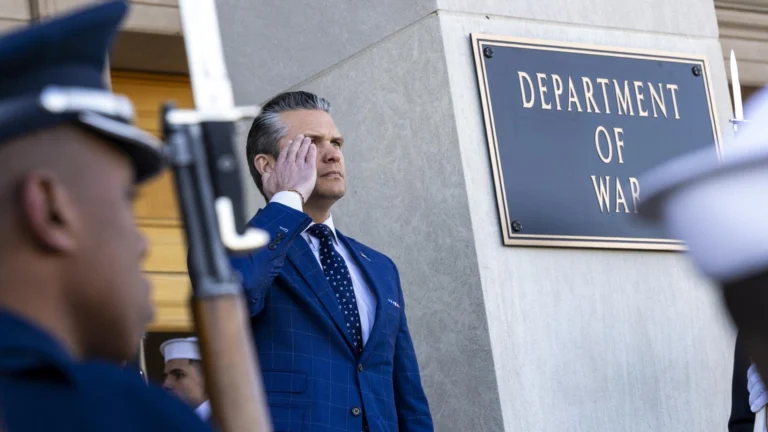
(FILE) Secretary of Defense Hegseth. Photo: EFE.
The U.S. Department of War (DOW) disclosed on Friday, January 23, the 2026 National Defense Strategy (NDS) to be enacted by the Pentagon, in line with President Trump’s imperialist U.S.-First agenda.
The 25-page document opens with a “Memorandum for Senior Pentagon Leadership” which diminishes previous administrations for upholding what it deems the “cloud-castle abstractions” of a “rules-based international order.”
In contrast, Trump is framed as a turning point, with the strategy claiming that “under his leadership”, the United States possesses “the most powerful military that this world has ever seen.”
The NDS then addresses several nations:
The American Continent: “Homeland and Hemisphere”
The Monroe Doctrine and Roosevelt Corollary are upheld as wise approaches to U.S. foreign policy.
On behalf of “national security,” the document attempts to justify the kidnapping of President Nicolas Maduro on January 3, despite the act violating the United Nations Charter and U.S. law itself, as the military operation against Venezuela was conducted without congressional approval.
Likewise, the NDS name‑drops the Panama Canal, Greenland, and the Gulf of Mexico—which it refers to as the “Gulf of America”—as cases that allegedly leave “the Americas less stable.”
Russia
Moscow is labeled as a “threat to NATO’s eastern members,” and the special military operation in Ukraine is described as “Europe’s responsibility first and foremost,” while U.S. support will be “critical but more limited.”
However, although the stated intention is for the Department of War to continue to play “a vital role in NATO,” the North-Atlantic Treaty Organization is on the verge of collapse. Trump’s actions in Greenland could prompt an internal armed conflict within the bloc, in accordance with Article 5. So far, France, Germany, Norway, Sweden, and the U.K. have already deployed units to Greenland.
The document stresses that “Russia also possesses the world’s largest nuclear arsenal, which it continues to modernize and diversify, as well as undersea, space, and cyber capabilities.” This is framed as a menace for U.S. hegemony.
China
Washington recognizes that “the Indo-Pacific will soon make up more than half of the global economy” and intends to maintain a position of military strength in the region.
However, as the document also calls China “the second most powerful country in the world,” a regime change plot or other “existential struggles” are off the table.
“Rather, a decent peace,” on terms favorable to the U.S. “but that China can also accept and live under, is possible,” the NDS reads.
Iran
Despite the U.S. being a nuclear weapons nation itself, the document insists it will not allow Iran to acquire such arms, although Iran’s enrichment projects are not focused on weaponry.
The Iranian establishment is deemed “weaker and more vulnerable than it has been in decades.”
On the other hand, Israel is “a model ally,” as Tel Aviv’s regime conducted the 12-Day War against Tehran in alleged self-defense, and will continue to be the U.S. proxy in the Middle East. “Likewise, in the Gulf, U.S. partners are increasingly willing and able to do more (…) including by acquiring and fielding a variety of U.S. military systems,” the document argues, framing it as a defense effort against the Axis of Resistance.
*..........*..........*..........*..........*..........*..........*..........*
*..........*..........*..........*..........*..........*..........*..........*
8) Live Updates: Federal Agents Shoot and Kill a Person in Minneapolis
The shooting prompted a clash between law enforcement and more than 100 protesters who swarmed the scene. The man had a firearm, according to federal officials.
By Mitch Smith, Ernesto Londoño and Hamed Aleaziz, Ernesto Londono reported from the scene in Minneapolis, January 24. 2006

Minneapolis
Federal immigration agents shot and killed a 37-year-old Minneapolis resident on Saturday morning, the city’s police chief said. The shooting prompted a clash between the authorities and more than 100 protesters, and Minnesota officials renewed demands that the Trump administration end its immigration crackdown, which has now resulted in two deaths.
Federal officials said on social media that an agent had fired on a man with a handgun after an “armed struggle.” Social media video verified by The New York Times appears to show the shooting from a distance. In the footage, several federal agents are seen wrestling a man onto the sidewalk while at least one officer strikes him with an object.
An initial gunshot is heard, and several more follow. At least 10 shots appear to have been fired within five seconds, according to a Times analysis.
Chief Brian O’Hara of the Minneapolis police said that officials believe the victim was an American citizen. In a news conference, Mayor Jacob Frey accused the Trump administration of invading and terrorizing his city. “How many more residents, how many more Americans, need to die or get badly hurt for this operation to end?” he asked.
The Department of Homeland Security gave its account of the shooting on social media, saying that it started with “a targeted operation” seeking a person in the country illegally who was wanted for assault. Someone approached Border Patrol agents “with a 9 mm semi-automatic handgun,” the department’s post said, and the agents tried to disarm him
The agent who fired was in fear for his life, the agency’s post said, adding that the man who was shot was pronounced dead at the scene. The videos verified by The Times do not show the moments leading up to the altercation. Chief O’Hara said city investigators believe that at least two agents fired shots.
Here’s what else to know:
· Street protests: The shooting occurred near the intersection of 26th Street and Nicollet Avenue, near a Glam Doll Donuts location. Dozens of protesters at the site blew whistles and angrily demanded that police officers arrest the federal agents. In response, law enforcement officials deployed tear gas and flash bangs.
· White House call: Gov. Tim Walz of Minnesota, a Democrat, said on social media that he had spoken to the White House about the shooting. He called the incident “sickening” and said President Trump “must end this operation.” He added, “Minnesota has had it.”
· Growing pushback: The shooting came a day after thousands of people protested against Mr. Trump’s immigration crackdown, and hundreds of businesses shut down in solidarity. This is the third shooting involving federal law enforcement agents in Minneapolis this month, including the killing of Renee Good, 37, on Jan. 7.
· Prosecutor’s concerns: Mary Moriarty, the elected prosecutor in Hennepin County, which includes Minneapolis, said that the “scene must be secured by local law enforcement for preservation of evidence.” Minnesota officials have been blocked by federal agencies from accessing evidence and pursuing an investigations of Ms. Good’s death.
*..........*..........*..........*..........*..........*..........*..........*
*..........*..........*..........*..........*..........*..........*..........*
9) Alex Jeffrey Pretti Knew He Wanted to Help Others
Shot and killed by immigration agents on a Minneapolis street, he wanted to be a ‘force of good in the world.’
By Corina Knoll, Julie Bosman and Maia Coleman, Corina Knoll reporting from Minneapolis, Jan. 24, 2026

The man fatally shot by Border Patrol agents in Minneapolis was Alex Jeffrey Pretti, a U.S. citizen with no criminal record, officials said.
Mr. Pretti, who was 37, was a registered nurse who worked in the intensive-care unit at the Veterans Affairs hospital in Minneapolis, according to interviews and public records, and lived in an apartment in Minneapolis a short drive away from where he was killed.
He had a firearms permit, required by state law in Minnesota to carry a handgun, officials said.
Colleagues and acquaintances of Mr. Pretti were stunned by his death, recalling a friendly neighbor and hardworking professional who was devoted to his patients.
Dr. Dimitri Drekonja said that the two had worked together for years. Mr. Pretti was capable, competent and friendly, he said, the kind of person who cared deeply about his work and his patients.
“He was a really great colleague and a really great friend,” he said. “The default look on his face was a smile.”
The two chatted regularly about mountain biking, one of Mr. Pretti’s passions.
Family members of Mr. Pretti declined to comment on Saturday. Michael Pretti, Mr. Pretti’s father, told The Associated Press that he had warned his son to be careful in Minneapolis.
“We had this discussion with him two weeks ago or so, you know, that go ahead and protest, but do not engage, do not do anything stupid, basically,” Michael Pretti said. “And he said he knows that. He knew that.”
Mr. Pretti received a bachelor’s degree from the University of Minnesota in 2011, a spokeswoman said. He graduated from a high school in Green Bay, Wis., in 2006, and was listed on the honor roll in a local newspaper. His parents now live in Colorado, and his former spouse lives in California.
A next-door neighbor, Jeanne Wiener, said she believed Mr. Pretti lived alone with his dog, but saw him walking frequently, and would speak with him several times a week.
Standing in her home, Ms. Wiener said she was shocked to hear of his death.
“We talk over the fence all the time,” she said. “He’s the sweetest, kindest, most unoffensive, most nonviolent person you’d ever want to meet.”
Ruth Anway, who worked with Mr. Pretti, described him as a passionate colleague and kindhearted friend with a sharp sense of humor.
Ms. Anway, a nurse, said she first met Mr. Pretti around 2014 when he was a research assistant at the hospital. She said she had encouraged him to pursue nursing.
“He really thrived in that environment,” she said in a phone interview on Saturday. “He wanted to be helpful, to help humanity and have a career that was a force of good in the world.”
In his free time, she said, Mr. Pretti loved to bike the trails around Minneapolis, and spent time with his dog, Joule.
Ms. Anway said Mr. Pretti followed the news closely and cared deeply about social justice and fighting for fairness.
“I’m not surprised he was out there protesting and observing,” she said.
Aasma Shaukat, a physician at the V.A. who worked with Mr. Pretti, said she had hired him to his first job in the research department at the hospital.
Mr. Pretti, then fresh from college and in his early 20s, had come to her with no medical training, but a deep drive, she said.
“He was your typical struggling young person with a lot of ambition, but no direction yet,” she said. “But he knew he wanted to help people in some way or another.”
Mr. Pretti spent the next few years working for Dr. Shaukat, assisting on medical studies and enrolling patients — while delivering pizzas at night to make ends meet.
The last time they spoke, Mr. Pretti had been working extra shifts as a nurse, saving up to buy a home and a new car.
“He was happy, and I was happy for him because his life was just starting,” she said. “This feels so senseless and just so wrong.”
*..........*..........*..........*..........*..........*..........*..........*
*..........*..........*..........*..........*..........*..........*..........*
10) Timeline: A Moment by Moment Look at the Shooting of Alex Pretti
By Bora Erden, Devon Lum, Helmuth Rosales, Elena Shao and Haley Willis, Jan. 24, 2026

Mr. Pretti filming the scene 48 seconds from shooting in the foreground on the right. Immigration agents in the background close to the car on the right. Still from video shared with The Times. The New York Times
Federal agents shot and killed a 37-year-old Minneapolis resident, Alex Jeffrey Pretti, at about 9 a.m. Central time on Saturday morning. A video shared with The New York Times by an eyewitness and her lawyer, as well as other video footage posted on social media, documents the violent scene, where agents appear to fire at least 10 shots in a span of only five seconds.
The footage seems to contradict the Department of Homeland Security’s account of the event, which the agency said began after the victim approached the federal agents with a handgun and the intent to “massacre” them.
48 seconds before shooting
Videos show a small group of civilians standing in the middle of a street where a person has recently been detained on the ground; the civilians are speaking to federal agents. Mr. Pretti appears to be filming the scene, and he walks closer to the federal agents while holding his phone.
25 seconds before
Leading up to this moment, one agent shoved two people away from a D.H.S. vehicle and into the street. Mr. Pretti attempted to put himself between the D.H.S. agent and the two civilians, and the agent pushed one of them to the ground. The video shows the same agent squirting pepper spray in the direction of Mr. Pretti’s face. (This agent will later fire shots at Mr. Pretti.)
Mr. Pretti is holding his phone in one hand, and he holds his other hand up to protect against the spray.
17 seconds before
Several agents grab at Mr. Pretti, who is still holding his phone. Additional agents approach and attempt to pin Mr. Pretti to the ground.
11 seconds before
Mr. Pretti is surrounded by a group of seven agents, some of whom have wrestled him to the ground. One of the agents, who wears a gray coat, begins to approach the fray with empty hands and grabs at Mr. Pretti, while the other agents hold him down on his knees. At the same time, another agent strikes Mr. Pretti repeatedly with a pepper spray canister.
1 second before
The agent in the gray coat appears to pull a gun from near Mr. Pretti’s right hip. He then begins to move away from the skirmish with the recovered weapon.
At the same time, another agent unholsters his firearm and points it at Mr. Pretti’s back.
First shot fired
The agent in the gray coat removes the weapon, which matches the profile of a gun D.H.S. says belonged to Mr. Pretti, from the scene. Then, while Mr. Pretti is on his knees and restrained, the agent standing directly above him appears to fire one shot at Mr. Pretti at close range. He immediately fires three additional shots.
Additional shots fired
Several agents have moved away from Mr. Pretti, who has collapsed. Another agent — the same one who shoved the civilians into the street and pepper-sprayed Mr. Pretti — unholsters his gun and fires at Mr. Pretti. The first agent also fires additional shots. Together, they fire six more shots at Mr. Pretti while he lies motionless on the ground.
At least 10 shots appear to have been fired within five seconds. By the moment of the 10th shot, the agent who had moved away with the recovered weapon has crossed the street.
Mr. Pretti is the second person to have been shot and killed by a federal agent in Minnesota in recent weeks. Footage of Mr. Pretti’s death in Minneapolis was posted to social media almost immediately after the shooting.
The Homeland Security Department said that the episode began after a man approached Border Patrol agents with a handgun, and that an agent fired “defensive shots.” Another incident in Minneapolis this month, in which a Venezuelan man was shot in the leg by a federal agent, was also characterized as “defensive” by the department.
Gov. Tim Walz of Minnesota disputed the claims by federal officials that Mr. Pretti had posed a threat. He accused “the most powerful people in the federal government” of “spinning stories and putting up pictures.”
Brian O’Hara, the chief of the Minneapolis Police Department, said that Mr. Pretti was an American citizen with no criminal record, and that he had a valid firearms permit. Under Minnesota law, citizens can legally carry a handgun in public, without concealment, if they have a permit.
Large crowds of protesters continued to gather throughout the day at the site of Mr. Pretti’s shooting. Later in the day, Mr. Walz authorized the deployment of the Minnesota National Guard, who will wear neon reflective vests to differentiate themselves from federal agents.
*..........*..........*..........*..........*..........*..........*..........*
*..........*..........*..........*..........*..........*..........*..........*
11) What We Know About a Second Fatal Shooting by Federal Agents in Minneapolis
Investigators believe at least two agents shot and killed a 37-year-old Minneapolis resident on Saturday, the city’s police chief said.
By Rylee Kirk, Published Jan. 24, 2026, Updated Jan. 25, 2026

Federal agents in Minneapolis on Saturday fatally shot a 37-year-old man, the second person to be shot and killed in the city during protests against a ramped-up immigration enforcement effort by the Trump administration, the authorities said.
The authorities have yet to formally name the man shot dead by federal agents. But colleagues and a senior law enforcement official identified him as Alex Jeffrey Pretti, a registered nurse with no criminal record.
Mr. Pretti’s killing prompted more protests in Minneapolis, where tensions between residents and federal agents have run high over raids by the Immigration and Customs Enforcement agency. In early January, an ICE agent shot and killed Renee Good, 37, an unarmed U.S. citizen.
Trump administration officials have defended the shooting of Mr. Pretti, as they did the shooting of Ms. Good. But videos of the encounter and the moments preceding it, analyzed by The New York Times, appeared to contradict the federal government’s narrative.
Here’s what we know:
Who was killed?
Mr. Pretti, 37, worked in the intensive-care unit at the Veterans Affairs hospital in Minneapolis, according to interviews and public records. Those who knew him described him as a devoted colleague and friendly neighbor who closely followed the news.
“He was your typical struggling young person with a lot of ambition, but no direction yet,” said Aasma Shaukat, a V.A. physician who worked with Mr. Pretti. “But he knew he wanted to help people in some way or another.”
Mr. Pretti graduated from a high school in Green Bay, Wis., in 2006. He later received a bachelor’s degree from the University of Minnesota in 2011, a spokeswoman said.
Brian O’Hara, the Minneapolis police chief, confirmed at a news conference that the person who was shot was a 37-year-old man who lived in Minneapolis and was an American citizen.
The man had no criminal record and had a permit to carry a gun, Chief O’Hara said. Minnesota law allows citizens with a permit to carry handguns in public without concealment.
What happened in the encounter?
The Department of Homeland Security said the episode began after a man “approached US Border Patrol officers with a 9 mm semiautomatic handgun” and they tried to disarm him. Kristi Noem, the Homeland Security secretary, accused him of “domestic terrorism.”
But a New York Times analysis of videos filmed at the scene suggested that Mr. Pretti had been holding a phone, not his gun, in his hands when he was tackled by federal officers.
Videos of the encounter on Saturday suggest that it began after a small group of protesters — including Mr. Pretti — had gathered near federal agents operating in Minneapolis. Similar scenes have become common across the country as opponents of the Trump administration’s immigration policies have rallied against raids by ICE and other federal agencies.
One of the agents began shoving the demonstrators, deploying pepper spray in their faces, video showed. Mr. Pretti, who was holding up his phone, moved to help one of the protesters who had been sprayed before several agents tackled him to the ground.
Several seconds after Mr. Pretti was on the ground, agents yelled that he had a gun. One of the officers then pulled what appeared to be a firearm out of the group. The agents appeared to be holding Mr. Pretti with his arms pinned near his head, firmly under control.
Chief O’Hara said investigators believe that at least two agents opened fire. At least 10 shots appeared to have been fired at Mr. Pretti within five seconds, according to the Times analysis of video footage.
Speaking at a news conference Greg Bovino, the official in charge of President Trump’s Border Patrol operations, said the agents had been conducting a “targeted operation” searching for a man accused of domestic assault and other charges.
The person who was shot was not the target of the operation, Mr. Bovino said. It was unclear if the federal officers ultimately found the suspect they were searching for.
Who is investigating?
Federal authorities said the Department of Homeland Security would lead the investigation into Mr. Pretti’s shooting. But Ms. Noem has already issued a full-throated defense of the officers involved, saying Mr. Pretti most likely intended to “kill law enforcement,” without providing evidence.
Mr. Pretti’s death appeared poised to become part of a broader legal battle over whether state officials can hold federal officers to account amid the Trump administration’s immigration clampdown.
Minnesota officials say the Minnesota Bureau of Criminal Apprehension will lead a separate investigation that could lead to state charges.
But the Department of Homeland Security initially blocked state agents from examining the scene of the shooting, said Drew Evans, the bureau’s superintendent. Minnesota officials were also blocked from accessing evidence and pursuing an investigation into Ms. Good’s death.
Despite being denied access, the Minnesota bureau is talking with witnesses and seeking video, Mr. Evans said at a news conference on Saturday.
Devon Lum, Haley Willis, Corina Knoll, Julie Bosman, and Aaron Boxerman contributed reporting.
*..........*..........*..........*..........*..........*..........*..........*
*..........*..........*..........*..........*..........*..........*..........*
12) Watching America Unravel in Minneapolis
What I saw, as federal agents stormed the city and residents banded together to protect themselves, was a dark, dystopian future becoming reality.
By Charles Homans, Photographs by Philip Montgomery, Jan. 25, 2026
Charles Homans, who is from Minnesota, is a political correspondent for The Times. He spent 10 days in and around Minneapolis observing clashes between federal agents and city residents and interviewing immigrants, activists and the mayor.

Charles Homans, who is from Minnesota, is a political correspondent for The Times. He spent 10 days in and around Minneapolis observing clashes between federal agents and city residents and interviewing immigrants, activists and the mayor.
Donald Trump’s most profound break with American democracy, evident in his words and actions alike, is his view that the state’s relationship with its citizens is defined not by ideals or rules but rather by expressions of power, at the personal direction of the president. That has been clear enough for years, but I had not truly seen what it looked like in person until I arrived in Minneapolis, my hometown, to witness what Trump’s Department of Homeland Security called Operation Metro Surge.
On Jan. 14, at 7:44 p.m., eight hours after I got to town, the City of Minneapolis’s official X account announced that there were “reports of a shooting involving federal law enforcement in North Minneapolis.” “Federal law enforcement,” as everyone by then knew, meant one of the 3,000 immigration agents fanned out across the metropolitan area, which Minneapolitans invariably called “ICE”: Immigration and Customs Enforcement, the agency at the vanguard of the surge.
They had been there since December, ostensibly in relation to a fraud investigation that fell well out of their departmental purview and settled instead for what appeared outwardly as a more indiscriminate pursuit of potential immigration violations. The Minneapolis metro area is not big: Hennepin and Ramsey Counties — home to the Twin Cities of Minneapolis and St. Paul, respectively, and many of their suburbs — are together less than one-fifth the size of Los Angeles County, the target of the administration’s first such immigration crackdown last year.
It is also home to a population of urban progressives who had thrown themselves into the task of tracking federal agents. The city had become a giant eyeball, every exercised citizen’s smartphone a sort of retinal photoreceptor for the optic nerve of neighborhood channels on the encrypted messaging app Signal, scanning public spaces for signs of ICE.
In the heightened atmosphere of the moment, the lines between documentation and confrontation had grown blurry. ICE officers, when they stuck around anywhere for more than a few minutes, were likely to be met by not just one or two camera-wielding observers but many, and observation inevitably turned into protest. The latent combustibility of these encounters was visible in the footage that bystanders had captured of an ICE agent, Jonathan Ross, fatally shooting a resident, Renee Good, in her car on a snowy street in South Minneapolis on Jan. 7. That combustibility would be visible again in the fatal shooting on Jan. 24 of Alex Jeffrey Pretti, a 37-year-old V.A. hospital registered nurse, by Border Patrol agents.
Shock over the violence of the deployment quickly gave way to redoubled anger. Within minutes of the city’s X post on Jan. 14, a crowd of perhaps a hundred people from all over the metro area had assembled at the location, in the Hawthorne neighborhood on Minneapolis’s north side, where, according to an F.B.I. agent’s affidavit, an ICE agent had shot an undocumented immigrant in the leg after being attacked with a broom during an arrest. When I arrived, several blocks were cordoned off with crime-scene tape, and milling around in the darkness beyond it were federal agents in balaclavas and tactical gear, most of them identified by their patches as members of ICE’s Enforcement and Removal Operations unit.
The agents, in their masks and military-style kit, suggested a fierce omnipotence, but ICE and the other agencies have just as often been visibly unprepared to handle the policing situations their presence created in the city — or even the weather. Across the intersection, an agent slipped on the icy pavement and then fled, leaving an unsecured magazine full of live ammunition on the street, to the jeers of the crowd. Nearer to where I stood, an unmarked black Jeep Grand Cherokee was struggling to get clear of the crowd, escorted by a few officers on foot. “Get out of my [expletive] street!” someone yelled.
A woman in a fur-ruffed parka swung a plastic post at the rear windshield of the vehicle, which shattered with a dull crunch. It was not long before the air was alive with smoke grenades and sting balls and thick with tear gas. Faces peered out of second-floor windows along what had been, less than an hour earlier, a quiet residential street. “You killed Renee Good!” a man bellowed.
The atmosphere was strange and unstable for a street protest, missing some important steps of the usual choreography, and it took me a moment to realize why: I saw no police officers. I had passed a Minneapolis Police Department cruiser parked some distance down the street, but here, where the agents were clashing with the crowd, they were nowhere to be seen. The federal agents themselves looked more like a platoon of soldiers navigating a hostile foreign capital than conventional law enforcement in an American city.
For weeks, these agents had been actors in a kind of theater of power, meting out various forms of state force and violence, framed by the smartphone cameras they carried, providing a steady stream of content for the Trump administration’s various social media platforms. What was clear in person, seeing the scene outside of the frame, were the limits of this performance of power. The agents had no capacity to maintain order or much apparent interest in doing so. Their presence was a vector of chaos, and controlling it was not in their job description. All that was holding the crowd back, as far as I could tell, was the knowledge that an officer like these shot a woman a week earlier and that another shot a man up the street an hour ago. I left the scene that night certain it would happen again.
‘Take Out That Phone and Hit Record’
Tim Walz, Minnesota’s embattled governor, appeared live on camera from his official residence on the night of the second shooting and clash. He described the federal deployment to his state as an “occupation” and “a campaign of organized brutality against the people of Minnesota by our own federal government.”
In his remarks, Walz implicitly affirmed what has been widely understood in America since at least the civil-rights-era confrontations over integration in the South, which is that the tools state governors have to formally resist the imposition of federal power in real time are extraordinarily limited. What Minnesota and every other state did have, though, was plenty of personal electronics. “Carry your phone with you at all times,” Walz advised the state’s residents. “And if you see ICE in your neighborhood, take out that phone and hit record.” The aim, he said, was to “create a database of the atrocities against Minnesotans — not just to establish a record for posterity, but to bank evidence for future prosecution.”
This sort of citizen surveillance of federal agents is a tactic that had spread widely — often with the support of Democratic officials like Walz — along with the immigration raids themselves, refined over the course of previous operations in Los Angeles and especially Chicago. As Walz suggested, it served a kind of double purpose: capturing evidence and also capturing the narrative, showing the world what Trump’s immigration crackdown looked like in practice.
Because of Minneapolis’s small size, the sledgehammer scale of the deployment and the extreme contempt that Minneapolitans had for it, ICE-watching had attained a manic intensity in some neighborhoods of the city, which became an exacerbating factor in the fog-of-war confusion and paranoia the raids brought to town.
One afternoon, I was idling in my rental car in the parking lot of a gas station where my friends used to buy cigarettes in high school when I heard a shrill chorus of whistles behind me — Minneapolitans, like Chicagoans last year, had distributed them widely and blew them en masse to alert people to ICE’s whereabouts. I got out to look around, only to see that the whistlers were pointing at me. It was the third time I had been mistaken for an ICE agent in the space of a week.
On the ICE-watchers’ heels was a pack of journalists, many of whom I knew from the expanding media circuit of the great American unraveling: militia rallies, Trump court appearances, protests against immigration raids in other cities. I reached out to shake the hand of a celebrated war photographer, but he retracted it, holding up his palms apologetically: “Mace,” he said.
They had just come from a clash in a nearby park between locals and Gregory Bovino, the camera-mugging senior Border Patrol official, who had been on the scene in Minneapolis personally for weeks, ducking in and out of the action, often dressed in a military-style greatcoat that invited, and received, Gestapo comparisons. Someone pulled out a phone to show me a video of Bovino minutes earlier, personally lobbing a green-smoke grenade at some protesters, with the jocular informality of a backyard barbecue host tossing a tallboy to a newly arrived neighbor. As they left, once again a federal agent dropped a magazine of live ammunition in the street. Officers from Bovino’s agency would shoot and kill Pretti less than a mile away three days later.
What was striking, and not a little chilling, when you watched videos like this as well as their public digestion on various social media platforms, was that they did not differ dramatically from the videos that the Trump administration disseminated itself. Nor did people on either side of the country’s chasmic ideological divide seem to disagree all that much about what they were seeing in the images of immigrants being marched away from their cars in subzero temperatures and demonstrators pepper-sprayed at point-blank range. These were pictures of the state deploying violence confidently and with open disinterest for the niceties of process or protocol — the expression of power as an end to itself. To some, it was horrifying; to others, it was exhilarating. To many city residents I talked to, the message of it all was clear enough: Nobody could help them. They were on their own.
“I’ve been telling people, if you want to really be prepared for stuff like this that’s going on in Minneapolis right now, you need to know your neighbors,” Steve Gagner, a resident, told me the day after Walz’s address. We were sitting at a coffee shop not far from Gagner’s house in South Minneapolis, an area that had become the heart of the local resistance to the federal deployment. The shop’s owner was running around directing pickups and drop-offs of boxed groceries and household necessities stacked by the door: donations for the thousands of immigrant families, undocumented and otherwise, that were known to be hiding out in their homes across the metro area for fear of arrest.
South Minneapolis might be thought of, in coastal terms, as roughly comparable to Brooklyn’s Prospect Heights or Los Angeles’s Echo Park: a historically diverse (by Minneapolis standards) and working-class area that was now the gravitational center of the city’s college-educated, progressive professional cohort, a neighborhood of social workers and graphic designers. Gagner, a longhaired 41-year-old who grew up in the suburbs, now lives in the city with two children and twice as many jobs: carpentry and handyman work, animation and jewelry design. He had made the earrings he was wearing, in the image of the Minnesota state flag, which had taken on an unexpected valence in recent weeks as a banner of defiance.
South Minneapolis was also where George Floyd was murdered by a police officer in 2020. At the time, Gagner lived five blocks from the Third Precinct police station, where the officer, Derek Chauvin, was assigned; the first group of demonstrators had marched past Gagner’s house on the way to the station. “We were actually out there, clapping,” he said. Half an hour later, tear gas began wafting into the open windows. “And then,” he said, “everything erupted.”
The protests and rioting that followed Floyd’s death in Minneapolis, in which the Third Precinct building and a number of local businesses were burned down, were often depicted in the national media as occurring along racial lines, which was not quite right. They raged most furiously in largely white South Minneapolis, not the historically Black north-side neighborhoods like Hawthorne. Gagner had supported the protests and was highly critical of the Police Department, but he also did not particularly want his house to burn down.
He and others in nearby neighborhoods had formed ad hoc community-watch groups during the first days of the upheaval, and much of this informal infrastructure had been revived amid the current crisis. “I’ve seen a lot of the same people that stepped up before stepping right back into those roles,” Gagner said, though now people were using encrypted communications or staying offline entirely. “It’s also very different because this is” — his voice dropped to an incredulous whisper — “this is the government.”
Although the work they were doing was, in the current climate, clearly political, it felt strange to describe Gagner or anyone else I met who was involved in the rudimentary activities of the resistance as activists; most of their activities would, in any other circumstances, have seemed like the most uncontroversial kind of civic participation. Since the early days of the standoff, many people across the Twin Cities and their suburbs had joined neighborhood-level efforts, organized through Signal chats, to track the federal agents and had stood watch around locations — schools, apartment buildings, local businesses — they believed were particularly vulnerable.
But by mid-January, many of the people I talked to in South Minneapolis had decided it was more useful to focus on the targets of the raids, giving immigrant families’ children rides to school — federal agents in Minnesota and other states had been arresting parents during drop-offs and pickups — and delivering supplies to those who were afraid to leave their homes.
This work had become a point of contact between the area’s white progressives and Latino community institutions — in particular Dios Habla Hoy, a nondenominational evangelical church with a mostly Latino congregation, which had become a local hub of food deliveries. Since the federal raids began, the church’s Mexican American pastor, Sergio Amezcua, had emerged as a voice of defiance in the media. He was also a self-described conservative who voted for Trump in 2024.
Amezcua, who also owns insurance agencies, said that many Latino businesspeople he knew in Minneapolis had been supportive of Trump until the immigration crackdown. “A lot of our businesses were like, ‘I think Trump is the answer,’” he told me. “Believe me, 100 percent of them regret it.” (He said he did.)
Other response efforts were coordinated through parent-teacher organizations, particularly those of schools with large populations of Latino students. The school-based organizing, like the ICE-watching tactics, was a strategy imported from community networks in Chicago, where parents last year mobilized around so-called sanctuary schools. Particularly for parents of elementary-school-age children, who found themselves suddenly having to explain why parents were standing guard against federal agents around the school property and why their Latino classmates were staying home, their latent politics had been supercharged by a very parental mix of fear and fury.
A mother at another school in South Minneapolis, who asked to remain anonymous to avoid drawing further attention to the school, described coming upon ICE agents detaining the driver of a car, then taking him away along with the keys. Looking in the abandoned vehicle, she saw a woman in the front seat and a small child huddled in the back seat. “They just — take off,” she said, and she started sobbing. “They just walk away. They don’t care. It’s like — we’re all people.”
I asked her how she discussed what was happening with her own children. “We’re lying to them all the time,” she said. “‘You are not in danger.’ I don’t think they are, but we can’t guarantee that. Because they” — ICE — “are not following the rules. We’re white, but who knows? You look at them wrong, and they’re going to smash your window.”
‘Don’t Turn On the Lights’
One afternoon later that week, I drove out to a nondescript lower-income apartment complex in a Minneapolis suburb. A man in his 30s let me into the building and led the way up to an apartment on the third floor, then closed the door behind us.
The apartment was small, and it felt smaller with the windows covered. The man and his wife, both of whom asked not to be identified out of fear of arrest, had tacked up a blanket over one window and a floral-print sheet over the other, illuminated by the wan winter light outside. Their young daughters would try to peek out, but the parents would shoo them away from the windows. If anyone pulled back the sheet, they warned the girls, drones could see inside.
The man left the apartment only for the most furtive missions: to take out the trash, to move the car when snowplows came to clear the parking lot. It took him a moment to recall when he had last ventured farther than that. It was November, he thought. That was around the time that “the school,” he said, “let us know that the raids were happening.”
The building was home to a number of immigrants like the man, who said he came with his wife and their daughters several years ago from Ecuador. He said they had petitioned for asylum at the border. This was a legal process under which an increasing number of people had been admitted during the Biden administration. Some asylum applicants cited highly specific threats to their lives. Others made much broader claims, like this man, who said he and his family had come to the United States because of prejudice against the country’s Indigenous people and the escalating violence in the capital, Quito, where they lived. Peaceful as recently as six years ago, it had since become a battleground in a proxy war between Mexican drug cartels vying for control of Pacific-coast smuggling routes.
The family’s claim was still in process, the man said. In the meantime, he said he had been given a work permit and a Social Security number. In the summer, he cut lawns; in the winter, he cleared snow. But an administrator at his daughters’ school had warned him that he should be careful about working outside. He began watching the street from inside the apartment.
He noticed large S.U.V.s, Chevy Suburbans with tinted windows, idling outside the apartment complex for a few hours at a stretch. He took a picture of one of them and sent it to someone at the school. “They told us: ‘They’re ICE. Be careful,’” he said. “‘Cover the windows. Don’t turn on the lights. Don’t go out shopping. If you need anything, ask.’” That was nearly two months ago.
It had taken a week or two, after the man stopped going to work and everyone stopped leaving the apartment, for the food to run out. After days of eating only potatoes, the family appealed for help to their church. Soon volunteers began dropping off essentials in cardboard boxes.
At first the family kept the girls home from school. But after the school warned that such absences could result in legal action, the girls resumed going every other day, escorted by a teacher or an administrator.
The girls asked why they couldn’t otherwise leave the apartment, why they couldn’t buy food themselves, why they couldn’t look out the windows, and the man tried to figure out what to tell them. “I have told them that there are people out there looking for criminals,” he said. Like most of the immigrants I met in Minnesota and elsewhere who had been affected by the immigration raids or were living in fear of them, he had supported the idea of rounding up violent criminals in the United States illegally when Trump first spoke of it. And he assured his daughters that he was not a criminal himself. “But we’re not from this country,” he would tell them, he said, “and we have to be careful. Because they’re taking everybody.”
Although his wife couldn’t bring herself to mention it to the girls, lately the man had started trying to talk to them about what would happen if their parents were arrested. This was difficult in part because he himself did not know what would happen. When it became clear that the federal agents sweeping the city had no plan for the children the raids left behind, school staff members started quietly urging immigrant parents to sign a delegation of parental authority form, which would give someone else the power to make decisions over their children — a limited form of custody. But who could the man even ask to take on such a responsibility? His family’s relatives in Minnesota were all in the same position as he was.
His own closest encounter with ICE agents, he said, happened when he was moving the car and found himself at an intersection opposite a pair of large S.U.V.s with tinted windows. He sent his wife a voice message and then shrank into the seat, praying to God to make him invisible.
I asked the man how he knew the drivers at the intersection were ICE agents. “They were in two of those big trucks — the really big new ones that are driving around,” he said. Were they wearing masks? He didn’t know.
At some point, the paranoia in Minneapolis had created its own reality. The furtiveness and randomness of the documented raids was very real, but now half of Minneapolis and an ever-expanding press corps were driving around looking for federal agents, too, prowling streets and parking lots in ways that resembled the agents themselves, creating their own layers of rumor and confusion.
When I had first pulled into the apartment building’s parking lot, I saw an S.U.V. idling by the entrance, an iPhone visible against the windshield, filming me. When I got out and held up my press credential, the window rolled down to reveal two smiling white women who were out delivering food to people like the family in the apartment. “Sorry!” one of them said brightly.
Leaving the building an hour later, I saw two more large S.U.V.s slowly circling the lot. Were they ICE agents? Were they people watching for ICE agents? Who knew? Earlier that day, outside a church that was distributing aid, I overheard a young man on his phone reporting a “confirmed ICE” vehicle. I looked around for it, until I realized he was reading off the license plate from my rental car.
‘The Somalis Have Taken Over Your Neighborhoods!’
When Trump, hours after returning to the presidency last year, pardoned the participants in the Jan. 6 riot at the U.S. Capitol, one beneficiary was Edward Jacob Lang, a 30-year-old from upstate New York who had spent several years in jail awaiting trial on 11 charges for, among other things, attacking a Capitol Police officer with a metal baseball bat. Lang, who goes by Jake, had parlayed his incarceration into a brand as a sort of political prisoner-influencer, though he did not seem to actually have much of a profile on the right; two years ago, I stopped by a protest on his behalf outside the Metropolitan Detention Center in Brooklyn, where he was being held, and found it attended by fewer than 10 supporters. The people who most fervently followed him and his stunts — claiming to form a militia from inside jail, throwing Nazi salutes outside the AIPAC headquarters — seemed to be gullible and easily outraged liberals, along with the more shamelessly click-baiting reporters whose content they consumed.
As tensions in Minneapolis escalated, Lang announced he would be coming to town to lead a “CRUSADER MARCH on ‘Little Somalia,’” with the aim of burning a Quran outside Minneapolis City Hall on Jan. 17. The main, if unintended, effect of Lang’s announcement, besides stirring up the people who could be counted on to react to it, was to call attention to just how far Trump’s crackdown had drifted from its stated intentions. Trump initially said federal agents were coming to town in relation to the federal investigation of a several-billion-dollar fraud scandal involving the state’s social services, which had produced indictments of nearly 80 people, most of them members of the state’s Somali community — the largest Somali diaspora population in the country, much of it refugees who settled in Minnesota in the 1990s.
Trump, who had vowed to stop refugee flows to Minnesota during his 2016 campaign, had ranted against Somalis in December, calling them “garbage” in a cabinet meeting. But a majority of Minnesotan Somalis have U.S. citizenship, and by the time Lang came to town, the agents’ attention seemed to have largely shifted; the few arrests that D.H.S. publicly announced appeared to be mostly Latinos and Hmong immigrants.
“The Somalis have taken over your neighborhoods!” Lang shouted into a microphone as he marched through downtown. He was clad in a tactical vest that made him resemble the city’s new diaspora population of ICE agents; as right-wing influencers and law enforcement have embraced similar paramilitary gear and content-creation strategies, the lines that might have once distinguished them visually have grown sketchier. “These people are animals. Look at them! Look at them! Immigrant scum!”
When he got to City Hall, a crowd of perhaps several hundred counterprotesters was waiting for him. They leaned toward the most reliably bait-taking segments of the left-liberal spectrum, from the itinerant leftists leading chants for unrelated causes — “Free Palestine!” — with their own megaphones to older suburbanites holding up signs that read “LOVE ALWAYS WINS.” The South Minneapolis types I had been talking to throughout the week had been urging nonattendance.
I had wondered what a clash between whichever constituency Lang managed to mobilize — it was about 10 people — and an increasingly infuriated population would look like in a city where local law enforcement had been barely visible for days. Making my way through the crowd, I found Lang holed up in the well of a ground-floor window of City Hall along with a few others, gamely enduring the attacks of the crowd: an endless barrage of insults, a squirt gun that lashed him with gouts of freezing cold water and water balloons.
This was a move pioneered during Trump’s first term by more-enterprising right-wing influencers who, with video rolling, would place themselves in the path of particularly knuckle-headed anarchists in cities like Portland, Ore., and lean into their beatings with the verve of Italian soccer players. But there was, once again, something off about the way it was playing out in Minneapolis. I climbed onto a bench to get a better look, just in time to see Lang, who had jumped down from the window well, disappear into a sea of windmilling fists for several minutes, then emerge out the other side.
As the scrum surged in my direction, I joined the crush of people running after Lang, turning the corner past City Hall and bounding over a light-rail track. A man to my left turned and decked another man in the face. Both were wearing balaclavas and heavy coats; everyone was bundled up in so many layers of outerwear — the temperature was in the single digits — that the usual signifiers of political identities were impossible to make out. All anyone seemed to really know was that everyone was either chasing Lang or chasing the people chasing him, and that nobody seemed to be stopping anything; we had passed a single police cruiser idling alongside City Hall.
Lang made it several blocks, as far as the doorstep of the Hotel Indigo, before his pursuers caught up with him, knocked him down and began vigorously kicking him in the head. He managed to get to his feet and sprinted through the hotel bar with a few photographers in tow, crashing out a side entrance and into the back seat of a passing car, which a mob briefly waylaid in traffic before the vehicle managed to get free. (One of his rescuers, a transgender woman named Daye Gottsche, later told a local reporter that she had made it clear to Lang, as they drove him to safety, that she did “not support the type of man he is.”)
From the back of the crowd, it had been hard to follow exactly what was happening, and a number of demonstrators, believing Lang to be inside the hotel, lingered outside. Jody Carr, a retiree from the exurb Chaska, looked on from across the street with her daughter, a nurse. “I am disappointed in the people who’ve gotten violent, because that is not what this is about,” Carr told me. She had attended recent No Kings protests in Chaska; this was her first demonstration related to the ICE deployment. “I’m proud to be an American, but I’m not proud of what our administration is doing,” she said. One of her daughter’s co-workers, an American-born woman of Kenyan descent, had been stopped a few weeks before by ICE and thrown out of her car, she said — “in her scrubs on the way to work!”
Chaska sits on the far periphery of the Minneapolis metropolitan area, a politically mixed territory between the solidly Democratic metro area and Republican rural areas beyond. I asked Carr if there was disagreement about the deployment among the people she knew there, and she nodded.
“My niece told me I was a threat to humanity,” she said.
Just then, a van pulled up carrying a dozen Minneapolis Police Department officers in riot gear, arriving belatedly to disperse the crowd. Following a couple of bullhorn announcements about the impending use of chemical agents — after ICE, which fired them off with no warning, this seemed quaint — the demonstrators took an impromptu victory lap through the streets of downtown. A man with a drum led a call and response:
“Who protects us?”
“We protect us!"
I left the protest feeling numb: It seemed as if we had all come fairly close to seeing a man beaten to death in the street. I called Lang the next night to ask how he was doing.
“As good as a man who’s been ripped limb from limb by a pack of wild hyenas can be!” he replied cheerfully.
Lang was back on the East Coast already. He told me he was up for an interview, but only if we did it in the form of a video clip that I would guarantee The Times would publish, and that he would as well. “That’s usually the way that I’m leaning toward things now, because the video content is so important for dissemination on both our social media platforms,” he said. We would not copublish a video. I went to sleep feeling a little sheepish. Lang was going to be fine.
The content, as he surely knew, was exceptional.
‘Get Out of the City’
I went to meet Mayor Jacob Frey of Minneapolis at Karmel Mall, a large and labyrinthine complex of Somali businesses on Lake Street in South Minneapolis, on the afternoon of Jan. 22. The location was his staff’s choice, and a pointed one. As we walked through the mall, it was largely empty, with most of the market stalls closed and locked down behind metal shutters, another picture of a city battened down in a storm. The Islamic afternoon call to prayer drifted from a speaker over a deserted hallway. In one of the few open stalls, he spotted a merchant he knew. “Osman!” he called out. The man greeted him with a hug. “You are winning,” he said.
Although Walz’s career had run aground amid the fraud scandal — he announced, amid Operation Metro Surge, that he would not be running for governor again — Frey, like Gov. Gavin Newsom of California, had arguably benefited from the enemy-of-my-enemy politics the federal invasion foisted upon Minneapolis. Although he easily won re-election in November, many south-side progressives still grumbled about his support for the city’s Police Department during the George Floyd crisis, which had led to his heckling out of George Floyd Square during a visit to the memorial that June.
“I got spat on and shamed and booed,” he told me, tucking into a plate of goat and rice in the otherwise deserted food court. “But it was the right decision” not to defund the Police Department, he said. “And it’s the right decision now to tell ICE to get out of the city.”
Like other mayors and governors who had found themselves on the receiving end of Trump’s immigration raids, Frey — who, like Walz, is currently under investigation by Trump’s Justice Department for impeding the federal action — had responded with lawsuits and media appearances, projecting unequivocal defiance while carefully keeping city law-enforcement agencies out of the fray. When I brought up the Lang episode, he told me that the police, uniformed and not, were nearby, ready to intervene if necessary. “It had the potential to be a complete disaster, and it wasn’t,” he said.
This was true, but in the moment, that outcome had seemed to be luck as much as anything else; I hadn’t seen any officers around until well after the beating, I said. “They were there,” Frey insisted, “and they did run to help” Lang before he got away in the car. Lang, he pointed out, had not actually filed a police report about the assault.
Trump’s federal deployment in Minneapolis, like the others before it, was not only about immigration; it was also a kind of ritual disciplining of unruly liberals, a ripping away of the protections they had so long enjoyed and a demonstration of how little the politicians they elected could really do to stop it. This would be underscored two days later, hours after I left Minneapolis, when Border Patrol agents confronting neighborhood observers several blocks from Karmel Mall shot Pretti, repeatedly and apparently after first disarming him of a gun he was licensed to carry and was not holding, based on video footage.
At the mall, I asked Frey whether this display of power, and imposition of powerlessness, might undercut the credibility of the city government, the faith its citizens had — needed to have — in its ability to stand up for its citizens in material terms.
“What we’re seeing is exactly the opposite,” Frey replied. “We’re seeing people unite. We’re seeing people proud to work with police officers — people who have been extraordinarily critical of law enforcement,” he added. “The loudest critics are now the most vocally supportive.” It was only later that I realized he had turned the question to the citizens’ support for the city, not the other way around.
Only a couple of food vendors adjoining the food court were open, and when we arrived, Frey had stopped to commiserate with one of them, a young Somali man. “It’ll be like a light switch when ICE leaves,” he said. “It’ll be a celebration.”
“We’re going to have a big party,” the man said, hopefully.
Frey nodded. “People will be dancing in the hallways here.”
His promise echoed down the empty hall.
*..........*..........*..........*..........*..........*..........*..........*
*..........*..........*..........*..........*..........*..........*..........*
13) G.O.P. Senator Cassidy Calls for Investigation of Fatal Minnesota Shooting
The Louisiana Republican, who is facing a primary opponent backed by President Trump, said there should be a joint state and federal inquiry into the shooting death of 37-year-old Minneapolis man.
By Catie Edmondson, Reporting from Washington, Jan. 25, 2026

Senator Bill Cassidy has faced accusations that he is not sufficiently supportive of President Trump. Credit...Kenny Holston/The New York Times
Senator Bill Cassidy, the Louisiana Republican who is facing a primary challenger backed by President Trump, called for a “full joint federal and state investigation” into the fatal shooting of a Minneapolis resident by federal agents.
Mr. Cassidy on Saturday night became the most prominent congressional Republican to condemn what was unfolding in Minneapolis, in a statement that called the fatal shooting of Alex Jeffrey Pretti “incredibly disturbing.”
“The credibility of ICE and D.H.S. are at stake,” Mr. Cassidy said. “There must be a full joint federal and state investigation. We can trust the American people with the truth.”
That is at odds with the approach of the Trump administration, which said the Department of Homeland Security would lead the investigation into the shooting and initially blocked Minnesota authorities from examining the scene of the shooting, according to a state official.
While Democrats in Congress have expressed outrage about the shooting and quickly said they could not support a spending deal to fund the Department of Homeland Security, most congressional Republicans, away from Washington for the weekend, have stayed quiet.
Mr. Cassidy’s comments were all the more striking because he is fighting for his political career amid accusations that he has been insufficiently supportive of Mr. Trump. The president has backed a primary challenger to Mr. Cassidy, who voted for an impeachment conviction of the president after the Jan. 6 Capitol riot.
Another Republican senator, Susan Collins of Maine, has also called for an investigation into the shooting.
Representative Andrew Garbarino of New York, the Republican chairman of the Homeland Security Committee, said in a statement on Saturday night that he had requested testimony from the heads of ICE, Customs and Border Protection, and U.S. Citizenship and Immigration Services.
Mr. Garbarino did not mention Minneapolis in his statement, but said: “I take my oversight duties for the department seriously, and Congress has an important responsibility to ensure the safety of law enforcement and the people they serve and protect.”
*..........*..........*..........*..........*..........*..........*..........*
*..........*..........*..........*..........*..........*..........*..........*
*..........*..........*..........*..........*..........*..........*..........*
*..........*..........*..........*..........*..........*..........*..........*
*..........*..........*..........*..........*..........*..........*..........*
*..........*..........*..........*..........*..........*..........*..........*
*..........*..........*..........*..........*..........*..........*..........*
*..........*..........*..........*..........*..........*..........*..........*
*..........*..........*..........*..........*..........*..........*..........*
*..........*..........*..........*..........*..........*..........*..........*
*..........*..........*..........*..........*..........*..........*..........*
*..........*..........*..........*..........*..........*..........*..........*
*..........*..........*..........*..........*..........*..........*..........*
*..........*..........*..........*..........*..........*..........*..........*
*..........*..........*..........*..........*..........*..........*..........*
*..........*..........*..........*..........*..........*..........*..........*
*..........*..........*..........*..........*..........*..........*..........*
*..........*..........*..........*..........*..........*..........*..........*
*..........*..........*..........*..........*..........*..........*..........*
*..........*..........*..........*..........*..........*..........*..........*
