
*..........*..........*..........*..........*..........*..........*..........*

*..........*..........*..........*..........*..........*..........*..........*

Minneapolis Regional Labor Federation Endorses Day of Truth and Freedom January 23, 2026
January 16, 2026
For Immediate Release
Contact: Stacie Balkaran:
stacie@minneapolisunions.org / 971.291.9486
Minneapolis Labor Union Delegation and Local Regional Labor Bodies Endorse January 23: Day of Truth and Freedom—No Work, School, or Shopping
Minneapolis—The Minneapolis Regional Labor Federation, AFL-CIO along with regional bodies throughout the state, including the Saint Paul Regional Labor Federation, the West Area Labor Council, the North East Area Labor Council and the East Central Labor Council, have joined in solidarity to endorse a powerful unified statewide action on January 23: Day of Truth and Freedom. The Minnesota labor movement is united against the violent ICE occupation of our beloved cities that has directly impacted union members, our workplaces and our families.
Workers are essential for our communities to function. Since the ICE campaign of terror began, both immigrant and non-immigrant workers have feared for their safety when going to work, being at work, and coming home from work. Union members and our families are being illegally detained at alarming rates, with workplaces and schools facing increased challenges.
Chelsie Glaubitz Gabiou, President of the Minneapolis Regional Labor Federation, AFL-CIO, shared why union federations are joining this call:
“Working people, our schools and our communities are under attack. Union members are being detained commuting to and from work, tearing apart families. Parents are being forced to stay home, students held out of school, fearing for their lives, all while the employer class remains silent. Our labor federations are encouraging everyone to participate on January 23rd. It’s time for every single Minnesotan who loves this state and the notion of truth and freedom to raise their voices and deepen their solidarity for our neighbors and coworkers living under this federal occupation.”
Unions join the demands for the day that call for:
· ICE must leave Minnesota now.
· The agent who killed Renee Good must be held legally accountable.
· No additional federal funding for ICE in the upcoming Congressional budget and ICE be investigated for human and constitutional violations of Americans and our neighbors.
· Minnesotan and national companies to become 4th Amendment Businesses—cease economic relations with ICE and refuse ICE entry or using their property for staging grounds.
The Minneapolis Regional Labor Federation, AFL-CIO is the umbrella organization of Minneapolis-area local unions and includes 175+ affiliated unions representing over 80,000 working people across seven Minnesotan counties. www.minneapolisunions.org
*..........*..........*..........*..........*..........*..........*..........*


CALL TO DROP THE CHARGES AGAINST NICK TILSEN BEFORE JANUARY 26, 2026
In 2022, an incident took place where a Native unhoused relative was being harassed and assaulted by Rapid City Police (RCPD) in Rapid City, South Dakota. Nick Tilsen, CEO and Founder of NDN Collective, pulled over to conduct a routine cop watch. One officer accused Nick of assaulting him despite no physical contact being made with the officer. During the interaction, Nick remained in his vehicle because he felt unsafe surrounded by several police cars. Nick communicated with an officer, who then got approval from someone off-site and allowed Nick to leave.
Despite no immediate action being taken at the time, more than a year later, the officer involved accused Nick of attempting to run him over, leading to a complaint and warrant for Tilsen’s arrest being filed on June 30, 2023 – the same day NDN Collective announced they would host a July 4th March Towards Justice.
Nick was originally charged with aggravated assault and obstruction of a police officer. But just a few weeks before the trial date (January 12, 2026), Nick was notified that the Pennington County Grand Jury added a “simple assault” to the list of charges.
Nick is being systematically targeted as local prosecutors intentionally sought out the police officer named in this case and encouraged him to press charges. The charges brought against Nick are false and inflated to criminalize, silence, and ultimately isolate him from his community through imprisonment. Nick is being targeted by RCPD because he has unapologetically stood on his values and has called for accountability and justice for people harmed by police in Rapid City.
NDN Collective has been pushing for a federal investigation into the Rapid City Police Department for over 3 years. This fight is bigger than just Nick Tilsen. It’s about protecting movement leaders, movement organizations, our right to free speech, and to demand justice for those harmed by colonial white supremacist systems and structures.
NDN Collective believes this to be a politically motivated effort to silence a movement leader by criminalizing his actions and misusing the legal system. If found guilty of these charges, Nick could face up to 26 years in prison.
Nick’s trial is set to begin January 26, 2026, at 9 am MT at the Pennington County Courthouse in Rapid City, SD.
As we see continued targeting of movement leaders, including Nick, we need your support to continue fighting these legal battles. Trials are expensive and are tactics used to drain movement resources. We need resources to continue this fight against legal repression and to continue our work.
This fund safeguards our organization against legal attacks aiming to suppress our leaders, imprison our people, and obstruct our movement’s objectives.
DONATE TO NDN LEGAL FUND HERE:
https://ndnlegalfund.org
SIGN PETITION: DROP THE CHARGES:
Support for the charges against Nick to be dropped is clear, with over 16,500 signatures on a petition to the Pennington County State’s Attorney’s office. If you haven’t already, please add your name to our petition:
https://www.instagram.com/p/DTdap1GFD-1/?utm_source=ig_web_copy_link&igsh=MzRlODBiNWFlZA%3D%3D
*..........*..........*..........*..........*..........*..........*..........*
*..........*..........*..........*..........*..........*..........*..........*

End Texas Torture of Revolutionary Elder Xinachtli
Organization Support Letter
Letter to demand the immediate medical treatment and release of Chicano political prisoner Xinachtli (Alvaro Hernandez #00255735)
To the Texas Department of Criminal Justice,
We, the undersigned organizations, write to urge immediate action to protect the life, health, and human rights of Xinachtli (legal name Alvaro Hernandez). Xinachtli is 73-year-old Chicano community organizer from Texas who has spent 23 years in solitary confinement and 30 years incarcerated as part of a 50-year sentence. His health is now in a critical and life-threatening state and requires prompt and comprehensive medical intervention.
Since his conviction in 1997, Xinachtli has spent decades in conditions that have caused significant physical and psychological harm. As an elder in worsening health, these conditions have effectively become a de facto death sentence.
Xinachtli’s current medical condition is severe. His physical, mental, and overall well-being have declined rapidly in recent weeks. He now requires both a wheelchair and a walker, has experienced multiple falls, and is suffering from rapid weight loss. He is currently housed in the McConnell Unit infirmary, where he is receiving only palliative measures and is being denied a medical diagnosis, access to his medical records, and adequate diagnostic testing or treatment.
A virtual clinical visit with licensed medical doctor Dr. Dona Kim Murphey underscores the severity of his condition. In her report of the visit, she wrote: "Given the history of recent neck/back trauma and recurrent urinary tract infections with numbness, weakness, and bowel and bladder incontinence, I am concerned about nerve root or spinal cord injury and/or abscesses that can lead to permanent sensorimotor dysfunction."
Despite his age and visible disabilities, he remains in solitary confinement under the Security Threat Group designation as a 73-year-old. During his time in the infirmary, prison staff threw away all of his belongings and “lost” his commissary card, leaving him completely without basic necessities. He is experiencing hunger, and the lack of consistent nutrition is worsening his medical condition. McConnell Unit staff have also consistently given him incorrect forms, including forms for medical records and medical visitation, creating further barriers to care and communication.
A family visit on November 29 confirmed the seriousness of his condition. Xinachtli, who was once able to walk on his own, can no longer stand without assistance. He struggled to breathe, has lost more than 30 pounds, relied heavily on his wheelchair, and was in severe pain throughout the visit.
In light of these conditions, we, the undersigned organizations, demand that TDCJ take immediate action to save Xinachtli’s life and comply with its legal and ethical obligations.
We urge the immediate implementation of the following actions:
Immediate re-instatement of his access to commissary to buy hygiene, food, and other critical items. Immediate transfer to the TDCJ hospital in Galveston for a full medical evaluation and treatment, including complete access to his medical records and full transparency regarding all procedures. Transfer to a geriatric and medical unit that is fully accessible under the Americans with Disabilities Act. Xinachtli requests placement at the Richard P LeBlanc Unit in Beaumont, Texas. Approval of Medical Recommended Intensive Supervision, the release program for individuals with serious medical conditions and disabilities, in recognition of the severity and progression of his current health issues. Failure to act will result in the continued and foreseeable deterioration of Xinachtli’s health, amounting to state-sanctioned death. We urge TDCJ to take swift and decisive action to meet these requests and to fulfill its responsibility to safeguard his life and well-being.
We stand united in calling for immediate and decisive action. Xinachtli’s life depends on it.
Signed, Xinachtli Freedom Campaign and supporting organizations
Endorsing Organizations:
Al-Awda Houston; All African People’s Revolutionary Party; Anakbayan Houston; Anti-Imperialist Solidarity; Artists for Black Lives' Equality; Black Alliance for Peace - Solidarity Network; Columbia University Students for a Democratic Society; Community Liberation Programs; Community Powered ATX; Contra Gentrificación; Diaspora Pa’lante Collective; Down South; DSA Emerge; Entre nos kc; Fighting Racism Workshops; Frontera Water Protectors; GC Harm Reductionists; JERICHO MOVEMENT; Jericho Movement Providence; Montrose Anarchist Collective; NYC Jericho Movement; OC Focus; Palestine Solidarity TX; Partisan Defense Committee; Partido Nacional de la Raza Unida; PDX Anti-Repression; Red Star Texas; Root Cause; San Francisco Solidarity Collective; Shine White Support Team; Sunrise Columbia; UC San Diego Faculty for Justice in Palestine; Viva Palestina, EPTX; Water Justice and Technology Studio; Workshops4Gaza.
Sign the endorsement letter for your organization here:
https://cryptpad.fr/form/#/2/form/view/MiR1f+iLiRBJC7gSTyfhyxJoLIDhThxRafPatxdbMWI/
IMPORTANT LINKS TO MATERIALS FOR XINACHTLI FREEDOM CAMPAIGN:
PHONE BLAST: Your community can sign up for a 15-minute-long call shift here: bit.ly/xphoneblast
FUNDRAISER: Here is the link to Jericho's fundraiser for Xinachtli: http://givebutter.com/jerichomovement
CASE HISTORY: Learn more about Xinachtli and his case through our website: https://freealvaro.net
CONTACT INFO:
Follow us on Instagram: @freexinachtlinow
Email us:
xinachtlifreedomcampaign@protonmail.com
COALITION FOLDER:
https://drive.proton.me/urls/SP3KTC1RK4#KARGiPQVYIvR
In the folder you will find: Two pictures of Xinachtli from 2024; The latest updated graphics for the phone blast; The original TRO emergency motion filing; Maria Salazar's declaration; Dr. Murphy's report from her Dec. 9 medical visit; Letter from Amnesty International declaring Xinachtli's situation a human rights violation; Free Xinachtli zine (which gives background on him and his case); and The most recent press release detailing who Xinachtli is as well as his medical situation.
Write to:
Alvaro Hernandez CID #00255735
TDCJ-W.G. McConnell Unit
PO Box 660400
Dallas, TX 75266-0400
*..........*..........*..........*..........*..........*..........*..........*
*..........*..........*..........*..........*..........*..........*..........*

Funds for Kevin Cooper
Kevin was transferred out of San Quentin and is now at a healthcare facility in Stockton. He has received some long overdue healthcare. The art program is very different from the one at San Quentin but we are hopeful that Kevin can get back to painting soon.
For 41 years, an innocent man has been on death row in California.
Kevin Cooper was wrongfully convicted of the brutal 1983 murders of the Ryen family and houseguest. The case has a long history of police and prosecutorial misconduct, evidence tampering, and numerous constitutional violations including many incidences of the prosecution withholding evidence of innocence from the defense. You can learn more here .
In December 2018 Gov. Brown ordered limited DNA testing and in February 2019, Gov. Newsom ordered additional DNA testing. Meanwhile, Kevin remains on Death Row at San Quentin Prison.
The funds raised will be used to help Kevin purchase art supplies for his paintings . Additionally, being in prison is expensive, and this money would help Kevin pay for stamps, books, paper, toiletries, supplies, supplementary food, printing materials to educate the public about his case and/or video calls.
Please help ease the daily struggle of an innocent man on death row!
An immediate act of solidarity we can all do right now is to write to Kevin and assure him of our continuing support in his fight for justice. Here’s his address:
Kevin Cooper #C65304
Cell 107, Unit E1C
California Health Care Facility, Stockton (CHCF)
P.O. Box 213040
Stockton, CA 95213
www.freekevincooper.org
Call California Governor Newsom:
1-(916) 445-2841
Press 1 for English or 2 for Spanish,
press 6 to speak with a representative and
wait for someone to answer
(Monday-Friday, 9:00 A.M. to 5:00 P.M. PST—12:00 P.M. to 8:00 P.M. EST)
*..........*..........*..........*..........*..........*..........*..........*
*..........*..........*..........*..........*..........*..........*..........*

Dr. Atler Still Needs Our Help!
Please sign the petition today!
https://www.change.org/p/texas-state-university-give-tom-alter-his-job-back
What you can do to support:
—Donate to help Tom Alter and his family with living and legal expenses: https://gofund.me/27c72f26d
—Sign and share this petition demanding Tom Alter be given his job back: https://www.change.org/p/texas-state-university-give-tom-alter-his-job-back
—Write to and call the President and Provost at Texas State University demanding that Tom Alter be given his job back:
President Kelly Damphousse: president@txstate.edu
President’s Office Phone: 512-245-2121
Provost Pranesh Aswath: xrk25@txstate.edu
Provost Office Phone: 512-245-2205
For more information about the reason for the firing of Dr. Tom Alter, read:
"Fired for Advocating Socialism: Professor Tom Alter Speaks Out"
Ashley Smith Interviews Dr. Tom Alter
—CounterPunch, September 24, 2025
*..........*..........*..........*..........*..........*..........*..........*
*..........*..........*..........*..........*..........*..........*..........*
 Russia Confirms Jailing of Antiwar Leader Boris Kagarlitsky In a secret trial on June 5, 2024, the Russian Supreme Court’s Military Chamber confirmed a sentence of five years in a penal colony for left-wing sociologist and online journalist Boris Kagarlitsky. His crime? “Justifying terrorism” — a sham charge used to silence opponents of Putin’s war on Ukraine. The court disregarded a plea for freedom sent by thirty-seven international luminaries. Kagarlitsky, a leading Marxist thinker in Russia’s post-Soviet period, recently addressed socialists who won’t criticize Putin: “To my Western colleagues, who…call for an understanding of Putin and his regime, I would like to ask a very simple question. [Would] you want to live in a country where there is no free press or independent courts? In a country where the police have the right to break into your house without a warrant? …In a country which…broadcasts appeals on TV to destroy Paris, London, Warsaw, with a nuclear strike?” Thousands of antiwar critics have been forced to flee Russia or are behind bars, swept up in Putin’s vicious crackdown on dissidents. Opposition to the war is consistently highest among the poorest workers. Recently, RusNews journalists Roman Ivanov and Maria Ponomarenko were sentenced to seven, and six years respectively, for reporting the military’s brutal assault on Ukraine. A massive global solidarity campaign that garnered support from thousands was launched at Kagarlitsky’s arrest. Now, it has been revived. This internationalism will bolster the repressed Russian left and Ukrainian resistance to Putin’s imperialism. To sign the online petition at freeboris.info —Freedom Socialist Party, August 2024 https://socialism.com/fs-article/russia-jails-prominent-antiwar-leader-boris-kagarlitsky/#:~:text=In%20a%20secret%20trial%20on,of%20Putin's%20war%20on%20Ukraine. Petition in Support of Boris KagarlitskyWe, the undersigned, were deeply shocked to learn that on February 13 the leading Russian socialist intellectual and antiwar activist Dr. Boris Kagarlitsky (65) was sentenced to five years in prison. Dr. Kagarlitsky was arrested on the absurd charge of 'justifying terrorism' in July last year. After a global campaign reflecting his worldwide reputation as a writer and critic of capitalism and imperialism, his trial ended on December 12 with a guilty verdict and a fine of 609,000 roubles. The prosecution then appealed against the fine as 'unjust due to its excessive leniency' and claimed falsely that Dr. Kagarlitsky was unable to pay the fine and had failed to cooperate with the court. In fact, he had paid the fine in full and provided the court with everything it requested. On February 13 a military court of appeal sent him to prison for five years and banned him from running a website for two years after his release. The reversal of the original court decision is a deliberate insult to the many thousands of activists, academics, and artists around the world who respect Dr. Kagarlitsky and took part in the global campaign for his release. The section of Russian law used against Dr. Kagarlitsky effectively prohibits free expression. The decision to replace the fine with imprisonment was made under a completely trumped-up pretext. Undoubtedly, the court's action represents an attempt to silence criticism in the Russian Federation of the government's war in Ukraine, which is turning the country into a prison. The sham trial of Dr. Kagarlitsky is the latest in a wave of brutal repression against the left-wing movements in Russia. Organizations that have consistently criticized imperialism, Western and otherwise, are now under direct attack, many of them banned. Dozens of activists are already serving long terms simply because they disagree with the policies of the Russian government and have the courage to speak up. Many of them are tortured and subjected to life-threatening conditions in Russian penal colonies, deprived of basic medical care. Left-wing politicians are forced to flee Russia, facing criminal charges. International trade unions such as IndustriALL and the International Transport Federation are banned and any contact with them will result in long prison sentences. There is a clear reason for this crackdown on the Russian left. The heavy toll of the war gives rise to growing discontent among the mass of working people. The poor pay for this massacre with their lives and wellbeing, and opposition to war is consistently highest among the poorest. The left has the message and resolve to expose the connection between imperialist war and human suffering. Dr. Kagarlitsky has responded to the court's outrageous decision with calm and dignity: “We just need to live a little longer and survive this dark period for our country,” he said. Russia is nearing a period of radical change and upheaval, and freedom for Dr. Kagarlitsky and other activists is a condition for these changes to take a progressive course. We demand that Boris Kagarlitsky and all other antiwar prisoners be released immediately and unconditionally. We also call on the auth *..........*..........*..........*..........*..........*..........*..........* *..........*..........*..........*..........*..........*..........*..........* |

Mumia Abu-Jamal is Innocent!
FREE HIM NOW!
Write to Mumia at:
Smart Communications/PADOC
Mumia Abu-Jamal #AM-8335
SCI Mahanoy
P.O. Box 33028
St. Petersburg, FL 33733
Join the Fight for Mumia's Life
Since September, Mumia Abu-Jamal's health has been declining at a concerning rate. He has lost weight, is anemic, has high blood pressure and an extreme flair up of his psoriasis, and his hair has fallen out. In April 2021 Mumia underwent open heart surgery. Since then, he has been denied cardiac rehabilitation care including a healthy diet and exercise.

He still needs more complicated treatment from a retinal specialist for his right eye if his eyesight is to be saved:
Donate to Mumia Abu-Jamal's Emergency Legal and Medical
Defense Fund
Mumia has instructed PrisonRadio to set up this fund. Gifts donated here are designated for the Mumia Abu-Jamal Medical and Legal Defense Fund. If you are writing a check or making a donation in another way, note this in the memo line.
Send to:
Mumia Medical and Legal Fund c/o Prison Radio
P.O. Box 411074, San Francisco, CA 94103
*..........*..........*..........*..........*..........*..........*..........*
*..........*..........*..........*..........*..........*..........*..........*
Resources for Resisting Federal Repression
https://www.nlg.org/federalrepressionresources/
Since June of 2020, activists have been subjected to an increasingly aggressive crackdown on protests by federal law enforcement. The federal response to the movement for Black Lives has included federal criminal charges for activists, door knocks by federal law enforcement agents, and increased use of federal troops to violently police protests.
The NLG National Office is releasing this resource page for activists who are resisting federal repression. It includes a link to our emergency hotline numbers, as well as our library of Know-Your-Rights materials, our recent federal repression webinar, and a list of some of our recommended resources for activists. We will continue to update this page.
Please visit the NLG Mass Defense Program page for general protest-related legal support hotlines run by NLG chapters.
Emergency Hotlines
If you are contacted by federal law enforcement, you should exercise all of your rights. It is always advisable to speak to an attorney before responding to federal authorities.
State and Local Hotlines
If you have been contacted by the FBI or other federal law enforcement, in one of the following areas, you may be able to get help or information from one of these local NLG hotlines for:
Portland, Oregon: (833) 680-1312
San Francisco, California: (415) 285-1041 or fbi_hotline@nlgsf.org
Seattle, Washington: (206) 658-7963
National Hotline
If you are located in an area with no hotline, you can call the following number:
National NLG Federal Defense Hotline: (212) 679-2811
*..........*..........*..........*..........*..........*..........*..........*
*..........*..........*..........*..........*..........*..........*..........*
Articles
*..........*..........*..........*..........*..........*..........*..........*
*..........*..........*..........*..........*..........*..........*..........*
1) Filipino Journalist Gets Prison in Case Seen as Attack on Free Press
Frenchie Mae Cumpio and her former roommate were convicted of financing terrorism and sentenced to up to 18 years in prison.
By Jason Gutierrez, Reporting from Manila, Jan. 22, 2026

Frenchie Mae Cumpio, right, and her former roommate Marielle Domequil arriving at Tacloban Regional Trial Court on Leyte island, in the Philippines, on Thursday. Jam Sta Rosa/Agence France-Presse — Getty Images
A Philippine court on Thursday convicted a journalist on charges of financing terrorism and sentenced her to more than a decade in prison, in a ruling that rights and press groups said was a blatant attack on press freedom.
The Regional Trial Court in Tacloban City gave the journalist, Frenchie Mae Cumpio, and her former roommate Marielle Dumaquil a jail sentence of 12 to 18 years, the maximum allowed. But the women, who have been in prison since they were arrested in 2020, were acquitted of charges of possessing firearms and explosives.
Before her arrest, Ms. Cumpio, who turns 27 this month, worked as a radio reporter and wrote articles for Eastern Vista, an online publication focused on the Eastern Visayas region of the Philippines. The authorities said her coverage of the community and local politics was biased in favor of communist insurgents, who have long had a presence in the region. She was convicted of being a conduit for funds for the rebels.
To many, Ms. Cumpio’s case was a glaring example of “red-tagging,” a practice by some Filipino authorities of linking their critics to the communist insurgency. She was arrested when Rodrigo Duterte was in power, a president who repeatedly attacked his critics in the media and moved to silence them. His successor and the current president of the Philippines, Ferdinand Marcos Jr., had vowed to support a free press in the Philippines.
“This absurd verdict shows that the various pledges made by President Ferdinand Marcos Jr. to uphold press freedom are nothing but empty talk,” said Beh Li Yih, the Asia-Pacific director of the Committee to Protect Journalists. “Although the journalist was cleared on the charge of illegal possession of firearms, the ruling underscores the lengths that Philippine authorities are willing to go to silence critical reporting.”
“The Philippines must free Frenchie Mae Cumpio without conditions and stop criminalizing journalists,” she continued.
Reporters Without Borders, an organization that advocates press freedom, said it had carried out its own investigation into the allegations against the women and concluded that it was a fabricated case.
“We are appalled by this verdict,” said Aleksandra Bielakowska, the advocacy manager for the group. She added that the conviction was a “devastating failure on the part of the Philippine justice system and the authorities’ blatant disregard for press freedom.”
A spokesman for the government’s National Task Force to End Local Communist Armed Conflict said the ruling was “a clear affirmation” that the justice system worked because the court threw out the weapons possession charge against Ms. Cumpio.
“This alone demolishes the false narrative that the courts are mere rubber stamps for the state or instruments of political persecution,” Joel Sy Egco, the spokesman, said in a statement. “It shows judicial independence.”
Ms. Cumpio and Ms. Dumaquil are expected to appeal the ruling.
*..........*..........*..........*..........*..........*..........*..........*
*..........*..........*..........*..........*..........*..........*..........*
2) It’s ‘Psychological Torture’: The Woman Who Was Granted Parole but Not Released
By Rachel Louise Snyder, Ms. Snyder is a contributing Opinion writer, Jan. 22, 2026

Jan Robert Dünnweller
Shajia Ayobi is a 59-year-old grandmother imprisoned for her role in the murder of her abusive husband. Last January, she went before California’s parole board and was found suitable for release. During her 14 years in prison, she has become a leader to her peers: running substance abuse classes, attending chapel and earning educational and good behavior credits. She was even assigned to live in the honor dorm — a unit of the Central California Women’s Facility reserved for model inmates. And yet a year later, Ms. Ayobi, along with nearly 200 other incarcerated people in the state, remains stuck in prison. And she may be there for months to come.
I first learned about Ms. Ayobi when I wrote about how our country’s self-defense laws fail to protect women trapped in abusive relationships. Ms. Ayobi hired an acquaintance to kill her husband after years of extreme abuse. He had destroyed a computer with an ax and threatened the couple’s son. He had stalked her and grown increasingly erratic and dangerous during the years of their marriage.
After Gov. Gavin Newsom’s office reviewed her case, she was assigned a parole officer in San Francisco and found housing through a nonprofit organization. The end of her imprisonment seemed near. She looked forward to spending time with her children, now all grown, and her grandchildren. But just when she was supposed to be freed, she was told that a lawsuit challenging a state program stood in her way.
No one could tell Ms. Ayobi how long she’d have to wait, or the time frame for the lawsuit to be resolved by the California Supreme Court. Another year or two was the likely best-case scenario.
The worst-case scenario, though, was far worse. If a lower court ruling is upheld, people who have been granted parole like Ms. Ayobi would be forced to essentially surrender their good-behavior credits and serve longer sentences. “People will lose years,” said Heidi Rummel, a University of Southern California law professor who directs the Post-Conviction Justice Project.
Ms. Ayobi found herself struggling to process the news. How could a person serve her time, pay her debt to society, have all relevant parties agree to grant her freedom and then be locked up indefinitely? “I was super sad, angry, disappointed and trying to figure out, how do I tell my kids now?” she told me by phone, her voice breaking.
The problem affects nearly 200 people across California prisons — all of whom have been approved for parole. And the number grows each month. The lawsuit stems from a California ballot initiative approved in 2016 called the Public Safety and Rehabilitation Act of 2016, or Proposition 57, which was aimed at reducing the state’s enormous prison population. In 2011, the overcrowding in California’s prisons was so bad that it was determined to be cruel and unusual punishment, and the U.S. Supreme Court ordered California to release or relocate upward of 30,000 incarcerated people.
Proposition 57 was an answer to the Supreme Court’s directive. It outlined three reforms: First, it required judges rather than prosecutors to decide when juveniles could be tried as adults; second, it set up a new parole process for nonviolent offenders; third, it gave the California Department of Corrections and Rehabilitation the authority to create a system in which incarcerated people could earn credits in the form of time off their sentences for their efforts at rehabilitation.
Ms. Rummel told me that one of the main goals of Proposition 57 was to incentivize rehabilitation. The ballot initiative purposely included broad language to give the corrections department discretion to determine standards of eligibility and the kinds of activities, such as vocational training, education classes and domestic violence courses, that would earn a person credits.
The Criminal Justice Legal Foundation, a victim’s rights nonprofit, brought the lawsuit against the corrections department, claiming Proposition 57 was never intended to release violent offenders. Referring to the department, the foundation’s legal director, Kent Scheidegger, said in a press release: “The C.D.C.R. has been releasing violent criminals, including murderers, years earlier than the law allows.”
The specific issue in the lawsuit is whether or not the department has the authority to award credits that could reduce the sentences of people who have “indeterminate” sentences, such as 25 years to life. These sentences are nearly always for violent crimes.
California’s Board of Parole Hearings publishes an annual report that includes recidivism rates for released offenders. The most recent report says that from 2011 to 2020, fewer than 1 percent of those released after serving a life sentence with the possibility of parole were convicted of new felony offenses against other people within three years of their release. When all misdemeanors and felonies were included, the rate was still just 2.5 percent.
In America, incarceration is based on four pillars: deterrence, retribution, incapacitation and rehabilitation. We aim to deter future crimes, punish past ones, take dangerous people off the streets and rehabilitate those who can be reformed. It is this last pillar that is arguably most vexing. What counts as reformed? How can any of us know the intent inside a person’s heart? Some people function well under the strict discipline of prison but fall apart once they’re released and must manage their own lives.
Under the Newsom administration, California has gone further with rehabilitation than most states by adopting what it’s called the California Model. Based in part on Norway’s model of incarceration, it emphasizes rehabilitation, trauma-informed staffing and mutual respect between staff members and inmates. The hope is to increase public safety, reduce recidivism and create a model of incarceration that parallels normal life outside as much as possible.
The California Model has its opponents, to be sure. But what is happening to Ms. Ayobi and others amounts to what Danica Rodarmel, a criminal justice reform lobbyist, calls “psychological torture.”
“It’s one thing to change a policy going forward,” Ms. Rodarmel told me, “but it’s another thing to take things away that were already given.”
For Ms. Ayobi, the stress is palpable. Even a minor infraction can get her parole revoked. News travels fast around prisons, and several people told me how those who are trapped by the lawsuit walk around with a terrifying sense of vulnerability. Stepping out of bounds, for example, can elicit a write-up. “People are denied parole routinely for very normal human contact,” Ms. Rodarmel said. They are now sitting in prison “with the knowledge that if something goes wrong during that time, they could lose their grant.”
Ms. Ayobi told me about a person in her unit whom she suspected was making hooch. If this turned out to be true and was discovered, the entire unit could be written up, which would be enough to revoke her parole. So she requested and has been approved for a single cell.
People who perpetrate violent crime deserve some punishment. But punishment alone cannot drive the conversation because the story of crime does not end at incarceration. At some point, nearly every person we incarcerate will be released. Life in prison without parole is generally reserved for the worst of crimes. So it seems particularly brutal to say to someone like Ms. Ayobi that she’s done everything she was meant to do, stayed out of trouble and proved to the best of her ability that she reformed and could contribute meaningfully to society, but she must nevertheless sit in purgatory for her foreseeable future.
“A lot of them,” Ms. Rummel told me, “are trying to balance the joy and the optimism of knowing they will be released one day, against probably the darkness of thinking they might never be released.”
One might even call it cruel and unusual.
*..........*..........*..........*..........*..........*..........*..........*
*..........*..........*..........*..........*..........*..........*..........*
3) We Asked 300 People About Health Care Costs. The Numbers Are Shocking.
By Tracie McMillan, Ms. McMillan is a journalist covering health care, Jan. 22, 2026

When Congress allowed the expanded Affordable Care Act subsidies to expire at the end of December, my monthly health insurance bill went up by about $200 a month. That’s a good chunk of the $25,000 I expect to earn, after business expenses, in 2026.
I am not alone in paying more for health care. More than 300 Times Opinion readers responded to a January invitation to share their experience of rising health care costs. They included a cancer patient who shifted care mid-recovery to a new insurance plan that doesn’t cover all her doctors. A mother who began skipping birthday parties to avoid the cost of a gift. A small-business owner who closed his doors. Many readers shared accounts of relying on retirement funds to pay for insurance. More than one Republican voter said they now regretted voting for that party. I am sharing a selection of these stories below, which have been edited for length and clarity.
Recently, 17 Republicans joined with House Democrats to vote to reinstate the subsidies. The issue now rests with the Senate, though President Trump says he might veto any legislation to extend them. Senators should keep in mind these stories, which show just how untenable health care costs have become, fueling distrust, fear and anger across incomes and political persuasions. Lawmakers should restore the subsidies, which will provide much-needed relief to some 20 million Americans. It is the least they can do.
Lance Loewenstein, 57, Parkville, Mo.
Job: Attorney, private practice
Household income: $144,000
2026 monthly bill: $3,698.67 for 2 people, up from $1,785.72 in 2025
2026 premiums + maximum out-of-pocket cost: $61,984.04
I am a self-employed attorney, and my wife runs a small nonprofit. Before the Affordable Care Act, my wife had considerable pre-existing conditions that made us uninsurable without an employer plan. The Affordable Care Act was a lifeline.
Between the increase in health care costs and my wife’s cancer diagnosis, I’ve had to raise my hourly rates by almost 10 percent, and my wife has cashed in her retirement account. Add on to that an 80 percent increase in property taxes for our building in Jackson County, Mo., and we are barely able to cover the increased cost of living.
These geniuses in Washington don’t get the number of self-employed small-business owners (mostly Republicans, like me) who are using these plans. I’ve passed on the extra cost to my clients and I’ve told them why. I have been a donating, volunteering Republican for 30 years, usually voting a straight ticket. That ended last year, when I voted for exactly one Republican statewide. Who does this to people, increasing their costs 100 percent without warning, glide path or alternative?
MaryBeth Bognar, 36, Westerville, Ohio
Job: Nonprofit consultant
Household income: $111,000
2026 monthly bill: $1603.09 for 3 people, up from $775.09 in 2025
2026 premiums + maximum out-of-pocket cost: $37,537.08
We had a baby and we bought a house in 2024. We’ve always been responsible with money, and these were life decisions we made based on a sense of our income and bills. Spending nearly $1,000 more a month, that’s not something we factored in.
My son was born with a chronic health problem and needed surgery. When we needed the children’s hospital, the only one in our area, we learned that it was not in network. At first, I was frustrated with myself, like, “Oh my gosh, why didn’t I check that?” Then everyone I talked to was like, “Wait, that’s a thing?”
I think we were up to like $40,000 in bills. After many months and many phone calls by me following up with many people, they did cover the surgeries at least. So I think now we are at around like $15,000 that’s all just pending.
I’ve definitely lost sleep and just felt anger that I don’t want to be feeling because we tried so hard to do the right thing. That’s the thing that’s so frustrating. We really tried to do the research, but it really just feels like it doesn’t matter. You’ll lose and lose.
Caroline Hanssen, 57, San Anselmo, Calif.
Job: Writing specialist
Household income: $75,000
2026 monthly bill: $0 after dropping insurance, down from $406.47 in 2025. It would have been $1,122.99 for 1 person if Ms. Hanssen kept her plan.
2026 premiums + maximum out-of-pocket cost: Unlimited
I’m sort of proof of the theory that healthy people are going to drop insurance. I’m hoping I can just skate through until this gets figured out. Kind of on a wing and a prayer.
The subsidies brought my payment down last year to about $400, which was manageable. This year, I lost my subsidies entirely. My premiums jumped to more than $1,100. California offered me a dollar a month in subsidy. Thanks anyway!
When prices are so inflated that it costs $1,100 a month for a healthy person to have bronze-basic coverage, that’s not my fault. But it prices me out of health insurance. When you make the premium that astronomical and out of reach, then you’re not playing along with me, right? You have all the cards, insurance company, and I am a financial victim of your basically predatory scheme.
The total of my premiums and out-of-pocket max would have been $20,000. What’s going to happen to me that’s going to cost that much? I don’t know. If I go two or three years without insurance, I can save that money, and I can be prepared. But if some sort of chronic illness crops up, well, then I’m concerned.
William Thompson, 52, Charlottesville, Va.
Job: Consultant
Household income: $270,000
2026 monthly bill: $2,932.39 for 6 people, up from $2,275.43 in 2025
2026 premiums + maximum out-of-pocket cost: $50,188.68
We’re going to pay between $40,000 and $50,000 a year for medical costs. Do I want to pay that much for insurance? No. But do I want to pay $100,000 in one month because I had a knee surgery? No. So this is the deal. We’re investing in insurance to keep some catastrophic thing from happening. We’re privileged to be able to make that choice. But all the while I have no idea how to save for retirement. I have no idea how to move forward.
Even though I didn’t qualify for a subsidy last year, I still saw my premiums spike by more than $650 a month this year. That’s because insurers have been raising rates to make up for the fact that so many healthy people are dropping coverage in response to losing their subsidies.
Even with insurance, we had to pay tens of thousands in out-of-network costs when we were dealing with a serious health crisis. I work as a chef on the weekends. I take outside catering gigs, I’ll do speaking, anything I can. My wife and I are both working all the time. We’re choosing slow debt over catastrophic debt. I don’t think that I’m, like, some sort of victim here. It’s just astonishing to me that as hard as it is for us, it is so much harder for other people.
Lynn Weidner, 43, Allentown, Pa.
Job: Home caregiver
Household income: $51,000
2026 monthly bill: $680.36 for 1 person, up from $401.52 in 2025
2026 premiums + maximum out-of-pocket cost: $16,714.32
I work as a full-time caregiver for my partner, who is on Medicaid. I make $14.11 an hour and I work 79 hours a week. There are no benefits included. I make too much money to get any medical assistance, but don’t make quite enough to get what I need. I have medical debt all the time. I just roll over whatever new bill that I incurred onto my payment plan. I never get to zero. There’s like $2,800 right now.
I have pre-existing conditions, so when I tried to purchase private insurance before the Affordable Care Act, the high-risk pool costs were too high for my income. I just didn’t have insurance. I didn’t go to the doctor. It was pretty awful, honestly. I didn’t know it at the time, but I had iron-deficient anemia, so I was really run down. I attributed it to depression and my working literally from sunup to sundown. I didn’t know I was sick until I was able to get on the Affordable Care Act and get blood work done.
I researched moving out of the country, but home care isn’t one of those skills that other countries are looking for. I was like, well, I guess I’ll just have to try to make our broken system better. Now I work with my union to push for better health care policies.
*..........*..........*..........*..........*..........*..........*..........*
*..........*..........*..........*..........*..........*..........*..........*
4) ICE Detains Four Children From Minnesota School District, Including 5-Year-Old
By Andrew Jeong/The Washington Post, January 22, 2026

Five-year-old Liam Conejo Ramos is taken into custody by federal immigration officers as he returns home from preschool on Thursday in Columbia Heights, Minnesota. (photo: Columbia Heights Public Schools)
Immigration and Customs Enforcement agents in Minnesota have detained at least four children from the same school district this month, including a 5-year-old boy, school officials in a Minneapolis suburb said Wednesday.
The events have inflamed tensions between residents and ICE officers, sparked by the fatal shooting of 37-year-old Renée Good by an ICE officer this month. The Trump administration has sought to justify the presence of ICE agents by saying that the officers are detaining immigrants convicted of violent crimes.
“Why detain a 5-year-old?” Zena Stenvik, the superintendent of the Columbia Heights Public Schools district, located just north of Minneapolis, said at a news conference. “You cannot tell me that this child is going to be classified as a violent criminal.”
Five-year-old Liam Conejo Ramos and his father, whom the Department of Homeland Security identified as Adrian Alexander Conejo Arias in an emailed statement, were detained in their driveway Tuesday afternoon, just as they were returning from the child’s preschool, according to a news release from Columbia Heights Public Schools.
The father fled on foot when ICE officers approached him, DHS said. “For the child’s safety, one of our ICE officers remained with the child while the other officers apprehended Conejo Arias,” it added.
After detaining the father, ICE officers then asked Liam to knock on the door to see if any other people were inside the home, “using a 5-year-old as bait,” according to the school district.
Another adult living in the home who was outside at the time, “begged the agents” to leave the child with them, the school district said. ICE agents refused.
Liam’s middle-school-aged brother returned home 20 minutes later to find that his younger brother and father had been taken away.
Liam and his father are now in San Antonio in the custody of Homeland Security authorities, the family’s lawyer, Marc Prokosch, said in an email. They are not U.S. citizens but “have been following the legal process perfectly, from presenting themselves at the border to applying for asylum and waiting for the process to go through,” he said.
DHS said it was not targeting Liam and that ICE’s policy is to ask parents if they want to be removed with their children, or ICE will place the children with a safe person designated by a parent.
It was not immediately clear why ICE officers had not left Liam in the care of the adult whom school officials say had begged the officers to leave Liam there.
Ella Sullivan, Liam’s teacher in the district’s prekindergarten program, said at the news conference that Liam is “a bright young student.”
“He’s very friendly. He comes into class every day, and he just brightens the room,” she said. “His friends haven’t asked about him yet, but I know that they’ll catch on.”
Three more students at Columbia Heights have been detained this month by ICE officers, according to school officials.
A 17-year-old high school student on their way to school was removed from their car earlier Tuesday and taken by armed and masked agents, believed to be ICE agents, according to the news release. “No parents were present,” it said.
Last week, “ICE agents pushed their way into an apartment and detained a 17-year-old Columbia Heights High School student and her mother,” the school district said.
A week before that episode, a 10-year-old fourth-grader was detained by ICE agents with her mother. “During the arrest, the child called her father to tell him the ICE agents were bringing her to school,” the district said. “The father immediately came to the school to find that both his daughter and wife had been taken.” The girl and her mother are in a detention center in Texas, according to the school officials.
Mary Granlund, the chair of the Columbia Heights Public Schools board of education, expressed exasperation at a meeting this week.
“I have spent the last few weeks trying to make sure that our students and staff and families and everybody in our community are safe,” she said.
“I saw the power of community,” she continued. “But at the end of the day, we have whistles and they have guns.”
*..........*..........*..........*..........*..........*..........*..........*
*..........*..........*..........*..........*..........*..........*..........*
5) Israel Orders Gaza Families to Move in First Forced Evacuation Since Ceasefire
By Nidal al-Mughrabi/Reuters, January 22, 2026
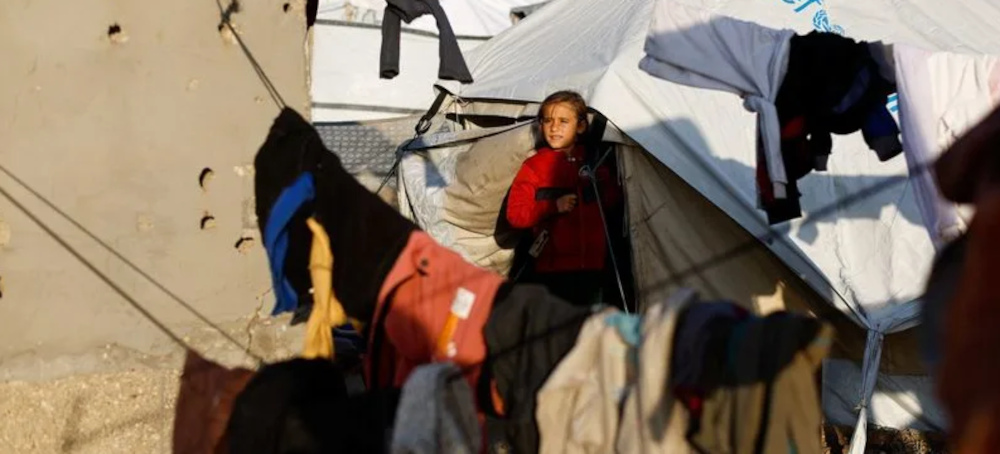
A child looks out from a tent as displaced Palestinians shelter in a tent camp in Deir al-Balah, central Gaza Strip, January 19, 2026. (photo: Mahmoud Issa/Reuters)
Israeli forces ordered dozens of Palestinian families in the southern Gaza Strip to leave their homes in the first forced evacuation since October's ceasefire, as residents and Hamas said on Tuesday the military was expanding the area it controls.
Residents of Bani Suhaila, east of Khan Younis, said the leaflets were dropped on Monday on families living in tent encampments in the Al-Reqeb neighbourhood.
"Urgent message. The area is under IDF control. You must evacuate immediately," said the leaflets, written in Arabic, Hebrew, and English, which the army dropped over the Al‑Reqeb neighbourhood in the town of Bani Suhaila.
Israel's military denied having plans to forcibly displace Palestinians from the area. It confirmed the leaflet drops but said they were aimed at warning Palestinians not to cross the armistice line with Hamas.
In the two-year war before the U.S. brokered ceasefire was signed in October, Israel dropped leaflets over areas that were subsequently raided or bombarded, forcing some families to move several times.
Residents and a source from the Hamas militant group said this was the first time they had been dropped since then.
SIDES FAR APART ON NEXT PHASES
The ceasefire has not progressed beyond its first phase, under which major fighting has stopped, Israel withdrew from less than half of Gaza, and Hamas released hostages in return for Palestinian detainees and prisoners.
Virtually the entire population of more than 2 million people are confined to around a third of Gaza's territory, mostly in makeshift tents and damaged buildings, where life has resumed under control of an administration led by Hamas.
Israel and Hamas have accused each other of major breaches of the ceasefire and remain far apart on the more difficult steps planned for the next phase.
Mahmoud, a resident from the Bani Suhaila area, who asked not to give his family name, said the evacuation orders impacted at least 70 families, living in tents and homes, some of which were partially damaged, in the area.
"We have fled the area and relocated westward. It is maybe the fourth or fifth time the occupation expanded the yellow line since last month," he told Reuters by phone from Khan Younis, referring to the line behind which Israel has withdrawn.
"Each time they move it around 120 to 150 metres (yards) inside the Palestinian-controlled territory, swallowing more land," the father-of-three said.
HAMAS CITES STATE OF HUMANITARIAN DISRUPTION
Ismail Al-Thawabta, director of the Hamas-run Gaza government media office, said the Israeli military had expanded the area under its control in eastern Khan Younis five times since the ceasefire, forcing the displacement of at least 9,000 people.
“On Monday, 19 January 2026, the Israeli occupation forces dropped warning leaflets demanding the forced evacuation of the Bani Suhaila area in eastern Khan Younis Governorate, in a measure that falls within a policy of intimidation and pressure on civilians,” Thawabta told Reuters.
He said the new evacuation orders affected approximately 3,000 people.
“The move created a state of humanitarian disruption, increased pressure on the already limited shelter areas, and further deepened the internal displacement crisis in the governorate,” Thawabta added.
Israel's military has previously said it has opened fire after identifying what it called "terrorists" crossing the yellow line and approaching its troops, posing an immediate threat to them.
It has continued to conduct air strikes and targeted operations across Gaza. The Israeli military has said it views "with utmost severity" any attempts by militant groups in Gaza to attack Israel.
Under future phases of the ceasefire that have yet to be hammered out, U.S. President Donald Trump's plan envisages Hamas disarming, Israel pulling out further, and an internationally backed administration rebuilding Gaza.
More than 460 Palestinians and three Israeli soldiers have been reported killed since the ceasefire took effect.
Israel launched its operations in Gaza in the wake of an attack by Hamas-led fighters in October 2023 which killed 1,200 people, according to Israeli tallies. Israel's assault has killed 71,000 people, the enclave's health authorities say.
*..........*..........*..........*..........*..........*..........*..........*
*..........*..........*..........*..........*..........*..........*..........*
6) Nurses in New York City Say They Deserve $200,000 a Year. Here’s Why.
As a strike by health workers stretches into its second week, pay is a major issue in negotiations, even if it’s not discussed much on the picket line.
By Joseph Goldstein and Patrick McGeehan, Jan. 22, 2026

As a strike by nurses at some of New York City’s leading hospitals stretched into its second week, Mayor Zohran Mamdani appeared on a picket line and addressed a crowd of health care workers.
Their strike, he said, had the same goals as his administration: making New York City more affordable. For nurses, he said, the walkout is about making sure “that this is a city you don’t just work in but a city that you can also live in.”
The nurses’ union, the New York State Nurses Association, said it had resumed negotiating on Thursday with several of the biggest hospitals in the city, including NewYork-Presbyterian/Columbia, Mount Sinai and Montefiore Medical Center. The two sides have reported little progress toward an agreement and only occasional bargaining sessions since the strike by nearly 15,000 nurses began on Jan. 12.
What are the issues in the strike?
The three hospital systems affected by the strike said their nurses on average make about $160,000 a year and are seeking raises that could propel nurses’ salaries on average past $200,000, according to the hospitals.
One hospital system, Mount Sinai, said that the financial demands originally made by the nurses’ union, known as NYSNA, would increase average pay to $275,000, an assertion that the union described as deceptive and a gross mischaracterization of its salary demands.
“From the very start, these negotiations have been primarily about NYSNA’s financial demands, plain and simple,” said Marc Kramer, the lead negotiator for Mount Sinai Hospital and the president of the League of Voluntary Hospitals and Homes of New York.
Since the start of the strike, nurses on the picket line and their union leaders have tended to minimize pay as a major reason for the labor action, instead highlighting other demands.
“If they were to move away from the money for just a second and look at the basic needs of human care, maybe they can see what we are fighting for,” said Johnaira Dilone-Florian, a nurse practitioner at Montefiore who was on the picket line on the third day of the strike.
In speeches and in conversations with reporters, nurses shared their concerns about workplace violence and demanded increased security at hospital entrances after a spate of violent episodes inside hospitals.
They also raised concerns about insufficient staffing, recounting how the hospitals had a history of leaving nurses with too many patients to care for at once.
But they have said less about money, unless it was to discuss the salaries of hospital chief executives. The president of the nurses’ union, Nancy Hagans, has called the hospital bosses “greedy.” The former head of NewYork-Presbyterian, Dr. Steven Corwin, who stepped down this week, received more than $26.3 million in 2024, making him one of the highest-paid hospital executives in the nation that year. His compensation for leading the nonprofit hospital system — which included not just base salary but payouts from incentive plans and other benefits — outpaced even the pay of many executives who lead for-profit hospital chains.
How much do nurses make?
At NewYork-Presbyterian/Columbia Hospital, nurses on average earn $163,000 a year, according to the hospital.
At Montefiore Medical Center in the Bronx, nurses make a bit more. There, the average salary is about $165,000, not including overtime, according to figures provided by the hospital. Of course, not every nurse makes that.
The average pay figures encompass different categories of nurses, including registered nurses and nurse practitioners, who have more education and responsibilities. The salary floor for an entry-level nurse at Montefiore was $117,424 in 2025, while a nurse practitioner earned $158,680 and a nurse midwife made $165,170, according to the union’s contract with Montefiore.
At Mount Sinai Hospital, nurses (including not only RNs but also a smaller number of nurse practitioners and a much smaller number of nurse anesthetists) had an average base salary of about $128,700 last year, according to an analysis prepared for the hospital’s negotiators. But after adding holiday pay and other differential compensation, the total pay of a Mount Sinai nurse averaged about $151,800 in 2025, the analysis showed. With overtime, which came out to $10,200 per nurse, the pay averaged $162,000.
A review of the union contract with Mount Sinai offers further details:
• An entry-level nurse at Mount Sinai last year made $121,931 in base salary. A clinical nurse who was assigned to float between units as needed was paid about 10 percent higher: $134,124.
• After each year of employment, a nurse’s salary increased. After five years, the “experience differential” meant a $9,100 higher salary; 10 years meant a $14,500 higher salary.
• Nurses who work nights are paid an extra $6,100 per year.
• Nurses with a bachelor’s degree earn $1,400 more a year, while those with a master’s degree earn an additional $1,600, and those with a Ph.D. receive $1,900 in extra income.
Some hospital executives have suggested nurses are paid well.
“I can tell you only that the nursing salaries that are paid in New York are well above the wages of other essential workers: police, firefighters, teachers,” said Kenneth E. Raske, the president of the Greater New York Hospital Association, a trade group.
Those are civil service jobs with a government employer. The nurses on strike work for large private, nonprofit institutions.
While entry-level nurses make significantly more than new police officers in New York City, officers’ pay rises steeply after a few years. Officers have starting salaries of $60,884, but that climbs to more than $125,000 after five-and-a-half years.
Nurses say that working in a hospital can be grueling, physically tiring and emotionally demanding. In crowded emergency departments, nurses are sometimes given an overwhelming number of patients to treat. In intensive care units, nurses care for patients on the edge of death, sometimes for weeks on end.
Many hospital nurses in New York work 12-hour shifts, three days a week. Their work is high-stakes. Mistakes can endanger patients. Polls suggest that they are generally more trusted and regarded as more ethical than members of just about any other profession.
Since the strike began, many nurses have spent long shifts on the picket line outside hospitals, in bitter cold, sometimes bringing their children. Others are working per diem nursing jobs elsewhere, according to interviews with nurses. A few have posted pleas for financial support on gofundme.com.
Mount Sinai nurses lost their health insurance when they went on strike. One of them, Zara Roy, who has worked at Mount Sinai Morningside for about 13 years, said she has had to cancel speech therapy appointments for her 7-year-old daughter now that her family is uninsured.
“It weighs heavily on me,” she said, but sending her daughter for therapy would cost $600 a week.
Still, Ms. Roy, who said she made at least $160,000 last year, supports the strike, characterizing the raises offered by the hospital as “unrealistic.”
In her view, nurses deserve a significant raise.
“I think it’s OK for nurses to make close to $200,000, just to make a livable living in the tristate area, honestly,” said Ms. Roy, who lives in Bergen County, N.J., and pays about $30 in tolls and parking each time she comes to work.
In the New York metropolitan area, a family of four with two working parents needs pretax income of about $145,000 to cover their cost of living, compared with about $112,000 in Miami and about $105,000 in Houston, data compiled by the Living Wage Institute show.
Nurse practitioners in New York earn more than their counterparts in every city in the country with the exception of Bellevue, Wash., according to data compiled by Indeed, the online job site. Indeed shows nursing jobs in New York pay about $142,000 a year, about 9 percent higher than the national average of about $130,000.
Nationally, the median annual pay for registered nurses was $93,600 in 2024, according to the Bureau of Labor Statistics.
New York City nurses in their last contract secured a 7 percent raise in 2023, 6 percent the following year and 5 percent in 2025.
The union would like to see similar raises — or higher — again. The hospitals say the increases this time will be far more modest.
When nurses went on strike in 2023, they had deep public support, after caring for Covid-19 patients during the deadliest days of the pandemic. Their ranks had been diminished because of burnout and retirements, and many hospital units were chronically understaffed. When the nurses went on strike — for the first time in New York City in 25 years — they caught the affected hospitals by surprise.
It’s different this time. Hospitals in New York anticipate billions less in federal dollars in the years ahead, making them reluctant to substantially increase nurses’ pay. And hospital administrators have been preparing for this strike, convinced they can outlast the nurses.
What are the nurses’ financial demands?
Last fall, as negotiations got underway, the nurses’ union asked for annual increases of 10 percent. That alone would push average salaries toward $200,000 by 2028, the third year of the contract. But other proposals would send nurses’ salaries above that.
At Montefiore, where the union posted some proposals online, the nurses are seeking an additional $7 an hour for weekend shifts. The union wanted nurses on the night shift to receive an extra $15,000 annually — not the current $6,000. They sought other increases, too.
Of course, at the start of any contract negotiation, neither side expects to get everything it’s asking for.
At Mount Sinai, the hospital claims that at a bargaining session in mid-December, the union proposed that each emergency department nurse receive hundreds of dollars in surge pay for every shift when there are more than a certain number of patients. The union proposed a similar payout for labor and delivery nurses. One hospital negotiator said that the threshold for additional payments would be reached at least one out of every two days, which could amount to an additional $10,000 or more a year for some nurses.
Amid the conflicting messages from the two sides, one things is clear: They remain very far apart on pay.
What are the hospitals offering?
Hospital negotiators have offered to give each nurse an additional $4,500 a year for the next three years. The nurses can decide how much of that money goes to salaries and how much toward health care, pensions and other benefits, hospital officials said. In interviews, nurses have called that offer unrealistically low or insulting.
That approach differs from traditional offers from management. Typically, hospitals lay out annual percentage increases in pay, as they did in the last negotiation.
This time, hospital officials wanted to illustrate that salaries are just one of many labor costs and to show how raises ripple outward, affecting overtime and holiday pay and driving up the cost of adding staff.
Olivia Bensimon and Samantha Latson contributed reporting.
*..........*..........*..........*..........*..........*..........*..........*
*..........*..........*..........*..........*..........*..........*..........*
7) ‘Enough Is Enough’: Hundreds of Minnesota Businesses Take Stand Against ICE
After protesters called for a pause on economic activity and work to strike against the federal immigration crackdown, many business owners kept their doors shut on Friday.
By Pooja Salhotra and Jazmine Ulloa, Jan. 23, 2026

Many businesses across Minnesota are expected to close on Friday as part of a general strike against the Trump administration’s immigration crackdown. David Guttenfelder/The New York Times
No work, no shopping, no dining out. Hundreds of businesses across Minnesota were expected to close and many people vowed to pause everyday activities on Friday as part of a general strike against the Trump administration’s immigration crackdown.
As tensions mount and a sense of fear of detention by immigration agents permeates the state, vendors, labor unions and residents said they would participate in an economic blackout and gather at prayers and protests on what organizers called a “Day of Truth and Freedom.”
“It’s tense and emotional, and folks are hurting,” said Bishop Dwayne Royster, the executive director of Faith in Action, which is helping with the organizing effort. Minnesotans, he said, are demonstrating “deep resilience and willingness to stand together in ways I haven’t seen folks do in a very long time.
The day of the strike, which was set to include outdoor demonstrations, dawned with much of the Midwest, including all of Minnesota, under an extreme cold warning from the National Weather Service. The cold was particularly bitter in Minneapolis, with temperatures as low as minus 20 forecast for much of the day, with wind chills even lower.
Parts of the city seemed like a ghost town on Friday morning, with many cafes and local coffee chains shuttered, signs posted in their windows expressing solidarity with the strike.
One of the few places still serving coffee was Misfit in Minneapolis, which sits in a large warehouse like building west of downtown. The owner, Marcus Parkansky, said his way of participating in the strike was to remain open on Friday but only offer coffee, pastries and espresso shots free of charge. And, thanks to a donation from a woman in Texas, there will also be a bottle of bourbon and a bottle of Baileys, for anyone who wants to spike their cup.
As to the point of the strike, Mr. Parkansky said he hopes it shows the federal government how organized Minneapolis is and how much people oppose the immigration enforcement surge. “What we want to see is for the shenanigans to stop,” he said.
Word of Friday’s strike and protests spread “like a wildfire” in the preceding days, said Jake Anderson, an executive board member with the St. Paul Federation of Educators, a labor union representing teachers and educational support professionals. Hundreds of businesses, mostly in Minneapolis and St. Paul, said they would close, while others have vowed to pause any economic activity, stay home from work or school, or fast to show support.
“There’s a time to stand up for things, and this is it,” said Alison Kirwin, the owner of Al’s Breakfast, a restaurant in Minneapolis that closed on Friday. “If it takes away from a day of our income, that is worthwhile.”
The strike comes as Minnesotans have clashed for weeks with federal agents, mostly in the Minneapolis and St. Paul areas. The immigration operation, which started late last year, has led to some 3,000 arrests, at least two shootings in Minneapolis and chaotic scenes on the streets.
Calls for the ouster of federal agents have grown from residents and local officials in recent weeks, especially after a U.S. Immigration and Customs Enforcement agent fatally shot Renee Good, an American citizen, in Minneapolis on Jan. 7. Protesters and state officials have also filed lawsuits to restrict the agents’ conduct toward demonstrators and to block the surge of immigration agents in the state.
But federal officials have asserted that the crackdown is necessary to root out fraud in the state’s social services system and have defended the actions of the ICE agent who killed Ms. Good.
On Thursday, Vice President JD Vance said that the Trump administration wanted to “turn down the temperature” in Minneapolis after weeks of clashes. Mr. Vance, who said he had traveled to the city to understand the tensions, called Minneapolis protesters “far-left agitators” who had harassed federal agents. He also said a “failure of cooperation” by state and local officials was to blame for the situation getting “out of hand.”
In an email on Thursday, a Department of Homeland Security official called the strike “beyond insane,” asking, “Why would these labor bosses not want these public safety threats out of their communities?” The official then included a list of undocumented immigrants who had apparently been convicted of serious crimes.
Minnesota is a mecca for corporate headquarters, with 17 Fortune 500 companies based in the state. But those organizations have not spoken publicly about the federal immigration activity, and none of Minnesota’s 15 biggest employers, including Target, UnitedHealth Group and Xcel Energy, responded to requests for comment on Thursday.
Still, Friday may be the largest worker action in the state’s history, said Christa Sarrack, president of a labor union that represents about 6,000 of Minnesota’s hospitality workers. Ms. Sarrack said some of the union members’ employers had decided to close for the day, while others were allowing employees to not come to work.
“We cannot simply sit by and allow this to continue,” Ms. Sarrack said. “We must use every tool that we have to fight back.”
But not all employers have committed to striking. For some, the choice over whether to participate has not been an easy one because they simply cannot afford to lose a day’s revenue.
Andrew Schoenzeit, who owns Zipps Liquors in Minneapolis, said his business would remain open on Friday. But he said he supported the strike and had no problem with the one employee of his who he said requested the day off to protest.
Mike Logan, the president of the Minneapolis Regional Chamber of Commerce, said he was also supportive of businesses closing in protest but would not encourage them to do so. “The last thing we need is a slowdown of commerce,” he said.
For some leaders of local and state unions, the decision over whether to encourage their members to participate in the general strike was difficult because it was not organized understate and federal strike laws, and it was not considered an official “work stoppage day.” But the push for the boycott spread so widely that it became hard to ignore.
Chris Rubesch, president of the Minnesota Nurses Association, a labor union representing more than 22,000 nurses and other health care workers across the state, said he and other leaders were discouraging their members from missing work because of “no-strike” provisions in their contract. But he said the union was encouraging the members to participate in other ways, including by not participating in any economic activity.
Mr. Anderson, the board member of the St. Paul Federation of Educators, said his union signed on to the day of action after much debate, and has sent letters to members asking them “to decide what that call to action means to them.”
“We decided it was now time to take a stand,” Mr. Anderson said. “It was time to boldly declare that enough is enough. We’re not going to take it anymore.”
Kailyn Rhone and Zachary A. Bohlman contributed reporting.
*..........*..........*..........*..........*..........*..........*..........*
*..........*..........*..........*..........*..........*..........*..........*
8) D.H.S. Cited Foreign Students’ Writings and Protests Before Their Arrests
Documents unsealed by a federal judge on Thursday include dossiers that investigators prepared on pro-Palestinian student activists before they were targeted for deportation.
By Zach Montague, Reporting from Washington, Published Jan. 22, 2026, Updated Jan. 23, 2026

Secretary of State Marco Rubio approved the revocation of visas for five international students last year. Credit...Eric Lee for The New York Times
Secretary of State Marco Rubio personally approved the deportation of five student activists last year after receiving memos largely describing their participation in pro-Palestinian protests and their writings about the war in Gaza, according to internal government documents unsealed by a federal judge on Thursday.
The documents reveal new details about how the Trump administration decided to target the activists, who were all foreign students visible in campus protests. They had been in the United States legally but were arrested and threatened with deportation last spring.
The several hundred pages were submitted as evidence in a trial held in Massachusetts in July over noncitizen students’ freedom of expression.
After hearing testimony and examining the documents, Judge William G. Young, an appointee of President Ronald Reagan, ruled last year that the Trump administration had illegally targeted the students for deportation based on their speech — in particular their opposition to the Israeli government and its military operations in Gaza.
Judge Young had acceded to requests from the government to seal the documents because of details they contained about federal investigations. But last week he agreed to a request from The New York Times and other media outlets that they be released as a matter of public interest.
The documents include several batches of memos, prepared by the Department of Homeland Security and sent to the State Department, which contained the formal recommendations that five students — Mahmoud Khalil, Rumeysa Ozturk, Mohsen Mahdawi, Badar Khan Suri and Yunseo Chung — be deported.
The documents indicate that in nearly all instances, the arrests of the students were recommended based on their involvement in campus protests and public writings, activities that the Trump administration routinely equated to antisemitic hate speech and support for terrorist organizations. They also show that officials privately anticipated the possibility that the deportations might not hold up in court because much of the conduct highlighted could be seen as protected speech.
“Given the potential that a court may consider his actions inextricably tied to speech protected under the First Amendment, it is likely that courts will scrutinize the basis for this determination,” read one memo describing the effort to deport Mr. Madhawi, who had a green card and was an undergraduate at Columbia University at the time of his arrest.
A State Department spokesman said in a statement that Mr. Rubio’s determinations were a matter of national security and were aimed at keeping “terrorist-supporting” individuals out of the country.
“A visa is a privilege, not a right. We abide by all applicable laws to ensure the United States does not harbor aliens who pose a threat to our national security,” the statement said.
In one set of documents with the referrals, officials acknowledged that almost no grounds existed for deporting the students other than a rarely used 1952 law that says the secretary of state may deem noncitizens deportable for reasons related to foreign policy.
“D.H.S. has not identified any alternative grounds for removability,” agents wrote of several of the students, “including the ground of removability for aliens who have provided material support for a foreign terrorist organization or terrorist activity.”
In justifying the attempt to deport the students, Mr. Rubio and other administration officials repeatedly asserted that they had supported terrorist organizations.
“We will be revoking the visas and/or green cards of Hamas supporters in America so they can be deported,” Mr. Rubio wrote online in March, referring to the militant Palestinian group in Gaza.
The students have denied that charge. They sued over their arrests, and judges last year ordered each of them released, citing concerns that their arrests had been based on protected speech.
The case before Judge Young, brought by two national academic organizations, argued more broadly that the arrests had chilled academic speech on the nation’s college campuses. Judge Young agreed, describing the behavior of Mr. Rubio and Kristi Noem, the homeland security secretary, as an “unconstitutional conspiracy” to “pick off” a few students with an eye to “violating” the free speech rights of thousands of noncitizen scholars.
“These cabinet secretaries have failed in their sworn duty to uphold the Constitution,” Judge Young said last week in an emotional denunciation of the government from the bench.
The government had argued in court that Mr. Rubio was exercising his sole authority to determine which activity by noncitizens might jeopardize the country’s foreign policy interests, which could include relations with Israel. They contended that the demonstrations had grown threatening to Jewish students on campus.
A homeland security spokesman did not immediately respond to a request for comment on Thursday.
Concluding the case, Judge Young ordered on Thursday that any future attempts to deport members of the two academic organizations that had sued could be immediately challenged in court, where the Trump administration would need to prove that it was not retaliating against the members over their speech or academic work.
The documents that Judge Young unsealed showed that government investigators searched for findings of wrongdoing on the part of the students, but internally acknowledged that they had found the task difficult.
In the case of Ms. Ozturk, a Tufts University postdoctoral student, officials wrote that there was no evidence she had “engaged in any antisemitic activity” or made “any public statements indicating support for a terrorist organization or antisemitism generally.” Nevertheless, they recommended that her visa be revoked based on “the totality of the circumstances presented.” A dossier compiled about her centered on an opinion piece she had written in The Tufts Daily, a student newspaper, calling for divestment from Israel.
Dossiers built with open-source research and summary reports on the students largely focused on news clips about their presence at campus demonstrations.
In the case of Mr. Khalil and Ms. Chung, both students at Columbia, investigators wrote that they had attended protests where fliers containing language from Hamas were distributed — but not that either had played any role in producing or distributing them.
In all cases, the determinations appeared to be largely based on assertions that various protest activities and statements had created a hostile environment for Jewish students on campus. President Trump last year directed agencies to monitor protests and crack down on any conduct that could be considered antisemitic as part of a wider campaign against universities.
It was only in Mr. Suri’s case that investigators claimed to have substantive reason to believe that he had direct ties to Hamas or was acting on the group’s behalf. Mr. Suri’s wife, an American citizen, is the daughter of Ahmed Yousef, a former adviser to Ismail Haniyeh, the Hamas leader assassinated by Israel in Iran in 2024.
But the documents released on Thursday did not include any evidence that Mr. Suri or his wife had been in touch with Hamas leaders. Mr. Suri’s file instead described his writings online, with investigators noting that he “appears to post pro-Palestinian content” on Instagram and citing a Facebook post “expressing support for Hamas founder Ahmed Yassin.”
Mr. Suri and his lawyer have denied that Mr. Suri engaged in any overt political activism, even saying he actively avoids protests.
While it is possible the government collected other information about the students, the records represent the information that the government presented to Judge Young to explain why the students were chosen for arrest.
The dossiers sent to the State Department were compiled by a specialized “tiger team” in the Homeland Security Investigations arm within Immigration and Customs Enforcement. The investigations unit has traditionally looked into serious crime like human trafficking, as well as national security cases.
Peter Hatch, an official tasked with overseeing the effort, testified during the trial last summer that the team had rushed a review of more than 5,000 students linked to pro-Palestinian demonstrations, sending their findings to Mr. Rubio’s staff for review. According to his testimony, the team’s work was also informed by reviewing lists of names compiled by at least two websites — the Canary Mission and Betar US — which identify and publish the personal information of pro-Palestinian protesters.
*..........*..........*..........*..........*..........*..........*..........*
*..........*..........*..........*..........*..........*..........*..........*
9) White House Posts Altered Photo Showing Arrested Minnesota Protester Crying
The New York Times ran the image through an A.I. detection system and concluded that it showed signs of manipulation.
By Tiffany Hsu, Alan Feuer and Stuart A. Thompson, Published Jan. 22, 2026, Updated Jan. 23, 2026

Nekima Levy Armstrong after speaking at an anti-ICE rally in St. Paul, Minn., on Monday. The Justice Department said on Thursday morning that it had taken her into custody, accusing her of helping to interrupt a church service in St. Paul. Credit...Angelina Katsanis/Associated Press
The White House posted a digitally altered image showing a demonstrator involved in interrupting a church service in Minnesota last weekend crying as she was arrested on Thursday. A previous version of the image, also posted by an official government account, showed her looking forward calmly.
When asked about its post, the White House pointed to a message on X from Kaelan Dorr, the deputy communications director, who wrote, “Enforcement of the law will continue. The memes will continue.”
The Justice Department said on Thursday morning that it had taken the demonstrator, Nekima Levy Armstrong, a lawyer, into custody, accusing her of helping to interrupt a church service in St. Paul, Minn., on Sunday. Demonstrators had gathered on Sunday to protest a pastor’s apparent connection to Immigration and Customs Enforcement.
Less than an hour after Attorney General Pam Bondi announced the arrest on X on Thursday, Homeland Security Secretary Kristi Noem posted an image of the arrest on the same social media platform. In Ms. Noem’s image, Ms. Levy Armstrong appears composed, walking in front of a law enforcement agent whose face is blurred out. Karoline Leavitt, the White House press secretary, shared Ms. Noem’s post.
Roughly a half-hour after Ms. Noem sent her message, the White House posted its own version of the arrest image, in which Ms. Levy Armstrong appears to be sobbing. Her skin appears to have been darkened. The arresting agent in Ms. Noem’s image is in exactly the same position.
The New York Times ran the image used by Ms. Noem as well as the one posted by the White House through Resemble.AI, an A.I. detection system. It concluded that Ms. Noem’s image was real but that the White House’s version showed signs of manipulation on Ms. Levy Armstrong’s face. The Times was able to create images nearly identical to the White House’s version by asking Gemini and Grok — generative A.I. tools from Google and Elon Musk’s xAI start-up — to alter Ms. Noem’s original image.
President Trump and his circle are enthusiastic distributors of A.I.-generated content, having shared dozens of synthetic images in recent years. Often, the visuals are obviously artificial, including posts in the past year showing Mr. Trump as a king and as a fighter pilot dropping excrement on demonstrators.
The doctored photograph could end up hindering the Justice Department’s nascent prosecution of Ms. Levy Armstrong.
As the case proceeds, her lawyers could use it to accuse the Trump administration of making what are known as improper extrajudicial statements. Most federal courts bar prosecutors from making any remarks about court filings or a legal proceeding outside of court in a way that could prejudice the pool of jurors who might ultimately hear the case.
Ms. Levy Armstrong’s lawyers could also claim that the photo was evidence that the Justice Department bore some sort of animus against her and filed the charges vindictively. A motion of that kind could, in theory, result in the charges one day being dismissed.
*..........*..........*..........*..........*..........*..........*..........*
*..........*..........*..........*..........*..........*..........*..........*
*..........*..........*..........*..........*..........*..........*..........*
*..........*..........*..........*..........*..........*..........*..........*
*..........*..........*..........*..........*..........*..........*..........*
*..........*..........*..........*..........*..........*..........*..........*
*..........*..........*..........*..........*..........*..........*..........*
*..........*..........*..........*..........*..........*..........*..........*
*..........*..........*..........*..........*..........*..........*..........*
*..........*..........*..........*..........*..........*..........*..........*
*..........*..........*..........*..........*..........*..........*..........*
*..........*..........*..........*..........*..........*..........*..........*
*..........*..........*..........*..........*..........*..........*..........*
*..........*..........*..........*..........*..........*..........*..........*
*..........*..........*..........*..........*..........*..........*..........*
*..........*..........*..........*..........*..........*..........*..........*
*..........*..........*..........*..........*..........*..........*..........*
*..........*..........*..........*..........*..........*..........*..........*
*..........*..........*..........*..........*..........*..........*..........*
*..........*..........*..........*..........*..........*..........*..........*
*..........*..........*..........*..........*..........*..........*..........*
*..........*..........*..........*..........*..........*..........*..........*
*..........*..........*..........*..........*..........*..........*..........*
*..........*..........*..........*..........*..........*..........*..........*
*..........*..........*..........*..........*..........*..........*..........*
*..........*..........*..........*..........*..........*..........*..........*
*..........*..........*..........*..........*..........*..........*..........*
*..........*..........*..........*..........*..........*..........*..........*
*..........*..........*..........*..........*..........*..........*..........*
*..........*..........*..........*..........*..........*..........*..........*
*..........*..........*..........*..........*..........*..........*..........*
*..........*..........*..........*..........*..........*..........*..........*
*..........*..........*..........*..........*..........*..........*..........*
*..........*..........*..........*..........*..........*..........*..........*
*..........*..........*..........*..........*..........*..........*..........*
*..........*..........*..........*..........*..........*..........*..........*
*..........*..........*..........*..........*..........*..........*..........*
*..........*..........*..........*..........*..........*..........*..........*
*..........*..........*..........*..........*..........*..........*..........*
*..........*..........*..........*..........*..........*..........*..........*
*..........*..........*..........*..........*..........*..........*..........*
*..........*..........*..........*..........*..........*..........*..........*
