

*..........*..........*..........*..........*..........*..........*..........*

|
|


*..........*..........*..........*..........*..........*..........*..........*
*..........*..........*..........*..........*..........*..........*..........*


DROP THE CHARGES
AGAINST NICK TILSEN
In 2022, an incident took place where a Native unhoused relative was being harassed and assaulted by Rapid City Police (RCPD) in Rapid City, South Dakota. Nick Tilsen, CEO and Founder of NDN Collective, pulled over to conduct a routine cop watch. One officer accused Nick of assaulting him despite no physical contact being made with the officer. During the interaction, Nick remained in his vehicle because he felt unsafe surrounded by several police cars. Nick communicated with an officer, who then got approval from someone off-site and allowed Nick to leave.
Despite no immediate action being taken at the time, more than a year later, the officer involved accused Nick of attempting to run him over, leading to a complaint and warrant for Tilsen’s arrest being filed on June 30, 2023 – the same day NDN Collective announced they would host a July 4th March Towards Justice.
Nick was originally charged with aggravated assault and obstruction of a police officer. But just a few weeks before the trial date (January 12, 2026), Nick was notified that the Pennington County Grand Jury added a “simple assault” to the list of charges.
Nick is being systematically targeted as local prosecutors intentionally sought out the police officer named in this case and encouraged him to press charges. The charges brought against Nick are false and inflated to criminalize, silence, and ultimately isolate him from his community through imprisonment. Nick is being targeted by RCPD because he has unapologetically stood on his values and has called for accountability and justice for people harmed by police in Rapid City.
NDN Collective has been pushing for a federal investigation into the Rapid City Police Department for over 3 years. This fight is bigger than just Nick Tilsen. It’s about protecting movement leaders, movement organizations, our right to free speech, and to demand justice for those harmed by colonial white supremacist systems and structures.
NDN Collective believes this to be a politically motivated effort to silence a movement leader by criminalizing his actions and misusing the legal system. If found guilty of these charges, Nick could face up to 26 years in prison.
Nick’s trial is set to begin January 26, 2026, at 9 am MT at the Pennington County Courthouse in Rapid City, SD.
As we see continued targeting of movement leaders, including Nick, we need your support to continue fighting these legal battles. Trials are expensive and are tactics used to drain movement resources. We need resources to continue this fight against legal repression and to continue our work.
This fund safeguards our organization against legal attacks aiming to suppress our leaders, imprison our people, and obstruct our movement’s objectives.
DONATE TO NDN LEGAL FUND HERE:
https://ndnlegalfund.org
SIGN PETITION: DROP THE CHARGES:
Support for the charges against Nick to be dropped is clear, with over 16,500 signatures on a petition to the Pennington County State’s Attorney’s office. If you haven’t already, please add your name to our petition:
https://www.instagram.com/p/DTdap1GFD-1/?utm_source=ig_web_copy_link&igsh=MzRlODBiNWFlZA%3D%3D
*..........*..........*..........*..........*..........*..........*..........*
*..........*..........*..........*..........*..........*..........*..........*

End Texas Torture of Revolutionary Elder Xinachtli
Organization Support Letter
Letter to demand the immediate medical treatment and release of Chicano political prisoner Xinachtli (Alvaro Hernandez #00255735)
To the Texas Department of Criminal Justice,
We, the undersigned organizations, write to urge immediate action to protect the life, health, and human rights of Xinachtli (legal name Alvaro Hernandez). Xinachtli is 73-year-old Chicano community organizer from Texas who has spent 23 years in solitary confinement and 30 years incarcerated as part of a 50-year sentence. His health is now in a critical and life-threatening state and requires prompt and comprehensive medical intervention.
Since his conviction in 1997, Xinachtli has spent decades in conditions that have caused significant physical and psychological harm. As an elder in worsening health, these conditions have effectively become a de facto death sentence.
Xinachtli’s current medical condition is severe. His physical, mental, and overall well-being have declined rapidly in recent weeks. He now requires both a wheelchair and a walker, has experienced multiple falls, and is suffering from rapid weight loss. He is currently housed in the McConnell Unit infirmary, where he is receiving only palliative measures and is being denied a medical diagnosis, access to his medical records, and adequate diagnostic testing or treatment.
A virtual clinical visit with licensed medical doctor Dr. Dona Kim Murphey underscores the severity of his condition. In her report of the visit, she wrote: "Given the history of recent neck/back trauma and recurrent urinary tract infections with numbness, weakness, and bowel and bladder incontinence, I am concerned about nerve root or spinal cord injury and/or abscesses that can lead to permanent sensorimotor dysfunction."
Despite his age and visible disabilities, he remains in solitary confinement under the Security Threat Group designation as a 73-year-old. During his time in the infirmary, prison staff threw away all of his belongings and “lost” his commissary card, leaving him completely without basic necessities. He is experiencing hunger, and the lack of consistent nutrition is worsening his medical condition. McConnell Unit staff have also consistently given him incorrect forms, including forms for medical records and medical visitation, creating further barriers to care and communication.
A family visit on November 29 confirmed the seriousness of his condition. Xinachtli, who was once able to walk on his own, can no longer stand without assistance. He struggled to breathe, has lost more than 30 pounds, relied heavily on his wheelchair, and was in severe pain throughout the visit.
In light of these conditions, we, the undersigned organizations, demand that TDCJ take immediate action to save Xinachtli’s life and comply with its legal and ethical obligations.
We urge the immediate implementation of the following actions:
Immediate re-instatement of his access to commissary to buy hygiene, food, and other critical items. Immediate transfer to the TDCJ hospital in Galveston for a full medical evaluation and treatment, including complete access to his medical records and full transparency regarding all procedures. Transfer to a geriatric and medical unit that is fully accessible under the Americans with Disabilities Act. Xinachtli requests placement at the Richard P LeBlanc Unit in Beaumont, Texas. Approval of Medical Recommended Intensive Supervision, the release program for individuals with serious medical conditions and disabilities, in recognition of the severity and progression of his current health issues. Failure to act will result in the continued and foreseeable deterioration of Xinachtli’s health, amounting to state-sanctioned death. We urge TDCJ to take swift and decisive action to meet these requests and to fulfill its responsibility to safeguard his life and well-being.
We stand united in calling for immediate and decisive action. Xinachtli’s life depends on it.
Signed, Xinachtli Freedom Campaign and supporting organizations
Endorsing Organizations:
Al-Awda Houston; All African People’s Revolutionary Party; Anakbayan Houston; Anti-Imperialist Solidarity; Artists for Black Lives' Equality; Black Alliance for Peace - Solidarity Network; Columbia University Students for a Democratic Society; Community Liberation Programs; Community Powered ATX; Contra Gentrificación; Diaspora Pa’lante Collective; Down South; DSA Emerge; Entre nos kc; Fighting Racism Workshops; Frontera Water Protectors; GC Harm Reductionists; JERICHO MOVEMENT; Jericho Movement Providence; Montrose Anarchist Collective; NYC Jericho Movement; OC Focus; Palestine Solidarity TX; Partisan Defense Committee; Partido Nacional de la Raza Unida; PDX Anti-Repression; Red Star Texas; Root Cause; San Francisco Solidarity Collective; Shine White Support Team; Sunrise Columbia; UC San Diego Faculty for Justice in Palestine; Viva Palestina, EPTX; Water Justice and Technology Studio; Workshops4Gaza.
Sign the endorsement letter for your organization here:
https://cryptpad.fr/form/#/2/form/view/MiR1f+iLiRBJC7gSTyfhyxJoLIDhThxRafPatxdbMWI/
IMPORTANT LINKS TO MATERIALS FOR XINACHTLI FREEDOM CAMPAIGN:
PHONE BLAST: Your community can sign up for a 15-minute-long call shift here: bit.ly/xphoneblast
FUNDRAISER: Here is the link to Jericho's fundraiser for Xinachtli: http://givebutter.com/jerichomovement
CASE HISTORY: Learn more about Xinachtli and his case through our website: https://freealvaro.net
CONTACT INFO:
Follow us on Instagram: @freexinachtlinow
Email us:
xinachtlifreedomcampaign@protonmail.com
COALITION FOLDER:
https://drive.proton.me/urls/SP3KTC1RK4#KARGiPQVYIvR
In the folder you will find: Two pictures of Xinachtli from 2024; The latest updated graphics for the phone blast; The original TRO emergency motion filing; Maria Salazar's declaration; Dr. Murphy's report from her Dec. 9 medical visit; Letter from Amnesty International declaring Xinachtli's situation a human rights violation; Free Xinachtli zine (which gives background on him and his case); and The most recent press release detailing who Xinachtli is as well as his medical situation.
Write to:
Alvaro Hernandez CID #00255735
TDCJ-W.G. McConnell Unit
PO Box 660400
Dallas, TX 75266-0400
*..........*..........*..........*..........*..........*..........*..........*
*..........*..........*..........*..........*..........*..........*..........*

Funds for Kevin Cooper
Kevin was transferred out of San Quentin and is now at a healthcare facility in Stockton. He has received some long overdue healthcare. The art program is very different from the one at San Quentin but we are hopeful that Kevin can get back to painting soon.
For 41 years, an innocent man has been on death row in California.
Kevin Cooper was wrongfully convicted of the brutal 1983 murders of the Ryen family and houseguest. The case has a long history of police and prosecutorial misconduct, evidence tampering, and numerous constitutional violations including many incidences of the prosecution withholding evidence of innocence from the defense. You can learn more here .
In December 2018 Gov. Brown ordered limited DNA testing and in February 2019, Gov. Newsom ordered additional DNA testing. Meanwhile, Kevin remains on Death Row at San Quentin Prison.
The funds raised will be used to help Kevin purchase art supplies for his paintings . Additionally, being in prison is expensive, and this money would help Kevin pay for stamps, books, paper, toiletries, supplies, supplementary food, printing materials to educate the public about his case and/or video calls.
Please help ease the daily struggle of an innocent man on death row!
An immediate act of solidarity we can all do right now is to write to Kevin and assure him of our continuing support in his fight for justice. Here’s his address:
Kevin Cooper #C65304
Cell 107, Unit E1C
California Health Care Facility, Stockton (CHCF)
P.O. Box 213040
Stockton, CA 95213
www.freekevincooper.org
Call California Governor Newsom:
1-(916) 445-2841
Press 1 for English or 2 for Spanish,
press 6 to speak with a representative and
wait for someone to answer
(Monday-Friday, 9:00 A.M. to 5:00 P.M. PST—12:00 P.M. to 8:00 P.M. EST)
*..........*..........*..........*..........*..........*..........*..........*
*..........*..........*..........*..........*..........*..........*..........*

Dr. Atler Still Needs Our Help!
Please sign the petition today!
https://www.change.org/p/texas-state-university-give-tom-alter-his-job-back
What you can do to support:
—Donate to help Tom Alter and his family with living and legal expenses: https://gofund.me/27c72f26d
—Sign and share this petition demanding Tom Alter be given his job back: https://www.change.org/p/texas-state-university-give-tom-alter-his-job-back
—Write to and call the President and Provost at Texas State University demanding that Tom Alter be given his job back:
President Kelly Damphousse: president@txstate.edu
President’s Office Phone: 512-245-2121
Provost Pranesh Aswath: xrk25@txstate.edu
Provost Office Phone: 512-245-2205
For more information about the reason for the firing of Dr. Tom Alter, read:
"Fired for Advocating Socialism: Professor Tom Alter Speaks Out"
Ashley Smith Interviews Dr. Tom Alter
—CounterPunch, September 24, 2025
*..........*..........*..........*..........*..........*..........*..........*
*..........*..........*..........*..........*..........*..........*..........*
 Russia Confirms Jailing of Antiwar Leader Boris Kagarlitsky In a secret trial on June 5, 2024, the Russian Supreme Court’s Military Chamber confirmed a sentence of five years in a penal colony for left-wing sociologist and online journalist Boris Kagarlitsky. His crime? “Justifying terrorism” — a sham charge used to silence opponents of Putin’s war on Ukraine. The court disregarded a plea for freedom sent by thirty-seven international luminaries. Kagarlitsky, a leading Marxist thinker in Russia’s post-Soviet period, recently addressed socialists who won’t criticize Putin: “To my Western colleagues, who…call for an understanding of Putin and his regime, I would like to ask a very simple question. [Would] you want to live in a country where there is no free press or independent courts? In a country where the police have the right to break into your house without a warrant? …In a country which…broadcasts appeals on TV to destroy Paris, London, Warsaw, with a nuclear strike?” Thousands of antiwar critics have been forced to flee Russia or are behind bars, swept up in Putin’s vicious crackdown on dissidents. Opposition to the war is consistently highest among the poorest workers. Recently, RusNews journalists Roman Ivanov and Maria Ponomarenko were sentenced to seven, and six years respectively, for reporting the military’s brutal assault on Ukraine. A massive global solidarity campaign that garnered support from thousands was launched at Kagarlitsky’s arrest. Now, it has been revived. This internationalism will bolster the repressed Russian left and Ukrainian resistance to Putin’s imperialism. To sign the online petition at freeboris.info —Freedom Socialist Party, August 2024 https://socialism.com/fs-article/russia-jails-prominent-antiwar-leader-boris-kagarlitsky/#:~:text=In%20a%20secret%20trial%20on,of%20Putin's%20war%20on%20Ukraine. Petition in Support of Boris KagarlitskyWe, the undersigned, were deeply shocked to learn that on February 13 the leading Russian socialist intellectual and antiwar activist Dr. Boris Kagarlitsky (65) was sentenced to five years in prison. Dr. Kagarlitsky was arrested on the absurd charge of 'justifying terrorism' in July last year. After a global campaign reflecting his worldwide reputation as a writer and critic of capitalism and imperialism, his trial ended on December 12 with a guilty verdict and a fine of 609,000 roubles. The prosecution then appealed against the fine as 'unjust due to its excessive leniency' and claimed falsely that Dr. Kagarlitsky was unable to pay the fine and had failed to cooperate with the court. In fact, he had paid the fine in full and provided the court with everything it requested. On February 13 a military court of appeal sent him to prison for five years and banned him from running a website for two years after his release. The reversal of the original court decision is a deliberate insult to the many thousands of activists, academics, and artists around the world who respect Dr. Kagarlitsky and took part in the global campaign for his release. The section of Russian law used against Dr. Kagarlitsky effectively prohibits free expression. The decision to replace the fine with imprisonment was made under a completely trumped-up pretext. Undoubtedly, the court's action represents an attempt to silence criticism in the Russian Federation of the government's war in Ukraine, which is turning the country into a prison. The sham trial of Dr. Kagarlitsky is the latest in a wave of brutal repression against the left-wing movements in Russia. Organizations that have consistently criticized imperialism, Western and otherwise, are now under direct attack, many of them banned. Dozens of activists are already serving long terms simply because they disagree with the policies of the Russian government and have the courage to speak up. Many of them are tortured and subjected to life-threatening conditions in Russian penal colonies, deprived of basic medical care. Left-wing politicians are forced to flee Russia, facing criminal charges. International trade unions such as IndustriALL and the International Transport Federation are banned and any contact with them will result in long prison sentences. There is a clear reason for this crackdown on the Russian left. The heavy toll of the war gives rise to growing discontent among the mass of working people. The poor pay for this massacre with their lives and wellbeing, and opposition to war is consistently highest among the poorest. The left has the message and resolve to expose the connection between imperialist war and human suffering. Dr. Kagarlitsky has responded to the court's outrageous decision with calm and dignity: “We just need to live a little longer and survive this dark period for our country,” he said. Russia is nearing a period of radical change and upheaval, and freedom for Dr. Kagarlitsky and other activists is a condition for these changes to take a progressive course. We demand that Boris Kagarlitsky and all other antiwar prisoners be released immediately and unconditionally. We also call on the auth *..........*..........*..........*..........*..........*..........*..........* |
*..........*..........*..........*..........*..........*..........*..........*

Mumia Abu-Jamal is Innocent!
FREE HIM NOW!
Write to Mumia at:
Smart Communications/PADOC
Mumia Abu-Jamal #AM-8335
SCI Mahanoy
P.O. Box 33028
St. Petersburg, FL 33733
Join the Fight for Mumia's Life
Since September, Mumia Abu-Jamal's health has been declining at a concerning rate. He has lost weight, is anemic, has high blood pressure and an extreme flair up of his psoriasis, and his hair has fallen out. In April 2021 Mumia underwent open heart surgery. Since then, he has been denied cardiac rehabilitation care including a healthy diet and exercise.

He still needs more complicated treatment from a retinal specialist for his right eye if his eyesight is to be saved:
Donate to Mumia Abu-Jamal's Emergency Legal and Medical
Defense Fund
Mumia has instructed PrisonRadio to set up this fund. Gifts donated here are designated for the Mumia Abu-Jamal Medical and Legal Defense Fund. If you are writing a check or making a donation in another way, note this in the memo line.
Send to:
Mumia Medical and Legal Fund c/o Prison Radio
P.O. Box 411074, San Francisco, CA 94103
*..........*..........*..........*..........*..........*..........*..........*
*..........*..........*..........*..........*..........*..........*..........*
Resources for Resisting Federal Repression
https://www.nlg.org/federalrepressionresources/
Since June of 2020, activists have been subjected to an increasingly aggressive crackdown on protests by federal law enforcement. The federal response to the movement for Black Lives has included federal criminal charges for activists, door knocks by federal law enforcement agents, and increased use of federal troops to violently police protests.
The NLG National Office is releasing this resource page for activists who are resisting federal repression. It includes a link to our emergency hotline numbers, as well as our library of Know-Your-Rights materials, our recent federal repression webinar, and a list of some of our recommended resources for activists. We will continue to update this page.
Please visit the NLG Mass Defense Program page for general protest-related legal support hotlines run by NLG chapters.
Emergency Hotlines
If you are contacted by federal law enforcement, you should exercise all of your rights. It is always advisable to speak to an attorney before responding to federal authorities.
State and Local Hotlines
If you have been contacted by the FBI or other federal law enforcement, in one of the following areas, you may be able to get help or information from one of these local NLG hotlines for:
Portland, Oregon: (833) 680-1312
San Francisco, California: (415) 285-1041 or fbi_hotline@nlgsf.org
Seattle, Washington: (206) 658-7963
National Hotline
If you are located in an area with no hotline, you can call the following number:
National NLG Federal Defense Hotline: (212) 679-2811
*..........*..........*..........*..........*..........*..........*..........*
*..........*..........*..........*..........*..........*..........*..........*
Articles
*..........*..........*..........*..........*..........*..........*..........*
*..........*..........*..........*..........*..........*..........*..........*
1) Four More Lawmakers in Video Say Federal Prosecutors Are Investigating Them
The lawmakers, all Democrats who urged military service members not to follow illegal orders, said prosecutors had contacted them. But it is unclear what crime they might have committed.
By Greg Jaffe, Reporting from Washington, Published Jan. 14, 2026, Updated Jan. 15, 2026

Representative Jason Crow of Colorado, one of the lawmakers being investigated, said President Trump was “using his political cronies in the Department of Justice to continue to threaten and intimidate us.” Haiyun Jiang/The New York Times
Four more Democratic lawmakers said on Wednesday that they were being investigated for their participation in a video urging military service members to resist illegal orders.
Representatives Jason Crow of Colorado, Maggie Goodlander of New Hampshire, Chris Deluzio of Pennsylvania and Chrissy Houlahan of Pennsylvania all reported that they had received inquiries from Jeanine Pirro, the U.S. attorney for the District of Columbia and a longtime ally of President Trump, requesting an interview with them or their private counsel.
The disclosures follow a similar one this week by Senator Elissa Slotkin of Michigan.
Mr. Trump and other administration officials have described the video, which restates a fundamental principle of military law, as “seditious.” But it is unclear what possible crime the lawmakers are believed to have committed.
The investigations are the latest escalation in a campaign by Mr. Trump and his allies to exact retribution on those he views as enemies. They also add to a growing list of high-profile targets who have clashed with Mr. Trump and are now being investigated by Ms. Pirro’s office, including the Federal Reserve chair, Jerome H. Powell.
A spokesman for Ms. Pirro’s office on Wednesday declined to confirm or deny any investigation.
Ms. Slotkin, who organized the video, served three tours in Iraq with the C.I.A. The other five members who appeared in the video, which was released in November, all served in the U.S. military. All six lawmakers also said they had received an inquiry from the F.B.I.’s counterterrorism division late last year.
Mr. Crow, who served as an Army Ranger and led troops in combat, accused Mr. Trump in a video post to social media of “using his political cronies in the Department of Justice to continue to threaten and intimidate us.”
Ms. Houlahan, an Air Force veteran, said on social media that she and her colleagues were being targeted because they had said something that Mr. Trump and Defense Secretary Pete Hegseth “didn’t want anyone to hear.”
“This investigation is ridiculous on any day but especially so on a day the President is considering launching airstrikes against Iran in retaliation for their crack down on free speech,” she said.
Ms. Goodlander, a Navy veteran, called the Trump administration’s response “sad and telling” in a social media post.
“These threats will not deter, distract, intimidate, or silence me,” she added.
In a video released on Wednesday, Ms. Slotkin disparaged the investigation and Mr. Trump’s attacks on her and her colleagues as “legal intimidation and physical intimidation meant to get you to shut up.” But she vowed that they would not work.
“Right now, speaking out against the abuse of power is the most patriotic thing we can do,” she said.
Last week, Mr. Hegseth announced that the military had started administrative actions against Senator Mark Kelly, Democrat of Arizona and a retired Navy captain, who also participated in the video. The proceedings could result in a reduction in his rank and military pension.
As a retired naval officer, Mr. Kelly, who flew 39 combat missions as a naval aviator and four spaceflights as an astronaut, is subject to the Uniform Code of Military Justice and therefore can be recalled to active duty and disciplined. The other Democratic lawmakers in the video did not serve long enough to retire and do not receive a pension or fall under military law.
In a lawsuit filed on Monday, Mr. Kelly called the Pentagon’s efforts to punish him “unlawful and unconstitutional” and asked a federal judge to block them.
Megan Mineiro and Devlin Barrett contributed reporting.
*..........*..........*..........*..........*..........*..........*..........*
*..........*..........*..........*..........*..........*..........*..........*
2) Under Trump, a Shift Toward ‘Absolute Immunity’ for ICE
Since the fatal shooting of Renee Good in Minneapolis, administration officials have defended the use of deadly force, which agency guidelines say should be a last resort.
By Hamed Aleaziz and Nicholas Nehamas, Reporting from Washington, Jan. 15, 2026

Newly recruited Immigration and Customs Enforcement agents at a training center last year. President Trump and administration officials have given tacit approval for more aggressive tactics by the agency. Audra Melton for The New York Times
The instructions to Immigration and Customs Enforcement agents explain in clear terms how to defuse dangerous encounters: Use “minimal force” when trying to remove people from cars. Issue commands in “professional,” “firm,” “courteous” voices.
“First step in arresting an occupant of a vehicle is NOT to reach in and grab him, unless there are specific circumstances requiring that action,” reads one internal ICE document providing legal guidance for uses of force during vehicle stops. It was reviewed by The New York Times, along with other training materials. ICE officials will thoroughly investigate any encounter, but “deadly force” is allowed only when agents believe lives are in danger.
The fatal shooting of Renee Good last week by an ICE agent in Minneapolis — and the quick reaction by Trump administration officials to declare the agent a hero and Ms. Good a villain — has put a new focus on whether federal agents enforcing President Trump’s deportation drive have been properly prepared for confrontations on city streets. The response of Mr. Trump and his top lieutenants to the killing has also underscored how they have embraced what is supposed to be a last resort under the written standards: using lethal force in self-defense.
Rather than encourage agents to de-escalate combustible encounters, as the agency guidelines emphasize, Mr. Trump and his lieutenants have provided tacit approval for more aggressive tactics.
Several weeks before the shooting, a top ICE official told officers to take “decisive action” if threatened. Immediately after, Mr. Trump and other administration officials said Ms. Good had tried to run the agent over, although a Times video analysis found that she appeared to have turned her vehicle away from him.
“That guy is protected by absolute immunity,” Vice President JD Vance said last week of the ICE agent who killed Ms. Good, 37. “He was doing his job.”
On Tuesday, the Homeland Security Department reiterated that sentiment to its agents, posting a clip on social media of Stephen Miller, a White House deputy chief of staff, saying, “You have immunity to perform your duties, and no one — no city official, no state official, no illegal alien, no leftist agitator or domestic insurrectionist — can prevent you from fulfilling your legal obligations and duties.”
Tensions in Minneapolis have boiled over in the days since Ms. Good’s death. On Wednesday night, a federal agent in the city shot and wounded a man who was attacking him, officials said. The episode led to hours of clashes between protesters and law enforcement officers.
Abigail Jackson, a White House spokeswoman, said ICE agents were using appropriate tactics.
“The entire Trump administration stands behind our heroic ICE officers who are conducting themselves with the utmost professionalism and integrity, while making American communities safer,” Ms. Jackson said in a statement. “It is not an ‘aggressive tactic’ to defend yourself from an individual using their car as a deadly weapon — ICE officers have a right to self-defense.”
Tricia McLaughlin, a homeland security spokeswoman, said that “ICE law enforcement officers are trained to use the minimum amount of force necessary to resolve dangerous situations to prioritize the safety of the public and our officers” and are “highly trained in de-escalation tactics.”
The Minneapolis shooting has also revealed the risks of Mr. Trump’s decision to send ICE on large-scale sweeps through cities, a move that has thrust agents into confrontations with hostile crowds. Most ICE agents are not trained to handle crowd control, according to a 2021 report by the Government Accountability Office. That is in part because ICE has historically focused on targeted arrests that attract less attention and rarely put its officers in conflict with the public.
Moreover, the agency is rapidly expanding its ranks, already more than doubling its number of law enforcement personnel, after an infusion of $75 billion in new funding over four years. It has expedited its training programs to accommodate the new recruits, including reducing training on how to handle vehicle stops, according to a former official at the federal government’s law enforcement academy who spoke on the condition of anonymity to discuss internal homeland security policies.
Ms. McLaughlin said there had been no reduction in training on vehicle stops.
Federal officers do not have “absolute” immunity from prosecution, although the U.S. Constitution makes it difficult for states to prosecute them for actions taken while on duty. They can also face federal charges. But that is unlikely to happen in the Minneapolis case.
In a sign of the administration’s priorities, the Justice Department has decided to investigate Ms. Good’s widow and groups that monitor and protest immigration agents, rather than open a civil rights inquiry into whether the actions of the ICE agent, Jonathan Ross, were legal. In a statement, Todd Blanche, the deputy attorney general, said there was “no basis for a criminal civil rights investigation” into the shooting.
*..........*..........*..........*..........*..........*..........*..........*
*..........*..........*..........*..........*..........*..........*..........*
3) Cracks Begin to Appear at the Nation’s Biggest Banks
This week, Bank of America, Citi, JPMorgan and Wells Fargo released fraught earnings reports as President Trump’s threatened cap on credit card rates loomed large.
By Rob Copeland, Jan. 15, 2026

Big bank stocks are up strongly over the past 12 months, even after this week’s stumble. Credit...Angela Weiss/Agence France-Presse — Getty Images
For a year, Wall Street’s dominant theme has been the so-called K-shaped economy, in which the well-to-do have powered financial activity despite lower earners’ struggles.
This week, the nation’s largest banks reported a broadly disappointing set of quarterly earnings, marking the first stumble after a yearlong spree of rising markets and softening regulations paid off handsomely for the finance set.
Results at Bank of America, Citi, JPMorgan Chase and Wells Fargo all fell short of expectations and their shares fell. Troubles ranged from delayed merger deals (JPMorgan) to stubborn expenses (Citi) to questions about the efficacy of artificial intelligence tools (Bank of America). Banks that do business largely with rich individuals and corporations, such as Goldman Sachs and Morgan Stanley, fared comparatively better.
Results from major lenders are closely watched because they contain hints about the state of the economy and ordinary American consumers.
Wells Fargo’s chief executive, Charles Scharf, said his organization had not seen a “meaningful” shift among the customer data it collects, including checking account flows, direct deposit amounts, overdraft activity and payments. Another Wells Fargo executive described “very consistent activity.”
Wells Fargo’s quarterly results disappointed for a different reason: Lower-than-expected profits, in part because mortgage lending stayed weak in a slow housing market. The bank’s stock saw its steepest fall in six months.
The Trump effect
For yet another quarter, Trump administration policies loomed large. This time, the banks were asked by reporters and Wall Street analysts about President Trump’s threatened 10 percent cap on credit card interest rates. Although it’s not clear how or if Mr. Trump could unilaterally impose that ceiling, bankers mostly gave identical responses by arguing that charging lower rates would cause them to lend less to riskier borrowers with patchier credit.
And Jeremy Barnum, JPMorgan’s chief financial officer, was candid about what a cap would mean for the bottom line. “It would obviously be bad for us,” he said.
Bank of America stumbles again
Brian Moynihan, Bank of America’s chief executive, kicked off 2025 by being publicly dressed down by Mr. Trump in a Davos, Switzerland, interview, and the lender’s stock lagged its rivals for much of the year.
On Wednesday, Wall Street analysts repeatedly prodded Mr. Moynihan and his chief financial officer during a question-and-answer session about why the bank’s expenses (including head count) remained high despite purported efficiency improvements, as well as its relatively slow pace of growth. Mr. Moynihan eventually conceded in response: “You should expect us to get back on a streak.” Shares dropped anyway.
Artificial intelligence makes inroads
Banks are not typically seen as on the cutting edge of technology, and Wall Street has been more eager to lend into the A.I. boom than to talk specifics about how it may change their own businesses.
Bank of America said its much-promoted “virtual financial assistant,” nicknamed Erica, was used less than before by customers in the fourth quarter. Executives attempted to argue that this was sign that the bank was doing a better job warding off questions before they even needed to be asked.
Goldman Sachs on Thursday said that it was debuting “a new operating model propelled by artificial intelligence.” A bank spokesman said that included creating a more enjoyable experience for the bank’s staff as the technology automated what he described as mundane tasks.
The sky is not falling
There are reasons for optimism on Wall Street. Investment bank traders took advantage of strong financial markets to bolster profits.
A rise in mergers and acquisitions, exemplified by the $100 billion bidding war between Netflix and Paramount for Warner Bros. Discovery, is also a boon to Wall Street dealmakers.
And for all of this week’s angst, large bank stocks are up strongly over the past 12 months, even after the recent stumble.
*..........*..........*..........*..........*..........*..........*..........*
*..........*..........*..........*..........*..........*..........*..........*
4) For the World’s Food Supply, Federal Funding Cuts Have Long-Term Impacts
The U.S. Agency for International Development has been a major supporter of global agriculture research. Now many studies are being scuttled or scaled back.
By Ted Alcorn, Jan. 15, 2026

Brian Diers was employed by the University of Illinois Urbana-Champaign soybean “innovation lab” before it was shuttered. Now he works with soybean plants on a volunteer basis. Taylor Glascock for The New York Times
Crops and livestock that are essential for feeding the world’s population are constantly threatened by depleted soil, evolving pathogens and erratic weather spurred by a changing climate.
So in laboratories and farms around the world, scientists labor to protect them, breeding more resilient varieties and developing farming practices to stabilize harvests against the swings and shocks of the environment.
But lately, the United States, not nature, has created the biggest uncertainty for global agriculture.
Until last year, when the Trump administration dismantled it, the U.S. Agency for International Development had been a major supporter of global agricultural science, disbursing about $150 million a year to universities, companies and international research centers. That funding was part of the Feed the Future initiative, which was most recently reauthorized in 2023, with broad bipartisan support. Now, around the world, scientists are scuttling or scaling back studies meant to defend the world’s food supply against plant disease outbreaks, and to develop crops and farming practices that will help ensure adequate food in the decades to come.
About a third of Feed the Future’s agricultural science budget went to 17 labs at U.S. universities that study everything from aquaculture and cereals to fruits and tubers. All but one of the labs received stop-work orders early last year when the Trump administration froze development spending and later eliminated it. The soybean “innovation lab” at the University of Illinois Urbana-Champaign, for example, had been developing dozens of higher-yielding varieties of soybeans for West African farmers, which Peter Goldsmith, the lab’s director, said would have accelerated local economic growth and created new export markets for U.S. soy farmers. Instead, he had to shutter the lab and lay off 30 staff members. “It was lights-off in an instant,” he said.
Another lab that lost funding, at the University of Florida, was running dozens of studies on how to raise livestock more efficiently and expand access to protein-rich foods sourced from animals, including for children and pregnant women.
J. Scott Angle, a senior vice president of the university who served in the first Trump administration, said U.S.A.I.D. had made some mistakes but Americans had benefited from many of the projects it funded. “They were just as important for the U.S. economy, U.S. farmers, U.S. consumers as it was for overseas,” Dr. Angle said.
Only Kansas State University’s lab for climate-resilient cereals retained its federal funding, albeit on a year-to-year basis, making it difficult to pursue agricultural projects that, by necessity, unfold over multiple growing seasons.
Tim Dalton, an agricultural economist who served as interim director of the Kansas State lab until August, credited Kansas’ Republican senior senator, Jerry Moran, with protecting its budget, but he expressed frustration that such intervention was necessary. “What’s maddening to me as a scientist,” he said, “is that national policy of this importance is now devolved to political favorites, as opposed to a strategic investment for the benefit of the nation.”
The funding cuts landed at a time when global public support for agricultural science was already slackening, as high-income countries grew complacent about their food supply and ceded research to private industry. The falloff has raised concerns among food-industry executives and national security experts, who see the food system as a pillar of global stability.
Vern Long, who directed U.S.A.I.D.’s agricultural research team from 2017 to 2019, said the need to address threats to the global breadbasket was bigger than partisan politics. “These issues transcend national identity,” she said. “These issues are about humanity.”
A pillar of development
Science that improves the resilience and productivity of agriculture is an undervalued driver of development, with outsized implications for health and economic well-being.
Around the world, crops and livestock are routinely felled by new diseases, their yields depressed by changing conditions. Shocks to the food supply can precipitate humanitarian disasters and political crises, since hunger can motivate citizens to topple their governments.
To respond to such emergencies, the United States often sends other countries food aid — American-grown commodities or, more commonly, food vouchers — to stave off famine. But agricultural science offers a more durable solution by seeking to unlock permanent improvements in how local farmers produce food. Among other practices, agronomists and biologists breed crops that are more resistant to disease, select varieties that increase yields and develop farming techniques that improve harvests.
As farmers become more efficient and food grows more abundant, people eat better and incomes rise, particularly in rural areas and among small-scale farmers who account for many of the world’s poorest people. Advances in agricultural productivity reduce poverty more than improvements in any other sector do, according to the World Bank.
Historically, there have been huge gains to make. A review of five decades’ worth of agricultural science found that each dollar of research yielded more than 10 dollars in economic benefits.
According to Keith Fuglie, chief economist of the nonprofit Food Security Leadership Council, “some of the most effective investments that U.S.A.I.D. made over its entire history were in agricultural research and development.”
Unexpected consequences
The federal government, via the aid agency, was also a leading funder of C.G.I.A.R., a network of institutions around the world that draws funding from a variety of public and private philanthropic sources.
Among the most renowned of those institutions is the International Maize and Wheat Improvement Center, which is based outside Mexico City and known by its Spanish acronym, CIMMYT. The center has 1300 affiliated employees and manages a seed bank of more than 150,000 genetically unique types of wheat and corn, including nearly every known variety and some decades-old samples that no longer exist beyond its walls.
The withdrawal of U.S. funding opened up a $60 million gap in the center’s budget, according to the executive director, Bram Govaerts.
That has unsettled leaders in the food industry like Matthias Berninger, an executive vice president at Bayer, the world’s largest supplier of seeds and agricultural chemicals since it acquired Monsanto in 2018. Bayer spends nearly $2.5 billion annually on agricultural research, Mr. Berninger said, predominantly on projects it can commercialize. The company depends on organizations like CIMMYT to bring those innovations to small-scale farmers and to conduct open-source research about shared threats.
“If you have a crop disease suddenly appearing in one part of the world, everybody, including us, relies on CIMMYT to catch that early and to help working on remedies,” Mr. Berninger said.
CIMMYT’s budget troubles also appear to have drawn the interest of Chinese officials. China is the world’s largest wheat producer and second-largest corn producer, and the country recently became the leading funder of agricultural research, spending double what the United States does.
Mr. Govaerts, the director, said that throughout last year, the center saw an uptick in visits by Chinese scientists, businesses and government officials. Mexican officials publicly fretted that China might seek to “relocate” CIMMYT closer to China as a condition for its financial support.
Citing these claims, the State Department sent Congress a letter in November warning that this would give China “unprecedented access to a wealth of valuable data and create vulnerabilities for the global food supply.” The agency promised CIMMYT $32 million.
But the money, drawn from a special fund for countering Chinese influence, was a one-time infusion and not a stable source of support, said Francisco Bencosme, who led China policy for U.S.A.I.D. until last year. “Just because they doled out this money doesn’t mean they will again next year,” he said. “This is not a food security funding stream.”
An uncertain future
Whether the United States will revive its funding for international agricultural research remains unclear.
Supporters’ hopes hinge on comments that the White House budget director, Russell T. Vought, made during a hearing last June, asserting that science like that taking place in U.S. labs “will be protected.” But the administration did not unfreeze previously appropriated funds for the labs, and in August it zeroed them out as part of a pocket rescission of billions of dollars of foreign aid.
There were further signs of momentum last weekend, when House and Senate negotiators cemented an agreement on a spending bill for this year that would devote $175 million to agricultural research funding. The House passed the measure on Wednesday.
With U.S.A.I.D. effectively dissolved, the State Department’s office of global food security now has primary oversight. The office’s head, Meghan Hanson, declined to comment on the administration’s plans.
The U.S. cuts are part of a broader slowdown in research on agriculture and food. From 2015 to 2021, the growth rate of global spending on agricultural science fell by a third, according to a recent paper published in the journal Nature.
Governments of high-income countries, in particular, have slowed their investment, whereas China, India and Brazil have risen to be among the world’s largest funders. And as the public sector has wavered, private industry has taken a bigger role, now accounting for more than half of funding.
Philip Pardey, an economics professor at the University of Minnesota and one of the Nature paper’s authors, said the global deceleration was likely to drive up food prices and hamper efforts to reduce malnutrition. It may also increase habitat loss, as farmers enlarge their holdings rather than intensify their use of fields already under cultivation.
Reaping the benefits of agricultural research takes patience, as anyone with a garden can attest. “There are really long lags from when you spend those R&D dollars to when they have their productivity impacts,” Dr. Pardey said. “Cutting back now is casting the die for the productivity performance in the 2030s and 2040s.”
*..........*..........*..........*..........*..........*..........*..........*
*..........*..........*..........*..........*..........*..........*..........*
5) Trump Threatens to Use the Insurrection Act to ‘Put an End’ to Protests in Minneapolis
By Steve Karnowski, Alanna Durkin Richer, Hallie Golden and Aamer Madhani/Associated Press, January 15, 2026
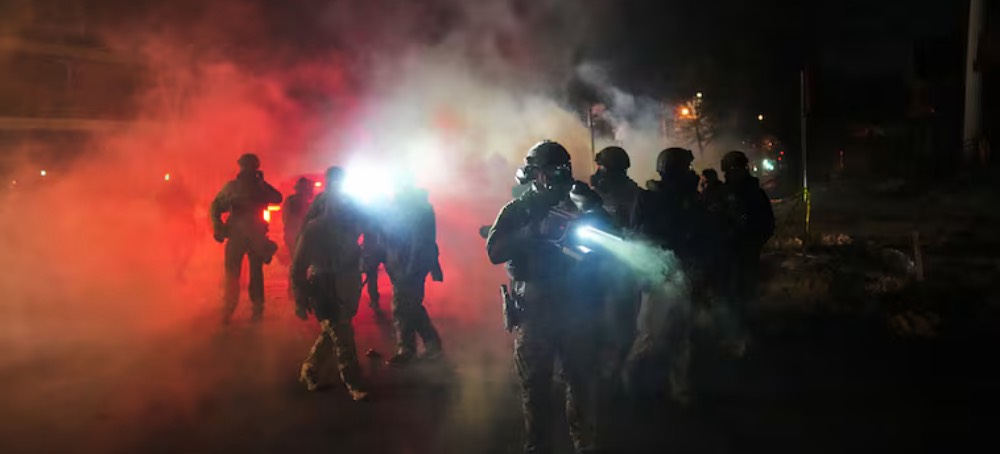
Federal Agents confront protesters in Minneapolis, MN. (photo: Adam Gray/AP)
President Donald Trump on Thursday threatened to invoke the Insurrection Act and deploy troops to quell persistent protests against the federal officers sent to Minneapolis to enforce his administration’s massive immigration crackdown.
The president’s threat comes a day after a federal immigration officer shot and wounded a Minneapolis man who had attacked the officer with a shovel and broom handle. That shooting further heightened the fear and anger radiating across the Minnesota city since an Immigration and Customs Enforcement agent fatally shot a Renee Good in the head.
Trump has repeatedly threatened to invoke the rarely used federal law to deploy the U.S. military or federalize the National Guard for domestic law enforcement, over the objections of state governors.
“If the corrupt politicians of Minnesota don’t obey the law and stop the professional agitators and insurrectionists from attacking the Patriots of I.C.E., who are only trying to do their job, I will institute the INSURRECTION ACT, which many Presidents have done before me, and quickly put an end to the travesty that is taking place in that once great State,” Trump said in social media post.
Presidents have indeed invoked the Insurrection Act more than two dozen times, most recently in 1992 by President George H.W. Bush to end unrest in Los Angeles. In that instance, local authorities had asked for the assistance.
The Associated Press has reached out to the offices of Gov. Tim Walz and Minneapolis Mayor Jacob Frey for comment.
The Department of Homeland Security says it has made more than 2,000 arrests in the state since early December and is vowing to not back down. ICE is a DHS agency.
Protests, tear gas and another shooting
In Minneapolis, smoke filled the streets Wednesday night near the site of the latest shooting as federal officers wearing gas masks and helmets fired tear gas into a small crowd. Protesters responded by throwing rocks and shooting fireworks.
Police Chief Brian O’Hara said during a news conference that the gathering was an unlawful assembly and “people need to leave.”
Things later quietened down and by early Thursday only a few demonstrators and law enforcement officers remained at the scene.
Demonstrations have become common on the streets of Minneapolis since the ICE agent fatally shot 37-year-old Good on Jan. 7. Agents have yanked people from their cars and homes, and have been confronted by angry bystanders demanding that the officers pack up and leave.
“This is an impossible situation that our city is presently being put in and at the same time we are trying to find a way forward to keep people safe, to protect our neighbors, to maintain order,” Frey, the mayor, said.
Frey said the federal force — five times the size of the city’s 600-officer police force — has “invaded” Minneapolis, scaring and angering residents.
Shooting followed a chase
In a statement describing the events that led to Wednesday’s shooting, Homeland Security said federal law enforcement officers stopped a driver from Venezuela who is in the U.S. illegally. The person drove away and crashed into a parked car before taking off on foot, DHS said.
After officers reached the person, two other people arrived from a nearby apartment and all three started attacking the officer, according to DHS.
“Fearing for his life and safety as he was being ambushed by three individuals, the officer fired a defensive shot to defend his life,” DHS said.
The two people who came out of the apartment are in custody, it said.
O’Hara said the man shot was in the hospital with a non-life-threatening injury.
The shooting took place about 4.5 miles (7.2 kilometers) north of where Good was killed. O’Hara’s account of what happened largely echoed that of Homeland Security.
During a speech before the latest shooting, Walz described Minnesota as being in chaos, saying what’s happening in the state “defies belief.”
“Let’s be very, very clear, this long ago stopped being a matter of immigration enforcement,” he said. “Instead, it’s a campaign of organized brutality against the people of Minnesota by our own federal government.”
An official says the agent who killed Good was injured
Jonathan Ross, the Immigration and Customs Enforcement officer who killed Good, suffered internal bleeding to his torso during the encounter, a Homeland Security official told The Associated Press.
The official spoke to AP on condition of anonymity in order to discuss Ross’ medical condition. The official did not provide details about the severity of the injuries, and the agency did not respond to questions about the extent of the bleeding, exactly how he suffered the injury, when it was diagnosed or his medical treatment.
Good was killed after three ICE officers surrounded her SUV on a snowy street a few blocks from her home.
Bystander video shows one officer ordering Good to open the door and grabbing the handle. As the vehicle begins to move forward, Ross, standing in front, raises his weapon and fires at least three shots at close range. He steps back as the SUV advances and turns.
Homeland Security Secretary Kristi Noem has said Ross was struck by the vehicle and that Good was using her SUV as a weapon — a self-defense claim that has been criticized by Minnesota officials.
Chris Madel, an attorney for Ross, declined to comment.
Good’s family has hired the same law firm that represented George Floyd’s family in a $27 million settlement with Minneapolis. Floyd, who was Black, died after a white police officer pinned his neck to the ground in the street in May 2020.
*..........*..........*..........*..........*..........*..........*..........*
*..........*..........*..........*..........*..........*..........*..........*
6) Journalists Confront New Reality in Reporting After FBI Raid
By Sarah Ellison, Patrick Marley and Colby Itkowitz/The Washington Post, January 15, 2026
Yes, its headquarters is a monstrosity—and it should stay in Washington. (photo: Getty)
After the FBI searched a Washington Post reporter’s home Wednesday morning, reporters from multiple outlets said they moved swiftly to secure their phones and laptops, reassure confidential sources and consult newsroom leaders as they worried about the federal government’s seizure of devices containing sensitive information.
Many journalists said they saw the FBI raid as a jarring new step aimed at limiting news organizations’ ability to gather information that the government does not want to be made public.
“It’s incredibly intimidating to be targeted by the government,” said Ted Bridis, a former Washington investigations editor for the Associated Press. His phone records, along with those of his employees, were secretly obtained by the Department of Justice in 2012, during the AP’s reporting into the NYPD’s clandestine surveillance of Muslims in New York City.
After his team won the Pulitzer Prize and news of the Justice Department’s actions became public, “people who used to meet us for coffee refused,” said Bridis, who now teaches journalism, including on the topic of source protection, at the University of Florida. “Our sources were scared to talk to us.”
Under previous administrations, reporters have been subpoenaed for information, and such actions are usually challenged in court. But raiding a reporter’s home early in the morning — a more intrusive step that limits the ability for a court challenge — is exceedingly unusual if not unprecedented, according to Gabe Rottman, an attorney and vice president of policy for the Reporters Committee for Freedom of the Press, who said he could think of no comparable examples.
The raid on Post reporter Hannah Natanson’s home — which involved taking possession of her phone, two laptops and a Garmin watch — prompted reporters from a range of outlets, who spoke on the condition of anonymity to discuss sensitive sourcing and security matters, to reevaluate how they keep their sources and devices safe.
One reporter who covers national security issues said he turned off facial recognition software on his phone so that he had to use a password to log into it, an action that at least half a dozen reporters said Wednesday they had taken in light of the search of Natanson’s home.
He said he made the change because he believed law enforcement agents easily could use his face to help them access his phone but would have a tougher time compelling him to provide his password. He has also contemplated using burner phones, he said.
One White House reporter said that their first thought, after the initial shock of the raid, was to review how they manage information from sources and go back through internal legal guidance. In the New York Times’s Washington bureau on Wednesday, a regularly scheduled meeting started with an update on security and legal protocols, according to a person who attended. A reporter who covers the Pentagon said one positive outcome of the FBI search was that it snapped journalists into action to protect themselves and their sources.
In a note to The Post’s staff Wednesday, Executive Editor Matt Murray said the publication was informed that neither Natanson nor The Post is the target of the FBI investigation, which was aimed at a government contractor accused of illegally retaining classified government materials. “Nonetheless, this extraordinary, aggressive action is deeply concerning,” Murray wrote.
He followed up later in the day to say “we are continuing to vigorously defend our journalists and our work.” He added that the publication is working to schedule refresher sessions to reinforce proper source and reporting practices.
“The reports of F.B.I. agents raiding the home of a journalist and seizing her electronic devices are deeply concerning and portray a stark threat to free press rights in this country,” said David McCraw, senior vice president and deputy general counsel for the New York Times. “Actions like this inevitably impede reporters’ ability to gather news in the public interest and as a result make the government less accountable.
“When you’re talking about reporting on the military or the intelligence agencies or foreign affairs or federal law enforcement, it’s often necessary for reporters to rely on assurances of confidentiality to sources in order to get information in the public interest out.”
One veteran reporter who handles sensitive stories has frequently worried about the prospect of an FBI raid. “I have been concerned for a long time — years actually — about exactly this, FBI agents knocking on my door or that of other reporters and seizing our devices,” the reporter said, adding that several of their sources “already were in contact this morning to register their worry about being discovered in a similar way.”
Natanson has spent the past year covering the Trump administration’s effort to fire federal workers and wrote a first-person piece late last year about her experience.
The Post also received a subpoena Wednesday morning seeking information related to the classified materials case.
The FBI declined to answer questions about the search and referred to a statement that Director Kash Patel posted on social media accusing the reporter of “obtaining and reporting classified, sensitive military information from a government contractor — endangering our warfighters and compromising America’s national security. The alleged leaker was arrested this week and is in custody.”
Other reporters and editors who had faced government surveillance and legal action said the case represented a new level of intimidation.
The raid on Natanson’s home “goes way beyond anything that is expected or required under any normal and traditional guidelines covering the way the government deals with the press,” said James Risen, a former investigative reporter for the New York Times, who has described undergoing years of FBI surveillance starting in 2008 as he fought to avoid testifying in a national security leak investigation involving his reporting.
Laura Poitras, the documentary filmmaker who helped Edward Snowden go public with his revelations about government surveillance, called the raid an “outrageous escalation” and a reminder to reporters that they need to take extra precautions when dealing with sensitive subjects and sources. She said she took extreme digital security measures to protect Snowden in 2013 when he disclosed details of secret government surveillance efforts.
“This administration is salivating for an opportunity to incarcerate journalists,” said Martin Baron, a former executive editor of The Post, noting that Trump talked openly about the possibility at rallies in 2022. Baron said the administration’s open disdain for the press indicated that “things are going to get far worse.”
When the Justice Department labeled a Fox News reporter a criminal in 2013 to seize his emails in a leak investigation, the backlash was swift and bipartisan.
Attorney General Eric Holder, accused by Republican lawmakers of misleading Congress, responded by barring prosecutors from falsely portraying reporters as criminals to obtain search warrants — unless they genuinely planned to bring charges.
In 2021, after revelations that Trump’s Justice Department had secretly seized records from reporters at The Post, the New York Times and CNN, Attorney General Merrick Garland went further: He banned using search warrants and subpoenas to obtain journalists’ materials or compel testimony about their sources.
Last year, Attorney General Pam Bondi reversed course, restoring investigators’ ability to target reporters’ information. She reinstated much of Holder’s framework but made one critical change: She eliminated the ban on misrepresenting reporters as criminals to circumvent a decades-old law protecting journalists.
While many journalists have adopted heightened security measures to protect their sources in recent years, including encrypted communications technology, the government has immense power to surveil.
The search warrant serves as a reminder to journalists of the difficult work of protecting sources, said Alex Papachristou, director of the Cyrus R. Vance Center for International Justice, which provides free legal services to small news organizations around the country. He predicted the warrant would have a “cryogenic effect” on the willingness of sources to disclose information to the press.
“We’re in a time,” he said, “when looking over your shoulder is just about the only way to look.”
*..........*..........*..........*..........*..........*..........*..........*
*..........*..........*..........*..........*..........*..........*..........*
7) UPenn Faculty Condemn Trump Administration’s Demand for ‘Lists of Jews’
By Alice Speri/Guardian UK, January 15, 2026

Students on the University of Pennsylvania campus in Philadelphia on 8 December 2023. (photo: Michelle Gustafson/Getty)
Several faculty groups have denounced the Trump administration’s efforts to obtain information about Jewish professors, staff and students at the University of Pennsylvania – including personal emails, phone numbers and home addresses – as government abuse with “ominous historical overtones”.
The US Equal Employment Opportunity Commission (EEOC) is demanding the university turn over names and personal information about Jewish members of the Penn community as part of the administration’s stated goal to combat antisemitism on campuses. But some Jewish faculty and staff have condemned the government’s demand as “a visceral threat to the safety of those who would find themselves identified because compiling and turning over to the government ‘lists of Jews’ conjures a terrifying history”, according to a press release put out by the groups’ lawyers.
The EEOC sued Penn in November over the university’s refusal to fully comply with its demands. On Tuesday, the American Association of University Professors’ national and Penn chapters, the university’s Jewish Law Students Association and its Association of Senior and Emeritus Faculty, and the American Academy of Jewish Research filed a motion in federal court to intervene in the case.
“These requests would require Penn to create and turn over a centralized registry of Jewish students, faculty, and staff – a profoundly invasive and dangerous demand that intrudes deeply into the freedoms of association, religion, speech, and privacy enshrined in the First Amendment,” the groups argued.
“We are entering territory that should shock every single one of us,” said Norm Eisen, co-founder and executive chair of the Democracy Defenders Fund on a press call. The fund is representing the faculty groups along with the American Civil Liberties Union of Pennsylvania and the firm Hangley Aronchick Segal Pudlin and Schiller. “That kind of information – however purportedly benign the excuses given for it – can be put to the most dangerous misuse. This is an abuse of government power that drags us back to some of the darkest chapters in our history.”
The EEOC did not immediately respond to a request for comment.
The University of Pennsylvania was among dozens of US universities to come under federal investigation over alleged antisemitism in the aftermath of the 7 October 2023 Hamas attacks and Israel’s subsequent war in Gaza. In response, the university established a taskforce to study antisemitism, implemented a series of measures and shared hundreds of pages of documents to comply with government demands.
But the university refused to comply with the EEOC’s July subpoena for personal information of Jewish faculty, students and staff, or those affiliated with Jewish organizations who had not given their consent, as well as the names of individuals who had participated in confidential listening sessions or received a survey by the university’s antisemitism taskforce. A university spokesperson said in November that “violating their privacy and trust is antithetical to ensuring Penn’s Jewish community feels protected and safe”. Instead, the university offered to inform all its employees of the EEOC investigation, inviting those interested to contact the agency directly.
But that was not enough for the commission, which brought the university to court to seek to enforce the subpoena.
“The EEOC remains steadfast in its commitment to combatting workplace antisemitism and seeks to identify employees who may have experienced antisemitic harassment. Unfortunately, the employer continues to refuse to identify members of its workforce who may have been subjected to this unlawful conduct,” the EEOC chair, Andrea Lucas, said in a statement at the time. “An employer’s obstruction of efforts to identify witnesses and victims undermines the EEOC’s ability to investigate harassment.”
The EEOC request prompted widespread alarm and condemnation among Jewish faculty, and earned rebukes from the university’s Hillel and other Jewish groups.
Steven Weitzman, a professor with Penn’s religious studies department who also served on the university’s antisemitism taskforce, said that the mere request for such lists “instills a sense of vulnerability among Jews” and that the government cannot guarantee that the information it collects won’t fall “into the wrong hands or have unintended consequences”.
“Part of what sets off alarm bells for people like me is a history of people using Jewish lists against Jews,” he said . “The Nazi campaign against Jews depended on institutions like universities handing over information about their Jewish members to the authorities.”
“As Jewish study scholars, we know well the dangers of collecting such information,” said Beth Wenger, who teaches Jewish history at Penn.
It’s not the first time the EEOC’s efforts to fight antisemitism have caused alarm among Jewish faculty. Last spring, the commission texted the personal phones of employees of Barnard College, the women’s school affiliated with Columbia University, linking to a survey that asked respondents whether they identified as Jewish or Israeli.
*..........*..........*..........*..........*..........*..........*..........*
*..........*..........*..........*..........*..........*..........*..........*
8) Video Analysis of ICE Shooting Sheds Light on Contested Moments
Newly available videos and existing footage synchronized and assessed by The Times provide a frame-by-frame look at how an ICE officer ended up shooting and killing a motorist in Minneapolis.
By The New York Times, Published Jan. 15, 2026, Updated Jan. 16, 2026
https://www.nytimes.com/2026/01/15/video/ice-shooting-renee-good-minneapolis-videos.html?unlocked_article_code=1.E1A.ajMz.0IDu0C2H1XOJ&smid=url-share

President Trump and members of his administration have said that Renee Good, the woman killed by a federal agent in Minneapolis on Jan. 7, “weaponized her vehicle” against the agent who shot her — an interpretation they claim is confirmed by the agent’s cellphone video.
“She didn’t try to run him over,” Mr. Trump said on the day of the shooting. “She ran him over.”
That description has been contested by local and state officials, who have blamed the federal government for the tension, saying aggressive tactics that violate police protocol had stirred unrest. Demonstrators have taken to the streets nationwide to protest the killing of Ms. Good, a U.S. citizen. The administration has responded by sending 1,000 additional agents to Minnesota.
In a video analysis, The Times focuses on some of the key contested moments of the agent’s cellphone video alongside other footage. More videos are likely to emerge, but the visual evidence shows no indication that the agent who fired the shots, Jonathan Ross, had been run over. The footage provides visibility into the positioning between the agent and Ms. Good’s S.U.V., and the key moments of escalation. It also establishes how Mr. Ross put himself in a dangerous position near her vehicle in the first place.
*..........*..........*..........*..........*..........*..........*..........*
*..........*..........*..........*..........*..........*..........*..........*
9) Agent Who Shot Renee Good Was Trained to Track and Apprehend Fugitives
From Iraq to ICE, Jonathan Ross’s career reflects a 20-year government effort to reshape immigration enforcement with a military mind-set.
By Katie J.M. Baker, Jan. 16, 2026

On Jan. 7, during an enforcement surge in south Minneapolis, Jonathan Ross fired three shots into a moving S.U.V., killing Renee Good.
Jonathan Ross stood before a small group of his fellow students at Anderson University in Indiana and cautioned that the war in Iraq was not the one they were seeing on television.
It was April 2006, and the 23-year-old was recently back from a National Guard deployment to Iraq, speaking at a “Support the Troops” event hosted by the College Republicans. Mr. Ross showed the students photos of charred Humvees and walls pockmarked with bullet holes.
“We just got armor from the dump,” he said, describing how they outfitted their vehicles. “They didn’t supply us with the trucks you see on the news at all.”
Twenty years later, Mr. Ross, now an agent with Immigration and Customs Enforcement, is once again on the front lines of a polarizing mission: the Trump administration’s aggressive immigration crackdown in Minnesota.
On Jan. 7, during an enforcement surge in south Minneapolis, Mr. Ross fired three shots into a moving S.U.V., killing Renee Good, a 37-year-old mother of three. Her partner, Becca, who recorded the standoff on her phone, later said the couple had “stopped to support our neighbors” after federal agents were spotted in their neighborhood.
President Trump and other federal officials have said that Mr. Ross acted in self-defense when he killed Ms. Good, and have accused her of driving at him or even running him over. Minnesota officials have called the administration’s accounts “propaganda” and “garbage.” (A New York Times analysis of videos of the shooting contradicts the claim that Mr. Ross was run over, and suggests Ms. Good was steering away from him at the time he opened fire.)
Chris Madel, a Republican candidate for governor of Minnesota, has said he is representing Mr. Ross. He did not respond to requests for comment.
The career trajectory of Mr. Ross from the National Guard to the Border Patrol, and finally to a tactical ICE unit, mirrors a broader, post-9/11 project: the steady militarization of the border and the agencies that police it.
Mr. Ross joined the Indiana National Guard in 2002, a year after graduating from high school in Peoria, Ill. In November 2004, he deployed to Iraq, and was there for a year, during a time when the insurgency was growing increasingly violent. He served as a gunner in convoys for his logistics unit, but nothing in his record suggests he saw combat.
Days before he deployed, Mr. Ross married for the first time. By the time he returned from Iraq, he had filed for divorce. According to records, the couple had no children or real estate to divide; the final decree simply required his ex-wife to return her engagement and wedding rings and Mr. Ross to pay her $3,000.
He spent the next two years at Anderson University, a Christian liberal arts college in Indiana. Michael Smith, a former dormmate, remembered Mr. Ross as a quiet, dependable student who didn’t participate in the campus party scene. “He was a little more mature than the rest of us,” Mr. Smith said. He said Mr. Ross rarely discussed his time in Iraq.
Mr. Ross graduated in 2007 with a degree in both business administration and psychology. That year, he left the Indiana National Guard to join the U.S. Border Patrol near El Paso, Texas.
He joined as the agency was racing to meet a Bush administration mandate to expand the force by the end of 2008 — effectively doubling its size compared to the start of the administration.
As a result of the push, many veterans joined, said Tony Payan, the director of the Center for the U.S. and Mexico at Rice University’s Baker Institute for Public Policy.
He said it was tough for many of the veterans to go from a military mind-set to one of law enforcement. “It is very difficult for those trained to interpret threats in war zones to pivot to a role where they must view a person as a community member,” Mr. Payan said.
Critics have pointed to the mid-2000s hiring wave as a turning point for the agency’s culture.
A 2013 American Immigration Council report on the use-of-force policies of U.S. Customs and Border Protection found an “organizational subculture” that fostered a “systematic problem” of mistreatment of migrants while in custody. A 2013 policy review commissioned by the agency and conducted by the Police Executive Research Forum urged the agency to make significant changes. It specifically recommended prohibiting agents from shooting at moving vehicles unless the occupants were attempting to use deadly force other than the vehicle against the agent.
In a statement, U.S. Customs and Border Protection said it has “always prided itself in the training of it’s officers and agents and at no point has the integrity or quality of the training been compromised.”
Carl Quaney, who served as a Border Patrol agent from 2008 to 2010 as part of the El Paso Sector, described the mission of the agency as a vital defense against narcotics and international terrorists. (He said he remembered Mr. Ross from his time there but that they didn’t work together.) As a former member of the Marine Corps who had deployed to Iraq, Mr. Quaney said the assets and support available at the Border Patrol made the job feel “like being back in the military again.”
When Mr. Ross arrived at the El Paso sector, it was relatively quiet, despite a drug cartel war taking place across the Rio Grande in Juárez, Mexico, some experts said.
Mr. Ross said in a 2025 court case that his duties included standard line-watch and tracking. He also worked as a field intelligence agent, analyzing raw data to map cartel operations and the mechanics of human and drug smuggling.
By 2015, he had married again and taken a job with ICE in Minnesota. That year, Mr. Ross bought a large home near the end of a quiet cul-de-sac in Chaska, a city about 30 minutes southwest of where the shooting took place in Minneapolis. One neighbor who declined to give his name out of fear of retribution said that the house had signage supporting Trump around the presidential election, and that a “Don’t Tread on Me” flag had waved from the front porch. He said he had seen children playing on the front lawn.
As a team leader for ICE Enforcement and Removal Operations in St. Paul, Mr. Ross focused on “fugitive operations” to track and apprehend “higher-value targets,” he later said in court testimony. He described coordinating with the F.B.I. and A.T.F. to oversee the surveillance and execution of arrest warrants. He said he was also a firearms instructor, and investigated transnational organized crime and national security cases.
Mr. Ross was also part of a cohort inside ICE known as the Special Response Team that is trained to handle more dangerous situations. In 2025, S.R.T. members were sent across the nation to cities where Mr. Trump’s immigration crackdown had spurred mass protests, including Los Angeles, Chicago and elsewhere.
One law enforcement officer who has worked with Mr. Ross described him as a thorough agent who would go down rabbit holes in search of undocumented immigrants. Mr. Ross mostly avoided bringing up politics in his workplace, said the colleague, who requested anonymity to protect himself from retribution.
The agency was dealing with a huge amount of burnout, the law enforcement officer said. Across the U.S., ICE officers were being pushed to conduct more arrests and operations than ever before to hit lofty arrest goals dictated from Washington, D.C.
In June 2025, Mr. Ross led a multiagency team to arrest a Guatemalan man who had been convicted of sexual abuse in Minnesota. After a pursuit, the driver, Roberto Carlos Muñoz-Guatemala, had refused to exit his vehicle, prompting Mr. Ross to shatter a window, according to a federal affidavit which stated he was then dragged nearly 100 yards at high speeds after reaching into the man’s car.
Mr. Ross later testified that he “feared for his life” during the incident and suffered a severe forearm gash and required 33 stitches across his face and limbs. Use-of-force experts told The Times that by reaching into the vehicle, Mr. Ross had disregarded standard law enforcement training.
Last month, a jury convicted Mr. Muñoz-Guatemala of assaulting Mr. Ross.
Six months later, the dragging incident has become a key point in the national debate surrounding the shooting of Ms. Good.
For some of his supporters, including top administration officials, it explains his lethal response to Ms. Good as a defensive reflex.
“The officer was in fear of his own life, the lives of his fellow officers and acted in self-defense,” said Tricia McLaughlin, a spokeswoman for the Department of Homeland Security. She said that ICE officers are trained to use the “minimum amount of force necessary” to resolve dangerous situations, and that the agency prioritizes public and officer safety through “de-escalation tactics” and regular, ongoing use-of-force training.
To Mr. Ross’s critics, however, the incident is evidence of a high-risk approach that favors counterinsurgency-style aggression over careful policing.
In court last December regarding the dragging case, Mr. Ross testified that he was dragged while screaming “at the top of my lungs” for Mr. Muñoz-Guatemala to slow down.
On Jan. 7, when Ms. Good began to drive instead of getting out of her S.U.V. as ordered by ICE agents, Mr. Ross, who was bracing himself against her vehicle with one arm, fired three times, killing her.
On footage from Mr. Ross’s own cellphone, there are no pleas for the car to stop. Instead, the video shows the car careening down the street. Mr. Ross can be heard muttering, according to a Times audio and video analysis, “Fucking bitch.”
*..........*..........*..........*..........*..........*..........*..........*
*..........*..........*..........*..........*..........*..........*..........*
10) Emergency Call Transcripts Record a Crisis Unfolding in Real Time
The killing of Renee Good by an ICE agent was instantly reported to the Minneapolis Police. The calls reflect shock, fury and confusion.
By Pooja Salhotra, Jan. 16, 2026

A memorial for Renee Good. She was shot after beginning to drive away from an ICE agent who told her to get out of her car. Credit...Jamie Kelter Davis for The New York Times
Records of police and emergency operators released late Thursday contain fragmentary, confused and profane reports from the scene in south Minneapolis and the efforts of the city police to contend with a crisis not of their making. The documents — about 60 pages of 911 call transcripts and police and fire department incident reports — sketch the visceral shock of bystanders, reduced to dry transcripts and terse entries in the shorthand of the police scanner.
The calls to 911 began at 9:38 a.m. on Jan. 7, shortly after an Immigration and Customs and Enforcement officer fired a gun into Ms. Good’s maroon Honda Pilot as observers and protesters confronted federal agents. The frantic calls persisted for about an hour.
“There’s 15 ICE agents, and they shot her, like, because she wouldn’t open her car door,” one caller said.
“I witnessed it,” a separate caller told an operator. Asked if anyone was hit, she replied, after catching her breath, “Yes, bleeding.” The caller later said, “She tried to drive away, but crashed into the nearest vehicle that was parked.”
The caller said she saw blood all over the driver.
The dispatcher responded that “lots of help” was on the way. Another caller pleaded: “Send an ambulance please. Ambulance, please.”
When paramedics arrived at 9:42 a.m., Ms. Good was in the driver’s seat, unresponsive, with blood on her face and torso, the records say. After they removed her from the vehicle, she was not breathing and had an irregular pulse.
She had two apparent gunshot wounds on the right side of her chest, another on her left forearm and a possible fourth on the left side of her head. Blood was flowing from her left ear, and her pupils were dilated, the Fire Department’s report said.
In an ambulance en route to the hospital, medics performed CPR on Ms. Good. About 10:30 a.m., resuscitation efforts were stopped.
Jonathan Ross, who was identified as the ICE agent who shot Ms. Good, was still on the scene, according to a report from the Minneapolis Police Department. About 15 minutes later, he was taken to a federal building.
One of the 911 calls came from a man who appeared to be calling for emergency assistance and local police on behalf of homeland security officers on the scene.
From there, the terse communications among Minneapolis police and fire units recorded in incident reports released Thursday night tell the story.
At 9:47 a.m.: “NEED CROWD CONTROL AND AREA BLOCKED OFF.”
Three minutes later: “CROWD GETTING HOSTILE.”
10:07 a.m.: “CONTACT WHO IS IN CHARGE OF FEDS AND HAVE THEM LEAVE SCENE”
But evacuating ICE was difficult, as the crowd became increasingly agitated. About 20 people tried to surround officers at one point, the records said.
11:01 a.m.: “ICE BEING SURROUNDED."
11:20 a.m.: “ALL ICE AGENTS HAVE LEFT SCENE.”
11:38 a.m.: “CROWD CALMED DOWN NOW THAT ICE IS GONE."
Within an hour after, videos of the killing were being seen on cellphones around the world.
*..........*..........*..........*..........*..........*..........*..........*
*..........*..........*..........*..........*..........*..........*..........*
11) Trump’s Fight With Minnesota Is About More Than Immigration
The state embodies a civic ideal that the administration in Washington wants to discredit.
By Charles Homans, Jan. 16, 2026
Charles Homans grew up in Minnesota and previously covered the state’s congressional delegation for the St. Paul Pioneer Press. He is in Minneapolis covering the state’s clash with the federal government.

Federal agents arresting a protester in South Minneapolis on Tuesday. David Guttenfelder/The New York Times
There are plenty of obvious reasons Minneapolis, despite ranking far down the list of U.S. cities in terms of its immigrant population, is the latest Democratic-led urban area targeted by President Trump’s punitive anti-immigration raids. There is Tim Walz, the governor and Trump’s 2024 rival. There is the genuinely stunning fraud scandal, recently revealed, that happened on Walz’s watch. And there is the long shadow of George Floyd. But to understand both the crackdown and its stakes, it’s also worth revisiting a speech Trump gave in the city in November 2016, two days before the election that would first deliver him to the White House.
“Oh, Minnesota,” Trump told the crowd, dropping into the just-you-and-me-talking mode that has always been one of his greatest assets as a politician. “You know what’s going on. You know what I’m talking about. Do you know what I’m talking about? Be politically correct. Just nod — quietly nod. The whole world knows what’s happening in Minnesota.”
What was happening in Minnesota then was a slow-burning tension surrounding the state’s Somali community, its second-largest immigrant population. In 2008, a young Somalia-born man from Minneapolis was recruited by the Somali Islamist militant group Al Shabab and detonated a car full of explosives outside a government building in his birth country’s Puntland region, the first of dozens of young men from the community who would fight for Al Shabab in Somalia and, later, for the Islamic State in Iraq and Syria over the next decade.
Minnesota had been a haven for refugees since after World War II, when it was an early destination for Holocaust survivors in the United States, and especially since the late 1970s, when it began taking in thousands of South Vietnamese and Hmong people on the wrong side of America’s withdrawal from Southeast Asia.
This hospitality had historically been a point of pride for the state, a piece of the exceptionalism that Minnesotans, performatively modest as they are, have always claimed. It was a product of a broader, deep-rooted civic idealism: the state’s preponderance of religious charities, community-level nonprofit organizations and in particular its Nordic-style social safety net, among the most generous in the country.
But amid the Shabab and ISIS recruitment, Minnesotans had grown ambivalent. A 2014 poll found that while the state’s residents were broadly supportive of immigration, less than half supported welcoming Somali immigrants.
For over half a century, Minnesota has embodied the civic ideal that Trump seems intent on overturning.
At an October 2015 listening session in the small city of St. Cloud, where tensions had run particularly high, the state’s Democratic governor, Mark Dayton, addressed the Somali community. “This is Minnesota, and you have every right to be here,” he said. The state, he said, was “not like it was 30, 50 years ago,” when it’s population was nearly entirely white — and bigots who had a problem with that should “find a state where the minority population is 1 percent or whatever. It’s not that in Minnesota. It’s not going to be again.”
Trump’s message, a year later, was that, in fact, it could be that again. If elected, he promised, his administration would “not admit any refugees without the support of the local community where they are being placed — the least they could do for you. You’ve suffered enough in Minnesota.”
The speech crystallized one of the core themes of Trump’s politics, which has become the overwhelming argument of his second term: that the country’s foundational idea of a civic nation — one whose people are bound by a shared commitment to principles rather than ancestry or cultural identity — is a sort of liberal swindle. In Trump’s America, shared prosperity requires exclusion: a policing, by force if necessary, of the boundaries of who gets to call themselves American based in large part on where they come from.
It is both fitting and not incidental that this agenda has been made so visible this month in Minneapolis, where immigration agents shot a woman dead and, in recent days, fired tear gas and smoke grenades at protesters on residential streets. On Wednesday, after a top Trump Justice Department official declared Minnesota’s resistance to the federal deployment an “insurrection” on social media, Walz posted on X that his state “will remain an island of decency, of justice, of community, and of peace.”
His statement made clear how the state government and many of its citizens see this conflict. Generalizing about any state’s political temperament is impossible in 2026, when practically all of them, including Minnesota, have variations on the same map of highly polarized rural reds and urban blues; rural Minnesotans, whose support for Democrats has collapsed in recent years, likely have a far different view than Minneapolitans do of Trump’s deployment.
Nevertheless, Minnesota is still a Democratic stronghold in presidential elections, and for over half a century, it has more clearly than perhaps any other state embodied the civic ideal that Trump seems intent on overturning. On the ground in Minneapolis, this is very overtly what the city’s residents who are tracking and confronting federal agents see themselves fighting for. Still, the largely unified local response to the flood of federal forces into Minneapolis is remarkable in light of the city’s very recent history, which has involved a deep soul-searching about precisely that ideal.
‘A State That Works’
In 2022, Lance Morrow, a former Time magazine writer and fellow at the conservative Ethics and Public Policy Center, wrote a column for The Wall Street Journal titled “How Minnesota Went From Tom Sawyer to Huck Finn.” Surveying Minneapolis’s grim crime statistics in the wake of the rioting and prolonged malaise that had followed George Floyd’s murder — a near-record number of homicides, a 537 percent year-over-year increase in carjackings — Morrow proclaimed the state to be “a microcosm of an America in crisis.”
Less than two years after the protests over Floyd’s killing, this was hardly an uncommon argument. But coming from Morrow, it carried an unusual sting. In 1973, he had written the ur-text of Minnesotan exceptionalism, a Time cover story called “Minnesota: A State That Works.”
Touring Minneapolis and its suburbs, Morrow, who had covered the 1967 riots in Detroit and the Vietnam War, seemed genuinely in awe of how little Minnesota appeared to have been touched by the traumas and upheavals wracking the country. “It is a state where a residual American secret still seems to operate,” he wrote, surveying Minnesota’s wonders one by one: a thriving and diversified economy; the lowest high-school-dropout rate in the country and the third-lowest crime rate; per capita incomes above the national average; an abundance of outdoor recreational opportunities that its unnervingly hale residents flocked to. (The cover of the issue featured Wendell Anderson, the state’s handsome young governor, on a lake in a plaid shirt, beaming over a freshly caught northern pike.)
But mostly, Morrow was struck by the “extraordinary civic interest” of Minnesotans. Citizens’ lobbies thrived. Minnesota-based companies voluntarily ponied up millions of dollars to improve downtown Minneapolis and build the Mayo Clinic. Voters cheerfully accepted statewide tax increases to better fund underserved local school districts. The state’s elected officials seemed to all be starry-eyed idealists motivated by a genuine commitment to service and little expectation of reward.
Daniel J. Elazar, the Minneapolis-born political scientist and scholar of American federalism, described Minnesota as a “moralistic” political culture, one of three such cultures he identified, along with the “individualistic” and the “traditionalistic.” The moralistic strain in American public life, in Elazar’s definition, saw politics as a noble pursuit, one that did not just guard liberty or identity or pursue interests but could be a tool for actively improving people’s lives. And Minnesota, Elazar argued, embodied the moralistic culture “more so than any other in the Union or perhaps in the world.”
This owed something to history — the state’s civil society was shaped in the 19th century by Yankee antislavery Republicans and later immigrants from Scandinavia and Germany, all deeply moralistic political cultures — and something to politics: The most powerful force in Minnesota politics for decades has been the Democratic-Farmer-Labor Party, a midcentury left-liberal fusion organization shaped in its early years by a cohort of cerebral amateurs, several of them young political science professors.
The D.F.L., in its early history, was particularly preoccupied with race relations: Hubert H. Humphrey, one of the party’s founders, led the campaign to insert the civil rights plank into the national party platform at the 1948 Democratic National Convention, prompting the Dixiecrat walkout and the realignment of American partisan politics that followed. The fact that this commitment existed in one of the least diverse states in the country — as recently as 1980, Minnesota was 96.7 percent white — seemed, to Minnesotan liberals, a further testament to the state’s exceptionalism.
But as race has become a ubiquitous lens for social science analysis, Minnesota has come in for a harder look. For a quarter-century now, researchers, drawing on data from around the world, have noted a clear correlation between the generosity of a country’s welfare state and the homogeneity of its population — a finding that invites a new reading of the idea of moralistic government as just another form of self-interest.
A particular criticism of Minnesota, which rocketed to the foreground following George Floyd’s killing, is that Minnesota’s proud progressivism on race was itself a counterintuitive product of the state’s lack of diversity and pervasive segregation. Beneath its rhetorical commitments, the state possesses some of the country’s most severe racial disparities across a wide range of metrics, from unemployment to homeownership to incarceration to educational attainment.
“African Americans are worse off in Minnesota than they are in virtually every other state in the nation,” the University of Minnesota economist Samuel L. Myers Jr. has written, describing what he has called the “Minnesota Paradox.” Well-off white people, living in neighborhoods surrounded by other well-off white people, could afford to subsidize a generous welfare state and were mostly insulated from its failings, when they were aware of them at all. The self-image the state’s white liberals had drawn from its history of civic idealism had kept them from seeing the many ways in which that idealism had come up short.
‘This Is Not Who We Are’
These are both critiques from the left, but the new right that has ridden into the center of American politics with Trump’s re-election turns them on their head. If diversity seems antithetical to the liberal dream of a welfare state that effectively serves its citizens, the right asks, then why are liberals so hung up on diversity? And if the sort of self-satisfied liberalism that Minnesotans are famous for hasn’t served the people of color that those liberals are so concerned about, then what is the point of it, exactly?
The fraud scandal in Minnesota, in which dozens of members of the state’s Somali community are implicated in stealing over $1 billion from the state’s much-vaunted social services system, has struck bone because it fits so neatly within this line of argument: that liberals’ civic commitments are not just empty and unproductive but also a cover for looting the state by the very people liberals are most preoccupied with protecting.
Walz, addressing the specters of extremism and political violence in the 2024 campaign, often fell back on a well-worn phrase from his gubernatorial candidacy, “This is not who we are.” But who are we, then? Liberalism, in Minnesota and elsewhere, has always struggled more with that question than the right, with its cultural conservatism, or the socialist left, with its appeals to class solidarity. Walz’s predecessor’s response — “This is Minnesota” — is not quite a complete answer. Much of Minnesota’s recent history is the story of a state learning that pluralism in the abstract is less complicated than pluralism in reality.
Minneapolis is still haunted by 2020 and the deep rift it cleaved within its liberal population.
But whatever its misgivings, Minnesota is still Walz’s state more than Trump’s. Much of the political particularity that nurtured Minnesota’s civic culture is gone now. But the state brushed off Trump’s appeal in 2016 and, for good measure, elected Ilhan Omar, the country’s first Somali congresswoman. Predictions that Trump would win the state in 2020 and 2024, after Floyd’s murder and its consequences, proved wrong, too.
Minneapolis is still haunted in many respects by 2020 and the deep rift it cleaved within its overwhelmingly liberal population. But it has been possible to see, in the very different and mostly unified local revolt against Trump’s federal deployment, a sort of foxhole reconciliation — a recognition that the city’s people do still share a broad vision of what the civic ideal means to them.
This has been true nationally, too. The response to Trump’s first year back in office has made clear that ambivalence and opposition are not the same thing. It is hard to think of a federal action that has become more unpopular more quickly than Trump’s immigration raids. Last February, a YouGov poll for The Economist found that a plurality of independent voters — 42 percent of them — had a favorable view of Immigration and Customs Enforcement. In a poll conducted the day of Renee Good’s shooting, 56 percent of independents disapproved of the agency’s work, 44 percent of them strongly.
That is a picture of a country that mostly agrees with Walz that this is not who we are — even if it is not entirely sure who it is instead. If Trump’s candidacy was a sustained attack on the idea of civic nationalism, his second presidency has very quickly become a clarification of what the alternative looks like — and what it looks like for now, in Minneapolis, is a masked federal agent shooting a woman in the head through the windshield of her own car.
*..........*..........*..........*..........*..........*..........*..........*
*..........*..........*..........*..........*..........*..........*..........*
12) Greek Court Acquits Rescue Workers Accused of Smuggling Migrants
The 24 former volunteers, including the refugee turned campaigner Sara Mardini, were prosecuted after helping migrants during the European refugee crisis nearly a decade ago.
By Niki Kitsantonis, Reporting from Athens, Jan. 16, 2026

Some of the aid workers and their lawyers outside the courthouse on Thursday in Lesbos, Greece, after they were acquitted of all charges. Credit...Panagiotis Balaskas/Associated Press
A group of 24 aid workers who had been put on trial in Greece after rescuing migrants at sea was acquitted of all charges on Thursday, according to lawyers who attended the hearing, in a case that had been widely condemned by rights groups as an attempt to criminalize rescue work.
The former volunteers, who included the Syrian refugee turned campaigner Sara Mardini, had faced up to 20 years in prison if convicted on charges including facilitating illegal entry, money-laundering and membership of a criminal organization.
Their prosecution was the latest salvo against both aid workers and migrants across Europe as leaders in Greece and beyond aimed to prevent a repeat of the 2015-2016 crisis that saw hundreds of thousands of people flee war and poverty.
The island of Lesbos, where the trial took place, was the front line of that crisis — and a focal point for volunteers who scrambled from across the world to rescue migrants at sea and help them after they landed. The volunteers included Ms. Mardini and her 23 co-defendants, who worked with the now-defunct Greek nonprofit Emergency Response Center International.
A criminal court in Lesbos cleared the defendants at a hearing on Thursday, saying their aim was not to commit criminal acts but to provide humanitarian aid, according to Zacharias Kesses and Evita Papakiriakidou, defense lawyers present in court. Court officials declined to comment by phone on the verdict because the judges have yet to formally issue it in writing.
Mr. Kesses, who represented several defendants including Ms. Mardini, said the decision was a “courageous ruling.”
“The decision is of particular importance because it prevented the creation of a dangerous precedent that would have threatened the humanitarian and solidarity movement,” he added.
The verdict came amid growing restrictions placed on migrants and their advocates by Greece’s conservative government. Recent legislation means that asylum seekers now face up to five years in prison if they remain in the country after their applications are rejected, and civil society groups face greater limits on their work with refugees. Those moves followed a broader crackdown on migrants trying to reach Greece, with a New York Times investigation in 2023 finding that Greek Coast Guard officers had rounded up asylum seekers and abandoned them at sea.
The aid workers’ exoneration was the culmination of a judicial process that began in 2018 with the arrest and detention of several volunteers, including Ms. Mardini, who is the sister of the Olympic swimmer Yusra Mardini. The sisters drew global attention in 2015 after they escaped the war in Syria and helped to pull their sinking boat — and another 18 refugees — to safety on the shores of Lesbos.
A Greek court threw out previous misdemeanor charges against the activists, including espionage, in early 2023. Their subsequent trial on more serious criminal charges, which began in December, took nearly three more years to get to court, keeping the defendants in legal limbo.
Rights groups welcomed the decision to dismiss those charges but also said it was a reminder that tougher migration policies have virtually stamped out humanitarian work.
“Justice for these 24 individuals is a relief, but the environment for solidarity in Greece remains under siege,” said Eva Cossé, a senior researcher stationed in Athens for Human Rights Watch, a New York-based rights group. “The Greek government’s campaign of criminalization has already achieved its chilling effect, shutting down independent rescue work in the Aegean.”
The verdict, which the lawyers said was final and could not be appealed, appeared to draw little reaction from right-wing groups that had previously been vocal critics of rescue workers. Public interest in the case has diminished, partly because migration levels have dropped significantly since their 2015 peak. In general, Greek court verdicts rarely provoke significant public pushback.
*..........*..........*..........*..........*..........*..........*..........*
*..........*..........*..........*..........*..........*..........*..........*
13) The ‘March of the Fighting People’ Shows Cuban Strength
By teleSUR/JF, January 16, 2026
Cubans in the March of the Fighting People, Jan 16, 2026. Photo: teleSUR
As they marched through the streets of Havana, demonstrators sent a clear message to U.S. President Donald Trump: Cuba does not fear imperialism and will defend its independence and sovereignty.
“Down with imperialism,” “Yes to Cuba, no to Yankees,” “Brink President Maduro back,” and “Justice for the fallen” were among the chants voiced by thousands of Cubans as they waved national flags.
Young people, students, workers, scientists, and artists took part in the march, which was led by Cuban President Miguel Diaz-Canel Bermudez and other Revolutionary government officials.
“Cuba does not forget its children. They are heroes. This people march for them, showing their love and respect. Eternal glory!” posted Mayara Rodriguez, a Cuban citizen, on social media.
Before the march set off from the Anti-Imperialist Platform, President Diaz-Canel delivered a speech honoring the 32 fallen fighters, warning the United States that coercion will not bend his nation.
“There is no possible surrender or capitulation, nor any kind of understanding based on coercion or intimidation. Cuba does not have to make any political concessions, nor will that ever be on the negotiating table for an understanding between Cuba and the United States,” he said.
“It is important that this be understood: We will always be willing to engage in dialogue and to improve relations between the two countries, but on equal terms and on the basis of mutual respect. That has been the case for more than six decades. History will not be different now,” Diaz-Canel added.
“Cuba does not threaten or defy. If we were to be attacked, we would fight with the same ferocity shown by several generations of brave Cuban fighters in the 19th century independence wars, in the Sierra Maestra guerilla, in the underground struggle, in Africa, and in Caracas in the 21st century,” he said.
“They will not intimidate us. Their current threats remind us of the threats made by nearly all previous U.S. administrations,” the Cuban president concluded.
Sources: teleSUR – PL
*..........*..........*..........*..........*..........*..........*..........*
*..........*..........*..........*..........*..........*..........*..........*
*..........*..........*..........*..........*..........*..........*..........*
*..........*..........*..........*..........*..........*..........*..........*
*..........*..........*..........*..........*..........*..........*..........*
*..........*..........*..........*..........*..........*..........*..........*
*..........*..........*..........*..........*..........*..........*..........*
*..........*..........*..........*..........*..........*..........*..........*
*..........*..........*..........*..........*..........*..........*..........*
*..........*..........*..........*..........*..........*..........*..........*
*..........*..........*..........*..........*..........*..........*..........*
*..........*..........*..........*..........*..........*..........*..........*
*..........*..........*..........*..........*..........*..........*..........*
*..........*..........*..........*..........*..........*..........*..........*
*..........*..........*..........*..........*..........*..........*..........*
*..........*..........*..........*..........*..........*..........*..........*
*..........*..........*..........*..........*..........*..........*..........*
*..........*..........*..........*..........*..........*..........*..........*
*..........*..........*..........*..........*..........*..........*..........*
*..........*..........*..........*..........*..........*..........*..........*
