
|
|


*..........*..........*..........*..........*..........*..........*..........*
*..........*..........*..........*..........*..........*..........*..........*


Dear Friends,
We are saddened to inform you that our dear comrade Nellie Wong passed away on January 2 from ovarian cancer.
She was diagnosed in mid-December and chose to forgo chemotherapy so that her quality of life would be on the level she was used to — spending time conversing with comrades, friends and family, writing poetry, enjoying good food, and consistently fighting for a better world. Nellie lived life the way she chose and that’s also how she left the world.
Nellie found her voice when she found the feminist movement. She was one of the first to call herself an Asian American feminist back in the mid-1970s. She embraced all of herself as a Chinese American woman, revolutionary, worker, poet, activist. She inspired many generations with her courage to stand by her beliefs and her willingness to fight for them.
Nellie was a prolific writer and she published five books of poetry and her writings were included in over 200 publications. She wrote for the Freedom Socialist newspaper and also penned the introductions to the anthologies Voices of Color and Talking Back. Her writings were a result of both her experiences and her socialist feminist politics. They were inseparable.
Nellie was a leader, the organizer of the San Francisco Bay Area FSP branch for 20 years. She was always proud to let people know of her involvement with the party and Radical Women. In every interaction, she weaved in her Marxist feminism, her belief that socialism is needed, and her conviction that the working class will make revolution.
FSP and RW will be holding a memorial for Nellie in the near future to celebrate her life and accomplishments, and we’ll let you know the details as soon as they are set.
Nellie Wong, ¡presente!
Nancy Reiko Kato
Bay Area FSP Organizer
Make a Donation:
*..........*..........*..........*..........*..........*..........*..........*
*..........*..........*..........*..........*..........*..........*..........*

*..........*..........*..........*..........*..........*..........*..........*
*..........*..........*..........*..........*..........*..........*..........*

End Texas Torture of Revolutionary Elder Xinachtli
Organization Support Letter
Letter to demand the immediate medical treatment and release of Chicano political prisoner Xinachtli (Alvaro Hernandez #00255735)
To the Texas Department of Criminal Justice,
We, the undersigned organizations, write to urge immediate action to protect the life, health, and human rights of Xinachtli (legal name Alvaro Hernandez). Xinachtli is 73-year-old Chicano community organizer from Texas who has spent 23 years in solitary confinement and 30 years incarcerated as part of a 50-year sentence. His health is now in a critical and life-threatening state and requires prompt and comprehensive medical intervention.
Since his conviction in 1997, Xinachtli has spent decades in conditions that have caused significant physical and psychological harm. As an elder in worsening health, these conditions have effectively become a de facto death sentence.
Xinachtli’s current medical condition is severe. His physical, mental, and overall well-being have declined rapidly in recent weeks. He now requires both a wheelchair and a walker, has experienced multiple falls, and is suffering from rapid weight loss. He is currently housed in the McConnell Unit infirmary, where he is receiving only palliative measures and is being denied a medical diagnosis, access to his medical records, and adequate diagnostic testing or treatment.
A virtual clinical visit with licensed medical doctor Dr. Dona Kim Murphey underscores the severity of his condition. In her report of the visit, she wrote: "Given the history of recent neck/back trauma and recurrent urinary tract infections with numbness, weakness, and bowel and bladder incontinence, I am concerned about nerve root or spinal cord injury and/or abscesses that can lead to permanent sensorimotor dysfunction."
Despite his age and visible disabilities, he remains in solitary confinement under the Security Threat Group designation as a 73-year-old. During his time in the infirmary, prison staff threw away all of his belongings and “lost” his commissary card, leaving him completely without basic necessities. He is experiencing hunger, and the lack of consistent nutrition is worsening his medical condition. McConnell Unit staff have also consistently given him incorrect forms, including forms for medical records and medical visitation, creating further barriers to care and communication.
A family visit on November 29 confirmed the seriousness of his condition. Xinachtli, who was once able to walk on his own, can no longer stand without assistance. He struggled to breathe, has lost more than 30 pounds, relied heavily on his wheelchair, and was in severe pain throughout the visit.
In light of these conditions, we, the undersigned organizations, demand that TDCJ take immediate action to save Xinachtli’s life and comply with its legal and ethical obligations.
We urge the immediate implementation of the following actions:
Immediate re-instatement of his access to commissary to buy hygiene, food, and other critical items. Immediate transfer to the TDCJ hospital in Galveston for a full medical evaluation and treatment, including complete access to his medical records and full transparency regarding all procedures. Transfer to a geriatric and medical unit that is fully accessible under the Americans with Disabilities Act. Xinachtli requests placement at the Richard P LeBlanc Unit in Beaumont, Texas. Approval of Medical Recommended Intensive Supervision, the release program for individuals with serious medical conditions and disabilities, in recognition of the severity and progression of his current health issues. Failure to act will result in the continued and foreseeable deterioration of Xinachtli’s health, amounting to state-sanctioned death. We urge TDCJ to take swift and decisive action to meet these requests and to fulfill its responsibility to safeguard his life and well-being.
We stand united in calling for immediate and decisive action. Xinachtli’s life depends on it.
Signed, Xinachtli Freedom Campaign and supporting organizations
Endorsing Organizations:
Al-Awda Houston; All African People’s Revolutionary Party; Anakbayan Houston; Anti-Imperialist Solidarity; Artists for Black Lives' Equality; Black Alliance for Peace - Solidarity Network; Columbia University Students for a Democratic Society; Community Liberation Programs; Community Powered ATX; Contra Gentrificación; Diaspora Pa’lante Collective; Down South; DSA Emerge; Entre nos kc; Fighting Racism Workshops; Frontera Water Protectors; GC Harm Reductionists; JERICHO MOVEMENT; Jericho Movement Providence; Montrose Anarchist Collective; NYC Jericho Movement; OC Focus; Palestine Solidarity TX; Partisan Defense Committee; Partido Nacional de la Raza Unida; PDX Anti-Repression; Red Star Texas; Root Cause; San Francisco Solidarity Collective; Shine White Support Team; Sunrise Columbia; UC San Diego Faculty for Justice in Palestine; Viva Palestina, EPTX; Water Justice and Technology Studio; Workshops4Gaza.
Sign the endorsement letter for your organization here:
https://cryptpad.fr/form/#/2/form/view/MiR1f+iLiRBJC7gSTyfhyxJoLIDhThxRafPatxdbMWI/
IMPORTANT LINKS TO MATERIALS FOR XINACHTLI FREEDOM CAMPAIGN:
PHONE BLAST: Your community can sign up for a 15-minute-long call shift here: bit.ly/xphoneblast
FUNDRAISER: Here is the link to Jericho's fundraiser for Xinachtli: http://givebutter.com/jerichomovement
CASE HISTORY: Learn more about Xinachtli and his case through our website: https://freealvaro.net
CONTACT INFO:
Follow us on Instagram: @freexinachtlinow
Email us:
xinachtlifreedomcampaign@protonmail.com
COALITION FOLDER:
https://drive.proton.me/urls/SP3KTC1RK4#KARGiPQVYIvR
In the folder you will find: Two pictures of Xinachtli from 2024; The latest updated graphics for the phone blast; The original TRO emergency motion filing; Maria Salazar's declaration; Dr. Murphy's report from her Dec. 9 medical visit; Letter from Amnesty International declaring Xinachtli's situation a human rights violation; Free Xinachtli zine (which gives background on him and his case); and The most recent press release detailing who Xinachtli is as well as his medical situation.
Write to:
Alvaro Hernandez CID #00255735
TDCJ-W.G. McConnell Unit
PO Box 660400
Dallas, TX 75266-0400
*..........*..........*..........*..........*..........*..........*..........*
*..........*..........*..........*..........*..........*..........*..........*

Help World-Outlook Win New Subscribers
(the subscription is free of charge)
Dear reader,
Over the last month, World-Outlook and its sister publication in Spanish Panorama-Mundial have published unique coverage of U.S. and world events.
This includes the three-part interview with Cuban historian and writer Ernesto Limia Díaz, ‘Cuba Is the Moral and Political Compass of the World.’ A related article by Mark Satinoff, World Votes with Cuba to Demand an End to U.S. Blockade, included information on the campaign to send medical aid to Cuba in the aftermath of Hurricane Melissa and was shared widely by the Los Angeles Hands Off Cuba Committee and other Cuba solidarity groups.
A number of readers sent their appreciation for Cathleen Gutekanst’s article Chicago Residents Fight ICE Abductions, Deportations, which provided a compelling, eyewitness account of this example of working-class resistance to the Trump administration’s war on undocumented immigrants. Some readers shared it widely on social media platforms.
The news analysis Bigotry, Jew Hatred Take Center Stage in GOP Mainstream also generated interest. It is part of World-Outlook’s consistent analysis of the danger of the rise of incipient fascism that Trumpism has posed for the working class and its allies in the U.S. and the world.
Most recently, another article by Mark Satinoff, ‘From Ceasefire to a Just Peace’ in Israel and Occupied Territories, was promoted by Friends of Standing Together (FOST NY/NJ) on the group’s website. Alon-Lee Green and Sally Abed — the two Standing Together leaders featured at the November 12 event in Brooklyn, New York, that Mark’s article covered — and Israelis for Peace sent their thanks to Mark for his accurate reporting.
This is a small sample of the news coverage and political analysis World-Outlook offers.
We ask you to use this information to try to convince at least one of your acquaintances, colleagues, friends, fellow students, neighbors, or relatives to subscribe to World-Outlook. As you know, the subscription is free of charge. Increasing World-Outlook’s subscription base will widen the site’s reach. It will also provide new impetus to improve our coverage. Comments and reactions from subscribers, or initiatives from readers to cover events in their areas, often result in unexpectedly invaluable articles or opinion columns clarifying important political questions.
Feel free to share this letter, or part of its contents, with those you are asking to subscribe. And keep World-Outlookinformed about the reactions you get from potential new readers.
In solidarity,
World-Outlook editors
*..........*..........*..........*..........*..........*..........*..........*
*..........*..........*..........*..........*..........*..........*..........*

Funds for Kevin Cooper
Kevin was transferred out of San Quentin and is now at a healthcare facility in Stockton. He has received some long overdue healthcare. The art program is very different from the one at San Quentin but we are hopeful that Kevin can get back to painting soon.
For 41 years, an innocent man has been on death row in California.
Kevin Cooper was wrongfully convicted of the brutal 1983 murders of the Ryen family and houseguest. The case has a long history of police and prosecutorial misconduct, evidence tampering, and numerous constitutional violations including many incidences of the prosecution withholding evidence of innocence from the defense. You can learn more here .
In December 2018 Gov. Brown ordered limited DNA testing and in February 2019, Gov. Newsom ordered additional DNA testing. Meanwhile, Kevin remains on Death Row at San Quentin Prison.
The funds raised will be used to help Kevin purchase art supplies for his paintings . Additionally, being in prison is expensive, and this money would help Kevin pay for stamps, books, paper, toiletries, supplies, supplementary food, printing materials to educate the public about his case and/or video calls.
Please help ease the daily struggle of an innocent man on death row!
An immediate act of solidarity we can all do right now is to write to Kevin and assure him of our continuing support in his fight for justice. Here’s his address:
Kevin Cooper #C65304
Cell 107, Unit E1C
California Health Care Facility, Stockton (CHCF)
P.O. Box 213040
Stockton, CA 95213
www.freekevincooper.org
Call California Governor Newsom:
1-(916) 445-2841
Press 1 for English or 2 for Spanish,
press 6 to speak with a representative and
wait for someone to answer
(Monday-Friday, 9:00 A.M. to 5:00 P.M. PST—12:00 P.M. to 8:00 P.M. EST)
*..........*..........*..........*..........*..........*..........*..........*
*..........*..........*..........*..........*..........*..........*..........*

Dr. Atler Still Needs Our Help!
Please sign the petition today!
https://www.change.org/p/texas-state-university-give-tom-alter-his-job-back
What you can do to support:
—Donate to help Tom Alter and his family with living and legal expenses: https://gofund.me/27c72f26d
—Sign and share this petition demanding Tom Alter be given his job back: https://www.change.org/p/texas-state-university-give-tom-alter-his-job-back
—Write to and call the President and Provost at Texas State University demanding that Tom Alter be given his job back:
President Kelly Damphousse: president@txstate.edu
President’s Office Phone: 512-245-2121
Provost Pranesh Aswath: xrk25@txstate.edu
Provost Office Phone: 512-245-2205
For more information about the reason for the firing of Dr. Tom Alter, read:
"Fired for Advocating Socialism: Professor Tom Alter Speaks Out"
Ashley Smith Interviews Dr. Tom Alter
—CounterPunch, September 24, 2025
*..........*..........*..........*..........*..........*..........*..........*
*..........*..........*..........*..........*..........*..........*..........*

*..........*..........*..........*..........*..........*..........*..........*
*..........*..........*..........*..........*..........*..........*..........*

Stop Cop City Bay Area
Did you know about a proposed $47 million regional police training facility in San Pablo—designed for departments across the Bay Area?
We are Stop Cop City Bay Area (Tours & Teach-Ins), a QT+ Black-led grassroots collective raising awareness about this project. This would be the city’s second police training facility, built without voter approval and financed through a $32 million, 30-year loan.
We’re organizing to repurpose the facility into a community resource hub and youth center. To build people power, we’re taking this conversation on the road—visiting Bay Area campuses, classrooms, cafes, and community spaces via our Fall 2025 Tour.
We’d love to collaborate with you and/or co-create an event. Here’s what we offer:
Guest Speaker Presentations—5-minute visits (team meetings, classrooms, co-ops, etc.), panels, or deep dives into:
· the facility’s origins & regional impacts
· finding your role in activism
· reimagining the floorplan (micro-workshops)
· and more
· Interactive Art & Vendor/Tabling Pop-Ups — free zines, stickers, and live linocut printing with hand-carved stamps + artivism.
· Collaborations with Classrooms — project partnerships, research integration, or creative assignments.
· Film Screenings + Discussion — e.g., Power (Yance Ford, 2024) or Riotsville, U.S.A. (Sierra Pettengill, 2022), or a film of your choice.
👉 If you’re interested in hosting a stop, open to co-creating something else, or curious about the intersections of our work: simply reply to this email or visit: stopcopcitybayarea.com/tour
Thank you for your time and consideration. We look forward to connecting.
In solidarity,
Stop Cop City Bay Area
*..........*..........*..........*..........*..........*..........*..........*
*..........*..........*..........*..........*..........*..........*..........*

Dear Organization Coordinator
I hope this message finds you well. I’m reaching out to invite your organization to consider co-sponsoring a regional proposal to implement Free Public Transit throughout the San Francisco Bay Area.
This initiative directly supports low-income families, working people, seniors, youth, and others who rely on public transportation. It would eliminate fare barriers while helping to address climate justice, congestion, and air pollution—issues that disproportionately affect disadvantaged communities.
We believe your organization’s mission and values align strongly with this proposal. We are seeking endorsements, co-sponsorship, and coalition-building with groups that advocate for economic and racial equity.
I would love the opportunity to share a brief proposal or speak further if you're interested. Please let me know if there’s a staff member or program director I should connect with.
A description of our proposal is below:
sharethemoneyinstitute@gmail.com
Opinion: San Francisco Bay Area Should Provide Free Public Transportation
The San Francisco Bay Area is beautiful, with fantastic weather, food, diversity and culture. We’re also internationally famous for our progressiveness, creativity, and innovation.
I believe the next amazing world-leading feature we can add to our cornucopia of attractions is Free Public Transportation. Imagine how wonderful it would be if Muni, BART, Caltrain, AC Transit, SamTrans, SF Bay Ferries, and all the other transportation services were absolutely free?
Providing this convenience would deliver enormous, varied benefits to the 7.6 million SF Bay Area residents, and would make us a lovable destination for tourists.
This goal - Free Public Transportation - is ambitious, but it isn’t impossible, or even original. Truth is, many people world-wide already enjoy free rides in their smart municipalities.
New York City mayoral candidate Zohran Mamdani is promoting free transit, with a plan that’s gained the endorsement of economists from Chile, United Kingdom, Greece, and the USA.
The entire nation of Luxembourg has offered free public transportation to both its citizens and visitors since 2020. Tallinn, the capital of Estonia, has given free transit to its residents since 2013. In France, thirty-five cities provide free public transportation. Ljubljana, the capital of Slovenia, offers free rides to seniors, disabled, and students. In Maricá (Brazil) – the entire municipal bus system is free. Delhi (India) – offers free metro and bus travel for women. Madrid & Barcelona (Spain) offer free (or heavily discounted) passes to youth and seniors.
Even in the USA, free public transit is already here. Kansas City, Missouri, has enjoyed a free bus system free since 2020. Olympia, Washington, has fully fare-free intercity transit. Missoula, Montana, is free for all riders. Columbia, South Carolina, has free buses, and Chapel Hill, North Carolina, has enjoyed free transit for over a decade. Ithaca, New York, and Madison, Wisconsin, offer free transit to students.
But if the San Francisco Bay Area offered free transit, we’d be the LARGEST municipality in the world to offer universal Free Transit to everyone, resident and visitor alike. (Population of Luxembourg is 666,430. Kansas City 510,704. Population of San Francisco Bay Area is 7.6 million in the nine-county area)
Providing free transit would be tremendously beneficial to millions of people, for three major reasons:
1. Combat Climate Change - increased public ridership would reduce harmful CO2 fossil fuel emissions. Estimates from Kansas City and Tallinn Estonia’s suggest an increase in ridership of 15 percent. Another estimate from a pilot project in New York City suggests a ridership increase of 30 percent. These increases in people taking public transportation instead of driving their own cars indicates a total reduction of 5.4 - 10.8 tons of emissions would be eliminated, leading to better air quality, improved public health, and long-term climate gains.
2. Reduce Traffic Congestion & Parking Difficulty - Estimates suggest public transit would decrease traffic congestion in dense urban areas and choke points like the Bay Bridge by up to 15 percent. Car ownership would also be reduced. Traffic in San Francisco is the second-slowest in the USA (NYC is #1) and getting worse every year. Parking costs in San Francisco are also the second-worst in the USA (NYC #1), and again, it is continually getting worse.
3. Promote Social Equity - Free transit removes a financial cost that hits low-income residents hard. Transportation is the second-biggest expense after housing for many Americans. In the Bay Area, a monthly Clipper pass can cost $86–$98 per system, and much more for multi-agency commuters. For people living paycheck-to-paycheck, this is a significant cost. People of color, immigrants, youth, seniors, and people with disabilities rely more heavily on public transit. 55–70% of frequent transit riders in the Bay Area are from low-to moderate-income households, but these riders usually pay more per mile of transit than wealthy drivers. Free fares equalize access regardless of income or geography.
Free transit would help people 1) take jobs they couldn’t otherwise afford to commute to, thus improving the economy, 2) Stay in school without worrying about bus fare, 3) Get to appointments, child care, or grocery stores without skipping meals to afford transit.
To conclude: Free Public Transit should be seen as a civil rights and economic justice intervention.
The Cost? How can San Francisco Bay Area pay for Free Transit throughout our large region?
ShareTheMoney.Institute estimates the cost as $1.5 billion annually. This sum can acquired via multiple strategies. Corvallis, Oregon, has had free public bus service since 2011, paid for by a $3.63 monthly fee added to each utility bill. Missoula, Montana, funds their fare-free Mountain Line transit system, via a property tax mill levy. Madison, Wisconsin’s transit is supported by general fund revenues, state and federal grants, and partnerships/sponsorships from local businesses and organizations.
Ideally, we’d like the funds to be obtained from the 37 local billionaires who, combined, have an approximate wealth of $885 billion. The $1.5 billion for free transit is only 0.17% of the local billionaire's wealth. Sponsorship from the ultra-wealthy would be ideal. Billionaires can view the “fair transit donation” they are asked to contribute not as punishment or an “envy tax”, but as their investment to create a municipality that is better for everyone, themselves included. They can pride themselves on instigating a world-leading, legacy-defining reform that will etch their names in history as leaders of a bold utopian reform.
Our motto: “we want to move freely around our beautiful bay”
——
Hank Pellissier - Share The Money Institute
Reverend Gregory Stevens - Unitarian Universalist EcoSocialist Network
*..........*..........*..........*..........*..........*..........*..........* *..........*..........*..........*..........*..........*..........*..........*  Russia Confirms Jailing of Antiwar Leader Boris Kagarlitsky In a secret trial on June 5, 2024, the Russian Supreme Court’s Military Chamber confirmed a sentence of five years in a penal colony for left-wing sociologist and online journalist Boris Kagarlitsky. His crime? “Justifying terrorism” — a sham charge used to silence opponents of Putin’s war on Ukraine. The court disregarded a plea for freedom sent by thirty-seven international luminaries. Kagarlitsky, a leading Marxist thinker in Russia’s post-Soviet period, recently addressed socialists who won’t criticize Putin: “To my Western colleagues, who…call for an understanding of Putin and his regime, I would like to ask a very simple question. [Would] you want to live in a country where there is no free press or independent courts? In a country where the police have the right to break into your house without a warrant? …In a country which…broadcasts appeals on TV to destroy Paris, London, Warsaw, with a nuclear strike?” Thousands of antiwar critics have been forced to flee Russia or are behind bars, swept up in Putin’s vicious crackdown on dissidents. Opposition to the war is consistently highest among the poorest workers. Recently, RusNews journalists Roman Ivanov and Maria Ponomarenko were sentenced to seven, and six years respectively, for reporting the military’s brutal assault on Ukraine. A massive global solidarity campaign that garnered support from thousands was launched at Kagarlitsky’s arrest. Now, it has been revived. This internationalism will bolster the repressed Russian left and Ukrainian resistance to Putin’s imperialism. To sign the online petition at freeboris.info —Freedom Socialist Party, August 2024 https://socialism.com/fs-article/russia-jails-prominent-antiwar-leader-boris-kagarlitsky/#:~:text=In%20a%20secret%20trial%20on,of%20Putin's%20war%20on%20Ukraine. Petition in Support of Boris KagarlitskyWe, the undersigned, were deeply shocked to learn that on February 13 the leading Russian socialist intellectual and antiwar activist Dr. Boris Kagarlitsky (65) was sentenced to five years in prison. Dr. Kagarlitsky was arrested on the absurd charge of 'justifying terrorism' in July last year. After a global campaign reflecting his worldwide reputation as a writer and critic of capitalism and imperialism, his trial ended on December 12 with a guilty verdict and a fine of 609,000 roubles. The prosecution then appealed against the fine as 'unjust due to its excessive leniency' and claimed falsely that Dr. Kagarlitsky was unable to pay the fine and had failed to cooperate with the court. In fact, he had paid the fine in full and provided the court with everything it requested. On February 13 a military court of appeal sent him to prison for five years and banned him from running a website for two years after his release. The reversal of the original court decision is a deliberate insult to the many thousands of activists, academics, and artists around the world who respect Dr. Kagarlitsky and took part in the global campaign for his release. The section of Russian law used against Dr. Kagarlitsky effectively prohibits free expression. The decision to replace the fine with imprisonment was made under a completely trumped-up pretext. Undoubtedly, the court's action represents an attempt to silence criticism in the Russian Federation of the government's war in Ukraine, which is turning the country into a prison. The sham trial of Dr. Kagarlitsky is the latest in a wave of brutal repression against the left-wing movements in Russia. Organizations that have consistently criticized imperialism, Western and otherwise, are now under direct attack, many of them banned. Dozens of activists are already serving long terms simply because they disagree with the policies of the Russian government and have the courage to speak up. Many of them are tortured and subjected to life-threatening conditions in Russian penal colonies, deprived of basic medical care. Left-wing politicians are forced to flee Russia, facing criminal charges. International trade unions such as IndustriALL and the International Transport Federation are banned and any contact with them will result in long prison sentences. There is a clear reason for this crackdown on the Russian left. The heavy toll of the war gives rise to growing discontent among the mass of working people. The poor pay for this massacre with their lives and wellbeing, and opposition to war is consistently highest among the poorest. The left has the message and resolve to expose the connection between imperialist war and human suffering. Dr. Kagarlitsky has responded to the court's outrageous decision with calm and dignity: “We just need to live a little longer and survive this dark period for our country,” he said. Russia is nearing a period of radical change and upheaval, and freedom for Dr. Kagarlitsky and other activists is a condition for these changes to take a progressive course. We demand that Boris Kagarlitsky and all other antiwar prisoners be released immediately and unconditionally. We also call on the authorities of the Russian Federation to reverse their growing repression of dissent and respect their citizens' freedom of speech and right to protest. Sign to Demand the Release of Boris Kagarlitskyhttps://freeboris.infoThe petition is also available on Change.org *..........*..........*..........*..........*..........*..........*..........* *..........*..........*..........*..........*..........*..........*..........* |

*..........*..........*..........*..........*..........*..........*..........*
*..........*..........*..........*..........*..........*..........*..........*

*..........*..........*..........*..........*..........*..........*..........*
*..........*..........*..........*..........*..........*..........*..........*

Mumia Abu-Jamal is Innocent!
FREE HIM NOW!
Write to Mumia at:
Smart Communications/PADOC
Mumia Abu-Jamal #AM-8335
SCI Mahanoy
P.O. Box 33028
St. Petersburg, FL 33733
Join the Fight for Mumia's Life
Since September, Mumia Abu-Jamal's health has been declining at a concerning rate. He has lost weight, is anemic, has high blood pressure and an extreme flair up of his psoriasis, and his hair has fallen out. In April 2021 Mumia underwent open heart surgery. Since then, he has been denied cardiac rehabilitation care including a healthy diet and exercise.

He still needs more complicated treatment from a retinal specialist for his right eye if his eyesight is to be saved:
Donate to Mumia Abu-Jamal's Emergency Legal and Medical
Defense Fund
Mumia has instructed PrisonRadio to set up this fund. Gifts donated here are designated for the Mumia Abu-Jamal Medical and Legal Defense Fund. If you are writing a check or making a donation in another way, note this in the memo line.
Send to:
Mumia Medical and Legal Fund c/o Prison Radio
P.O. Box 411074, San Francisco, CA 94103
*..........*..........*..........*..........*..........*..........*..........*
*..........*..........*..........*..........*..........*..........*..........*
Resources for Resisting Federal Repression
https://www.nlg.org/federalrepressionresources/
Since June of 2020, activists have been subjected to an increasingly aggressive crackdown on protests by federal law enforcement. The federal response to the movement for Black Lives has included federal criminal charges for activists, door knocks by federal law enforcement agents, and increased use of federal troops to violently police protests.
The NLG National Office is releasing this resource page for activists who are resisting federal repression. It includes a link to our emergency hotline numbers, as well as our library of Know-Your-Rights materials, our recent federal repression webinar, and a list of some of our recommended resources for activists. We will continue to update this page.
Please visit the NLG Mass Defense Program page for general protest-related legal support hotlines run by NLG chapters.
Emergency Hotlines
If you are contacted by federal law enforcement, you should exercise all of your rights. It is always advisable to speak to an attorney before responding to federal authorities.
State and Local Hotlines
If you have been contacted by the FBI or other federal law enforcement, in one of the following areas, you may be able to get help or information from one of these local NLG hotlines for:
Portland, Oregon: (833) 680-1312
San Francisco, California: (415) 285-1041 or fbi_hotline@nlgsf.org
Seattle, Washington: (206) 658-7963
National Hotline
If you are located in an area with no hotline, you can call the following number:
National NLG Federal Defense Hotline: (212) 679-2811
*..........*..........*..........*..........*..........*..........*..........*
*..........*..........*..........*..........*..........*..........*..........*
Articles
*..........*..........*..........*..........*..........*..........*..........*
*..........*..........*..........*..........*..........*..........*..........*
1) Somalis Fled Civil War and Built a Community. Now They Are a Target.
A fraud scandal has made the Somali community in Minnesota a focus of the Trump administration’s crackdown on immigrants.
By Jazmine Ulloa and Campbell Robertson, Photographs by Jamie Kelter Davis, Jazmine Ulloa reported from Minneapolis, Jan. 11, 2026


Abdulahi Farah, a Somali American community organizer, handed out sambusas, traditional Somali pastries, at a memorial for Ms. Good.
On an icy Friday morning, Mahad Omar watched armed federal agents run down the street and tackle one of his neighbors to the ground. They handcuffed the man and put him inside a black-tinted S.U.V.
Mr. Omar, 28, an Uber driver, immigrated to Minneapolis from Somalia two decades ago. He had never imagined seeing something like that in his community.
“Minneapolis is a great city,” Mr. Omar said after the agents had left and residents emerged from their homes to discuss in hushed voices what they had seen from their yards and windows. Several women wept.
“It’s never been like this,”said Mr. Omar, one of thousands of Somalis who fled civil war in their country and came to the United States through a federal refugee program, many of them settling in Minnesota.
Cities around the country have taken their turn in the glare of President Trump’s immigration enforcement campaign, and now Minneapolis is the focus. The federal crackdown, triggered in large part by a viral video purporting to show widespread fraud at Somali-run day care centers, is concentrated among the city’s Somali-Americans.
Somali residents, lawmakers and civic leaders in Minneapolis and beyond say they have been accustomed for decades to being treated with suspicion for being Black, immigrant or Muslim. But the disparagement from Mr. Trump and his allies, both in his first term and now, has solidified into a more direct rhetorical attack on them.
Now, many said, they feel targeted simply for being Somali.
“Maybe they got tired of attacking Muslims,” Imam Yusuf Abdulle, director of the Islamic Association of North America, which oversees more than three dozen Islamic centers and groups across the country. “Now, they have another name, another reason,” he said, citing Vice President JD Vance’s use of the words “the Somali problem.”
Most Somali Americans in Minneapolis say that in recent weeks they have been subject to a level of intense scrutiny far beyond anything that had come before. The tensions ratcheted up further last week after a federal agent shot and killed a woman, Renee Nicole Good, at the wheel of her S.U.V., which was partially blocking a lane in a Minneapolis neighborhood. The killing has ignited protests nationwide, but has evidently not diverted the federal pressure in Minneapolis from its focus on Somalis.
Representative Ilhan Omar, who in 2018 became the first Somali-American elected to Congress, spoke on Saturday morning outside a federal building in Minneapolis, where she said she and two other congressional Democrats were denied full entry to inspect the detainee holding area.
“He’s trying to scare them and terrorize them every single day,” she said. “And what we know is that Somalis are not intimidated.”
President Trump’s derision of immigrants stretches back decades and has largely focused on people from African and developing nations. At times, that has included Somalis, with Mr. Trump calling their resettlement in Minneapolis a “disaster,” and repeatedly attacking Representative Omar. He unleashed an especially xenophobic tirade at Somali Americans in December, when at the tail end of a Cabinet meeting, he called Somali immigrants “garbage” as he denounced a fraud scandal in Minneapolis involving social services run by Somalis.
“President Trump is right,” said White House spokeswoman Abigail Jackson on Saturday. “Aliens who come to our country, complain about how much they hate America, fail to contribute to our economy, rip off Americans, and refuse to assimilate into our society should not be here.”
Last week, Mr. Trump said his administration was taking steps to strip some naturalized Somali Americans of their U.S. citizenship.
First Refugees, Then Citizens
The attacks have reverberated across Somali communities in the United States, where refugees began arriving in large numbers in the early 1990s, fleeing a country that was engulfed in civil war. In 1990, there were around 3,000 Somali-born people nationwide. Many of them were in Southern California where the climate was familiar, according to Ahmed Ismail Yusuf, a writer and teacher who was raised in a nomadic family in Somalia and now lives in Minneapolis.
In 1992, though, a handful of young Somali men found work at a poultry plant in southwest Minnesota, and word began to spread of a friendly (if cold-weathered) place with plenty of jobs, good wages and a low cost of living.
Now there are 260,000 people across the country with Somali heritage, and roughly 42 percent of them live in Minnesota, mostly in and around Minneapolis and -St. Paul. The majority are U.S.-born, and more than 92 percent are U.S. citizens. The rest have various forms of legal protection, including visas and asylum, or are undocumented.
Nationwide, about 700 Somalis nationwide were living and working under the Temporary Protected Status program, a humanitarian initiative for people from troubled nations. Trump officials have long targeted the program, and in November they moved to revoke the program’s protection of Somali immigrants.
Minnesota has a long history of immigrant resettlement and has, for the most part, been a welcoming place.
In the southern part of the city, the scent of spices, perfumes and homemade foods waft through the Karmel Mall of Somalia, a thriving cultural hub that includes shops, child care centers, a senior care facility, a mosque and a Quran school. Further north, stores in the Cedar-Riverside area, known as “Little Mogadishu,” attract new arrivals.
Over time, poverty levels in the Somali community have dropped, and homeownership has increased. Many Somalis have found work in home health care or opened small businesses. Some opened child care centers, said Ismail Mohamed, an Ohio state representative and one the first Somali-Americans to be elected to the Ohio General Assembly, because they wanted their children to be looked after by people who shared their language and religious values.
Somali-Americans have also become involved in politics, winning seats on city councils, in state legislatures and in Congress.
Suspicion and Scrutiny
Still, the Somali community has at times been viewed with suspicion. After the Sept. 11 attacks, when anti-Muslim sentiment spread nationwide, agencies that people used to send money to relatives in Somalia were temporarily shut down. In the late 2000s, when federal authorities discovered that around 20 Somali-Americans had left Minnesota to join terror groups overseas, federal law enforcement agencies began working with the community to prevent the radicalization of young men.
In 2016, after President Trump denounced Somali refugees at a nearby campaign rally, the Dar Al-Farooq mosque in Bloomington, Minn., which has a largely Somali congregation, began receiving threatening emails and calls. The harassment peaked in 2017 when a white supremacist bombed the mosque.
The last few weeks, though, have felt altogether different.
Armed immigration agents have been marching through apartment complexes and shopping malls, demanding to see documents and handcuffing some people. Black tinted S.U.V.s have circled residential blocks while local volunteers kept watch and blew whistles to warn others in the neighborhood that the agents were coming.
Somali-American schoolchildren have come home in tears, saying that classmates had called them “garbage.” Strangers with no evident connection to the government have walked into cafes and Somali-run businesses and demanded to see people’s papers.
“Just going to the grocery store, people look at you differently,” said Mina Omar, 27, a nurse who was born and raised in Minneapolis. She recalled coming to the defense of an elderly woman recently when another shopper demanded that the woman “go back home.”
Sidewalks in Somali neighborhoods, once bustling, are now quiet.
Tricia McLaughlin, a spokeswoman for the Department of Homeland Security, said on Saturday that “claims law enforcement officers are ‘terrorizing the Somali community’ is absolute garbage.”
“Our law enforcement are arresting criminal illegal aliens who are terrorizing American citizens,” she said.
A Viral Video Inflamed Tensions
Although Mr. Trump had been making bigoted remarks about Somalis for some time, declaring that “they come from hell” and “we don’t want them in our country,” the deep chill in Minneapolis set in following the posting of a viral video that purported to expose extensive fraud at Somali-run child care centers in Minnesota.
“Once I saw the video,” said Mr. Yusuf, the writer, “I was actually punched in the gut. I just knew something terrible was just on the horizon.”
Federal prosecutors in Minnesota have described a brazen and sprawling fraud scandal in which people stole millions and possibly billions of dollars from state social service organizations. Of the 98 people who have been charged in connection with the fraud so far, 85 are of Somali descent, according to the White House.
“ICE’s homeland security investigations are conducting operations to identify, arrest, remove criminals who are defrauding the American people in Minnesota,” Ms. McLaughlin said. “We will root out this fraud and hold those who steal from American taxpayers accountable.”
Abdulahi Farah, a Somali American community organizer, and other Somali leaders said that fraud should be investigated and rooted out because child care and senior centers are desperately needed in Minnesota and should function with integrity. But he and others said they saw in the White House’s reaction an orchestrated attempt to entirely take away the services, denigrate all Somali immigrants and use them as scapegoats.
“It’s a way to distract Americans,” Mr. Farah said.
Fraud allegations in Minneapolis first became public years ago, but the viral video, which was posted online in late December, attracted sudden, intense nationwide scrutiny to a community that was used to being overlooked.
“We are just like a blip, literally — in a population of, like, 330 million, we are such a small, insignificant group,” said Mr. Mohamed, the Ohio state representative. “I don’t think I would have naturally thought that the vice president and the president, Elon Musk and everyone would be tweeting about Somalis.”
Now, the killing of Ms. Good has felt like another turning point. Some Somali Americans said they have felt heartened by the surge in protests against the Trump administration’s actions. Mr. Farah, the mosque leader, likened the spirit of Ms. Good to that of the neighbors and community volunteers who helped rebuild his mosque and who stood outside with signs spelling messages of love and solidarity to successfully deter harassers.
On a snowy Saturday evening, Mr. Farah and other organizers were passing out Sambusas, or East African pastries, they had bought from ailing Somali restaurants to people stopping by to pay their respects at a memorial for Ms. Good.
A day earlier, Taher Muse, 38, the owner of an auto shop in Minneapolis, ran toward a man who had been stopped by federal immigration agents down the block, shouting at him that he had a right not to answer any questions. Within minutes, a caravan of black S.U.V.s pulled up outside Mr. Muse’s garage.
Mr. Muse, who was born in Mogadishu, arrived in Minneapolis when he was two years old, as his parents fled the Somali civil war. He became a U.S. citizen long ago, and opened his auto repair shop last year after working at a laundry list of other jobs — including as a poultry factory worker, a truck driver, and an employee at a rental car company.
Now federal agents were asking Mr. Muse and his workers for their identification. Among the agents was Gregory Bovino, a top Border Patrol official and key figure in the federal immigration crackdown. Mr. Muse and the other workers at the garage refused to answer any questions and waved the agents off.
“I thought they would stop after killing Renee Good, but they are still out here harassing people,” Mr. Muse said later Friday afternoon, after the federal agents had left. Still, he said, he believed there were limits to what the administration could do.
“This country is better than they think it is,” he said.
Kirsten Noyes and Jeff Adelson contributed research.
*..........*..........*..........*..........*..........*..........*..........*
*..........*..........*..........*..........*..........*..........*..........*
2) Pope Leo Confronts Trump on His Own Terms
By David Gibson, Jan. 11, 2026
Mr. Gibson is the director of the Center on Religion and Culture at Fordham University.

Anwar Amro/Agence France-Presse — Getty Images
Since his election in May as the first American pope, Leo XIV has become a political and temperamental counterweight to an incendiary American president.
A face-off between the two most prominent Americans on the world stage was inevitable, if only for the contrast between President Trump’s blustery inconstancy and Leo’s soft-spoken yet firm dignity. The pope is “neither quiet nor shy — if he has something to say, he will say it,” in the words of his eldest brother, Louis Prevost, a Trump devotee whom the president has hosted in the Oval Office and at Mar-a-Lago.
Indeed, after Mr. Trump sent forces to seize the Venezuelan leader Nicolás Maduro, the pope declared that Venezuela’s “sovereignty” must be guaranteed along with “the rule of law enshrined in its Constitution.” Leo had already urged the United States not to follow through on threats against Venezuela and criticized the administration’s military buildup in the Caribbean. He also repeatedly lamented the treatment of immigrants by U.S. authorities and called on American clergy members to be vocal and active on the issue, which they have been.
But rather than viewing Leo’s statements as one half of a mano-a-mano between pope and president, they may be better seen as the articulation of a post-Trump global order, one informed by universal values and institutional norms rather than tribal and individual self-interest. Leo is not looking for a fight with Mr. Trump; he is looking past him. When he challenges the president’s policies, he does so as an American-born pope recalling the American-inspired system that Mr. Trump is dismantling — one that values statesmanship over gamesmanship, the common good over national conquest and common decency over jingoist bullying.
In early December Leo met with President Volodymyr Zelensky of Ukraine and said he would like to visit the country, which has suffered a yearslong assault from Russia. Hours later, he criticized the Trump administration’s peace plan: “Trying to reach a peace agreement without including Europe in the discussions is not realistic,” he said. “The war is in Europe.”
Soon after, in remarks that could have been aimed at the MAGA movement, Leo told European politicians on the center-right that “the mark of any civilized society is that differences are debated with courtesy and respect.” He later told diplomats that honesty is the greatest virtue in “an international context plagued by prevarications and conflict” and he blasted the “war of words armed with lies, propaganda and hypocrisy.”
Throughout the Christmas season and into the new year, Leo continued to call for a world based on old ideals, pushing for “the strengthening of supranational institutions, not their delegitimization.” He lectured civic leaders on how to be responsible public servants. On Christmas he urged world leaders to pursue peace through dialogue — even as Mr. Trump was launching military strikes on Islamic militias in Nigeria, ostensibly to protect Christians.
In his state of the world address to the diplomatic corps at the Vatican on Friday, Leo delivered his most thoroughgoing defense of postwar multilateralism, calling the rule of law “the foundation of all peaceful civil coexistence.”
“A diplomacy that promotes dialogue and seeks consensus among all parties is being replaced by a diplomacy based on force,” the pope said. “The principle established after the Second World War, which prohibited nations from using force to violate the borders of others, has been completely undermined.”
Leo obviously has no hard power to deploy and his is not a nostalgia for a durable yet flawed Pax Americana. But his voice, with its American accent, is filling a void. During Leo’s first international papal trip last fall, to Turkey and Lebanon, he showed himself to be a classic American internationalist speaking in a classically Christian register. La Croix’s Vatican reporter Mikael Corre noted that the trip was marked by “the exact opposite of the diplomacy we now associate with the United States: no hyper-personalization, no show of force, no shocking announcements or thunderous slogans.”
Since Benedict XV tried and failed to stop World War I, popes have sought to address the global political reality in which they have found themselves. In the 1980s the Polish pope, John Paul II, helped Ronald Reagan hasten the end of the Soviet empire, but he was at a loss in navigating the cultural and political upheavals that followed. His successor, Benedict XVI, elected in 2005, was an inward-looking theologian whose focus was “less diplomacy and more Gospel,” as one Vatican reporter put it. That left the papacy adrift internationally and internally.
Francis, the Argentine pope elected in 2013, provided a powerful rhetorical and moral language that could stand up to the noisy demagogues and populist nationalism that emerged during his papacy, an era he framed as “a third war, one fought piecemeal.” The solution, Francis said, would be “artisanal” or “handcrafted” peace between individuals and among communities.
Pope Leo has brought an even more insistent focus on peace. His vocabulary evokes Pope John XXIII’s Cold War-era encyclical addressed to “all men of good will" and its focus on human rights and interstate relations, and a pragmatic sensibility that recalls the founders of Europe’s unification, Robert Schuman, Alcide De Gasperi and Konrad Adenauer, all devout Catholics. His worldview is also informed by decades of living in Peru and his global travels as head of the Augustinian order to which he belongs, and by the input of the cardinals from around the world who almost certainly elected him in part because he epitomizes the America they miss.
Will it make any difference? Mr. Trump and his Catholic allies in the administration thought nothing of criticizing Pope Francis, and they don’t appear too interested in heeding Leo. “I haven’t heard any statements from the pope,” Mr. Trump told Politico last month before going on to sing the praises of the pope’s brother Louis. Mr. Trump’s vice president, JD Vance, a Catholic, has also dismissed Leo’s view on the negotiations to end the war in Ukraine as too “Eurocentric.”
The Catholic Church, it is said, thinks in centuries, and Pope Leo is unlikely to worry about such pushback. He is a fit 70-year-old who could potentially set a papal record as the oldest pope to die in office, outlasting another Leo, Leo XIII, who was 93 at his death in 1903. Donald Trump, who turns 80 on June 14, has three years left in his second term and faces political headwinds that has conservatives talking about a post-MAGA vision for the Republican Party. Of course, even three more years of Mr. Trump could do incalculable damage not only to the United States but to the global commonwealth.
When Leo was elected, there were regular references to the first pope to take that name, Leo the Great, who served in the fifth century amid the declining Roman Empire. As barbarian armies swept across Europe, that first Pope Leo led a delegation to northern Italy to meet Attila the Hun and his invading forces. Leo’s holiness and diplomacy (perhaps aided by a menacing vision Attila was said to have had of SS. Peter and Paul brandishing swords) is credited with persuading Attila to turn back and spare the Italian peninsula.
But a more apt parallel for our current circumstances might be the legend of Leo’s meeting three years later, in 455, with Gaiseric the Vandal outside Rome. On that occasion, it is said, Leo was able to persuade the barbarian king only to spare several large churches so that thousands of Romans could find sanctuary from the ensuing devastation. In the aftermath, Leo and his successors were able to rebuild city and society.
Catholicism has a knack for preserving the best of the past to help seed a better future. Today’s Leo may be the surest guardian of a legacy that America, and the world, will desperately need.
*..........*..........*..........*..........*..........*..........*..........*
*..........*..........*..........*..........*..........*..........*..........*
3) Warriors’ Steve Kerr rips US government’s response to ICE ‘murder’ in Minneapolis
AP, January 11, 2025
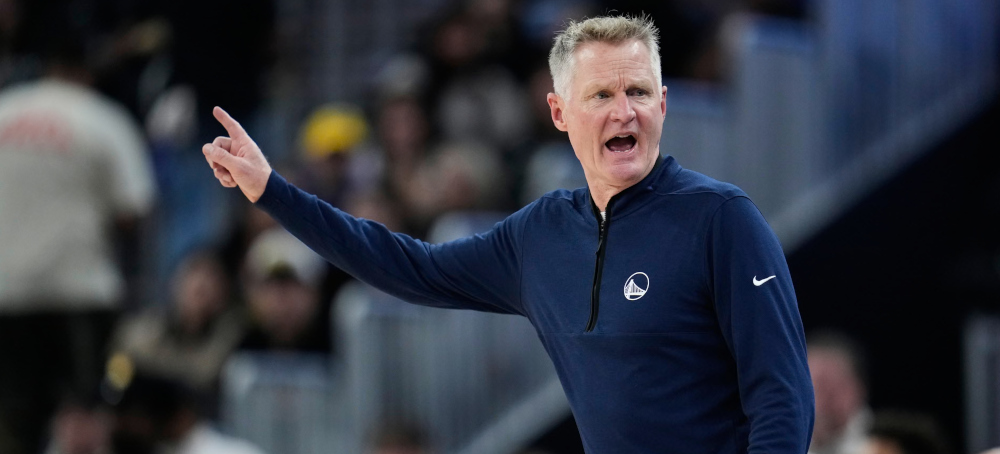
Golden State head coach Steve Kerr gestures during the second half of Friday’s game against Sacramento. (photo: Godofredo A Vásquez/AP)
Golden State Warriors coach Steve Kerr delivered a blistering condemnation of the US federal government on Friday, criticizing official accounts of the fatal shooting of Renee Nicole Good in Minneapolis and praising the Minnesota Timberwolves for publicly acknowledging the woman’s death.
Speaking to reporters before the Warriors’ game against the Sacramento Kings at Chase Center, Kerr said the response from federal authorities following Good’s killing by an Immigration and Customs Enforcement (ICE) agent was “shameful”, accusing officials of misrepresenting events despite the existence of video footage and eyewitness accounts.
Good, 37, was shot and killed on Wednesday on a residential street in Minneapolis after ICE agents approached her vehicle, which was partially blocking a lane of traffic. Video of the encounter shows agents ordering her to exit the car and attempting to open the driver’s side door. As Good tried to pull away, one agent stepped in front of the vehicle and another fired shots, killing her.
The incident has sparked protests across the Twin Cities and intensified scrutiny of federal immigration enforcement tactics. US president Donald Trump and senior administration officials have said the agent acted in self-defense, claiming Good used her vehicle as a weapon – a description disputed by Minnesota governor Tim Walz, Minneapolis mayor Jacob Frey, and other local officials, who have characterized the shooting as reckless.
“I’m glad that the Timberwolves recognized her life and the tragic nature of her death,” Kerr said, referring to the moment of silence held Thursday night before Minnesota’s home game against Cleveland. “It’s shameful, really, that in our country we can have law enforcement officers who commit murder and seemingly get away with it.
“It’s shameful that the government can come out and lie about what happened when there’s video and witnesses who have all come out and disputed what the government is saying. So, very demoralizing, devastating to lose anyone’s life, especially in that manner. So it’s terrible, terribly sad for her family, and for her, and that city, and I’m glad the Timberwolves came out and expressed that sadness.”
Timberwolves coach Chris Finch addressed the shooting before Thursday’s game, offering condolences to Good’s family and acknowledging the toll the incident has taken on the Minneapolis community. “Our community has suffered yet another unspeakable tragedy,” Finch said. “We want to convey our heartfelt wishes and prayers to everyone affected.”
Kerr, 60, has long been one of the most outspoken figures in American professional sports on political and social issues, particularly around gun violence and accountability in law enforcement. He has frequently criticized Trump and his administration during both of Trump’s terms in office, using his platform to speak on issues that extend well beyond basketball.
*..........*..........*..........*..........*..........*..........*..........*
*..........*..........*..........*..........*..........*..........*..........*
4) Trump Says Civil Rights Led to White People Being ‘Very Badly Treated’
President Trump’s comments were a blunt distillation of his administration’s racial politics, which rest on the belief that white people have become the real victims of discrimination in America.
By Erica L. Green, Jan. 11, 2026
Erica L. Green is a White House correspondent. She reported from Washington.
https://www.nytimes.com/2026/01/11/us/politics/trump-interview-white-people-discrimination.html

President Trump said in an interview that he believed civil rights-era protections resulted in white people being “very badly treated,” his strongest indication that the concept of “reverse discrimination” is driving his aggressive crusade against diversity policies.
Speaking to The New York Times on Wednesday, Mr. Trump echoed grievances amplified by Vice President JD Vance and other top officials who in recent weeks have urged white men to file federal complaints with the Equal Employment Opportunity Commission.
When asked whether protections that began in the 1960s, spurred by the passage of the Civil Rights Act, had resulted in discrimination against white men, Mr. Trump said he believed “a lot of people were very badly treated.”
“White people were very badly treated, where they did extremely well and they were not invited to go into a university to college,” he said, an apparent reference to affirmative action in college admissions. “So I would say in that way, I think it was unfair in certain cases.”
He added: “I think it was also, at the same time, it accomplished some very wonderful things, but it also hurt a lot of people — people that deserve to go to a college or deserve to get a job were unable to get a job. So it was, it was a reverse discrimination.”
Mr. Trump’s comments were a blunt distillation of his administration’s racial politics, which rest on the belief that white people have become the real victims of discrimination in America. During his campaign for president, Mr. Trump harnessed a political backlash to the Black Lives Matter and other protests, saying there was “a definite anti-white feeling in this country,” and he joined his base in denouncing what he deemed to be “woke” policies.
The Trump administration has claimed that eradicating policies that promote diversity would shepherd in a “merit-based” society. But for civil rights leaders, Mr. Trump’s remarks showed that the perceived plight of white men was the true focus.
Derrick Johnson, the president of the N.A.A.C.P., the nation’s oldest civil rights organization, said there was “no evidence that white men were discriminated against as a result of the civil rights movement, the Civil Rights Act, and efforts to rectify the long history of this country denying access to people based on race in every measurable category.”
Within hours of taking office, Mr. Trump ordered the dismantling of diversity, equity and inclusion offices that were responsible for addressing systemic discrimination against minorities and women, and last year he ordered federal agencies to halt enforcement of core tenets of the bedrock Civil Rights Act.
He has gone on to equate diversity with incompetence and inferiority, and cast himself as the protector of white people both at home and abroad. Asked on Wednesday whether his immigration agenda was aimed at making the country whiter, Mr. Trump said he wanted people “that love our country.”
“It’s very simple,” said Mr. Trump, who has carved out exceptions to his crackdown on refugee admissions for mostly white South Africans. “I want people that love our country,” he said.
Carrying out Mr. Trump’s agenda is the Equal Employment Opportunity Commission, which was formed in 1965 under the Civil Rights Act. The commission’s chair, Andrea Lucas, issued a striking video message last month underlining the agency’s new posture.
“Are you a white male who has experienced discrimination at work based on your race or sex?” Ms. Lucas said in the video posted on X. “You may have a claim to recover money under federal civil rights laws. Contact the E.E.O.C. as soon as possible. Time limits are typically strict for filing a claim.”
“The E.E.O.C. is committed to identifying, attacking, and eliminating ALL forms of race and sex discrimination — including against white male applicants and employees,” she said.
In the video, Ms. Lucas pointed white men to the commission’s F.A.Q. on “D.E.I.-related discrimination,” which notes that D.E.I. “a broad term that is not defined” in the Civil Rights Act.
The Equal Employment Opportunity Commission is the nation’s primary litigator of workplace discrimination, and for decades has been a resource for minorities, women and other groups who have historically faced discrimination. But Ms. Lucas has endeavored to make it one of Mr. Trump’s most powerful tools against D.E.I., with a particular focus on remedying perceived harms against white men.
Ms. Lucas’s tweet was boosted by Stephen Miller, Mr. Trump’s top domestic policy adviser, and Mr. Vance, who shared the video in a series of tweets railing against D.E.I. last month.
The vice president also shared an essay that blamed diversity initiatives for depriving white men of opportunities. “A lot of people think ‘DEI’ is lame diversity seminars or racial slogans at N.F.L. games,” Mr. Vance wrote last month on X. “In reality, it was a deliberate program of discrimination primarily against white men.”
Labor and civil rights lawyers said Ms. Lucas’s video was an escalation in the administration’s tactics to use civil rights laws to remedy what it sees as the disenfranchisement of white men, rather than to help groups that have historically faced discrimination.
“I’ve never seen, in the history of an agency, a blanket request to only one racial group and gender to contact the chair’s office directly to raise concerns about discrimination,” said Jenny R. Yang, a former chair of the commission. “That raises significant concerns.”
Zolan Kanno-Youngs contributed reporting.
*..........*..........*..........*..........*..........*..........*..........*
*..........*..........*..........*..........*..........*..........*..........*
5) Under Trump, U.S. Adds Fuel to a Heating Planet
The president’s embrace of fossil fuels and withdrawal from the global fight against climate change will make it hard to keep warming at safe levels, scientists said.
By Lisa Friedman, Jan. 12, 2026

America’s greenhouse gas emissions from the burning of coal, oil and gas, which had finally started to decline, rose 1.9 percent after Mr. Trump returned to office. Credit...Benjamin Rasmussen for The New York Times
By pulling the United States out of the main international climate treaty, seizing Venezuelan crude oil and using government power to resuscitate the domestic coal industry while choking off clean energy, the Trump administration is not just ignoring climate change, it is likely making the problem worse.
President Trump has never been shy about rejecting the scientific reality of global warming: It’s a “hoax,” he has said, a “scam,” and a “con job.”
In recent days his administration has slammed the door on every possible avenue of global cooperation on the environment. At the same time, it is sending the message that it wants the world to be awash in fossil fuels sold by America, no matter the consequences.
The moves follow one of the hottest years on record, during which scientists say climate change supercharged raging wildfires in Los Angeles, deadly flooding in Texas, and a Category 5 hurricane that ravaged Caribbean islands.
The planet is on course to heat up more than 1.5-degree Celsius (2.7 Fahrenheit) compared with preindustrial levels. That’s the threshold beyond which scientists say the risks of catastrophic storms, droughts, wildfires and heat waves, as well as species extinction, increase significantly. The Earth has already warmed by between 1.3 and 1.4 degrees Celsius.
Under President Trump, the United States has become the only nation to renege on a pledge to try to keep warming to 1.5 degrees. Its actions will make the global fight harder, scientists said.
“Emissions will be higher,” warned Justin S. Mankin, an associate professor at Dartmouth College who researches climate variability. “Trump’s greenhouse gas emissions will cause Trump’s heat waves, Trump’s droughts, Trump’s floods, and Trump’s wildfires.”
America’s carbon dioxide emissions from burning coal, oil and gas, which have made it the biggest polluter since the start of the Industrial Age, had been declining steadily since 2007. But last year, after Mr. Trump returned to the White House, emissions rose 1.9 percent, according to the federal government.
Researchers attributed the rise to an increased use of coal, the dirtiest fossil fuel. Scientists said U.S. emissions should ultimately decline again, in large part because renewable energy remains cheaper than fossil fuels. But the decrease could be slower and smaller than a safe atmosphere requires.
“The science is clear that every action matters and every ton of carbon matters,” said Katharine Hayhoe, a climate scientist and professor at Texas Tech. “There’s a price to pay for every ton of carbon we produce, and that price is being added to our global debt.”
On Wednesday Mr. Trump announced that he was withdrawing the United States from a long list of United Nations organizations, including the treaty that underpins international cooperation on global warming and a Nobel Prize-winning group made up of the world’s leading climate scientists.
It came days after the U.S. seized control of Venezuela’s oil, the largest known supply in the world but a particularly “dirty” grade, which produces more greenhouse gases when burned than American oil.
And those were just the latest maneuvers. Over the past months, the administration has forced five domestic power plants that burn coal to continue operating despite their planned retirement. It also halted five offshore wind farms along the East Coast that are already partially built and were to provide clean energy to millions of homes and businesses.
Those moves capped a year in which the Trump administration systematically eliminated regulations designed to reduce greenhouses and gutted federal subsidies that could have brought more wind and solar power onto the grid. With Republican allies in Congress, the administration erased incentives to help consumers switch to nonpolluting electric cars from gasoline-burning vehicles. At the same time, federal agencies imposed new policies making it easier and cheaper to produce and burn oil, gas and coal.
Trump administration officials have insisted that investment in clean energy hurts the United States.
“When it comes to climate change we just chuck rationality at the door,” Chris Wright, the Energy secretary, said this week at a Goldman Sachs energy event in Miami. He claimed clean sources don’t produce enough energy and don’t reduce emissions, calling it “the greatest malinvestment in human history.”
Scientists disagreed.
“In my wildest dreams I could not have imagined that the Trump administration would do the level of destruction they have tried to do to the development of renewable energy in this country,” said Michael Oppenheimer, a professor of geosciences and international affairs at Princeton. “Why didn’t I think it imaginable? Because it’s not rational.”
Dr. Oppenheimer said the totality of Trump administration actions could lead to either a rise in U.S. emissions or a slowing of their decline. The severity of the climate consequences depends upon how long the policies stay in place.
Calculating the potential impact of the Trump administration on emissions is complicated by the fact that some of the changes to policy and regulations have not yet taken effect.
One study conducted by the Environmental Defense Fund, a nonprofit group, found that some of the biggest regulatory actions being taken by Mr. Trump could add 32 billion metric tons of additional climate pollution to the atmosphere by 2055, more than four times the country’s annual emissions today.
“The administration seems hellbent on blowing past ever more dangerous thresholds,” said Rob Jackson, a Stanford climate scientist who chairs the Global Carbon Project, a group of scientists that tracks countries’ climate emissions.
He noted that China and Europe are continuing to lead the world in addressing climate change, but said he worries about the signal Mr. Trump’s actions send globally.
“They won’t continue to act on their own forever if countries like the U.S. ignore the threat of climate change,” Dr. Jackson said.
For the foreseeable future, the United States is no longer part of the global community trying to slow the Earth’s warming.
Johan Rockström, director of the Potsdam Institute for Climate Impact Research and a leading climate scientist, described the Trump administration’s actions as the last gasp of fossil fuel interests.
He argued that on a global level, the transition to clean energy was already accelerating despite Mr. Trump, driven by the economics of clean energy. In 2025, wind, solar and other renewable power sources surpassed coal as the leading producer of electricity.
“We are at the beginning of the end of the fossil fuel economy,” Dr. Rockström said. “The U.S. is betting on the wrong horse.”
*..........*..........*..........*..........*..........*..........*..........*
*..........*..........*..........*..........*..........*..........*..........*
6) As Death Toll Surges in Iran, Leaders Take Tough Line Against Protesters
Despite an internet blackout, reports are emerging of a rise in deadly violence as protests spurred by economic woes have snowballed into a mass movement.
By Erika Solomon and Sanam Mahoozi, Published Jan. 11, 2026, Updated Jan. 12, 2026

An image taken from a social media post released on Saturday showing demonstrators gathered in Tehran. Credit...UGC, via Associated Press
A severe crackdown in Iran on protesters challenging the government has led to a sharp rise in the death toll in recent days, with rights groups reporting casualties in the hundreds and no sign that the authorities are relenting.
Despite a near-complete internet blackout and draconian limits on phone communications in the country of 80 million, reports have started to trickle out that include verified videos of protester deaths and corpses lined up in body bags outside hospitals.
The worsening crisis in Iran, which started as a protest over economic grievances, represents what some experts are calling one of the gravest challenges to the authorities since the Islamic Revolution nearly five decades ago.
After initially striking a more sympathetic tone when demonstrations began two weeks ago, Iran’s president, Masoud Pezeshkian, took a tougher stance in an interview on Iranian state television Sunday, saying he was working to address protesters’ anger over the economy but vowed “not to let rioters destabilize the country.”
Late Sunday, President Trump, who had earlier warned that the United States would intercede if the Iranian government killed peaceful protesters, hinted that he might be ready to act. Asked by reporters traveling with him on Air Force One whether Iran’s leaders had crossed a red line, he replied: “It looks like it. There seems to be some people killed who weren’t supposed to be killed.”
Without getting into details, Mr. Trump said: “We’re looking at it very seriously, the military’s looking at it. And there’s a couple options.”
Demonstrators started taking to the streets on Dec. 28, spurred by a sudden plunge in the value of Iran’s currency. But their calls quickly broadened to demanding the overthrow of Iran’s authoritarian clerical rulers. Over the past few days, the protests have snowballed into a mass movement, drawing huge crowds to the streets, from Iran’s major cities to the impoverished towns of its rural hinterland.
On Sunday, human rights groups began reporting a sharp rise in the death toll as accounts of a violent repression broke through a three-day communications blackout imposed by the Iranian authorities.
The Oslo-based Iran Human Rights group raised its toll to 192, while HRANA, a rights group based in Washington, said it had confirmed the deaths of nearly 500 protesters and almost 50 security personnel.
Videos published on Iranian social media channels on Sunday and verified by The New York Times showed dozens of what appeared to be black body bags, lined up on the ground or on stretchers outside the Forensic Diagnostic and Laboratory Centre in Kahrizak, a town on the outskirts of Tehran.
In the videos, large crowds of people gather around the body bags, with some people unzipping them to try to identify a loved one, while others crouch or lie on the ground to weep or offer each other comfort.
Assessing the violence and size of the protests is challenging because the Iranian authorities have imposed such severe limits on how information is shared both internally and outside the country. Because of the communications blackout, it can take hours for verified videos from the protests to emerge.
“The violence has certainly skyrocketed in the past several days as the internet shutdown has been implemented,” said Hadi Ghaemi, head of the Center for Human Rights in Iran, based in New York. “There are hundreds and possibly thousands of deaths. It will only become clear when the internet shutdown ends.”
As protests grew, senior officials laid the blame on the United States and Israel, saying they are backing the protesters.
Iran’s military and nuclear facilities were battered by a 12-day war with Israel last June, and the country has been sinking into a severe economic crisis after the reinstatement of U.N. economic sanctions last year.
Mr. Trump’s warnings have added to the pressure. Several U.S. officials told The Times on Saturday that he has been briefed on new options for military strikes.
Such threats feel particularly potent in the aftermath of U.S. forces’ capture of Venezuela’s president, Nicolás Maduro, this month.
“If the United States takes military action, both the occupied territories and U.S. military and shipping lanes will be our legitimate targets,” Mohammad Ghalibaf, Iran’s speaker of Parliament, said in a statement on Sunday, according to Iran’s semiofficial news agency, Tasnim. Both U.S. and Israeli military bases could be targets, he added.
The Iranian government has now called for a three-day period of national mourning for those killed by “urban terrorist criminals” — presumably referring to security forces killed in the confrontations — according to the semiofficial news agency, Tasnim.
“The president of Iran, expressing deep sorrow over the loss of the country’s beloved sons,” Tasnim wrote, called on the population to join a “National Resistance March” on Monday.
One factor in the mass mobilization over the past four days has been the calls to the streets by some activist groups, and by Reza Pahlavi, son of the shah who was deposed in the 1979 revolution that ushered in the Islamic Republic. Videos from many protests show that chants supporting the Pahlavis — anathema to previous Iranian protest movements over the past decade — are increasingly common.
Amid the growing violence, Mr. Pahlavi, who lives in exile, urged protesters in a video statement not to abandon the streets.
“President Trump, as the leader of the free world, has closely observed your indescribable bravery and has declared that he is ready to help you,” he said.
The protests in recent days have not only grown significantly in size but also appear to have become increasingly violent on both sides.
Government buildings have been set ablaze, while Iran’s chief of police, Brig. Gen. Ahmadreza Radan, blamed the deaths and injuries on “unpaid soldiers of Iran’s enemies.”
“A significant portion of those killed died from bladed weapons and knife wounds. In cases involving gunfire, the shooting distance was very close, indicating that these actions were not carried out by security forces, but by trained and directed elements,” General Radan said.
According to HRANA, the rights group, more than 10,000 people have been arrested so far.
Skylar Thompson, HRANA’s deputy director, said the organization had confirmed cases of the authorities removing injured protesters from hospitals.
“We have hospital documents that show individuals have been impacted with tear gas, we have similar instances of people being hit with bullets — rubber bullets and live ammunition — and being transferred to detention facilities without proper care,” she said. Mr. Ghaemi, of the Center for Human Rights in Iran, said he had managed to reach hospitals in Karaj, west of the capital, and the western province of Kermanshah, which described being occupied by security forces. In Kermanshah and the northern city Mashhad, he said, injured protesters were so fearful of going to hospitals they were seeking treatment in secret.
António Guterres, the U.N. secretary-general, was “shocked by the reports of violence and excessive use of force,” according to his spokesman, Stéphane Dujarric. “All Iranians must be able to express their grievances peacefully and without fear.”
Unlike some Iranian security officials and even the supreme leader, Ayatollah Ali Khamenei, Mr. Pezeshkian, the president, had previously tried to take a tone of governmental responsibility and offered a string of small reforms, though economists say they are not enough to address the severity of the crisis.
“Do not look for America or anyone else to blame,” he said during a visit to southwestern Iran last week. “We must serve properly so that people are satisfied with us.”
But in his comments on Sunday, he said “the enemy has brought trained terrorists into the country,” in an apparent reference to the United States. “Those causing disturbances and riots are not protesting citizens.”
Sanjana Varghese and Farnaz Fassihi contributed reporting.
*..........*..........*..........*..........*..........*..........*..........*
*..........*..........*..........*..........*..........*..........*..........*
7) U.S. Citizens Are Joining the Military to Protect Undocumented Parents
Amid an ICE crackdown in her area, an Oregon National Guard recruiter offers U.S. citizens a way to save their immigrant parents.
By Greg Jaffe, Jan. 12, 2026
Greg Jaffe spent eight days in The Dalles, Ore., with a recruiter from the Oregon National Guard.

Lindsey Vazquez, 20, joined the National Guard to help her parents, who had crossed the border three decades earlier as teenagers. Credit...Amanda Lucier for The New York Times
She believed that the key to being a good recruiter was not just selling the military and its benefits, but herself. Sgt. First Class Rosa Cortez wanted potential recruits to notice the pictures of her smiling children, her college diploma and the awards she had earned in the course of her nearly 20 years with the Oregon National Guard.
Her goal was to “radiate positivity,” she said. “People will see it and want to align with you.”
Lately though, she, along with hundreds of other recruiters around the country, had been offering something else: protection from the government she served.
President Trump’s second term has been defined by an extensive crackdown on undocumented immigrants that has set off waves of fear in places with large Hispanic populations. In many of these areas, a little-known government program called Parole in Place has become a refuge of last resort and a powerful recruiting tool.
Only U.S. citizens and permanent residents are eligible to enlist in the military. The Parole in Place program, launched in 2013, provides the undocumented parents and spouses of service members protection from deportation, and an expedited pathway to permanent residency.
In early December, Sergeant Cortez was working with six potential recruits who wanted to use the program. One of them was Juan, a 23-year-old with messy, black hair and a gold earring. (Juan requested that his last name be withheld to protect his undocumented family members.)
Juan had seen a video that Sergeant Cortez posted on social media and contacted her about enlisting. “I would like it if you could provide me some more information before I come to a decision,” he wrote in a text message in late September.
Sergeant Cortez sent a message back, asking Juan about his “goals in life.”
“Well for starters I’m hoping to get my mother qualified for PIP so that she doesn’t have to leave the country,” he replied, using the acronym for Parole in Place.
Two months later, masked immigration agents grabbed a longtime resident of the area at a Home Depot a few miles from the small business that Juan’s family operated in The Dalles, Ore., a town of about 16,000 people on the Columbia River.
Now Juan was sitting across from Sergeant Cortez in her small office. He handed over his Social Security card and shifted nervously in his chair. Everything was moving so fast.
National Guard soldiers train one weekend a month and two weeks every summer. During times of war, domestic unrest or natural disaster, they can be mobilized by states or the federal government to full-time duty.
Mr. Trump has also sought to deploy Guard soldiers on policing missions in cities across the country, including Portland, Ore., where the courts recently ruled that he could not send troops over the objections of local officials. On Thursday, Border Control agents shot two people in Portland during a traffic stop, stoking anger and protests.
When meeting with recruits, Sergeant Cortez liked to talk about the pride she felt helping during floods or fires, and the camaraderie that came with military service. But as the child of undocumented immigrants, she also recognized the fear gripping her community.
Her recruiting territory traces a 100-mile swath of central Oregon that has long drawn migrant farmworkers from Mexico, some of whom stayed and put down roots.
Sergeant Cortez had grown up in the region’s cherry and pear orchards. She had close friends who were afraid to leave their homes.
“It’s insane what’s happening,” Juan said as Sergeant Cortez took his fingerprints and finished his paperwork.
Sergeant Cortez shared a link to a practice exam that would measure his math and English skills. He promised to do it later that evening. If he passed, Juan could take the actual test in just a few weeks.
But first he needed to finish his evening shift at his family’s business, where his mother was working the cash register.
A Soldier’s Sacrifice
Parole in Place’s origins trace to May 2007, one of the deadliest months of the Iraq War. Sgt. Alex R. Jimenez’s platoon was patrolling a village south of Baghdad when insurgents attacked and took him captive. His remains were recovered more than a year later.
While thousands of U.S. troops searched for the 25-year-old soldier, his wife, who had entered the United States illegally from the Dominican Republic, was being deported. Amid a public outcry, the Bush administration granted her permanent residency.
“The sacrifices made by our soldiers and their families deserve our greatest respect,” said Michael Chertoff, the homeland security secretary at the time.
The program was formalized a few years later. The goal was to provide soldiers peace of mind before they went to war. If a service member drops out or is dishonorably discharged, their family member loses protective status. In 2023, about 11,500 relatives of military recruits used the benefit, a 35 percent increase over the previous year, according to the U.S. Citizenship and Immigration Services.
The agency did not respond to requests for more recent data. But several states reported a recent surge in program enlistees. In Nevada, 79 enlistees, or about 20 percent of the state’s new National Guard recruits in 2025, used the program.
For Sergeant Cortez, the program had become something bigger than numbers. Her mother had crossed the Mexican border illegally with her family in 1976 at age 7. “Cherries, apples, pears, plums, onions. You name it, we probably picked it,” Sergeant Cortez said.
Home was a tent, or if they were lucky, a barn. Eventually, they settled in a farm labor camp outside Walla Walla, Wash.
The turning point for her family came when one of her uncles, who had obtained legal residency in the 1980s, joined the Oregon National Guard. The entire family — seven people crammed into a car fit for five — drove more than 30 hours to Fort Knox, Ky., for his basic training graduation.
The farm labor camp, Sergeant Cortez recalled, could be chaotic. There were drugs, crime and families fighting to survive.
The basic training graduation ceremony was another world. The soldiers, clad in their dress uniforms, brass buttons gleaming, marched in perfect rows onto the parade ground.
A second uncle followed the first into the military. Soon, both found steady jobs as full-time technicians working on the Oregon National Guard’s fleet of cargo helicopters. Sergeant Cortez and her extended family moved from the farm labor camps to a neighborhood in Milton-Freewater, Ore.
In 2004, when Sergeant Cortez was 16, her uncles deployed to Afghanistan. Two years later, she enlisted and shipped off to basic training.
Now, she was a 37-year-old mother of three and a full-time National Guard recruiter, selling the benefits of service to a nation at war with itself over immigration, and who deserved to be an American.
As a soldier and a recruiter, she had to steer clear of divisive, political fights. As the child of Mexican immigrants in a place that felt besieged by Immigration and Customs Enforcement officers, the topic was impossible to avoid.
“Emotions are everywhere for me,” she said.
‘We’re Scared’
The mayor and five members of The Dalles City Council stared out at the crowd that had turned out on a rainy night in early December.
The elected officials were white men. The crowd was almost entirely Hispanic. They filled the meeting room on the second floor and spilled over into the hall and a nearby overflow room, where Sergeant Cortez was watching.
Nine days had passed since Salvador Muratalla, a father of five who came to the country in 2002, was taken from the Home Depot by masked ICE agents. He had been shopping for electrical circuits for a construction job.
Sergeant Cortez had seen the online video of the three agents dragging Mr. Muratalla out of the store by his arms as he yelled his name and phone number.
Now his daughter, Yami Muratalla, was shaking as she addressed the Council.
“Why did they let three masked agents take my father?” she cried. “They went to where he was and took him away from his five children, the youngest being 10 years old, who’s mentally affected, who’s scared to go to school!”
She gasped for breath.
“I’d ask you to wrap it up,” the mayor said.
“That’s all I’ve got to say,” replied Ms. Muratalla, who covered her face with her hands.
The elected officials were not sure what to do. One proposed that they draft a statement. A second said he needed time to reflect.
“I don’t have a lot of Hispanic friends,” confessed a third.
“We’re your new friends,” someone called out from the crowd.
The meeting ended with the Council members deciding that they needed more time to study the situation.
Sergeant Cortez approached Ms. Muratalla in the hallway outside the meeting room. Months earlier, Ms. Muratalla and her mother had attended an information session on Parole in Place that Sergeant Cortez had held at the National Guard armory, where she works.
The two women hugged.
“I’m so sorry,” Sergeant Cortez told her.
Sergeant Cortez recalled the anger, fear and shame she had felt as a child watching police arrest her grandfather at a community festival where he was selling Mexican snacks to make extra money.
He often stole the identities of Americans so that he could get hired and work. Eventually, the police would catch him and send him to jail. Sometimes, he would be deported to Mexico, where he would sleep on the street until the family raised enough money to hire a smuggler to bring him back across the border.
Like Sergeant Cortez’s grandfather, Mr. Muratalla had a theft conviction, according to a Department of Homeland Security spokesman.
Sergeant Cortez’s phone buzzed later that evening with a message from Ms. Muratalla. Her father was being moved from Tacoma, Wash., to a detention facility somewhere in Texas.
“I can’t stop crying,” Ms. Muratalla wrote.
“I completely understand,” Sergeant Cortez replied.
An American Dream
One of the soldiers Sergeant Cortez had helped was Lindsey Vazquez, 20. Ms. Vazquez stood only 4 feet 8 inches tall and had needed to gain five pounds just to meet the military’s minimum weight requirement.
She had joined to help her parents, who had crossed the border three decades earlier as teenagers, and because she wanted to prove she could support herself and be a soldier.
Ms. Vazquez was a logistics specialist for the Guard and worked full time as a clerk at a discount department store in The Dalles, with hopes of someday using her military benefits to go to college. She, her parents and two sisters were living in a camping trailer parked next to the nearly finished house her father had spent the last six years building.
During the day, her father, Omar, ran a one-person construction company out of his white pickup truck. At night and on weekends, he built their house. “Whatever I have is what I spend on it,” Mr. Vazquez said of the three-bedroom, two-bath home.
Ms. Vazquez, her mother and sisters helped hang drywall and cut tile.
Ms. Vazquez’s parents had already received work permits and Social Security numbers through the Parole in Place program. As soon as they had their permanent residency cards, her father wanted to go to Mexico to see his 87-year-old mother. His wife had siblings she had not seen in decades.
But their lives, their children and their future were in Oregon.
“All the way to the creek is ours,” Mr. Vazquez said. There were fruit trees, fairy lights and a small barn where he kept a pinto horse and some chickens. A few days earlier, Mr. Vazquez had installed the kitchen and living room flooring, purchased at the same Home Depot where Mr. Muratalla was arrested. The two men knew each other from construction work.
He wanted to build a stone patio with a grill where he would be able to gaze out at the high-desert mountains. “I go step by step by step,” he said.
This was his American dream.
Cold Feet
Juan scored in the 44th percentile on his practice entrance exam, 13 points above what he would need when he took the actual test. But as the prospect of joining the military grew more real, so too did his reservations.
He worried about leaving his girlfriend, who had moved to The Dalles four months earlier from Portland to be with him. He was nervous about basic training.
When Sergeant Cortez suggested setting a firm date for the test, he hesitated. “I was wondering if there’s any chance for you to put my application at a halt,” he wrote in a text message. “I’m so sorry.”
“Absolutely,” Sergeant Cortez replied. “I’ll put you on my back burner.”
She went to talk to Juan’s mother, who had spent 22 years building a life in Oregon and nine years growing a small business with Juan’s stepfather. She did not want her son to join just so she could get legal status.
“We make sacrifices because we don’t want our children to have to sacrifice,” she told Sergeant Cortez in Spanish.
Sergeant Cortez replied that Juan was acting out of “love.” Helping his mother, she said, could bring him “a sense of peace.”
Three days after The Dalles City Council meeting, Sergeant Cortez asked Juan to stop by her office at the armory. Almost all recruits get cold feet. She knew that the best way to overcome such doubts was to keep the process moving.
They talked about basic training. Juan had been watching online videos of new recruits packing before they left, and was thinking about one of his last visits to the airport. He recalled seeing people with military-style haircuts frantically running through the concourse with their green duffel bags, and wondered if that would be him.
“Is it a hassle trying to get the new recruits on planes?” he asked.
“I give you a whole brief before you leave,” she reassured him.
And they talked about his mother’s precarious status. The recent arrests and uncertainty were taking a mental toll, Juan explained.
“It just breaks me,” he said.
Juan scheduled a time to drive with Sergeant Cortez to Portland so he could take the military’s entrance exam. He still was not entirely committed to enlisting. But he was getting closer.
“It’s become more realistic to me,” he said.
He strode out of Sergeant Cortez’s office, passing plaques, streamers and black-and-white photos commemorating Oregon Army Guardsmen’s service over the last 150 years fighting in places like the Philippines, Europe and Afghanistan.
“He’s a good kid, full of energy,” Sergeant Cortez said. “I think he’ll be a great leader.”
Some people join the military for the benefits. Others for adventure, patriotism or to escape a bad situation at home. Juan was motivated primarily by a desire to keep his family together.
To Sergeant Cortez, his reasons made perfect sense.
Juan passed the entrance exam on Dec. 22. He planned to take his physical, the next step in the process, in the new year.
*..........*..........*..........*..........*..........*..........*..........*
*..........*..........*..........*..........*..........*..........*..........*
8) If You Can’t Teach Plato in a Philosophy Class, What Can You Teach?
By Greg Lukianoff, Jan. 12, 2026
Mr. Lukianoff is the president and chief executive of the Foundation for Individual Rights and Expression.

Antonio Carrau
Martin Peterson, a Texas A&M University philosophy professor, was presented last week with a choice straight out of a dystopian novel. To bring his class in line with a prohibition on course materials that “advocate race or gender ideology,” he could either censor the part of his course that included readings from Plato or he could teach a different class.
The case illustrates the extent to which campus censorship has run amok in Texas: If some of Plato’s texts can’t be taught in a college philosophy course, what, exactly, can be taught?
A bill passed last spring by the Texas Legislature undercut faculty control on public university campuses and clamped down on what can be taught, the First Amendment be damned. Last fall, the Texas A&M University system separately introduced policy changes aimed at purging woke curriculums. Under these measures, administrators have conducted a sweeping review of course materials, aiming to root out officially disapproved ideas about race and gender that professors may impart to their students.
Dr. Peterson submitted the materials for his course on contemporary moral issues to a university administrator as part of one such review — which he accurately described as “mandatory censorship.”
This is a philosophy class that explores how classical ethical concepts apply to contemporary social problems. It includes discussions on the ethics of war, the death penalty and abortion. And to the apparent alarm of university leadership, it includes discussions related to race and gender.
Dr. Peterson was told he could “mitigate” his course content to “remove the modules on race ideology and gender ideology, and the Plato readings that may include these.” Those readings included a portion of Plato’s “Symposium,” a classic of Western philosophy. In one of its most famous passages, Plato offers a haunting, beautiful idea: that we are incomplete creatures, wandering the world in search of our other halves, and that love can make us whole — even, in a sense, bring us closer to the divine.
To cut that material from a class because it might set off alarms about “gender ideology” would only further politicize the classroom. It is importing today’s culture war into the ancient agora — turning the modern academy into a parody of its ancient namesake, a place where discussion is replaced by prior restraint.
Texas A&M seems to have concluded that the safest way to handle the ideas contained in a classic text is to bury them. This is no way to run an institution of higher education.
University administrators and state lawmakers are saying, in effect, that academic freedom won’t protect you if you teach ideas they don’t like. Never mind that decades ago, the Supreme Court described classrooms as the very embodiment of the “marketplace of ideas”: “Our nation is deeply committed to safeguarding academic freedom, which is of transcendent value to all of us, and not merely to the teachers concerned. That freedom is therefore a special concern of the First Amendment, which does not tolerate laws that cast a pall of orthodoxy over the classroom.”
Texas A&M leadership seems to want, instead, to ensure that faculty members push the state’s preferred orthodoxy. It’s part of a broader effort in Texas and beyond to limit academic freedom.
In late 2024 The Chronicle of Higher Education reported that administrators at the University of North Texas College of Education had made over 200 changes to graduate and undergraduate courses, including to the syllabuses, course names and descriptions. Last fall, the larger University of North Texas system began a review of faculty syllabuses, and the University of Houston system said it was conducting a similar review.
Within the Texas Tech University System, which has more than 60,000 students, a Dec. 1 memo warned faculty members not to “promote or otherwise inculcate” certain specific viewpoints about race and sex in the classroom. These include concepts like “One race or sex is inherently superior to another”; “An individual, by virtue of race or sex, is inherently racist, sexist or oppressive”; and “Meritocracy or a strong work ethic are racist, sexist or constructs of oppression.” The point isn’t that these concepts should just be accepted or go unchallenged, it’s that challenging them through a robust give-and-take is what universities are for.
The language in the memo echoes a law in Florida known as the Stop WOKE Act, which my organization, the Foundation for Individual Rights and Expression has been litigating against since 2022. A federal judge described Florida’s law restricting instruction in college classrooms as “positively dystopian,” recognizing that the First Amendment protects classroom instruction. Unfettered, Texas is following Florida’s unconstitutional example.
Texas’s authoritarianism does not end at the classroom door, either. Last September, my organization sued to stop a brazenly unconstitutional Texas law banning all “expressive activities” on campus between 10 p.m. and 8 a.m. — a measure clearly aimed at campus protest. The law doesn’t even try to hide its targeting of “speech or expressive conduct protected by the First Amendment.”
In 2023, the president of West Texas A&M University, Walter Wendler, canceled a drag show on campus, claiming that the show would be demeaning and offensive to women. He admitted that even though “the law of the land appears to require” that he allow the “artistic expression” to go forward, he was still shutting it down. (My organization is suing to allow the drag show to proceed.)
First Amendment advocates often warn about a slippery slope. Once censorship starts at the margins, core freedoms are next. In Texas, university administrators and state commissars are skipping the slope and going straight for the trap door.
*..........*..........*..........*..........*..........*..........*..........*
*..........*..........*..........*..........*..........*..........*..........*
9) Israel Is Still Demolishing Gaza, Building by Building
More than 2,500 structures have been destroyed since the start of the cease-fire, an analysis by The New York Times has found.
By Samuel Granados, Adam Rasgon, Iyad Abuheweila and Sanjana Varghese, Jan. 12, 2026

Israeli control under cease-fire Mediterranean Sea Demolitions after cease-fire
More than two months ago, Israel and Hamas signed a cease-fire agreement that offered Palestinians in Gaza a hope of respite after a punishing two-year Israeli bombardment that left much of their enclave in ruins.
The destruction has continued.
Israel has demolished more than 2,500 buildings in Gaza since the cease-fire began, according to a New York Times analysis of satellite imagery from Planet Labs. It says it is destroying tunnels and booby-trapped homes.
This is what Israel’s actions look like. A nighttime video from Oct. 30, when the cease-fire was in effect, shows what appears to be a large-scale controlled demolition in a part of Shejaiya, a neighborhood in Gaza City, that is under Israeli military control.
As part of the cease-fire agreement reached earlier that month, the Israeli military withdrew its forces beyond an agreed-upon boundary inside Gaza, represented on maps published by Israel as a yellow line. That left Israel in control of about half of the enclave.
Most of the demolitions since the cease-fire began have been in those Israeli-controlled areas.
But dozens of buildings have been destroyed beyond the yellow line in areas effectively under Hamas control, where the Israeli military had agreed to halt its operations.
In satellite images taken shortly after the truce, clusters of intact buildings can be seen in the Shejaiya neighborhood, which spans the yellow line. Shots of the same area months later show that it has largely been reduced to wasteland. And scores of buildings, the images show, were destroyed beyond the yellow line, in some cases as far as 900 feet over.
Many of the structures were likely to have already been severely damaged after two years of Israeli bombardment. A United Nations assessment found that, as of Oct. 11, more than 80 percent of Gaza’s structures were damaged or destroyed. The people who lived in them are believed to have been displaced by successive evacuation orders and raging fighting.
Israeli officials say the widespread demolitions are happening as part of efforts to “demilitarize” Gaza. Since the cease-fire, they say the military has destroyed underground tunnels that were once used by militant groups, and has leveled buildings that were booby-trapped.
At the height of the war, which began after Hamas attacked southern Israel on Oct. 7, 2023, the Israelis estimated that the tunnel network spanned hundreds of miles, with thousands of entrances. Hamas has used the tunnels to store weapons, hide hostages and stage ambushes of Israeli soldiers.
Many Palestinians in Gaza argue that Israel has been flattening entire neighborhoods, with little regard for those who once lived or owned property there. Given the extent of the tunnel network, they say they fear that if Israel tries to dismantle it all, many more of the remaining structures in the territory could be imperiled.
Niveen Nofal, 35, who lived in Shejaiya before being forced to move, said she felt a deep sense of loss to learn that Israel was leveling her neighborhood. “Our hopes and dreams have been turned into mounds of rubble,” she said.
The scale of ongoing destruction is stark. Across eastern Gaza, in areas under Israeli control, satellite imagery reveals that entire blocks have been erased since the cease-fire, as well as swaths of farmland and agricultural greenhouses.
“Israel is wiping entire areas off the map,” said Mohammed al-Astal, a political analyst based in Gaza. “The Israeli military is destroying everything in front of it — homes, schools, factories and streets. There’s no security justification for what it’s doing.”
An Israeli military official, who spoke on the condition of anonymity under military rules, said Israel was not indiscriminately knocking down buildings. He said they sometimes collapsed when Israeli soldiers detonated explosives in the tunnels beneath them.
The official acknowledged that the military was carrying out demolitions on both sides of the yellow line, but said that Israeli ground forces had not crossed the line to do so. The Times was unable to verify that claim.
He also said that the Air Force was striking structures that posed a threat to Israeli soldiers, and that some of these were adjacent to the yellow line. Some tunnels, he said, traverse the withdrawal line, so detonating them could cause buildings on either side of it to collapse.
President Trump’s 20-point plan for ending the Gaza war, which formed the basis for the cease-fire, said that “all military, terror, and offensive infrastructure, including tunnels and weapons production facilities, will be destroyed.” But Israel and Hamas also agreed to suspend “all military operations, including aerial and artillery bombardment.”
One former Israeli military official questioned the scope of the demolition.
“This is absolute destruction,” said Shaul Arieli, who commanded forces in Gaza in the 1990s. “It’s not selective destruction, it’s everything.”
Classified maps from the Israeli military intelligence directorate show an expansive tunnel network in the Shejaiya area and scores of locations where the military believes militants have booby-trapped homes and roads.
The Israeli military allowed The Times to view those maps, which it said were produced for soldiers deployed in Gaza. The Times could not independently verify the accuracy of the maps.
Husam Badran, a senior Hamas official in Qatar, said the Israeli demolitions were violating the cease-fire agreement.
“The agreement isn’t vague, it’s clear,” he said in an interview. “Destroying people’s homes and property isn’t allowed. They’re hostile actions.”
Israeli officials have said that the military will continue carrying out the demolitions “until the last tunnel,” as the defense minister, Israel Katz, put it in a post on social media in November. “If there are no tunnels,” Mr. Katz wrote,” there is no Hamas.”
Ashraf Nasr, 32, who lived in Shejaiya before being displaced, said he was filled with sadness to see his hometown pulverized.
“Our memories have been erased,” he said. “But Hamas gave Israel the pretext to carry out this disaster. It militarized civilian spaces.”
*..........*..........*..........*..........*..........*..........*..........*
*..........*..........*..........*..........*..........*..........*..........*
10) F.D.A. Decisions on Abortion Pill Were Based on Science, New Analysis Finds
A study of more than 5,000 pages of agency documents on mifepristone over 12 years found that agency leaders almost always followed the evidence-based recommendations of scientists.
By Pam Belluck, Jan. 12, 2026

The abortion pill mifepristone is one of the most politically contentious medications in America, one increasingly targeted by anti-abortion activists trying to limit its availability and championed by abortion rights supporters seeking greater access.
Both sides have pressured the Food and Drug Administration for years — and both have, at times, accused the F.D.A. of political considerations in its regulatory decisions about the medication.
Now, a new study, published Monday in the medical journal JAMA, evaluates the F.D.A.’s track record of making decisions about mifepristone, drawing on rare access to internal memos, emails and thousands of pages of other documents.
The study was led by experts in federal health policy and drug regulation at Johns Hopkins University. They found that, in the 12 years they examined, from 2011 to 2023, important F.D.A. actions involving mifepristone almost always adhered to evidence-based recommendations from the agency’s scientists.
“We found that F.D.A. staff and scientists were basing the recommendations on the evidence, and that’s how it’s supposed to be,” said one of the study’s authors, Dr. Caleb Alexander, a professor of epidemiology and medicine at the Johns Hopkins Bloomberg School of Public Health. “The F.D.A. wasn’t making decisions that suggest that they were on one side or another of larger societal debates governing mifepristone regulation.”
One major exception to the overall finding occurred during the first Trump administration, the authors wrote.
In 2020, as the Covid pandemic raged, and government health authorities advised people to stay home, major reproductive health organizations filed a lawsuit asking the F.D.A. to lift its requirement that women obtain mifepristone in person from health providers. The F.D.A.’s scientists supported that request, finding that research indicated that the pills were safe to be prescribed by telemedicine and mailed, without an in-person medical visit, but the agency’s leadership declined to lift the restriction and argued against it in the lawsuit, even appealing to the Supreme Court.
It wasn’t until the spring of 2021, after the Biden administration took office, that the F.D.A. agreed to drop the in-person requirement.
The findings of the study are particularly relevant now because abortion pills have increasingly become a political battleground since the Supreme Court eliminated the nationwide right to abortion in 2022. Their use, including by patients in states with abortion bans, has swelled since then, and pills now account for about two-thirds of pregnancy terminations in the United States.
Lawsuits brought by several conservative states are seeking to force the F.D.A. to sharply restrict access to mifepristone or even withdraw its 25-year-old approval of the medication. The federal health secretary, Robert F. Kennedy Jr., and the F.D.A. commissioner, Dr. Marty Makary, said, after pressure from Republican politicians and anti-abortion advocates, that the F.D.A. would review mifepristone’s safety, despite decades of research showing that it is overwhelmingly safe, and that serious complications are rare.
On the other side, lawsuits by abortion rights advocates and petitions by several Democratic-led states ask the F.D.A. to ease restrictions further and to lift a special regulatory framework that limits who can prescribe and dispense mifepristone.
Amid it all, the F.D.A. in October granted approval for a new generic version of the medication.
A major finding of the new study is that internal documents show that the F.D.A. has repeatedly evaluated new evidence about mifepristone and reaffirmed that it is safe.
“There were very consistent findings on the safety of mifepristone, and the F.D.A. has continued to monitor this based on many different types of data,” Dr. Alexander said. He said the data included adverse event reports submitted to the F.D.A., clinical studies, manufacturer assessments, published literature and information submitted by professional organizations and advocacy groups.
The study also found that, when the F.D.A. took steps to expand mifepristone access and to lift some restrictions, it did so cautiously.
“While the F.D.A. considered more radical changes at several key moments, they opted against them to better balance various considerations,” the authors wrote. The team included Joanne Rosen, a lawyer who co-directs the university’s Center for Law and the Public’s Health, and Dr. Joshua Sharfstein, a vice dean at the school of public health and a former deputy commissioner of the F.D.A., who served before the time frame examined in the study.
In an editorial also published Monday by JAMA, Dr. Reshma Ramachandran, an expert on regulatory policy at Yale University, and Christopher Morten, a pharmaceutical law expert at New York University, wrote that the findings “challenge Kennedy and Makary’s contention that the FDA has, in recent years, failed to apply ‘adequate consideration’” to its mifepristone regulation.
Any review of mifepristone, the editorial says, must ensure that “the F.D.A.’s scientific staff are at the helm of the analysis and protected from political interference.”
To obtain the documents, the researchers filed Freedom of Information Act requests, then a lawsuit when the agency failed to produce some of the requested documents. They eventually received 264 documents totaling 5,239 pages, from between June 2011 and January 2023, including internal communications, regulatory correspondence, agency reviews and company reports. The agency redacted some documents.
Mifepristone, approved in 2000, has always been regulated under strict frameworks. Since June 2011, it has been governed under a program called Risk Evaluation and Mitigation Strategies (or REMS). About 70 drugs in the United States currently fall under REMS frameworks, typically applied to medications with serious safety concerns.
The researchers focused on five significant points in the F.D.A.’s mifepristone regulation, starting with the 2011 REMS. The other four points were: a 2013 decision that the REMS remained necessary; the 2016 easing of some restrictions in response to a request from mifepristone’s manufacturer; decisions during the Covid pandemic that allowed temporary access by telemedicine and mail; and a 2021 evaluation making telemedicine and mail access permanent and paving the way for allowing retail pharmacies to dispense mifepristone.
The internal documents rarely mention the political debate over abortion. They evaluate safety in extensive detail. One review reported that, for the 1.88 million women in the United States who had abortions using mifepristone as of Oct. 31, 2012, there were 2,740 total adverse events and that about one in 2,448 patients required hospitalization. There were 14 deaths, the document said, but at least three were completely unrelated to mifepristone (one was a suspected homicide, one involved cocaine and fentanyl poisoning, and one was a methadone overdose).
In 2016, after a thorough review, the F.D.A. expanded access in significant ways: allowing additional types of health providers, not just doctors, to become certified to prescribe mifepristone; extending the official time frame for mifepristone use to 10 weeks’ gestation instead of seven; and eliminating the requirement that the second medication in the two-drug abortion regimen, misoprostol, be taken in front of a doctor instead of at home. The agency also reduced some information about adverse events that the manufacturer had to file because it said it was already receiving that information in other ways, the documents indicated.
During the 2016 review, F.D.A. scientists also recommended eliminating the requirement that patients sign an agreement form saying they had chosen pregnancy termination and understood what to expect from the medication. The scientists said the form was “duplicative” of other information patients received.
In the only other example, though, that the new study found of scientists being overruled, the F.D.A. commissioner in 2016, Dr. Robert Califf, appointed by President Obama, decided to retain the patient agreement form, saying that it would provide additional assurance that patients were informed and would not disrupt abortion access.
“As the F.D.A. prepares to review the safety data again, as legal challenges are expected to continue, and as state policies diverge, mifepristone will likely remain a flashpoint in reproductive health policy,” the authors wrote. “Maintaining integrity in this process will require a continued commitment to scientific evidence and an avoidance of political interference.”
*..........*..........*..........*..........*..........*..........*..........*
*..........*..........*..........*..........*..........*..........*..........*
11) A Push to Expand the Rights of Immigrants in Defiance of Trump
An effort by New Jersey Democrats is seen as a provocative statement of principle in a state with the country’s second largest percentage of immigrants, after California.
By Tracey Tully, Jan. 12, 2026

A vigil is held outside the gates of Delaney Hall immigration detention center in Newark, N.J., after the death of Renee Good, who was shot and killed by a federal agent in Minnesota. Credit...Dakota Santiago for The New York Times
Democratic lawmakers in New Jersey — emboldened by convincing wins in November — are poised to expand migrant rights, an effort seen as a defiant and provocative statement of principle in a state with the country’s second largest percentage of immigrants after California.
On Monday the State Legislature is scheduled to vote on measures that would reinforce existing protections and make it more difficult for federal agents to target undocumented immigrants for deportation. The legislation has already drawn criticism from the Trump administration, which has expanded deportation efforts across the country over the past year.
The push comes months after immigration and deportation became divisive issues in the governor’s race.
Mikie Sherrill, New Jersey’s Democratic governor-elect, assiduously avoided taking a clear position during the campaign on the state’s Immigrant Trust Directive, a policy enacted in 2018 to limit how much help local law enforcement officers can offer federal immigration agents. At the time, her Republican opponent, Jack Ciattarelli, was vowing to repeal the directive on Day 1 as he tried to appeal to voters supportive of President Trump’s efforts to increase deportations.
The conversation has grown only more complex since then and gained new intensity last week after a federal immigration agent shot and killed Renee Good, a U.S. citizen, during an enforcement action in Minnesota.
“We recognize we have no ability to direct ICE,” said Nedia Morsy, director of Make the Road New Jersey, an immigrant rights group supportive of the package of legislation. “But we can make it very clear that New Jersey has consistently been committed to honoring people’s due process rights, and it’s important that legislators are taking this moment to underline that commitment.”
The bills have been pushed most ardently in the State Assembly, which is led by Craig Coughlin, whose district abuts Edison, a diverse suburb where two of the region’s largest warehouse immigration raids took place. In November, the Democrats’ already large majority in the Assembly grew even more formidable as voters overwhelmingly rejected Mr. Ciattarelli, who was endorsed by Mr. Trump and who embraced much of the president’s far-right ideology during the campaign.
Monday’s votes come a week after a White House spokeswoman criticized the bills in a statement that urged the Legislature to protect “law-abiding citizens, not the criminal aliens who kill them.”
The push to adopt the three bills, versions of which have languished in the Legislature for years, comes in the final week of a two-year legislative cycle, just days before Ms. Sherrill is set to take over as governor.
To be enacted, the outgoing Democratic governor, Philip D. Murphy, would need to sign the three bills into law before Tuesday at noon, if they were approved in the Assembly and Senate, where versions of the legislation cleared key committees last week. He could also issue a conditional veto, requesting specific amendments.
One bill would give the guidelines contained in the Immigrant Trust Directive, enacted by a former attorney general, Gurbir Grewal, the force of law, making it harder for a future administration to undo. A second piece of legislation would require the state to write “model policies” to protect the rights of New Jersey residents at sensitive locations, including schools, courthouses, shelters, jails and health care facilities.
Under the bill, the state would be expected to provide instruction to employees of these so-called safe spaces about when and where federal agents are permitted to enforce civil immigration laws — and when and where they are not.
A third bill would safeguard personal information held by health care facilities and government agencies, including the Department of Motor Vehicles, and limit its release to federal authorities. Undocumented immigrants have been able to obtain driver’s licenses in New Jersey since 2019, leaving details about their personal lives vulnerable to scrutiny by federal immigration authorities.
A spokesman for Ms. Sherrill said that she would not comment on pending legislation, but noted that she had indicated support for the goals of the Immigrant Trust Directive.
Mr. Trump made significant inroads in New Jersey in 2024, winning more votes than his Democratic opponent, former Vice President Kamala Harris, in more than half of the state’s counties. But his administration’s immigration policy has been particularly contentious in the state.
Soon after taking over, the Trump administration authorized a $1 billion contract with a private prison company to reopen Delaney Hall, a 1,000-bed jail near Newark Liberty International Airport, as a migrant detention facility.
In May, Newark’s mayor, Ras J. Baraka, and the city’s congresswoman, LaMonica McIver, were charged with crimes stemming from a brief but volatile clash with federal agents. The next month, four men escaped through a flimsy wall at Delaney Hall during unrest over meager food portions and crowded conditions.
The charge against the mayor was dropped, but Ms. McIver’s case is moving toward trial.
Immigrant rights advocates had pressed to not only enshrine the Immigrant Trust Directive into law, but to also add additional protections for undocumented migrants with final orders of removal from the United States; that effort was sidelined in the Senate after a lengthy hearing last week filled with impassioned pleas from immigrants.
During the hearing, Sen. Bob Smith, a Democrat, said that the amended bills were a necessary and appropriate response to what he called “atrocities” by immigration agents, including the shooting death of Ms. Good in Minneapolis.
“This is the kind of thing that has to be done for us to get America back and to get it working and for people to be respected and not to have masked police forces hurting people,” he said.
*..........*..........*..........*..........*..........*..........*..........*
*..........*..........*..........*..........*..........*..........*..........*
12) Trump Tells Cuba to ‘Make a Deal’ or Face the Consequences
Jon Henley and Tom Phillips, Guardian UK, January 12, 2026
Donald Trump. (photo: Erin Schaff/NYT/Redux)
Donald Trump has told Cuba to “make a deal” or face unspecified consequences, adding that no more Venezuelan oil or money would flow to the communist-run Caribbean island that has been a US foe for decades.
As Cuba, a close ally of Venezuela and big beneficiary of its oil, braced for potential widespread unrest after Nicolás Maduro was deposed as the South American nation’s leader, the US president ramped up his threatening language on Sunday.
“THERE WILL BE NO MORE OIL OR MONEY GOING TO CUBA – ZERO!” Trump posted on his Truth Social platform. “I strongly suggest they make a deal, BEFORE IT IS TOO LATE.”
He provided no details about what form such a deal could take.
Venezuela is Cuba’s biggest oil supplier but amid a strict US oil blockade, shipping data shows that no cargoes have left Venezuelan ports headed to the Caribbean country since last week’s capture of Maduro by US forces.
Dozens of Venezuelan and Cuban security personnel were killed in the US raid, after which Trump said Cuba was “ready to fall”, noting the island’s deep economic crisis and that it would be difficult for Havana to “hold out” without cheap Venezuelan oil.
Earlier on Sunday, the US president reposted a message suggesting the US secretary of state, Marco Rubio, whose parents were Cuban immigrants, could become the country’s new president, adding: “Sounds good to me!”
In a separate message soon afterwards, Trump said Cuba had “lived, for many years, on large amounts of OIL and MONEY from Venezuela. In return, Cuba provided ’Security Services’ for the last two Venezuelan dictators, BUT NOT ANYMORE!
“Most of those Cubans are DEAD from last week’s USA attack, and Venezuela doesn’t need protection any more from the thugs and extortionists who held them hostage for so many years.”
Cuba’s president, Miguel Diaz-Canel, vowed to defend the country against any attack. “Cuba is a free, independent and sovereign nation. No one tells us what to do,” Diaz-Canel wrote on X, adding that the Caribbean island was “ready to defend the homeland to the last drop of blood”.
Some Republican US lawmakers on Sunday lauded Trump for his aggressive comments. Mario Díaz-Balart, a US congressman from Florida, said that after “decades of misery, tragedy, and pain” the regime in Havana was nearing its end.
Caracas and Washington are working on a $2bn deal to supply up to 50m barrels of Venezuelan oil to the US, with proceeds to be deposited in US Treasury-supervised accounts – a test of relations between Trump and Venezuela’s interim president, Delcy Rodríguez.
Trump’s remarks came after the US on Saturday urged its citizens to leave Venezuela immediately amid reports that armed paramilitaries are trying to track down US citizens in the country.
In a security alert sent out on Saturday, the state department said there were reports of armed members of pro-regime militias, known as colectivos, setting up roadblocks and searching cars for evidence that the occupants were US citizens or supporters.
“US citizens in Venezuela should remain vigilant and exercise caution when travelling by road,” the alert added, urging citizens to depart immediately now that some international flights from Venezuela had restarted.
Speaking to the New York Times last week, Trump said he would like to visit Venezuela in the future after having claimed the US was “running” the South American country after removing its leader.
“I think at some point it’ll be safe,” the US president told reporters. But the state department alert exposed how volatile the situation remains after last weekend’s special forces raid, during which scores of people were killed.
Responding to the security alert, the Venezuelan foreign ministry said the US state department warning was “based on fabricated accounts aimed at creating a perception of risk that does not exist”.
“Venezuela is in absolute calm, peace, and stability,” the ministry said. “All populated centres, communication routes, checkpoints, and security devices are functioning normally.” It said the government was “the sole guarantor of the legitimate monopoly of force and the tranquility of the Venezuelan people”.
*..........*..........*..........*..........*..........*..........*..........*
*..........*..........*..........*..........*..........*..........*..........*
*..........*..........*..........*..........*..........*..........*..........*
*..........*..........*..........*..........*..........*..........*..........*
*..........*..........*..........*..........*..........*..........*..........*
*..........*..........*..........*..........*..........*..........*..........*
*..........*..........*..........*..........*..........*..........*..........*
*..........*..........*..........*..........*..........*..........*..........*
*..........*..........*..........*..........*..........*..........*..........*
*..........*..........*..........*..........*..........*..........*..........*
*..........*..........*..........*..........*..........*..........*..........*
*..........*..........*..........*..........*..........*..........*..........*
*..........*..........*..........*..........*..........*..........*..........*
*..........*..........*..........*..........*..........*..........*..........*
*..........*..........*..........*..........*..........*..........*..........*
*..........*..........*..........*..........*..........*..........*..........*
*..........*..........*..........*..........*..........*..........*..........*
*..........*..........*..........*..........*..........*..........*..........*
*..........*..........*..........*..........*..........*..........*..........*
*..........*..........*..........*..........*..........*..........*..........*
*..........*..........*..........*..........*..........*..........*..........*
*..........*..........*..........*..........*..........*..........*..........*
*..........*..........*..........*..........*..........*..........*..........*
*..........*..........*..........*..........*..........*..........*..........*
*..........*..........*..........*..........*..........*..........*..........*
*..........*..........*..........*..........*..........*..........*..........*
*..........*..........*..........*..........*..........*..........*..........*
*..........*..........*..........*..........*..........*..........*..........*
*..........*..........*..........*..........*..........*..........*..........*
*..........*..........*..........*..........*..........*..........*..........*
*..........*..........*..........*..........*..........*..........*..........*
*..........*..........*..........*..........*..........*..........*..........*
*..........*..........*..........*..........*..........*..........*..........*
*..........*..........*..........*..........*..........*..........*..........*
*..........*..........*..........*..........*..........*..........*..........*
*..........*..........*..........*..........*..........*..........*..........*
*..........*..........*..........*..........*..........*..........*..........*
*..........*..........*..........*..........*..........*..........*..........*
*..........*..........*..........*..........*..........*..........*..........*
*..........*..........*..........*..........*..........*..........*..........*
*..........*..........*..........*..........*..........*..........*..........*
*..........*..........*..........*..........*..........*..........*..........*
